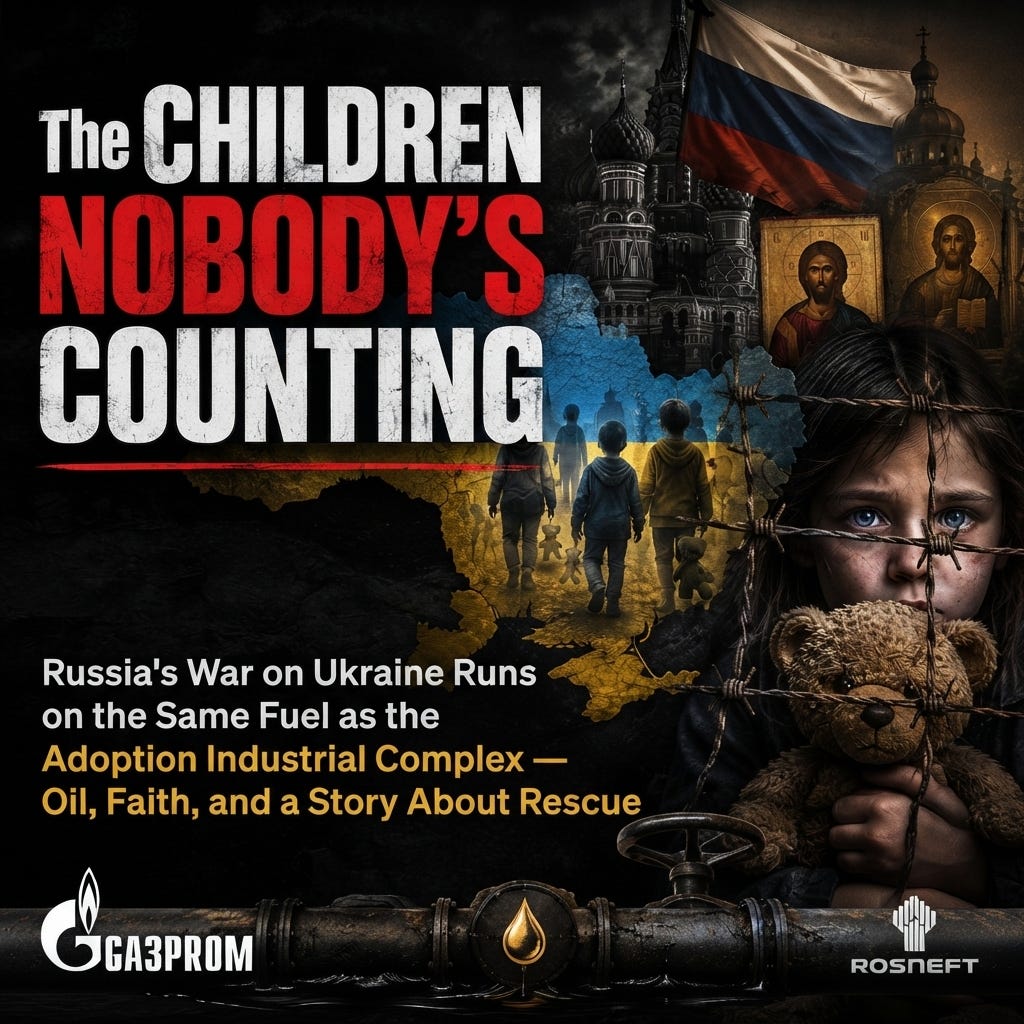
I wrote about this before there was a name for it back in 2022.
In the opening weeks of the invasion, I flagged the risk that children in occupied Ukraine would be moved into Russian territory against the will of the people responsible for them. Months later, citing Ukrainian officials, I put a number on it: 121,000 children, taken. At the time, both pieces read like warnings. They have since become documentation.
What was chaos is now a program.
Yale’s Humanitarian Research Lab spent twenty months building the most extensive public accounting of what Russia has done, and their conclusion isn’t ambiguous: intentional, systematic, and widespread. Ordered from the top. Coordinated with occupation officials in Donetsk and Luhansk. Aimed, in Yale’s own language, at the Russification of children who did not ask to be part of anyone’s demographic project.
The International Criminal Court moved on it in March 2023 — arrest warrants for Vladimir Putin and Maria Lvova-Belova, Russia’s Commissioner for Children’s Rights, for the unlawful deportation and transfer of children. The first warrant ever issued against the sitting leader of a permanent UN Security Council member. Three years on: no arrests. Russia doesn’t recognize the court. Lvova-Belova has said, on the record, that she personally adopted one of the children taken from Mariupol.
And in August 2025, occupation authorities in the unrecognized “Luhansk People’s Republic” put children up for adoption on a public website — filterable by age, gender, eye color, hair color. A catalogue. Save Ukraine’s founder called it a marketplace, because that’s what it is.
The law caught up faster than the enforcement did. In July 2025, the European Court of Human Rights ruled outright that Russia’s practice — including the machinery that facilitates adoption — breaches the Convention. In March 2026, the UN’s own Independent Commission of Inquiry went further, formally concluding that the deportation, forcible transfer, and enforced disappearance of these children constitutes crimes against humanity, with 1,205 individual cases verified so far and eighty percent of those still not returned four years on. Europe’s anti-trafficking watchdog followed in July, stating the practice may meet the legal definition of trafficking outright, and confirmed it isn’t confined to Russia and occupied Ukraine — it extends into Belarus too. The world’s institutions have now said, in writing, what I said in 2022 without a legal framework to hang it on.
Follow the money, because the money always tells the truth the rescue story is built to hide.
The Russian Orthodox Church runs a fundraising infrastructure for this — testimony before the US Commission on International Religious Freedom put the figure at $3.3 million raised by November 2022 alone, funding the church homes, monasteries, and camps that receive deported children. The church works directly alongside the state. This is not incidental charity. It is purpose-built.
And underneath the church money sits state oil money. A Yale report from earlier this year found Gazprom and Rosneft — Russia’s two dominant energy companies — financed and organized transport for camps that processed more than two thousand Ukrainian children, running “re-education” designed to erase their Ukrainian identity. Forty-four entities involved. Eighty percent of them not sanctioned. Then, in March 2026, US Treasury handed those same two companies a sanctions waiver, framed as relief for oil prices spiking over an unrelated conflict. Stanford’s own analysis put a number on what that waiver is actually worth to Russia: $36.1 billion if extended through the year, with roughly $12 billion of that landing directly in Gazprom and Rosneft’s accounts, according to a bipartisan letter from thirteen members of the US Congress demanding it be reversed. A sitting US Congressman put it plainly at a Human Rights Commission hearing: anyone still consuming Russian oil is subsidizing a war crime.
If that architecture sounds familiar, it should. It’s the same one I mapped in the DeVos network — a moral cover story about rescue and family laundering a financial and institutional structure that has nothing to do with either. Evangelical philanthropy and Amway money funding Bethany, NCFA, and CCAI in one country. Orthodox Church fundraising and state oil revenue funding a deportation pipeline in another. Different fuel. Identical machine.
And this isn’t even the first time children have been the currency.
In 2012, the US sanctioned Russian officials under the Magnitsky Act. Russia’s retaliation, within weeks, was to ban American adoptions of Russian children outright. Roy Blunt spent years fighting that ban from a Senate seat, while sitting on a CCAI advisory board funded by the same DeVos money running through Bethany. That same fight is the reason a 2016 Trump Tower meeting got publicly laundered as being “primarily” about a Russian adoption program. Children as diplomatic leverage isn’t a wartime innovation. It’s an instinct with a decade-long paper trail, and I already put it on record once.
So why has this gone quiet?
Because of the numbers, and because there isn’t one number, and because that instability is exactly what lets a story stop being news. The UN has formally verified 1,205 cases. Ukraine’s own working count is nearly 20,500. Yale’s database tracks closer to 35,000. Russia claims the true figure could be 700,000. Ukraine’s Bring Kids Back initiative has returned roughly 2,100 children, against any of those. Pick whichever number makes the story look most or least resolved — that’s the problem. A warehouse fire has one stock price. This has four competing counts and no single number anyone can put in a headline and defend. And in January 2025, the US government pulled funding from the exact program doing the tracking — Yale’s Humanitarian Research Lab, the outfit that had already fed evidence into six ICC cases and built a database of 30,000 identified children with satellite imagery to track their movement. That capacity is now at risk of disappearing entirely.
Compare that silence to what happened the moment Ukraine’s drones started hitting Wildberries and Ozon warehouses this year. Days of headlines. A stock price falling thirty percent in real time. Fire footage on every feed. Twenty-three warehouses, and the world watched every one.
Children have no share price. No daily strike count. No single image that resets the news cycle. What they have is an active war crimes warrant against a sitting head of state, and a silence that has nothing to do with the severity of what happened and everything to do with what the world is built to keep watching.
This isn’t disappearance. It’s a structural choice about attention — the same choice, dressed differently, that I’ve spent years documenting inside adoption systems that never had a war to hide behind.
Thanks for reading! This post is public so feel free to share it.
Sources and full forensic dossier available on request.