This is a free preview of a paid episode. To hear more, visit thoughtlessdel.substack.com
Every adoption begins with a record being rewritten.
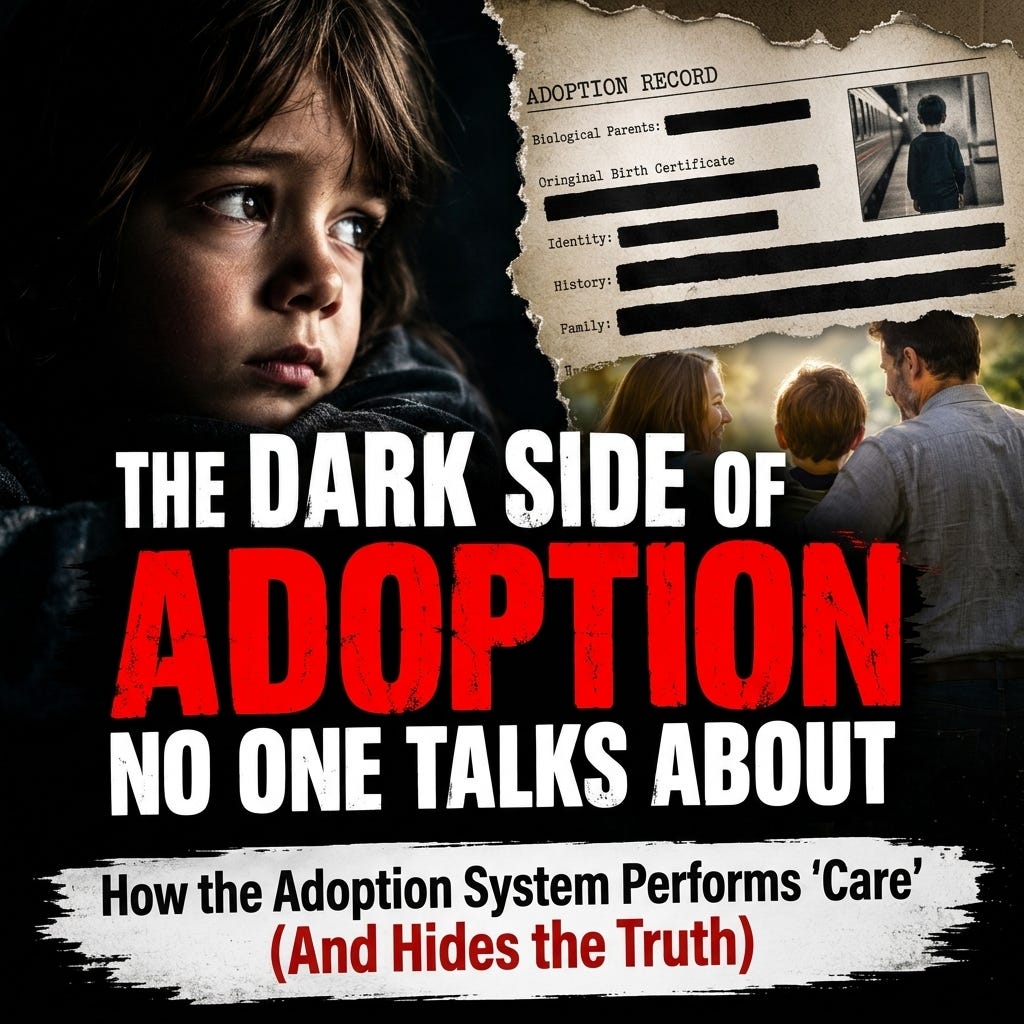
The original birth certificate is sealed. An amended one is issued in its place, naming the adoptive parents as though the birth never happened. The state has issued a document that says something untrue, and it has done so on purpose, with a court order behind it.
Everything else in the adoption story is built on that document: the “chosen child” script, the gratitude, the public applause. This article is about what that performance is for, and what it costs the person it is performed on.
Youtube Short :
https://youtube.com/shorts/liAKR5T2jao
What is the “clean slate” in adoption?
The clean slate is the founding requirement of the modern adoption system. It needs a child with no prior family, no prior name and no prior history, and it needs a total legal severance to produce one.
That is not a side effect of adoption. Without the blank slate there is no product. The commercial and legal machinery of stranger adoption (termination of parental rights, sealed records, amended certificates) exists to manufacture it.
The system also has to make that manufacturing look like love. That is where the performance begins.
Why is “parenting is parenting” a false equivalence?
You will hear this everywhere: love is love, parenting is parenting, family is family. It is warm and well-intentioned, and it is structurally false.
Biological parenthood begins with continuity. Adoptive parenthood, structurally, begins with a rupture. A first family had to be severed before the adoptive one could exist, and the authority the adoptive parents hold is delegated by the state, not naturalised by birth.
Three structural differences follow, and none of them is a criticism of any individual’s affection:
* The relationship is triadic, not dyadic. Adoptive parent, child and first family are all present in the structure whether or not anyone acknowledges the third.
* The authority is conditional. It is granted, vetted and legally maintained by the state.
* The legal record contradicts the biological one. The child lives inside a document that says something untrue about where they came from.
Insisting on equivalence erases these differences. The adult gets comfort. The child inherits the tension and has to carry it alone, because the social rule says there is nothing to carry.
What is the Savior Contract?
The Savior Contract is the unwritten deal that adoption is an act of rescue, and that the rescued owe something back.
It has three parts:
* Socioeconomic capital buys the legal severance of the first family.
* Moral capital shields the adopter from critique. Society grants them a permanent surplus of public virtue.
* Emotional debt is placed on the adoptee, permanently.
Basic parental duties (housing, food, education, affection) are recast as a debt the child can never repay. Any grief the child expresses over their lost family becomes evidence of ingratitude. You were saved. To critique your savior is to prove you didn’t deserve saving.
This is why so many adoptees know the accusation before they can name the mechanism: “After everything we’ve done for you.”
What is weaponised moral capital?
Adoption is one of the few social acts that nearly everyone praises automatically. That praise is a resource. It works like credit, and it can be spent.
When an adoptee names identity loss, a falsified record, or a family they were cut off from, the public does not weigh the evidence. It looks at the adopter’s reputation and rules on that. The adopter’s stored virtue absorbs the adoptee’s testimony.
It is a protection racket run on kindness. Critique is treated as a moral offence, so the structure never gets audited.
What does the performance look like up close?
Forensic psychologist Dr. Leanne ten Brinke, whose research covers deception detection and the developmental roots of manipulative traits, gives us two useful lenses. These are her concepts. Applying them to adoption is this publication’s analysis, not a finding from her lab, and it should be read that way.
Lens one: two developmental routes to callous, controlling behaviour. Her work identifies cold, unsupportive caregiving on one side and child overvaluation on the other. In adoption the second is the live one. When unresolved infertility grief or a personal need for meaning is reframed as a divine mission or an act of moral heroism, the child is no longer simply a child. The child has been cast in someone else’s story.
Then the child does what children do. They resist, or grieve, or ask questions. The script breaks, and in many homes the temperature drops. Warmth turns conditional on the child keeping the parent’s public narrative intact.
Lens two: the Duchenne mask. A genuine smile engages the muscles around the eyes, and the same signal can be produced deliberately to project warmth and disarm suspicion. The savior posture demands this kind of visibility in the church, the agency testimonial and the curated feed. Public benevolence has to be legible.
The point is not that adoptive parents are liars. The point is that the system rewards the mask and punishes the question, and it puts the adoptee in the position of the one who has to keep the mask in place.
How does the script fail?
Sustained deception, ten Brinke’s experiments suggest, is hard to maintain off-script. Rehearsed accounts come out fluent. Unrehearsed follow-up questions produce sparse, abstract, defensive answers.
Adoptees see this pattern at the boundary between the scripted question and the real one.
Ask “where did I come from?” and you get the script. Ask about agency fees, the exact timeline of relinquishment, biological siblings or the original birth record, and the answers thin out. They become abstraction (”they couldn’t give you the life we could”), deflection (”why isn’t our love enough?”) or stonewalling, a withdrawal that teaches the child that investigating their own identity threatens their own security.
Many of these responses aren’t lies in any deliberate sense. Often they are the sound of a person defending a structure they inherited. That is the more damning reading, because the deflection is built into the arrangement itself, not into one bad actor.
What does the system erase to keep the story intact?
If the clean slate were the only way to care for a child who cannot stay with their parents, it might be harder to indict. It isn’t.
Non-erasure models already exist:
* Kinship care. Grandparents, aunts and siblings raise the child, and lineage stays intact. It is chronically underfunded compared with stranger adoption because there is no agency match fee attached.
* Customary and Indigenous models. Extended clan placement preserves name, land rights and identity. Western law historically criminalised these arrangements because they refuse the severance binary.
* Adult and step-parent adoption, and second-parent adoption. These formalise a relationship without pretending the original birth never happened.
The commercial standard is total termination of rights, an amended record and a stranger placement. It is the one model that requires the erasure, so it is the one model that gets the marketing.
In Australia this is not an abstraction. The Senate inquiry into forced adoption produced a national apology, and the recommendations that would change the records regime have never been fully implemented. The apology was delivered. The architecture stayed.
Why “better adoption” is the wrong conclusion
The usual response to all of this is to ask for gentler, more informed, better-vetted adoption: mandatory grief counselling for prospective parents, ethics training, transparency about origins.
Those measures would reduce some harm. They also leave the founding mechanism untouched.
A family built on a falsified record, a delegated authority and a severed first family is still that family, however sincere the people inside it. Love inside such a structure tends to be conditional in ways the adoptee learns early: conditional on gratitude, on compliance, on not investigating.
The honest conclusion is not to refine the clean slate. It is to stop needing one. Guardianship and kinship models keep the child’s name, lineage and record intact, and they give the child a caregiver without requiring anyone to pretend a birth didn’t happen.
YouYube
FAQ
What is the “clean slate” in adoption?The legal and social construction of a child with no prior family or history, produced through termination of parental rights, sealed records and amended birth certificates.
What is the Savior Contract?The unwritten arrangement in which adoption is framed as rescue and the adoptee is expected to repay it with gratitude, which places a permanent emotional debt on them.
What is weaponised moral capital?The public praise adoptive parents receive, used (deliberately or not) to shield the adoption structure from critique and to discredit adoptees who speak about loss.
Are adoptive parents deceiving their children?Some are, some aren’t. The stronger claim is structural: the system gives every adoptive parent a script, sets a cost on leaving it, and rests on a legal fiction that the script protects.
What alternatives exist?Kinship care, Indigenous and customary models, and guardianship arrangements that preserve lineage and identity without severing the original record.
The stage
Take the amended certificate, the sealed original, the script and the applause, and what you have is not a sanctuary. It is a stage. The adoptee is the audience member who was never told they were also the subject of the play.
The question to leave with is a plain one. If the arrangement is as loving as its defenders say, why does it depend so heavily on a record that isn’t true?
Resources and Reports Available for Paid Subscribers
* Graphs
* Presentation
* Deception, Performance, and Systemic Power in Adoption.pdf
* The Architecture of the Clean Slate- Systemic Power, Deception, and the Mechanics of Adoptive Equivalence.pdf
* Navigating the Language of Adoption Power_ A Student’s Guide to Conceptual Terminology.pdf
* Forensic Audit Framework_ Evaluating Parental Integrity and Narrative Control in Adoption Placements.pdf
* Comparative Analysis_ The Commercial Standard vs. Forgotten Domestic Care Models.pdf