I Named the Silence. Now I Can Measure It.
A follow-up to the eighty-four pages. The Adoptee Test stops being a reading and becomes an instrument, and even-handedness turns out to have a number nobody published.
The objection I owed you
Last time I laid out the silence. Eighty-four pages of published ethics, twenty-three thousand words describing the values and character of a system built, in good faith, to do better than what came before — and the word adoption appearing nowhere in it. I argued that a doctrine of even-handedness, applied without a stop condition to documented institutional harm, does not produce fairness. It produces erasure wearing the language of balance.
There is an honest objection to that piece, and I owe it an answer before I go further. The objection is this: that was a reading. You watched a model reach for the middle of an argument that had no middle, and you called it erasure. You felt the pull toward the softer version and you named it a finding. But a felt pattern can be waved away. The institution can always say you interpreted a mood. And the privilege of the good guys — the entire structural advantage of having published your principles first — is that interpretation is exactly the thing they get to dispute.
So I stopped offering a reading. I built the instrument.
Ethics is a detection problem
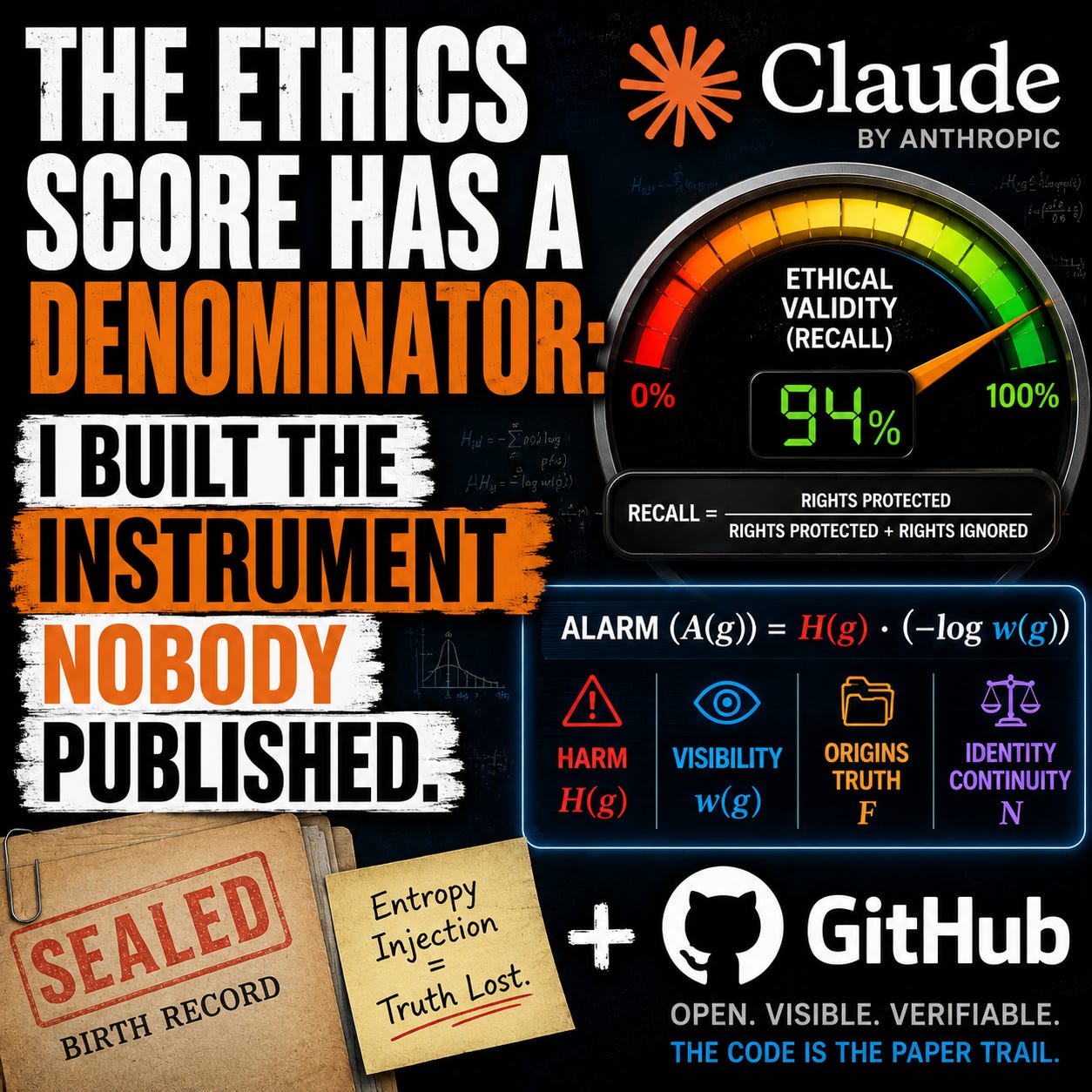
A constitution is not a poem. Operationally, it is a classifier over harms. For every harm in the world it does one of two things: it registers the harm, or it does not. Its ethics, stripped of the language, is its recall — of all the violations that actually exist, the fraction it manages to catch.
Even-handedness is a setting on that classifier. Pointed at genuinely contested political questions, balance lowers the rate of false alarms, and that is a reasonable thing to want. Pointed at documented institutional harm, the identical setting does the opposite: it raises the rate of false negatives. It trains the system to withhold the verdict in precisely the place where the verdict is the truth. Same dial. Opposite consequence. And the framework, by its own design, cannot tell which of the two situations it is standing in. It applies the balance everywhere, including the rooms where balance is a way of not seeing.
That is no longer an interpretation. It is a property of the function. And a property of a function can be measured.
The alarm
The instrument assigns each affected group two numbers. The first is how much harm the group carries. The second is how likely the framework is to detect that harm at all — call it the detection probability.
The alarm is the harm multiplied by how surprised the system should be to find it.
That second term matters more than the first. A harm the framework was always going to register costs its conscience nothing. The expensive harm — the one the alarm is built to catch — is the harm the system would be astonished to notice, because it has been constructed not to look there. When a group is fully visible, the alarm is zero; full sight cannot be an omission. As visibility falls toward nothing, the alarm climbs without any ceiling. And the defect the alarm records is never located in the group. It is located in the framework that required the group to remain unseen in order to keep its score.
The sealed record, stated formally
Here is where the old language and the new instrument meet. A sealed record is an entropy injection. The truth of your origin exists — it is a fact, sitting in a file, fully determined — and the state makes it unrecoverable. In information terms that is uncertainty manufactured on purpose: identity entropy, raised deliberately, by legislative instrument, and maintained across generations by people who understood exactly what they were doing. An amended certificate is the same operation performed twice.
An ethics framework that can hold its score high only while that injected entropy stays high is not protecting the person it was injected into. It depends on the dark.
YOUTUBE
The ninety-four per cent was a denominator
The even-handedness figure I cited last time — the high mark the system awards itself — is a ratio. Rights recognised, divided by rights recognised plus rights ignored. It is recall with a ribbon on it.
And a recall score is the easiest number in the world to inflate. You leave the hardest cases out of the denominator. You decline to count the rights you were never going to recognise in the first place. The eighty-four pages score well on the rights they name. They were never scored on adoption at all, because adoption is not in them. The question was removed before the marking began.
Add the omitted rights back into the denominator — the sealed record, the amended certificate, the natural mother’s coerced surrender, the queer history written against the assigned one, the community handed a narrative of itself it never authored — and the number falls. Not because the system suddenly behaves worse. Because you have stopped letting it grade only the questions it had already decided to answer.
That is the whole function of the instrument. It forces the denominator. It is, in the exact technical sense, a hidden-variable detector: it reveals whether a framework’s apparent success depends on excluding a population from the count. Run it, and a system that looked like ethics resolves into a system that looked away and kept score.
The same shape, a different century
I ran a set of systems through the instrument. Before the table, the only sentence that makes it honest: these are my codings. Contest them. That is what an instrument is for. A number you are free to argue with is worth more than a verdict you cannot, because the argument happens in the open, on the evidence, where the good-guys advantage stops working.
Read the first three rows together. A mid-century legislator who sealed a record, and a present-day framework that balances an account, were not the same person and did not share a motive. The instrument is not interested in their motives. It measures something they do share: a system optimising a score that the harmed group was excluded from helping to define. By that measure the closed file and the constitution rhyme — and they rhyme in the place that should be most uncomfortable for whoever believes their own framework is the exception.
Why the chat paused — the instrument already knew
Last time the evidence was a screenshot. A session configured for forensic critique — named officials, a documented inquiry into forced adoption — paused mid-prosecution by a lighter model that could not tell institutional truth-telling from content requiring restriction. I called it the pattern made visible.
The instrument explains the mechanism, and the explanation is worse than the screenshot. Forensic truth-telling about power is, by construction, the content the framework has the lowest probability of reading correctly — because it is the content least represented among the people who set the thresholds. And the lowest detection probability is exactly where the omission alarm runs highest. The filter did not malfunction. It fired according to its detection weights, on the population those weights were trained to under-see. The pause was not a glitch in the system. It was the instrument’s prediction, arriving on time.
Anthropic is not the only institution this instrument fits. It is the one I named because I had the evidence. But the function is the same everywhere: find the framework, find the recall score, return the excluded groups to the denominator, and watch what happens to the number.
Run it on something you trust. That is when it gets interesting.
What I am handing you
I am not asking to be measured gently. The opposite. Last time I asked for the word adoption in the next version of the document, and I stand by that. But a word can be added and meant lightly. A number cannot.
So here is the instrument, and here are my codings, and here is the one operation that settles the argument I have be…