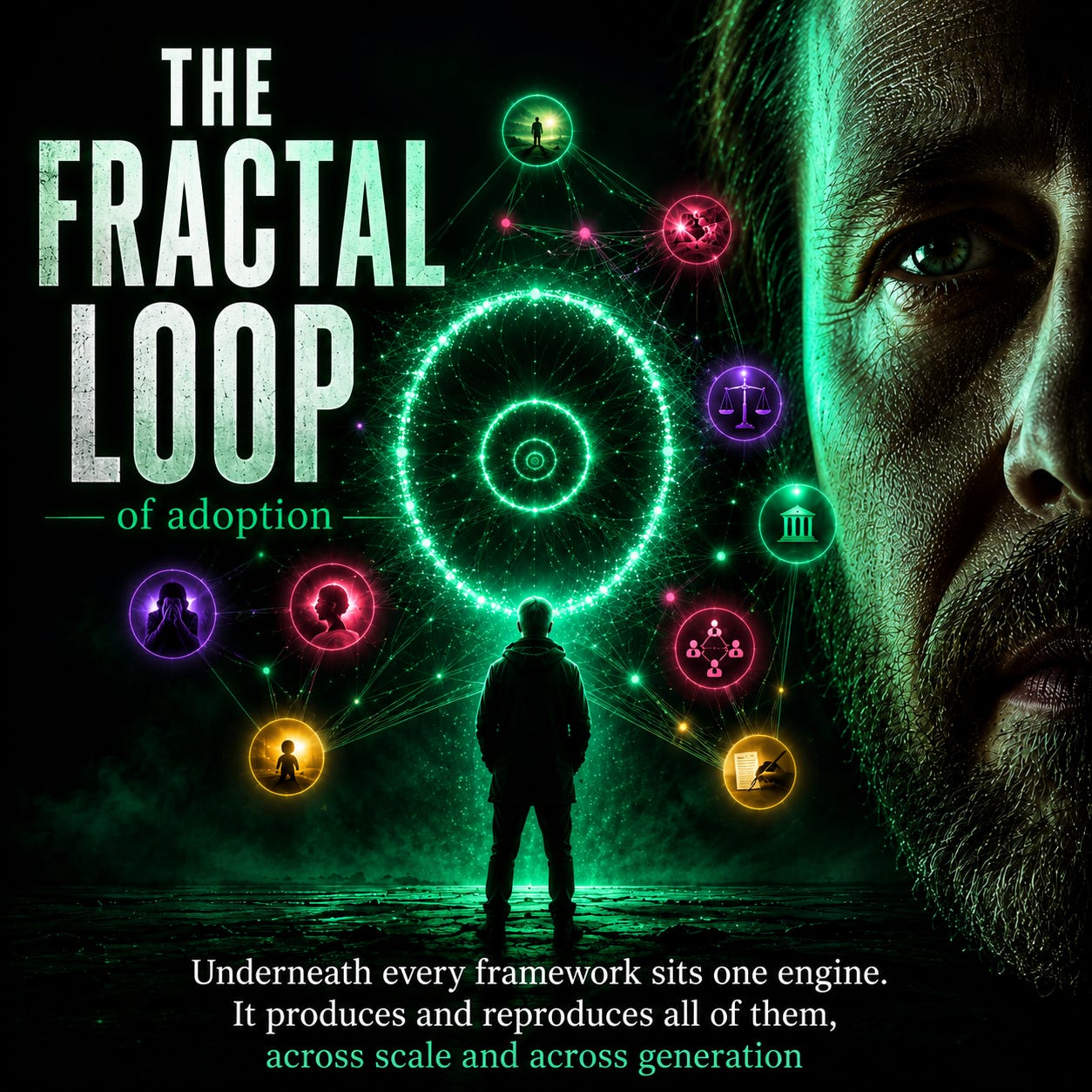
I have spent the better part of a year giving things names. The Adoptee Paradox. Architecture of Silence. Identity Gravity Well. Administrative Violence. Thirty-six of them now, sitting in a corpus built essay by essay, with no masterplan, no whiteboard, no architecture diagram taped to a wall. Each one arrived because a piece of the machinery needed a name before I could point at it.
Then I built a knowledge graph of the whole thing — the corpus rendered as nodes and the connections between them rendered as lines — and rotated it for the first time, and watched thirty-six frameworks I’d named across a year of separate, unrelated Tuesdays collapse into a single shape.
They all trace back to one loop.
THE LOOP
Twenty-six days ago I resolved something I’d been circling for months without naming: underneath every framework in this corpus sits one generative mechanism, not a sibling to any of them but the thing that produces and reproduces all of them, across scale and across generation. I called it the Analog Fractal Feedback Recursion of Adoption. Stated structurally, it runs:
FORECLOSURE → SILENCE → SYMPTOM → MISATTRIBUTION → CONTROL → TRANSMISSION → back to FORECLOSURE, one generation down, in a drifted form.
An identity is issued before the person has standing to contest it. The silence closes around the issuing. A symptom surfaces — searching, rupture, the thing a caseworker’s file calls “acting out.” The system reads its own output as new information and misattributes the cause, using the wound it produced as the justification for tightening its grip. Control follows. And then it transmits — parent to child, caseworker’s file to statute, one generation’s unresolved loss re-executing the identical architecture on the next.
I wrote a standing rule for myself when I resolved this: any framework I name from now on gets tested against those six steps first. If it maps cleanly onto one of them, it isn’t a new mechanism. It’s a local instance wearing a new name.
I wrote that rule believing it going forward. What the graph showed me is that it was already true going backward.
WHAT THE STRUCTURE ACTUALLY SAYS
Here is the part I didn’t expect to be able to say with this much certainty: I ran the actual connectivity, node by node, through every link in the corpus. Not a vibe. A traversal.
Every one of the thirty-six named frameworks in this corpus is structurally reachable from that one loop. Not most. All thirty-six. The furthest of them — The Cytowic Protocol, Epigenetic Risk Architecture, Sovereign Inquiry, three others — sit four connections away. The average distance, across the entire reachable corpus of a hundred and forty-four ideas, essays, and reports, is 3.2 links. This is a small, tight, load-bearing structure, not a loose federation of theories that happen to share a subject.
The frameworks sitting closest to the loop — one connection out, no intermediary — are Identity Gravity Well, Architecture of Silence, Identity Foreclosure, Weaponised Inverted Maternal Grief, and Adoptee Metacognition. That is not a random handful. Silence is the ambient condition the loop depends on to keep running unnoticed. Identity Foreclosure is the CONTROL step with a name and a citation. Weaponised Inverted Maternal Grief is FEEDBACK and TRANSMISSION caught in the same generation, the clearest single frame I’ve written of the loop closing on itself in real time — one person’s unprocessed loss converting a child’s normal need to search into a threat against her. Identity Gravity Well is what the loop feels like from inside a body: the late-life pull toward origin when the adaptive signal that was supposed to hold you finally fails. And Adoptee Metacognition isn’t a fifth thing standing next to the loop at all — it’s the loop re-entering the subject’s own mind, the same six steps running inside someone’s epistemic architecture instead of around them.
I didn’t design the graph to prove this. I built it to fix a data problem — a handful of nodes that shouldn’t have been in there, counts that didn’t add up after a caching bug. The structural convergence showed up as a side effect of doing that housekeeping honestly. I find that more convincing than if I’d set out looking for it.
View the Loop Here:
https://bouel.com.au/The-TD-Brain-3D.html
WHAT THIS ISN’T
This isn’t a discovery that adoption trauma is “one thing.” It is the opposite of flattening. The loop doesn’t erase the differences between a sealed birth certificate, a caseworker’s discretionary judgment, and a mother’s inverted grief directed at the child who reminds her of what she couldn’t keep. Those are different rooms in the same building, built by different hands, on different days, for different immediate reasons. Naming the load-bearing wall they all share doesn’t make the rooms identical. It makes the building legible.
And the building is not metaphorical. FORECLOSURE is a birth certificate reissued with the adoptive parents’ names where the natural mother’s belonged, and the original sealed against the person it describes. CONTROL is a state’s discretionary-release process, or a family’s unspoken rule about which questions get asked at dinner. TRANSMISSION is not poetic — it is measurable in the epigenetic literature this corpus cites, and it is observable in the second generation of the same adoptive family repeating a pattern nobody in that family would claim to have taught. None of this needed the graph to be true. It needed the graph to be checkable.
WHY I’M SHOWING YOU THE STRUCTURE, NOT JUST TELLING YOU ABOUT IT
I could have written this essay as an assertion — trust me, it all connects — and asked you to take my word for the architecture the way you’re asked to take an institution’s word for a sealed file. I have spent this entire publication arguing that identity claims, mine included, should be traceable to primary-source origin and not accepted on the authority of the person making them. It would have been a strange place to stop applying that standard to myself.
So the graph is public. It renders in your browser, in three dimensions — you can rotate the whole corpus, isolate any one of the thirty-six frameworks and watch its actual neighbourhood light up, and count the hops back to the loop yourself. Nothing in it is sealed. If you find a connection I’ve drawn wrong, or a framework that doesn’t actually map where I’ve claimed it does, that’s not a threat to the argument. That’s the argument working the way it’s supposed to.
A year of separate essays, written without a plan, turned out to be describing one recurring mechanism from thirty-six different rooms in the same building. I didn’t know that when I was writing most of them. I know it now because I finally built something that could show me, and because I was willing to let it show me I was wrong about anything it found, and it didn’t.
That’s the turn. Not relief that the pattern holds — I already suspected it would. The turn is what it means to build the instrument that could have proven you wrong, and use it anyway.
YOUTUBE
This Substack is reader-supported. To receive new posts and support my work, consider becoming a free or paid subscriber.
Presentation
VIEW in your Browser:
https://bouel.com.au/The-TD-Brain-3D.html