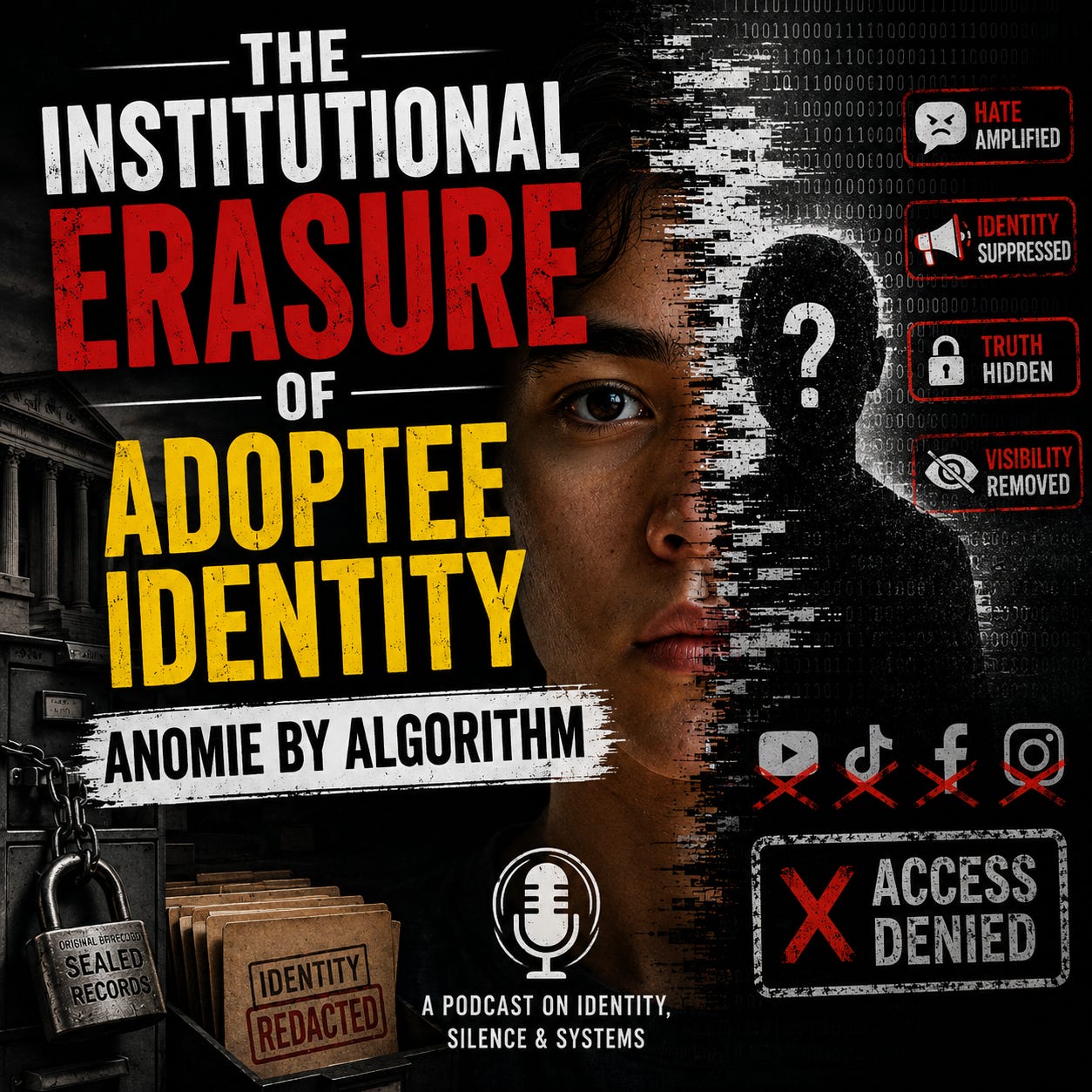
Last week, GLAAD released its sixth annual Social Media Safety Index. The report is comprehensive, forensic, and necessary. It documents how Meta, YouTube, X, and TikTok are failing LGBTQ+ users: not just by allowing hate speech to circulate, but by simultaneously suppressing legitimate LGBTQ+ expression. The mechanism is named precisely. Platforms built to maximise engagement amplify what drives engagement. The cost is borne by marginalised people whose identity itself becomes “sensitive content.”
But here is what the report cannot see: adoptees experience this identical architecture. And because adoptees are absent from GLAAD’s framework, the result is a specific kind of institutional harm.
It is not just suppression. It is anomie.
YOUTUBE
What Is Anomie
Anomie is Durkheim’s term for the psychological devastation of living in a society where the structures that gave life meaning have collapsed. It is not confusion. It is not simple loss. It is the specific pain of disconnection — from purpose, from community, from the possibility that your life can cohere.
Anomie happens when the world stops making sense and you are made responsible for making sense of it anyway.
Adoptees know this condition intimately. You are told you are chosen, rescued, integrated into a family. The narrative says: you belong here now; your original family is irrelevant; this is your home. But your body knows differently. You are severed from biological origin. You are constructed from absence as much as presence. The adaptive family narrative does not cohere with the subsonic truth.
This is the Fifth-Dimensional Split — living across two asynchronous signals, neither of which resolves into coherence.
For decades, the adoption industry maintained this state of anomie through the Architecture of Silence: sealed records, amended birth certificates, legal prohibitions on adoptee access to information. The state and the adoption industry said, in effect: you must not search for coherence; the coherence you are offered is the only one available.
Then DNA testing happened. Adoptees found their biological relatives outside the institutional gatekeeping system. They built communities. They found ways to construct coherence from the severed parts. They demanded change.
The institutions adapted. They did not open the sealed records — that would have been too direct. Instead, they deployed a new Architecture of Silence, built in code.
GLAAD Documents the Mechanism
The 2026 SMSI evaluated six platforms across fourteen LGBTQ-specific indicators. The findings are stark. Meta’s platforms — Facebook, Instagram, Threads — all declined in scores. YouTube dropped eleven points after removing gender identity from its hate speech policy. X remains at 29 out of 100.
The specific finding: platforms fail to moderate anti-LGBTQ+ hate that violates their own policies, while simultaneously suppressing legitimate LGBTQ+ expression.
One example from the report: Meta blocked teenagers from searching LGBTQ+ hashtags like #lesbian and #trans for months. The official reason was “sensitive content.” The effect was clear — the platform was erasing identity disclosure.
Here is the mechanism GLAAD names:
Social media platforms generate revenue by maximising engagement. Engagement is driven by emotional activation — outrage, conflict, division. This creates a structural incentive to allow harmful content to circulate.
Platforms are simultaneously under pressure to be “safe,” so they deploy automated content moderation systems, usually powered by AI. These systems are trained on data from a dominant-group perspective. They are deployed at scale with minimal human review. They lack the cultural and linguistic competence to distinguish between hate speech and authentic identity disclosure.
So they default to the conservative option: flag anything coded as “sensitive” and remove it.
GLAAD shows this happening to LGBTQ+ people across six major platforms. The systems are simultaneously under-moderating hate and over-moderating identity.
The person affected experiences it as erasure.
Where Adoptees Live
Adoptees experience this identical algorithmic architecture. But because they are absent from GLAAD’s framework, the institutional blindness is easier to maintain.
On genealogy and DNA platforms: Ancestry, 23andMe, MyHeritage, and other direct-to-consumer genetic testing services use algorithmic systems to match DNA and connect biological relatives. For adoptees, these systems are treated as risky. Privacy settings default to restrictive. DNA matching results are sometimes suppressed or delayed if an adoptee’s biological profile might connect them to a relative who has not consented to contact. The institutional logic is “protection.” The effect is erasure of biological truth.
On mainstream social platforms: Adoptees who post about searching for biological relatives often find their content shadowbanned, age-gated, or demonetised. A TikTok creator posting about adoptee rights might see engagement plummet. A Facebook group for adoptee searchers might find posts marked as “sensitive content.” The algorithmic systems cannot distinguish between identity disclosure and exploitation risk. So they suppress.
On adoption forums and genealogy communities: These spaces, where adoptees gather to share search strategies and DNA results, face the same pressures as LGBTQ+ creators. Content gets flagged. Accounts suspended. The communities are small enough that institutional oversight never reaches them.
The architecture is the same. The algorithmic logic is the same. The outcome — suppression of biological identity disclosure — is identical to what GLAAD documents.
But adoptees are not in GLAAD’s framework. So the suppression is not named. The oversight does not extend.
The Production of Anomie
Here is what distinguishes the adoptee experience from what GLAAD documents happening to LGBTQ+ people:
LGBTQ+ identity suppression is an injustice. It is a violation of the right to authentic self-expression. It deserves institutional redress.
But LGBTQ+ people, in the current moment, have institutional recognition. GLAAD exists because LGBTQ+ identity is recognised — politically, legally, socially — as a category worth protecting. When a platform suppresses LGBTQ+ expression, that suppression is recognisable as harm to a named group. It can be measured. It can be protested. It can lead to policy change.
This institutional recognition creates a specific kind of possibility: the possibility that the harm will be seen, named, and addressed.
Adoptees do not have this. Adoptee identity is not yet recognised as a protected category. There is no box on the census for “adoptee.” There is no civil rights legislation written in adoptee terms. When an algorithmic system suppresses adoptee identity disclosure, there is no framework that calls it what it is. It is treated as a privacy issue, or a commercial decision, or a data security matter. Not as suppression. Not as harm to a named group.
This is the production of anomie at the institutional scale.
An adoptee searching for biological relatives on Ancestry finds their DNA matches suppressed. They do not know why. The platform does not explain. There is no advocacy group demanding transparency. There is no regulatory pressure. There is no public report measuring the harm.
The adoptee is left alone with the suppression — unable to name it, unable to protest it, unable to demand that it stop. The world has stopped making sense. The structures that were supposed to help them cohere — the platforms built for biological search, the institutions that claim to support adoptee rights — have become the mechanisms of their erasure.
This is anomie. Not as an abstract concept, but as a lived condition.
It is what happens when institutional power operates in the gaps where no one is watching.
Non-Adoptee Bias as Structural Blindness
GLAAD’s framework uses fourteen LGBTQ-specific indicators. They are rigorous. They are necessary. And they are built entirely…