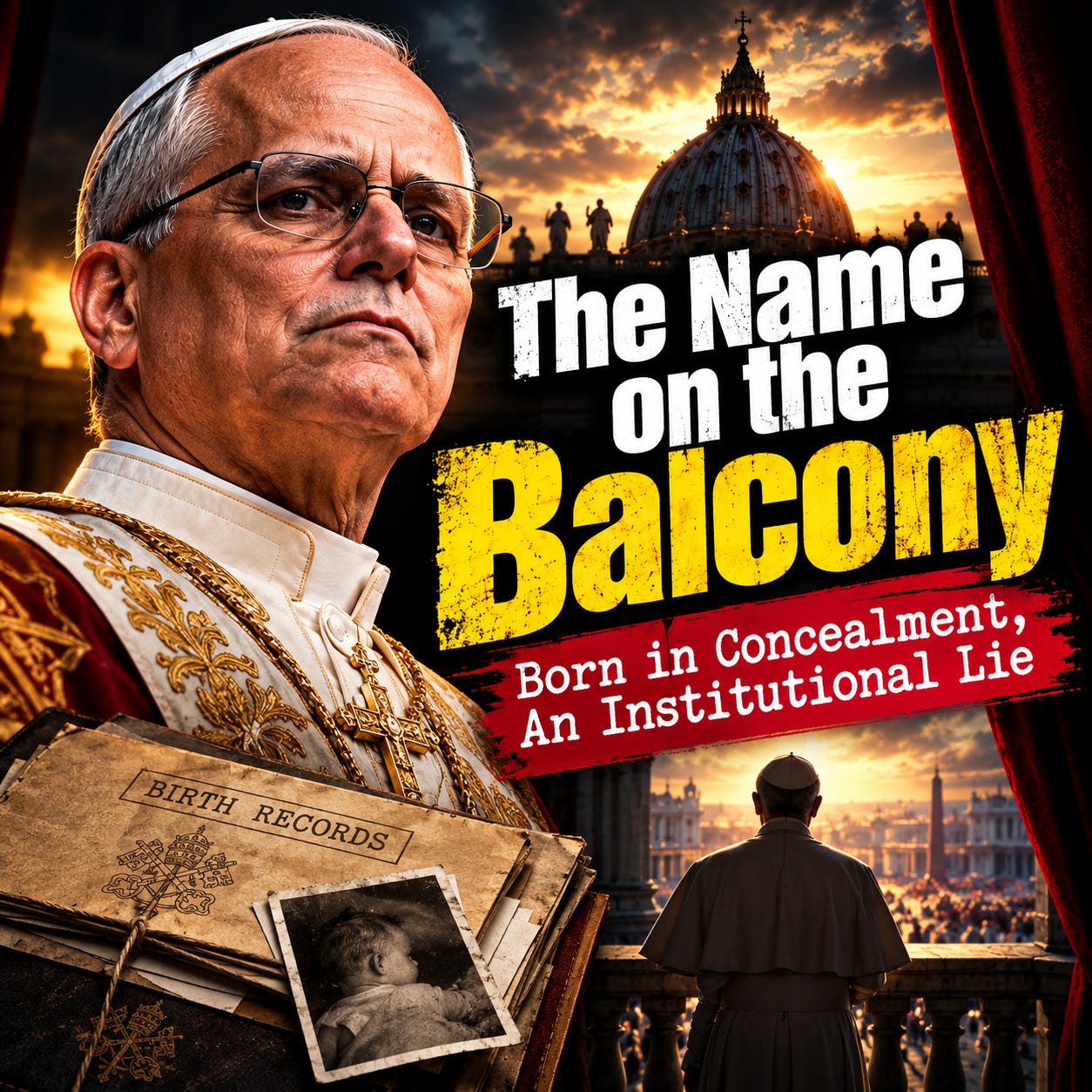
In May 2025, a man stepped onto the balcony of St Peter’s and the world learned his name. Robert Francis Prevost. Leo XIV. A French surname, a Chicago accent, a story that seemed to explain itself.
It did not explain itself. Genealogists went looking for the marriage that should have produced the name Prevost, and they could not find one. They could not find the grandparents at all. What they found instead, within a few months, was a birth certificate from a Catholic infant home in upstate New York, dated 1917, on which two people used an invented surname for the first time.
The name the world now says in prayer was built inside a mother and baby home, for the purpose of hiding a birth.
I want to sit with that for a moment before doing anything clever with it. Because I know what it is to carry a name that was issued rather than inherited. I know the particular hum of it, low under everything, the sense that the word people call you by was decided in a room you were never in, by people who needed a document to say something tidier than the truth.
What the record shows
The facts, as reported by The Irish Times this week and established by researchers at Geneanet and an online group of volunteer genealogists, run like this.
Suzanne Fontaine was a baker’s daughter from Le Havre. She crossed to New York in 1915 and lived for a time in a Catholic-run home for French women without family in the city, working as a governess. At some point she met Salvatore Giovanni Riggitano, a Sicilian-born teacher of languages, prominent in Chicago society, eighteen years her senior. He was married. His wife, Daisy Hughes, was of Irish parentage.
In March 1917, Daisy accused her husband of an improper relationship with Suzanne. Both were arrested. Adultery was a crime in Illinois. Suzanne was released on bail, and she was pregnant. Rather than appear in court visibly carrying a child, she went to Canada, then crossed back into the United States in May and made her way to the Our Lady of Victory Infant Home in Lackawanna, New York, a short distance from the border.
On 23 July 1917, she gave birth to a son. She named him Jean. For his surname she reached back across the Atlantic to her own mother’s maiden name: Prevost. And on the birth certificate, the father’s name was no longer Salvatore Riggitano. It was Jean Prevost.
A second son, Louis, followed in 1920. Louis Prevost would grow up, marry Mildred Martínez in 1949, and in 1955 become the father of Robert Francis Prevost.
The truth surfaced, finally, because of a different government form. In 1940, the Alien Registration Act required every non-citizen in the United States to register. On his form, the man who had lived for twenty-three years as John Prevost wrote the name he had arrived under: Salvatore Giovanni Riggitano Alioto.
So be precise about what this is. The pope was born within marriage. His father and his uncle were not. Suzanne kept both boys and raised them. No child was separated from this mother. This is not an adoption story.
It is something the adoption system was built on top of: an identity rewritten at the moment of birth, by an institution, to make an unsanctioned existence disappear on paper.
The home and the venerable man
Our Lady of Victory Infant Home was founded by Fr Nelson Baker, a priest celebrated in Western New York for his work with the poor. In 2011 the Church declared him Venerable, a formal step toward sainthood.
The coverage of the pope’s family has been careful to note that mother and baby homes in the United States do not carry the same weight of trauma that they carry in Ireland. That framing deserves pressure, because the same article undoes it in the next breath. There is a Facebook group for people who passed through Baker’s home. It is full of the stories every adoptee and every separated mother recognises: the records that cannot be found, the siblings who cannot be traced, the mother who was seventeen in 1971, who was not permitted to take her son home, who rang the home after her eighteenth birthday to say she was coming for him and was told he had already been placed with strangers. She has been looking for him for more than fifty years.
That is the same building. The same paperwork. The same institutional reflex.
What separates Suzanne Fontaine’s story from that young mother’s story is not the ethics of the home. It is circumstance. Suzanne was an adult with a partner who, whatever else he was, stayed. She had somewhere to go. The machinery that rewrote her children’s names was the same machinery that, for tens of thousands of other women, rewrote the children out of their lives entirely.
The asymmetry nobody is naming
Here is where the story stops being a curiosity and becomes evidence.
When a man became pope, his family’s concealed origins were unwound in a matter of months. Volunteer genealogists across several countries pooled their effort. One of them persuaded a civil registrar to release a 1917 birth certificate from a mother and baby home. Immigration records, census returns, newspaper archives and federal registration forms were cross-referenced and published. Leo met a celebrated television genealogist, who presented him with his ancestry.
That is what it looks like when the world wants you to know where you came from.
Now consider the ordinary person born in that same home. For most of the twentieth century, New York sealed the original birth certificates of adopted people. An adult who wanted the single document recording their own birth, their mother’s name, the place and the hour, had to petition a court and prove a reason the state found sufficient. The state only opened those records to adult adoptees in January 2020. Many who spent their lives waiting did not live to see it. Many mothers who might have been found had already died.
Ireland only legislated a clear right for adopted people to their birth certificates and early-life information in 2022, after the Commission of Investigation into Mother and Baby Homes reported. In Australia, where I was taken from my mother under the forced adoption regime, the national apology came in 2013. The apology was real. The amended birth certificate, with its replacement parents and its replacement name, remained the official account of my origin.
And then there is Tuam. In 2014, the local historian Catherine Corless established that 796 children died at the Bon Secours mother and baby home in that Galway town between 1925 and 1961, and that there were no burial records for them. A test excavation found remains in a disused sewage chamber. The full forensic dig only began in July 2025. By the middle of this year, investigators had recovered the remains of 99 infants and children, some from ground that had been tarred over and used as a vehicle track, with nothing on the surface to say anyone lay beneath it.
Hold those two archives side by side. One family’s century-old secret, rebuilt in a season from birth certificates, census returns and registration forms. Hundreds of children whose deaths were noted and whose graves were not, being lifted out of the ground one by one, eighty years late, by forensic archaeologists. The same Church. The same era. The same logic, that a child born outside marriage was a problem for the paperwork to solve. In one case the paperwork gave the child a new name. In the other it recorded their deaths and kept no account of where they were put.
The pope’s history was recovered because his name mattered to millions. Ours has been withheld because our names mattered to no one with power. The archive was always there. Access was the variable. And access was rationed by status.
This is the mechanism, stated plainly: the record systems of the mother and baby home era were not designed to be lost. They were designed to be locked. The information survived. It was simply placed behind a door that opens for the celebrated and stays shut for the ordinary.
A name as a confession
There is something quietly astonishing in the fa…