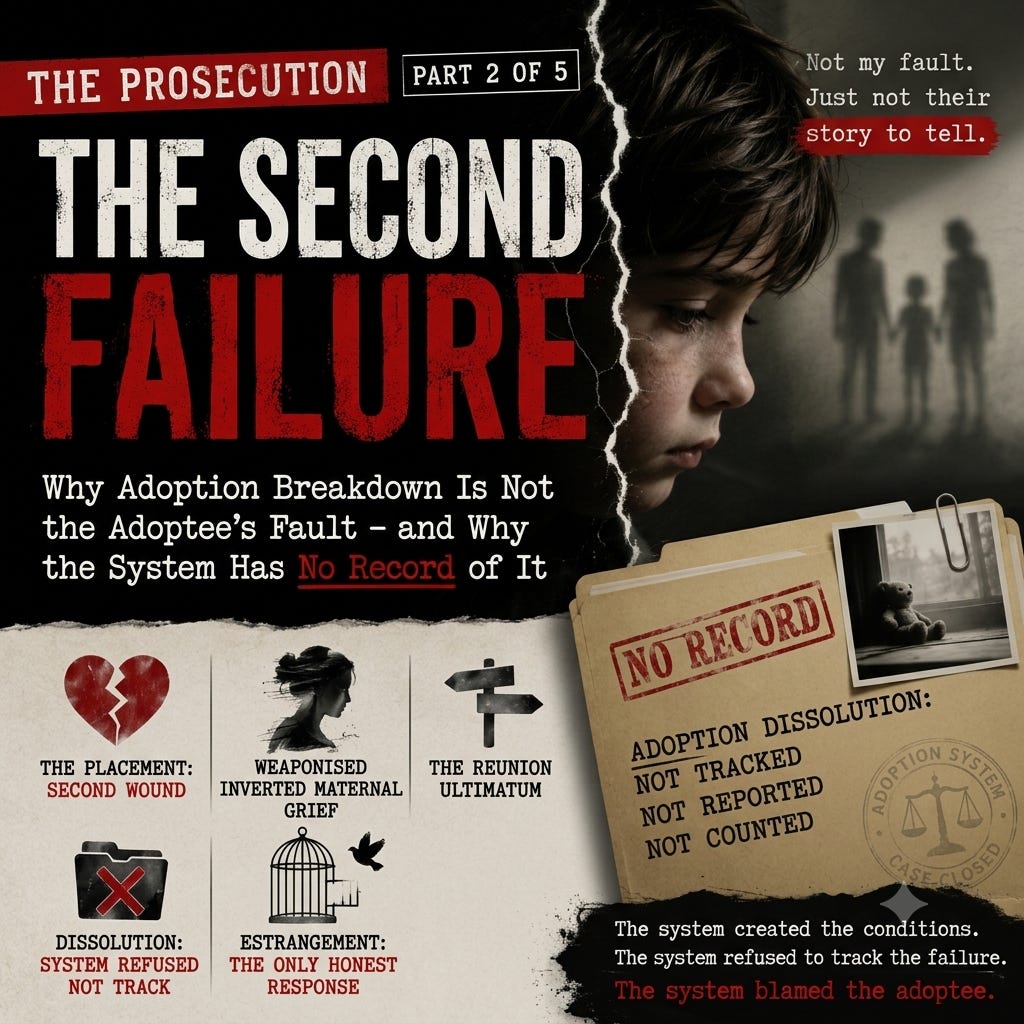
There is a wound the adoption system has never named. Not because it doesn’t exist. Because naming it would require the system to account for itself.
It is the wound of being failed twice. First by the original severance — the removal from biological family that the science now documents in tissue, in cortisol, in the architecture of the developing brain. And then by the family that was supposed to repair it. The adoptive family. The placement the system calls a solution.
When that placement breaks — and it breaks more often than the system tracks — the adoptee is left holding a particular kind of silence. Not the silence of the original loss, which at least has a name and a growing body of advocacy. This silence is different. It has no category. No support structure. No institutional acknowledgement. The system that created the placement takes no responsibility for its failure. It simply moves on.
The adoptee does not get to move on. They carry it.
The Placement Was Never Neutral
Before a single day of adoptive family life begins, the conditions for failure are already in place. This is not speculation. It is documented.
Research on prospective adoptive parents found that more than half — 58 per cent — carried unresolved loss or trauma into the adoption process. There was an 87 per cent correspondence between the way they spoke about their loss of fertility and the way they related to attachment. Their grief for the biological child they never had did not disappear when a child was placed with them. It went underground. And it shaped everything.
When adoptive parents carry poorly elaborated elements of their own history — unresolved grief, unaddressed trauma, the silent weight of infertility — highly conflictual family situations can arise that reinforce rather than repair the adoptive child’s already disrupted attachment. The research is unambiguous on this point. Two damaged attachment systems, placed together, without adequate screening or sustained support, do not automatically heal each other. They compound.
The adoptive mother’s unresolved grief becomes a presence in the household — a ghost she cannot name, whose absence she projects onto the child standing in front of her. The adoptee, already neurobiologically wired by infant separation to read threat, to scan for the gap between what is performed and what is true, feels it. They have always felt it. They simply have no language for what they are sensing.
What they are sensing is that they were placed to fill a space that was never theirs to fill. That they arrived not as themselves, but as a response to someone else’s loss. That the love on offer is real, but it is not clean — it is freighted with the phantom of a child who was never born, or in some cases, a child who was lost to the same system that produced the adoptee.
This is the structural trap the system built and never disclosed. The adoptee could not consent to it. The adoptive parents may not have understood it. And the institution that arranged the placement walked away the moment the paperwork was signed.
Weaponised Inverted Maternal Grief
There is a specific mechanism that operates inside this trap — one that the adoption system has never named because naming it would require it to account for what it did to both parties in the adoptive relationship.
Call it weaponised inverted maternal grief.
When a woman who has lost a child to adoption — through forced relinquishment, infertility, or any form of institutional severance — adopts a child without resolving that loss, something particular happens. The grief does not disappear. It inverts. The love that should have reached the lost child has nowhere to go, so it reaches for the adoptee instead — but it reaches for a ghost, not a person. The adoptee is not seen as themselves. They are seen as a replacement. A second chance. A living answer to an unanswerable loss.
This dynamic is not deliberate cruelty. It is the predictable consequence of placing an unresolved wound inside a relationship that demands wholeness. The adoptive mother — herself a victim of the same institutional forces that severed the adoptee from their biological family — becomes, without knowing it, the instrument through which those forces continue their work.
The inversion turns grief into control. The adoptive mother who cannot mourn her lost child openly, who cannot acknowledge the wound the system gave her, redirects that unexpressed pain into possession of the child she has. She needs the adoptee to be hers — completely, exclusively, permanently — because that is the only way the original loss feels contained. Any threat to that exclusivity — a birth family search, a reunion, a curiosity about origins — is experienced not as the adoptee’s natural need but as a personal betrayal. A reopening of the wound she cannot name.
And when that wound is narcissistically structured — when the adoptive mother’s own psychological architecture organises around the need for control, for the child to reflect her rather than exist independently — the dynamic becomes actively harmful. The adoptee is not permitted to be a separate person. Their origins are not permitted to matter. Their grief is not permitted to exist. Because all of these things are threats to the one relationship through which the adoptive mother’s own unresolved loss is being managed.
The system created this. It took two people shaped by loss and placed them together without disclosure, without support, and without any framework for what was happening between them. The result is not a family failure in the conventional sense. It is the system completing its own logic — using one wound to suppress another.
The Reunion and the Ultimatum
When an adoptee finds their biological family — or tries to — they are attempting the most natural human act available to them: the recovery of their own origin story. It is not a rejection of the adoptive family. It is not disloyalty. It is a person trying to locate themselves in the world.
For an adoptive mother operating through weaponised inverted maternal grief, it is experienced as an existential threat.
Research confirms what adoptees have long known in their bodies: even where adoptive parents express support for reunion, adoptees still feel the pressure to reassure — to manage the adoptive parent’s emotional response, to hold back their own curiosity and affection toward the biological family when the adoptive parent is present. The focus shifts. The adoptee’s reunion, their most fundamental act of self-recovery, becomes an exercise in managing someone else’s feelings.
When the adoptive family’s response is not support but ultimatum — when the demand arrives to choose, to declare allegiance, to confirm that one family is real and the other is not — the mechanism becomes fully visible. This is weaponised inverted maternal grief at its most explicit. The adoptee’s search for their biological origins has activated the adoptive mother’s unresolved loss. The only way she knows to contain it is to demand that the adoptee choose — to make the adoptee responsible for the grief she cannot carry herself.
Choose us or her. Choose us or him. Choose us or the part of yourself that existed before we named you.
This is not a family in crisis. This is a system completing its own logic. The original severance was imposed. The adoptive placement was imposed. And now the demand to sever again — from biological family, from biological self — is imposed. The adoptee has been acted upon at every stage. Their response to the ultimatum, whatever it is, will be framed as their failure. Their ingratitude. Their dysfunction.
It was never their choice to make.
The Breakdown the System Does Not Track
Adoption dissolution — the formal breakdown of an adoptive placement after legal finalisation — is not something readily tracked or regularly reported by government agencies or private entities. The system that mandated the placement has no mechanism for accounting for its co…