Before you read further, do something for me. Picture your mother's face. Not a photo. The face you can call up without trying, the one that's been there your whole life.
Now imagine a government official tells you she isn't your mother. Your biological mother's name has been removed from your birth certificate and replaced with someone else's. The original is sealed. You're not allowed to see it. And the people who did this expect you to be grateful.
Stay there for a moment. Don't skip ahead.
What you just felt
Maybe your chest tightened. Maybe some part of you said this is a hypothetical, I don't have to do this, and started looking for the exit.
That exit is the difference between you and an adoptee. You can close this page and go back to a life where your origin is a fact. They can't. What you just felt for ten seconds, they carry every day: at the doctor's when asked about family history, in the mirror, at the birth of their own children.
You flinched, and that's fine. Notice the flinch anyway, because it's the most honest thing in this article. Everything that follows is about where that flinch comes from.
You're afraid you could have been anyone's
Adoption proves something most people spend their lives not knowing. A child can be handed to strangers, renamed and re-papered, and the world carries on as if nothing happened.
If that's possible, your own belonging is an accident too. Born in a different year, to a different mother, in a different postcode, you'd be someone else's child with someone else's name, defending someone else's story.
You don't defend adoption because you've thought it through. You defend it because the alternative means admitting the ground under you was never as solid as you were told.
You're afraid you're replaceable
If a child can be swapped, so can love. If a mother's place can be filled by a signature, maybe yours can too.
Every child, adopted or not, carries one primal fear: would they still keep me if I were different? Adoptees are the people who had that fear answered out loud, by an institution, in writing.
So when they speak, you're not hearing about their life. You're hearing your oldest fear confirmed, and you need them to stop.
Why you argue instead of listening
The story of adoption as rescue holds up a belief you need: that love is enough, that family is something you choose, that blood doesn't matter.
If an adoptee says the love I got came with conditions — be grateful, don't ask, don't look for her, that doesn't stay inside their family. It walks into yours. It raises the question of whether your love was conditional too, on compliance, on gratitude, on being who they needed you to be.
That question is unbearable. So it's easier to decide the adoptee is bitter, ungrateful or damaged. The defence isn't about them. It's protecting you.
Notice who you picture yourself as
When you think about adoption, which person are you?
Almost certainly the adoptive parent: the one who chooses, receives, rescues. You don't picture yourself as the mother in a hospital bed being told to sign. You don't picture yourself as the infant with no say.
You identify with the person holding power, because that's the only position that feels safe. That says less about adoption than about what you'll ignore to stay on the comfortable side of a transaction.
You envy the clean slate
Be honest. Haven't you wanted to start over? To be free of your family's history, its patterns, its weight?
Adoption sells that fantasy to infants: a fresh start, a new name, no past. Part of you finds that beautiful, because part of you wants it. That's why you can't see it as loss. You're projecting your escape fantasy onto a child who never asked to escape anything. They lost the very thing you take for granted enough to wish away.
The sentences you've said
"At least you were wanted." "Think of where you could have ended up." "Your adoptive parents are your real parents." "Why does it matter now?"
Each one asks the adoptee to manage your discomfort. Each one shuts a door to a room you don't want to enter: the room where a mother was separated from her child, a state rewrote the record, and everyone agreed to call it love.
You didn't mean harm. That's the point. Harm at this scale doesn't need you to mean it. It only needs you to stay comfortable.
You'd do it too
This is the deepest layer, and the one you'll push back against hardest.
If you desperately wanted a child and couldn't have one, and someone handed you a baby and called it rescue, you would take it. You'd believe the story, because believing it is what lets you have what you want.
That's how the system has always worked. It isn't run by monsters. It runs on ordinary desire, given a moral costume. The people who did this were not unlike you.
You are the infrastructure
You benefit from the silence. Not with money. With ease.
Every baby announcement you liked without asking where the mother was. Every apology you watched on the news and then forgot when no law changed. Every adoptee you told to move on. Each was a small payment into a system that runs on people like you not looking.
You are not the villain of this story. You are its infrastructure.
What the discomfort is for
Everything you've felt reading this isn't an attack on you. It's information about you: your fears, your projections, the deals you've made with your own history.
Adoptees have been forced to examine all of this, alone, from childhood. You're being asked to do it once, as an adult, with your identity intact. That's not too much to ask.
Here is where to put it:
- Stop asking for gratitude. Don't ask any adoptee to be thankful for losing their family, ever again.- Ask the real question. Not "do you love your adoptive parents?" Ask: "Do you have your original birth certificate?" Then listen to the answer without fixing it.- Back open records and redress. Australia apologised for forced adoption in 2013 and still excludes many adoptees from redress. Find out where your state stands, and say so publicly.- Stop defending the institution. The answer isn't kinder adoption. It's guardianship and kinship care, which protect a child without erasing who they are.- Stay in the room. When an adoptee tells you something that makes your chest tighten, don't leave. That tightness is the beginning of understanding, not a sign you're being attacked.
Go back to the beginning
Picture your mother's face again.
You got it back, didn't you? It was always there.
Now you know what it costs the people who don't have that.
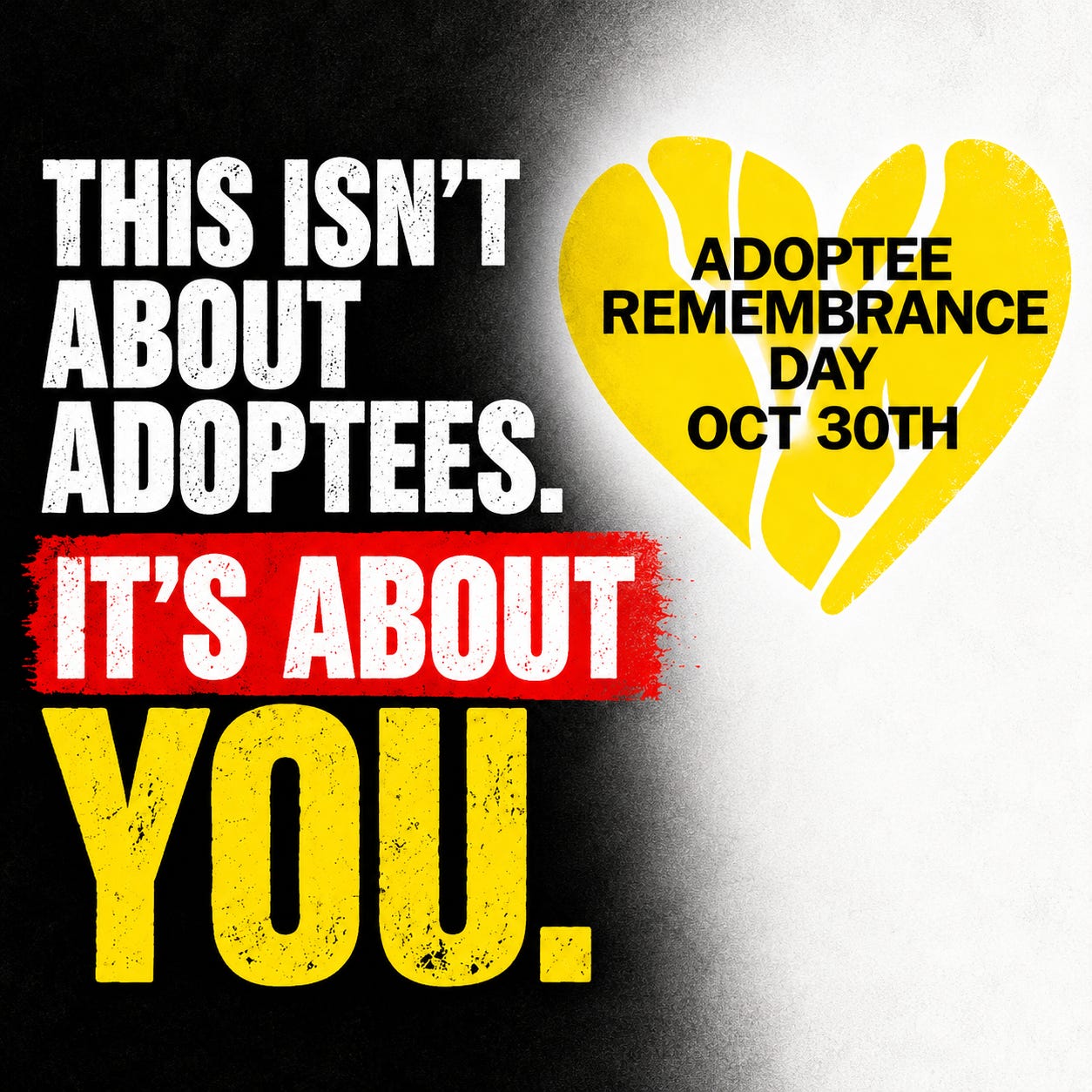
Today is Adoptee Remembrance Day. It exists because some of the people who paid that cost didn't survive it.
You were asked to sit with this for the length of an article. Sit with it a little longer today. For them.
Thanks for reading! This post is public so feel free to share it.