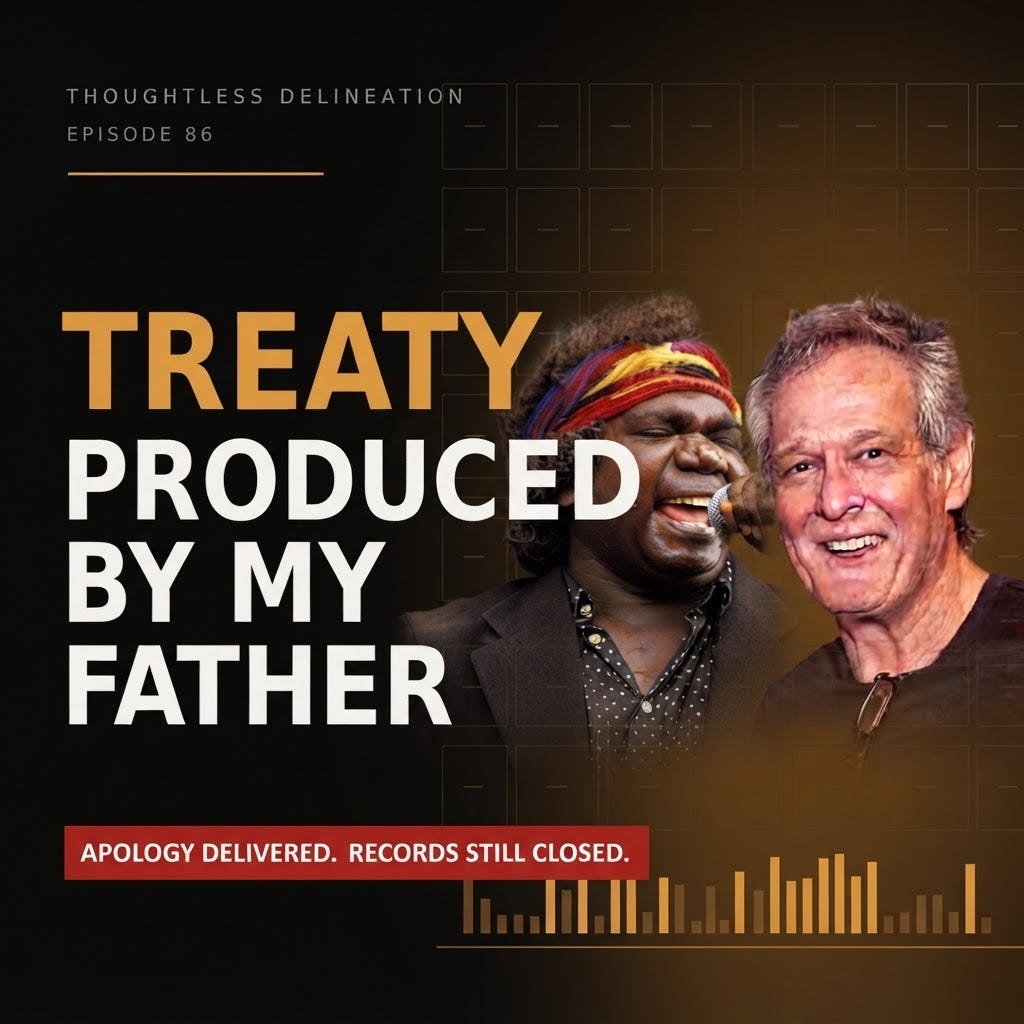
The single was released on 18 February 1991. Yothu Yindi, “Treaty,” Mushroom Records. Written by Mandawuy Yunupingu, Witiyana Marika, Banula Marika, Milkayngu Mununggurr, Stuart Kellaway, Cal Williams, Gurrumul Yunupingu, Paul Kelly and Peter Garrett.
Producer: Mark Moffatt.
The album credits also list him on Hammond organ and guitar. His hands are on the record, not just his name above it.
Mark Moffatt was my father. I did not learn this from a registry, a caseworker, an agency file or an amended certificate. I learned it from my mother and a confirmed DNA test. The Commonwealth had the information. So did the state. Neither of them was ever going to be the source.
He died on 6 September 2024, in Nashville, aged 74. I never met him.
What the song is about
“Treaty” is about a promise made in public and not honoured. That is the whole content of it. An undertaking given by a government, in front of witnesses, and then not delivered. The song asks what a promise is worth when the party that made it faces no consequence for abandoning it.
It took a remix to get it onto the radio. Australia would dance to the question before it would answer it.
I want to be precise about something here, because precision is the only thing I have that is worth anything. “Treaty” belongs to Yothu Yindi and to Yolŋu people. Its meaning is not mine, was never mine, and does not become mine because of a production credit. Land rights and forced adoption are not the same injury and I am not making them equivalent. What I am claiming is a fact about a credit and a fact about my own paternity. Nothing more.
The second promise
On 29 February 2012, the Senate Community Affairs References Committee reported on the Commonwealth’s contribution to former forced adoption policies and practices. Twenty recommendations.
On 21 March 2013, the Prime Minister delivered the National Apology in the Great Hall of Parliament House. Recommendation 1 concerned a national framework, to be progressed, the government response said, through the Standing Council on Community and Disability Services.
The framework was never built. Adoptee Rights Australia’s review at the tenth anniversary found that most of the recommendations accepted at the time were never implemented, that no harmonisation of births, deaths and marriages registers has occurred, and that no single national access point to those registers exists. The working group established to progress the recommendations was dissolved after the change of government within months of the apology.
That is the operative fact. Not the sentiment of the apology. Not whether it was moving. Whether the thing promised was delivered.
It was not.
What that costs, specifically
Here is what the failure to build that framework looks like at the level of one person.
It looks like a man in Nashville with pancreatic cancer and a son in Australia, and no mechanism in either jurisdiction designed to put the two facts in the same room. It looks like a commercial DNA kit doing in six weeks what the Commonwealth had been asked to do in 2012 and had thirteen years to complete. It looks like finding your father’s discography before you find your father.
I want to be careful not to overstate this. I do not know what he knew. I make no claim about his intentions, his knowledge, or what he would have done with the information. That is not the point and it never was. The point is that the question of whether he wanted to know was never permitted to arise, because the architecture that would have allowed it to arise was recommended, accepted, apologised for, and then not built.
An apology that is not followed by the thing it apologised for is not a reckoning. It is a closing statement. It permits the country to file the matter as historical while the mechanism that produced the harm continues to operate, quietly, through sealed and inconsistent records in eight separate jurisdictions.
Not a coincidence
I have been asked whether I find it strange, the coincidence. The man who produced the country’s most famous song about an unhonoured promise, and a son taken by the same country’s removal system.
It is not a coincidence and it is not a message. It is the same behaviour showing up twice.
A state that will apologise and not deliver in 1991 is the same state that will apologise and not deliver in 2013. There is no irony to it once you see the pattern. There is only consistency. My father recorded one instance of it and fathered a witness to the other, and the two facts sit at right angles for no reason other than that the country was doing the same thing in both decades.
Where it stands
Two years today he passed. The producer credit is public and permanent. It will outlast everyone involved, including me.
The recommendations remain unimplemented. There is still no national framework. There is still no harmonised access to birth records. There is still no single point at which an Australian adoptee can go and be told the truth about their own origin without paying a private company for it.
Treaty now. Still no treaty. Apology delivered. Still no records.
The song asked what a promise is worth. Thirty-five years later the country has produced an answer, and I have it in writing, and it is nothing.
Shane Bouel is a forced adoption survivor and the author of Thoughtless Delineation.