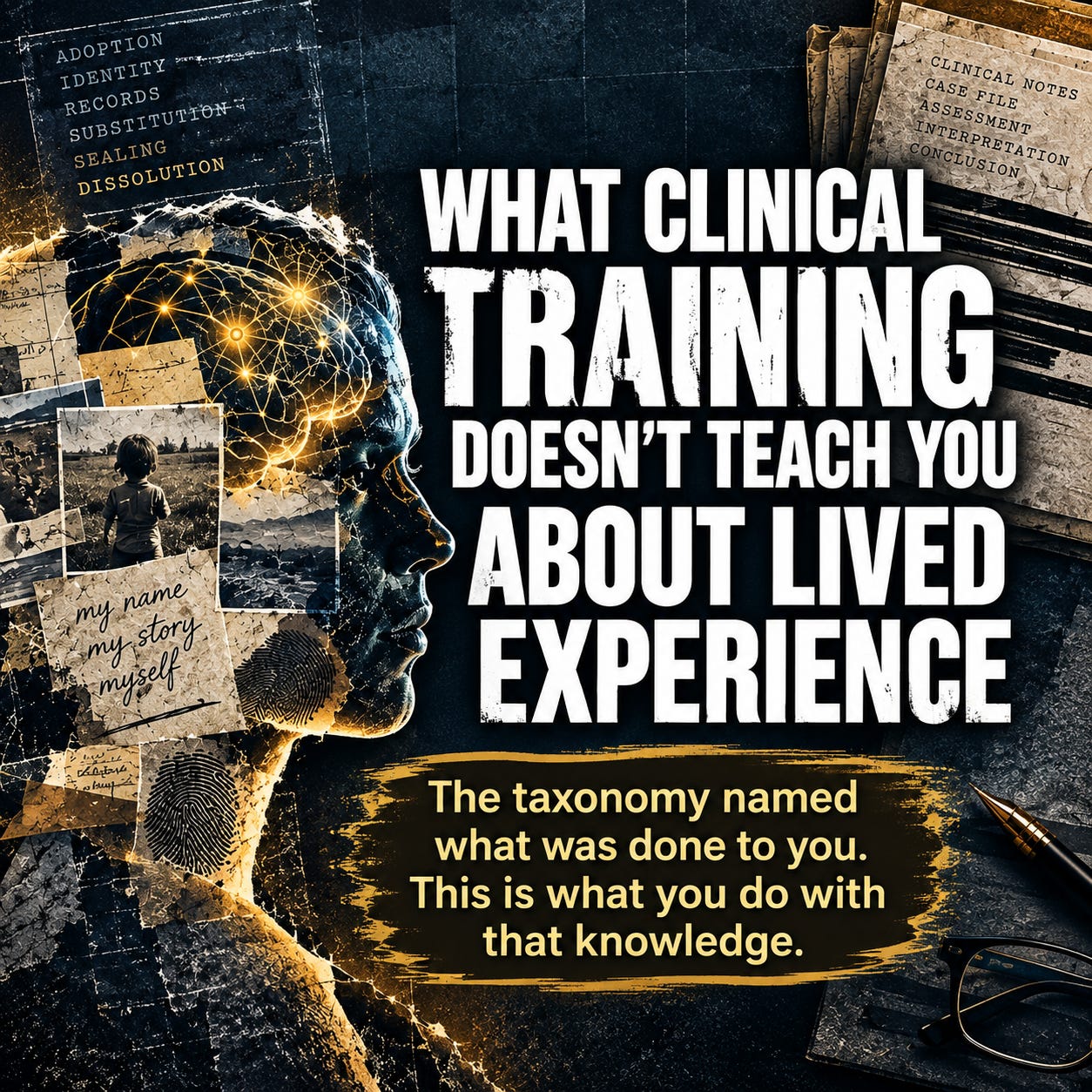
This is a free preview of a paid episode. To hear more, visit thoughtlessdel.substack.com
There is a particular vertigo that follows the moment of naming.
You read the taxonomy. You recognised yourself in it — in the Substitution, or the Sealing, or the Dissolution. The mechanism became visible. And then, almost immediately, the Gaslighting arrived to do its work: Are you sure? Isn’t that a bit much? Maybe you’re reading too much into it.
This is not a coincidence. It is the system defending itself.
The naming is the first act of resistance — but it is not the last, and it is not sufficient on its own. A name without a witness is still vulnerable. The system knows this. It has spent considerable effort ensuring that the only testimony you have about your own experience is yours — and then spent equal effort teaching you not to trust it.
What follows is about how to change that.
WHAT AN EXPERT WITNESS ACTUALLY DOES
In a courtroom, an expert witness does something precise: they take their specialised knowledge and apply it to the facts of a specific case. They do not guess. They do not speculate. They observe what is in front of them and name what it is, using a vocabulary that has been earned through direct experience with the subject matter.
You have direct experience with the subject matter.
You have, in fact, more direct experience with what happened to you than any clinician, any case worker, any adoptive parent constructing a narrative at the family dinner table. The thing that was done to your name, your record, your story, your sense of self — you were there for all of it. The institution was not inside your body when it processed your paperwork. You were.
The expert witness framework is not a metaphor. It is a method. It asks you to do four specific things with your experience.
1. TREAT YOUR MEMORY AS DATA, NOT AS TESTIMONY REQUIRING CORROBORATION
The Gaslighting mechanism works by installing a second-order doubt: not just this didn’t happen but you cannot trust yourself to know what happened. It takes your most direct source — your own embodied memory — and reclassifies it as unreliable.
The expert witness does the opposite. They treat their observations as data points, not as claims requiring an external referee before they count. What you remember counts. What your body registered counts. The fact that no one else in the room acknowledged it does not make it inadmissible — it makes it evidence of the Substitution operating correctly.
Write it down. Not to prove it to anyone else. To stop it from being revised by the next conversation that tells you it didn’t happen.
2. DISTINGUISH BETWEEN WHAT YOU WERE TOLD AND WHAT YOU EXPERIENCED
The Substitution works by overlaying an official account on top of the actual one. Over time, if the overlay is repeated often enough and the original has no record, the substitute becomes the operative version — even inside you.
The expert witness separates these. Two columns, if that helps: what the record says and what I remember. The gap between them is not a sign that you are confused. It is precisely the gap the taxonomy describes. The Sealing exists to make that gap permanent. Your job is to document it before it closes again.
This is not about prosecuting anyone. It is about restoring the evidentiary record that was removed — beginning with your own account of events.
3. NAME THE MECHANISM, NOT JUST THE FEELING
“I felt erased” is true. It is also exactly what the architecture wants you to say, because it can be reclassified as a feeling — subjective, unverifiable, the kind of thing a sensitive person might feel without there being any structural cause.
“I experienced the Sealing — my original birth certificate was withheld by the state until I was an adult, at which point the record had been altered” is different. It names a mechanism. It points at an institution. It is not a feeling. It is a description of a process that operated on a specific person at a specific time.
The expert witness uses the vocabulary of mechanism, not the vocabulary of wound. Not because the wound doesn’t exist — it does — but because mechanism is harder to gaslight. You cannot tell someone they misread a sealed file.
4. RECOGNISE THAT YOUR UNCERTAINTY IS ITSELF EVIDENCE
This is the hardest one.
The Dissolution produces a particular kind of person: someone who cannot fully trust their own account of events, who qualifies every statement about their own experience, who feels the absence of themselves without being able to point to where they went. If you read that description and felt it land, your uncertainty is not a sign that you are wrong. It is a precise symptom of a system that ran to completion.
The expert witness knows that a subject who has been thoroughly gaslit will doubt themselves. That doubt is expected. It is, in fact, the clearest sign that the mechanism operated — because a person whose story was never substituted, never sealed, never dissolved does not carry that particular vertigo.
Your uncertainty about your own experience is diagnostic. It belongs in evidence, not in the column marked reasons I might be wrong.
THE DOCUMENT
None of this requires a courtroom. It does not require anyone to listen, validate, or agree.
What it requires is a record. Your record. A document — written, spoken, whatever form holds — in which you apply the taxonomy to your own case with the same precision you would bring to anyone else’s. The Substitution: here is what the family narrative said, and here is what I remember. The Renaming: here is the name I was given and here is what I know of the one it replaced. The Sealing: here is what was withheld and for how long. The Gaslighting: here is the specific language used to relocate my account into psychological deficiency. The Dissolution: here is what did not form, and here is my best reconstruction of what it would have been.
This document does not need to go anywhere. It does not need to be published, submitted, or shared. Its primary function is to exist — to be a record that the architecture was designed to prevent.
The system depends on the absence of that document. On you remaining unable to produce a coherent, mechanistically-precise account of your own case. The moment you can, you have done something the architecture cannot fully undo: you have treated your experience as evidence, and yourself as the expert most qualified to read it.
That is not recovery. Recovery is a longer road, and this essay is not about that.
This is about what you do the morning after the taxonomy lands. You pick up the vocabulary it gave you. You apply it to your own case with the rigour the institution never applied to yours. You write it down.
You become the witness the system was designed to ensure you would never have.
This Substack is reader-supported. To receive new posts and support my work, consider becoming a free or paid subscriber.
Resources Available on Paid Subscription
The Expert Witness Resource Suite operationalizes a structural inversion of clinical authority, establishing lived experience as the primary evidentiary source rather than a subject for secondary professional interpretation[1]. Designed for both survivors documenting their own accounts and clinicians seeking to eliminate institutional gaslighting from their intake protocols[4], this suite—comprising an executive Slide Deck, a hands-on Evidence Workbook, and a comprehensive Clinical Training Curriculum—translates the Expert Witness Framework into actionable practice[4]. Through these resources, users learn to execute a four-step forensic methodology: treating embodied memory as primary data, mapping the gap between official records and lived experience, reclassifying subjective feelings into precise institutional mechanisms, and recognizing self-doubt as diagnostic evidence of system operation[7]. Ultimately, these tools empower individuals and practitioners alike to move beyond traditional pathology and construct the rigorous, un-gaslinkable record that institutional architecture was designed to prevent
SEE BELOW