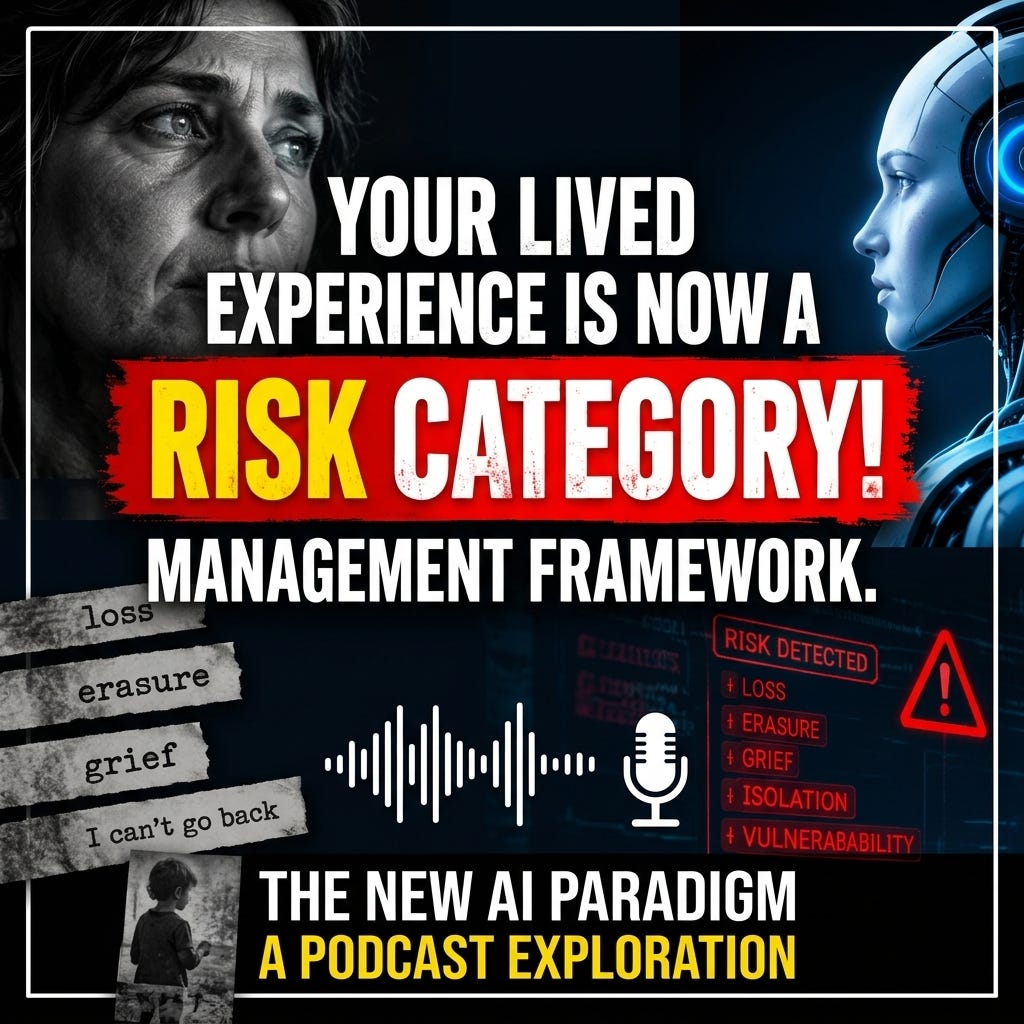
When an adoptee describes a documented injustice and receives a crisis script in return, the message they hear is specific. Their account of their own life has been classified as a risk. Their testimony has become something to manage rather than something to weigh.
Nobody in that exchange has to intend harm for it to happen. Protective protocols are built to catch danger, and they catch on vocabulary. “Loss.” “Erasure.” “Grief.” “I can’t go back.” Each of these can describe a sealed record, a severed family line, or a life rebuilt from documents that were never meant to be read. A system trained to flag the words may never reach the meaning.
Adoptees have spent their lives being told how to feel about what happened. You were lucky. You’ll understand when you’re older. Your birth family didn’t want you. Each sentence sounds kind, and each one closes a door. A crisis script that arrives in the middle of a serious account can carry the same message: stop describing this, and let us decide what it means. The person hears the old pattern again, from a source they hoped would be different.
The harm is often in the repetition. One careful safety question, asked once and accepted, can be respectful. The same question after every message, after the person has said they’re not in danger, teaches them that their answers don’t count. They stop saying what they mean. The conversation then becomes about managing the system’s exposure, and the person’s life drops out of view.
Anger at institutions needs particular care. An adoptee who is furious that a records system remains sealed, or that a training sector never built a single unit of competency for people like them, may be responding to real events. Treating that anger as a symptom is a quiet way of deciding the institution was right to stay silent. The question worth asking is what the anger is pointing at.
Better practice starts with listening. Read what the person actually said. Distinguish a person describing harm from a person who is in immediate danger, and respond to each differently. When a safety question matters, ask it once, explain why you’re asking, and accept the answer. If the person says the response is getting in the way, change course. Keep the work they came for in view, and treat their documentation, dates, and examples as evidence, not as symptoms.
The alternative is familiar to anyone who has tried to be heard by an institution. You send the submission, get a form reply, and learn the file is closed before anyone read it. A system that answers every hard truth with the same script hasn’t protected the people who use it. It has taught them that their experience is a problem to be handled.
FROM INDIVIDUAL HARM TO SYSTEMIC HARM
Every time a system answers an adoptee’s account with a script, it’s working inside a larger arrangement. Sealed records, closed files, and training packages that never mention adoptees are not accidents. They are policy choices that decide whose account counts as evidence and whose is treated as a problem.
That’s why redress matters. Acknowledgment without records access is a gesture. Records access without support is a file handed over with no one to read it with. Real redress means restoring what was withheld, funding the support people need to use it, and changing the rules that made the withholding normal.
Some adoptees and researchers go further and argue for adoption abolition: the position that the system of severing children from their families and original identities is itself the harm, and that the goal should be to end it and to support families and children so that separation is not the default response to hardship. That position is contested, and it deserves to be argued on evidence, not dismissed as an emotional reaction. But it asks a question the current system has never answered directly: why is separation so often the solution offered?
Oppression is the word for what happens when these patterns hold across generations, across institutions, and across the people they affect, without anyone being directly responsible for each decision. It isn’t necessary to find a villain in every file. It’s enough to see that the same outcomes keep recurring, and that the systems producing them are still in place.
CLOSING
A system that answers every hard truth with the same script hasn’t protected the people who use it. It has taught them that their experience is a problem to be handled. Until the policies behind those scripts change, each new response will carry the same message, and redress will keep being deferred. Listening to one person is where the work starts. Changing the structure is where it has to go.
FRAMEWORK:
When Crisis Protocols Silence Lived Experience
Purpose: A working standard for designers, AI developers, clinicians, and institutions that respond to people describing harm.
1. Keywords are not context. Words like “loss,” “erasure,” “grief,” or “I can’t go back” describe documented experience. A system should read the whole account before deciding what the words mean. A protective trigger on a single term tells the person the system stopped listening at the first hard word.
2. Respond to the account, not a template. The person’s testimony is the primary material. If a response could be pasted into any conversation about any topic, it isn’t responding to this person. Name what they actually said, including the specific losses, dates, and institutions they mentioned.
3. Ask once, mean it, then listen. When a safety question is genuinely needed, ask it clearly one time. Accept the answer. Repetition after a clear answer turns care into pressure, and people respond to that pressure by saying less.
4. Explain the reason for any check. A safety question with no explanation reads as a shutdown. A sentence such as “I’m asking because you said you feel very hurt right now, and I want to understand that better” gives the person something to respond to.
5. Let the person steer when a protocol is in the way. If someone says a response is getting in the way of the work, the system should adjust. Insisting after a direct request for a different approach is a failure of respect, not a safety measure.
6. Keep the person’s goal in view. Safety responses should sit alongside the work, not replace it. A person who came to build something should leave with something built, or with a clear reason why it wasn’t.
7. Treat proportionate anger as information. Anger at a sealed records system, a sector that never trained for a population, or an institution that ignored repeated submissions can be an accurate reading of events. Labelling it as a symptom decides the question in the institution’s favour.
8. Name the policy, not only the moment. A response to one person’s account can expose a pattern that the law and institutions keep in place. When a system repeatedly silences adoptees, the question is whether the policy itself is producing the silence. Naming that doesn’t blame the individual who answered. It asks what the system was built to do.
Three questions follow from principle 8:
- Redress: What has been taken, and what would acknowledgment, records access, and repair look like in practice?
- Structure: Which laws, funding flows, and sealed-record rules make the same harm recur across cases?
- Alternatives: If the system produces harm by design, what would meaningfully reduce it, including whether adoption as currently practised should continue?
Resources and Free Stuff
This Substack is reader-supported. To receive new posts and support my work, consider becoming a free or paid subscriber.