Missed a Dispatch? They’re all right here.
It took me a bit longer than expected to get out of Santa Fe. I’d meant to tip the housekeeper but realized too late that I was down to thirty-five dollars in cash to get from New Mexico to North Carolina. I spent most of the morning trying to get money without an ATM card ( I don’t travel with one)—discovering, belatedly, that banks don’t really do cash advances anymore. When I finally found one that did, my card wasn’t on the right network.
I’m officially a relic of another age.
I left with a guilty conscience for stiffing the housekeeper, but figured it would be just my luck to hit a gas station or diner without network service, and I wasn’t about to risk it. I told myself I’d repay the debt somewhere down the road. Still, I couldn’t stop thinking about the imbalance—the same one that keeps widening everywhere. My small lapse in tipping the housekeeper felt like a crack in a larger system. Work deserves pay that covers rent and groceries—that’s just basic dignity. I hate tip culture.
Wage and dignity still travel together elsewhere in the world; we’re the ones who keep separating them.
With that on my mind and only thirty-five dollars in my pocket, I turned back to the road. Less than an hour away was Glorieta Pass, site of the last major battle of the Civil War in the New Mexico Territory. Other than a brown highway marker, I couldn’t find much evidence from the road that anything out of the ordinary had ever taken place there.
I’d been looking for a battlefield; I found a throughline instead.
Corridors and Conscience
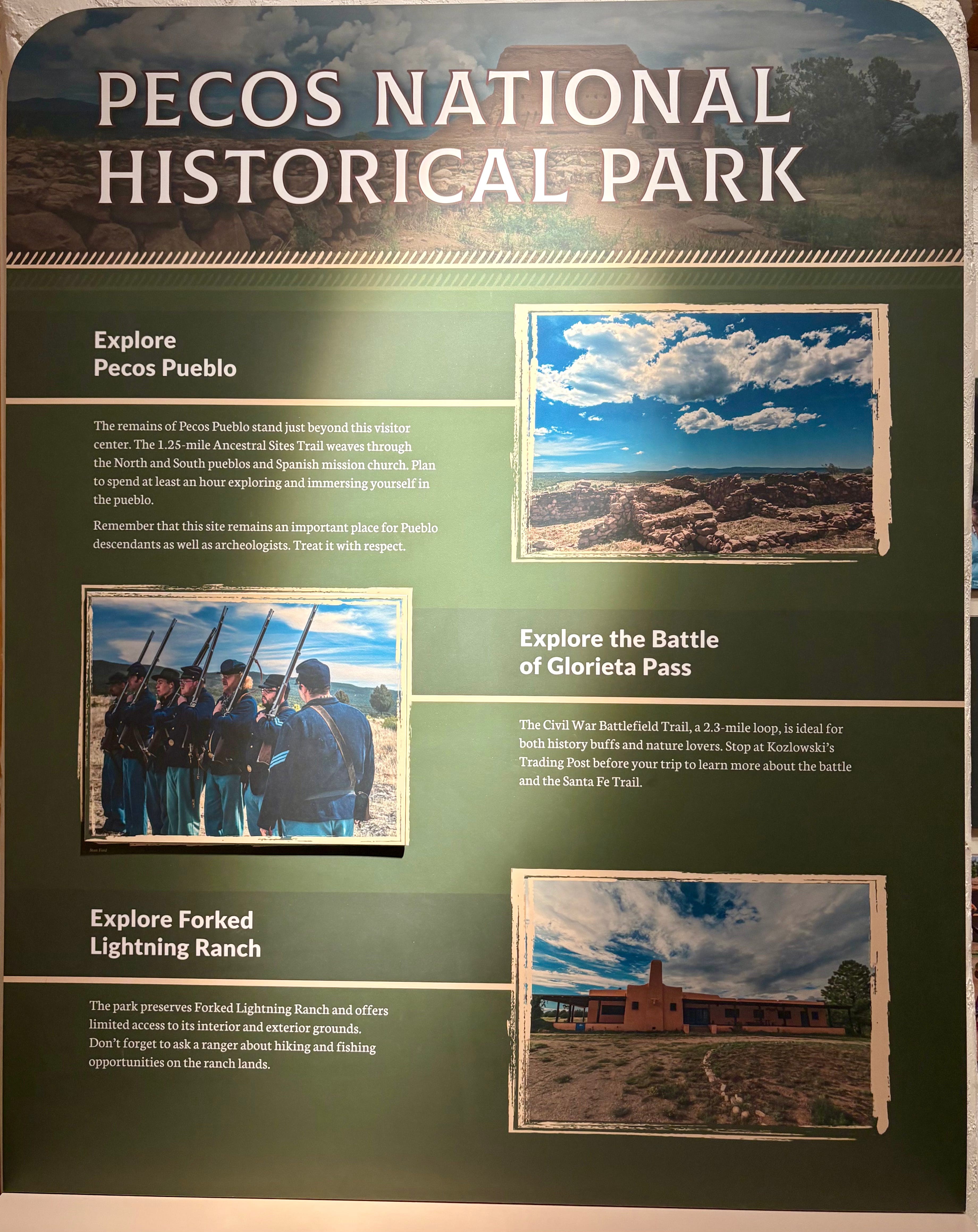
At Pecos National Historical Park, an ever-helpful ranger told me how to find the general area of the battle “if you really try—but you’d have to know what you’re looking at.”
I didn’t try. What I was looking for wasn’t coordinates but continuity. I was more interested in what endures than what was lost. Inside the park’s exhibit halls, the story wasn’t war but passage—centuries of travelers sharing the same corridor: Pueblo traders, Spanish missionaries, Anglo soldiers, the Santa Fe Trail, the railroad, Route 66, I-25. One road stacked upon another. My own eastward ride felt like claiming an inheritance.
As I left the park, the skies were overcast, and the wind vexed me. I was traveling between 7,500 to 8,000 feet, where cold wind and stunted piñon-juniper and ponderosa forests dominate. (Back home, Mount Mitchell, North Carolina, peaks at 6,684 feet.)
The cold and thin air cast a shadow over my spirits as I left the high-altitude remnants of the Southern Rockies, headed again toward the flat plains for what I assumed would be a couple of dull travel days before reaching the Southern Appalachians.
Then—boom—the land fell away to reveal the Pecos River Valley, a long, erosion-carved corridor where the highlands yielded to the Great Plains. Broad, sweeping passes opened one after another—sheer mesa walls above, an unexpected valley floor below. I dropped from the mountain zone to basin-and-range foothills, skimming the edge of the Raton-Clayton Volcanic Field farther east. I was in a worn-down portion of the Great Plains margin, riding atop layers that were once near-shore seabeds, laid down ~250 million years ago.
I hadn’t expected such beauty; there wasn’t a hint of green on Google Maps to warn me. I don’t know if my eyes or my lungs were happier during those miles. Within thirty minutes, I was unzipping my jacket collar to feel the breeze. Whew.
Oasis and Inheritance
By the time the road leveled near Trementina—around 5,500 feet—I’d surrendered the mountains. What came next was pure high plains: windblown, wide open, and suddenly interrupted by water.
The Conchas River cuts a gorge through the land, forming a surprise oasis: low cliffs, wide water, a fringe of green. The dam here was built in the 1930s—not for profit, but for public good. One of thousands under the WPA, it helped reshape the American landscape.
The ethos rang familiar. This was the kind of work my grandfather—Papaw—did during the Great Depression, laying stone in Kentucky with the Civilian Conservation Corps. He was the fourth child of twelve and his paycheck was $30 a month—$25 of it sent straight home.
That split might not fly with teens today—maybe not even with labor law. But it fed his family, and it helped shape a country that once believed in shared work and shared reward. I wouldn’t be here without the CCC.
The thought brought me back to Hot Springs and those grand old bathhouses—another relic of a Progressive Era that valued public health, beauty, and structure. Somewhere along the way, we decided income was the prerequisite for healing. If a new CCC were proposed now, it would probably need a corporate sponsor and a media campaign to justify itself.
We don’t build for the public good anymore. We still spend public money—but only if there’s a ribbon-cutting, a sponsor logo, a photo op in hard hats. Otherwise, good luck.
Even now, Congress jockeys for political cover while dismantling the very systems that once held families like mine together—families who survived only because those programs existed. America has gone beyond austerity for the poor and fallen straight into social murder. Not metaphorically, but structurally. When a government withdraws food, shelter, and healthcare from the vulnerable while protecting the powerful, that is not neutral policy—it’s murder, written into law.
The Shape of Their Labor
My grandfather’s legacy was built with stone and sweat. I always think of him doing something outdoors, even though he had a civil service job. His real love was animals, and husbandry was his other full-time occupation. Calving and planting hay and straw in spring, then harvesting alfalfa and Timothy continuously from early summer through October. Year-round repairs. Always in motion.
The torch passed quietly from stone to spirit. My mother’s labor was of a different kind, but like her father, she was always in motion. She labored by force of will—physically and socially. Always scanning for what could be improved—made more useful, beautiful, meaningful. Mom saw the world as something to be elevated, and she carried that mission like a calling.
They each labored in their own way—Papaw with his hands, Mom with her convictions. Papaw’s bridges are probably still standing, and Mom’s convictions live on in her descendants.
I labor too, but mine is quieter: the work of noticing, of pattern and meaning. I don’t shape stone or command a room; I gather what’s overlooked and thread it into stories that hold.
Maybe that’s why I sense the subtle changes first—the flickers in Mom’s recall, the gentle fray in her precision. I don’t want to see it, but I do. It strikes me that tending the mind—our own or another’s—is invisible but relentless work.
Speaking of the mind, Papaw died from complications of Alzheimer’s, and my mother has always said that’s her worst fear for anyone she loves.
I used to think she meant the heartbreak of watching someone disappear. But now I think she fears being the one who vanishes—who loses her edge, her authority, her grip on the story.
She’s never been quick to say, “I don’t remember.” If the details slipped, she often filled them in with what she believed should have happened—what aligned with her values or her sense of justice. The version she told became the version. Not to deceive, but because the world should run a certain way—and someone had to hold the line.
What I Carry
One moment stands out—a story she’s told many times, and always in the same way: my high school club hazing. In 1978, club initiations were just thinly veiled abuse that you tolerated so you could dish it out as an upperclassman. Mom was furious when she found out about one of the initiation requirements. She marched into the school, confronted the gym teacher who sponsored the club, and then the principal who had looked the other way.
Of course, I was mortified. What teenager wants their mother barging into school, making a scene? Even though Mom was right—which I couldn’t see then—I didn’t want reform. I just wanted to survive the week unscathed.
In her telling, she got the teacher fired—with thanks from the principal for standing up to cruelty. That’s not what happened; they both retired years later. But in Mom’s mind, she had taken a stand and won. Her version wasn’t anchored in fact so much as justice—the story she needed to be true.
For years I told it differently, too—my version focused on the embarrassment, not the courage.
Looking back now, I see the shape of her loyalty. Fierce, public, and unyielding. But I also see how much it meant to her to be the one who knew what to do. To not just protect her children, but to be recognized for doing it well.
I sometimes think Mom and I share the same internal siren, tuned to injustice but calibrated differently. Hers goes off at the sight of a bad actor, mine at the sound of a bad system. She likes to be the hands of retribution—swift, decisive, righteous. I’m slower. I build my case, try to understand what produced the mess before I touch it. The only time I move first and think later is when an animal’s in trouble. Then instinct wins every time.
These days, when something she considers important escapes her, I can see Mom wrestle with it—her mind reaching, her words circling, pride trying to hold steady. This isn’t just about trying to stay organized; she’s trying to stay legible to herself—to keep the story straight so the world still makes moral sense.
I recognize the gesture in myself—small hesitations, the wrong word arriving just ahead of the right one. This prelude of the inevitable isn’t alarming—yet. It’s just a faint draft that wasn’t there before. It’s enough to make me wonder if the drift begins this quietly.
Download your Craft Tips and Writing Prompts here.