Buckskin Rides Again is FREE! Subscribe so you don’t miss a thing
If you remember Pixar’s Cars movie (2006), you’ll remember Radiator Springs—the dusty little town bypassed by the interstate, fading until someone slowed down long enough to see its charm. Tucumcari, New Mexico, isn’t Radiator Springs exactly, but Pixar clearly had places like it in mind.
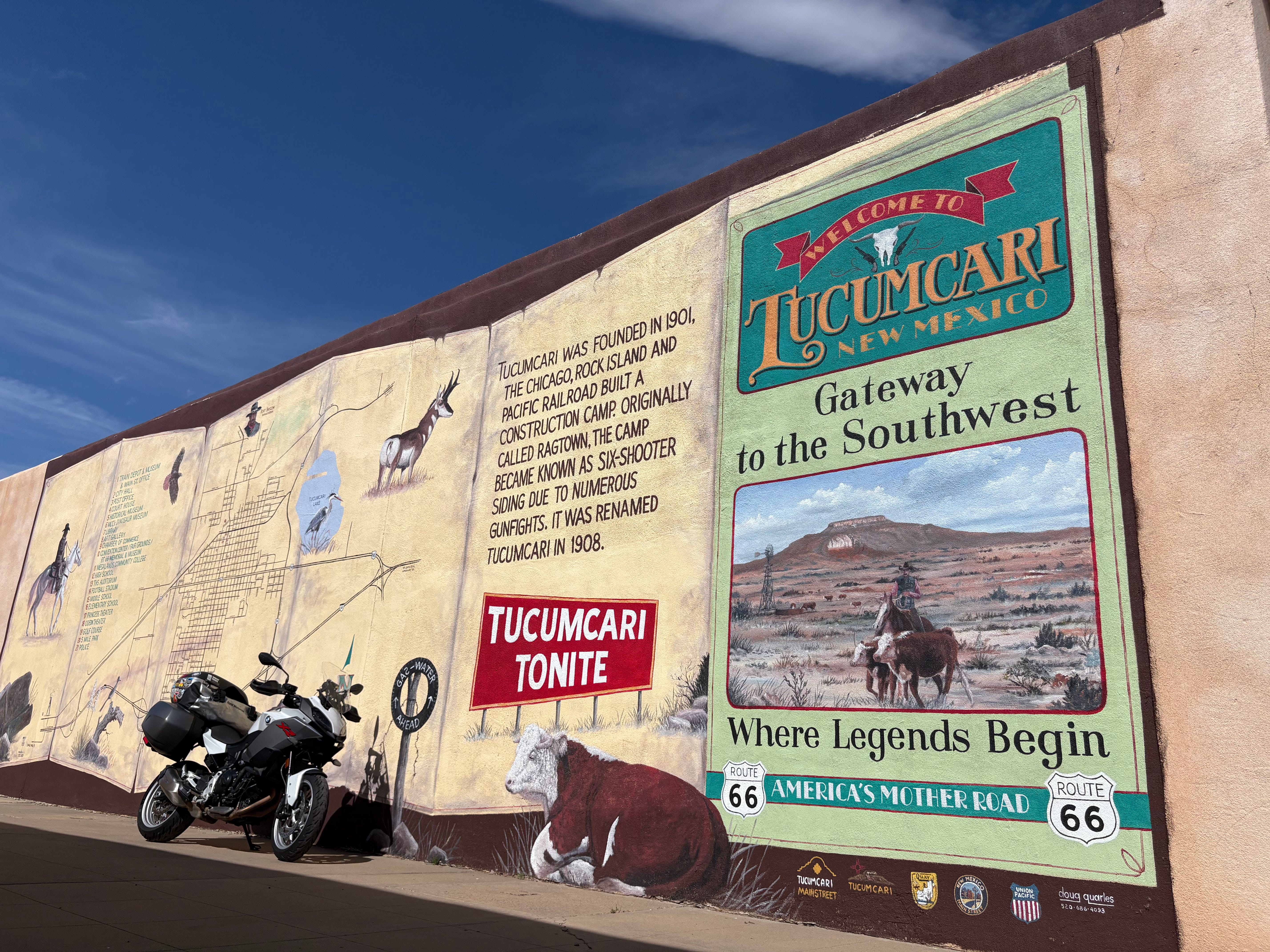
The town wears the same stubborn hope, its civic pride painted straight onto stucco. More than a hundred murals brighten Main Street and back alleys—cowboys, longhorns, diners, the ghosts of Route 66 motels. They may look spontaneous, but most are part of a plan. Murals declare: We were here. We mattered. We still do.
And they whisper: Please stop and spend a little money.
As life gets faster, meaner, more expensive, and more extractive, nostalgia becomes our refuge—and our trap. Maybe that’s why the murals got to me: they weren’t just decoration; they were defense. Don’t just take my word for it—sociologists have tracked the same trend. It’s a global reflex: vinyl records in Europe, Mao-era kitsch in China, vintage Vespa cafés in Vietnam.
But in the U.S., nostalgia is baked right into capitalism; it’s one of our most infectious exports. We don’t just remember—we monetize. The American model turns memory into experience, and experience into product. We brand the past so we can buy it back. And nobody does that better than Disney.
As a connoisseur of roadside kitsch (including murals) Tucumcari was a must-see. I doubt my family ever stopped there, and if we did, mural tourism hadn’t yet been invented. In the late ‘60s early ‘70s we were after comfort, not nostalgia. And comfort was hit-or-miss, with air conditioning more conceptual than real.
I remember the metal water barrels along the loneliest stretches of Route 66 in Arizona, New Mexico, and west Texas—set out to keep cars from overheating, or to revive them after they had. Drivers could ladle water into their radiators or leave jugs for the next traveler. Some barrels were tended by local agencies, others by the kindness of strangers.
Mamaw and Papaw took jobs where they could find them, based largely on the advice of other family members, some of whom had settled in California. Somewhere in my family’s archives is a story about Papaw rigging his own version of roadside mercy for the car—an evaporative cooler strapped to the passenger window, burlap-lined and fed by a leaking water bladder. The store-bought versions, often Firestone or Thermador, used balsa shavings or porous pads, but Papaw was handy and broke, so he built his own. Unlike some of his jury-rigged contraptions (of which there were dozens), this one actually worked—long enough to make the desert a little more bearable.
Maybe those barrels—and Papaw’s homemade cooler—were the real Radiator Springs: proof that strangers and tinkerers once looked out for each other on the long, hot road.
If I’d pulled into town an hour earlier, I’d have had time to tour the Tucumcari Railroad Museum, housed in the old Santa Fe depot—white stucco, red tile roof, and a long row of arched windows that still catch the late sun just right.
Instead, I idled at the depot fence, watching freight cars shimmer past in the heat—steady and indifferent, just like they were when this town mattered to travelers.
Echoes from the paternal past
That rail line is where my dad’s family history starts to echo. His mother’s family—the Whites—followed the Santa Fe west from Fort Madison, Iowa, to Barstow, California. My grandmother’s parents made that journey too. Her mother, my great-grandmother White, died in her fifties of what they then called “sugar diabetes,” a term that sounds folksy now. Her strong genes show up in both my grandmother and Dad—the same almond-shaped eyes, the same wide smile that still turns up in family photos.
Dad reminded me of that illness, a little wistfully, when we were learning to monitor his glucose. He believed his grandmother probably had access to insulin by then, but working-class women didn’t always get timely care—especially in desert towns like Barstow.
On Dad’s father’s side—the Cummins side—there’s a different kind of legacy. I recall seeing a photo of me and my brother standing beside our great-grandfather Cummins in Iowa. He stayed put in Fort Madison, where the Santa Fe built one of the first railroad bridges across the Mississippi and helped turn the town into a major rail hub.
Great-grandpa Cummins worked as a Santa Fe Railroad detective—part cowboy, part lawman, part company enforcer. His job was to ride the line, settle disputes, protect cargo, and put down unionization efforts.
If you’re my age—or a connoisseur of vintage cartoons—you probably remember that old Looney Tunes series with Ralph Wolf and Sam Sheepdog. Ralph trying to steal the sheep, Sam thwarting him at every turn. But come noon, they shared a sandwich. And at five, they punched the clock and walked home together like old friends. I imagine that’s how my great-grandfather—the Santa Fe special agent—felt about the other side of the family, his in-laws. They followed the rails west to Barstow, read contract language like scripture, and stood firm with the union.
Still, they all worked the same line—just from opposite sides of the track.
Dad never said much about the divide—railroad detective on one side, union men on the other. But by the time I was coming up in the ’70s, when union-busting was gaining traction as the national sport, I could sense his angle. He gave the stink-eye to slowdowns and “not pitching in.” He respected grit more than grievance, but he never mounted his high horse.
Mom would’ve weighed in. She’s always believed in law and order—but she also roots for the underdog. I used to think those instincts were at odds. Now I think she gave her allegiance to whoever deserved it—a case-by-case call based on circumstance and character.
Where do I fall on that spectrum? For starters, I have an MBA, which means I’ve read the anti-union case studies. I was raised to believe in effort, not excuses—and I still do. But somewhere along the way, my compass shifted.
These days, I side with the union by default and I’m rarely convinced otherwise. The wildcat strikes and sabotage I remember from the ’70s are gone, which makes it easier. It’s hard not to root for people who organize for something better. Who take risks. Who do the slow work of community-building.
What I’ve come to admire most are the unions that form quietly, without theatrics—movements of caretakers rather than combatants. Take the 43,000 home-based daycare providers in California—mostly women of color, running child care businesses out of their homes. Technically independent. Chronically underpaid. Routinely overlooked.
In 2019, they voted to unionize. Two years later, they secured a contract with the state: 20% raises, retirement and health funds, and—most important—formal recognition of their work. No wildcat strikes. No sugar in gas tanks. Just organizing, lobbying, and showing up.
It worked. It changed lives. Stories like that help me keep the faith.
That’s why I still believe in solidarity. Because I’ve seen too many people do everything right and still get steamrolled. Because I’ve spent enough time as a freelancer to know what it means to get stiffed—and to rely on my spouse for that most American of luxuries: health insurance.
Small-Town Solidarity
Tucumcari tried solidarity once. When the federal interstate plans were announced, highway officials insisted that bypasses guaranteed prosperity. Locals didn’t buy it. Mayors, merchants, and ordinary residents linked arms to protect their one dependable economy: the slow, steady stream of Route 66 travelers. Like so many workers I’ve known, they weren’t fighting modernity—they were fighting disposability.
Solidarity became their only strategy, though even solidarity rarely stops the kind of progress that’s already been promised to someone else. Sometimes collective action buys time; sometimes it becomes the record of who refused to disappear.
Either way, solidarity is always an argument against erasure.
I ate a chile relleno in a small café downtown, turning over how solidarity is still needed today—though the battleground has shifted. It’s no longer fought primarily through labor unions or factory gates, but through whatever means a community can muster to stay viable in this new, 21st Century Gilded Age.
Leaving Tucumcari, I eventually had to merge onto I-40—the very interstate that siphoned travelers away and starved the motels and cafés I had just spent the afternoon admiring. I-40 hummed like a future I might’ve welcomed once, dazzled by the promise of growth and jobs. But I’ve lived long enough to recognize the echoes—the same breathless claims now made by tech bros promising AI data centers, endless prosperity, and somehow endless water.
The bypass didn’t just reroute traffic; it rerouted identity, economy, and time. But, like time itself, the wind never stops; it only changes direction and velocity. Weather systems move, and I moved with them.
Skipping The Big Texan Steak Ranch
I set my course for Canyon, Texas, deliberately avoiding Amarillo—not only because it’s bigger, louder, and paved with parking lots, but because I’ve been there before. Many times, back in my original Buckskin days.
Stagecoach and Running Deer always stopped for dinner at the Big Texan Steak Ranch in Amarillo, home of the infamous 72-ounce steak challenge. Eat the whole thing—steak, roll, salad, shrimp cocktail, baked potato—in under an hour, and it’s free. Even as a kid, I couldn’t stand the spectacle. The eating theatrics are a blur—but I never forgot the gift shop.
That’s where I found it: a ponytail holder with tiny plastic pistols in tooled leather holsters. I still have it—proof that kitsch endures the test of time. I didn’t want to be Annie Oakley, but I was drawn to the drama of small things made serious—and powerful things rendered trifling. Even then, I understood the strange pull of symbolic power.
There was also a rattlesnake behind glass, caged for spectacle. I remember feeling sorry for it, coiled and staring in its artificial habitat. Wild things deserve to be wild—and maybe, even then, I knew that included me. Not that I was some untamable rebel—I was a good student, an animal lover, a kid with a conscience. But I had parts of me that refused to be subdued. A mind that wandered to more interesting topics. Beliefs that didn’t bend easily. A distaste for performance—especially when it was demanded, not chosen.
That’s probably why I ride solo. Why I freelance. Why I choose the projects—and the people—that let me keep my edges sharp. Somewhere along the line, I stopped letting myself be put on display in someone else’s enclosure.
Thirty minutes later, I-40 leveled out and the light turned silvery, the trees doing that eerie sway. I could smell the static in the air before I felt the shift—the scent of dry grass meeting ozone. Then the air went metallic, and I began to play that familiar game: outrun the rain. I reached Canyon just ahead of the first drops, parked at the Hampton Inn, and stood for a moment in that thin tension between motion and storm.
Front desk clerks usually let motorcyclists park under the canopy for safety’s sake, and that night the safety wasn’t from vandals. A huge storm raged through, including a few buckets of hail, from the way it sounded on the roof. Inside, the place was buzzing again with teenaged athletes—boys and girls in warm-up jackets, hauling coolers and duffel bags, there for some kind of regional basketball tournament.
I stayed in that night—not just because of the storm, but because I had pages due for Stephanie.
The road clears your mind, but the work always rides pillion—waiting for you under the next storm canopy.
Download Craft Tips and Writing Prompts here.