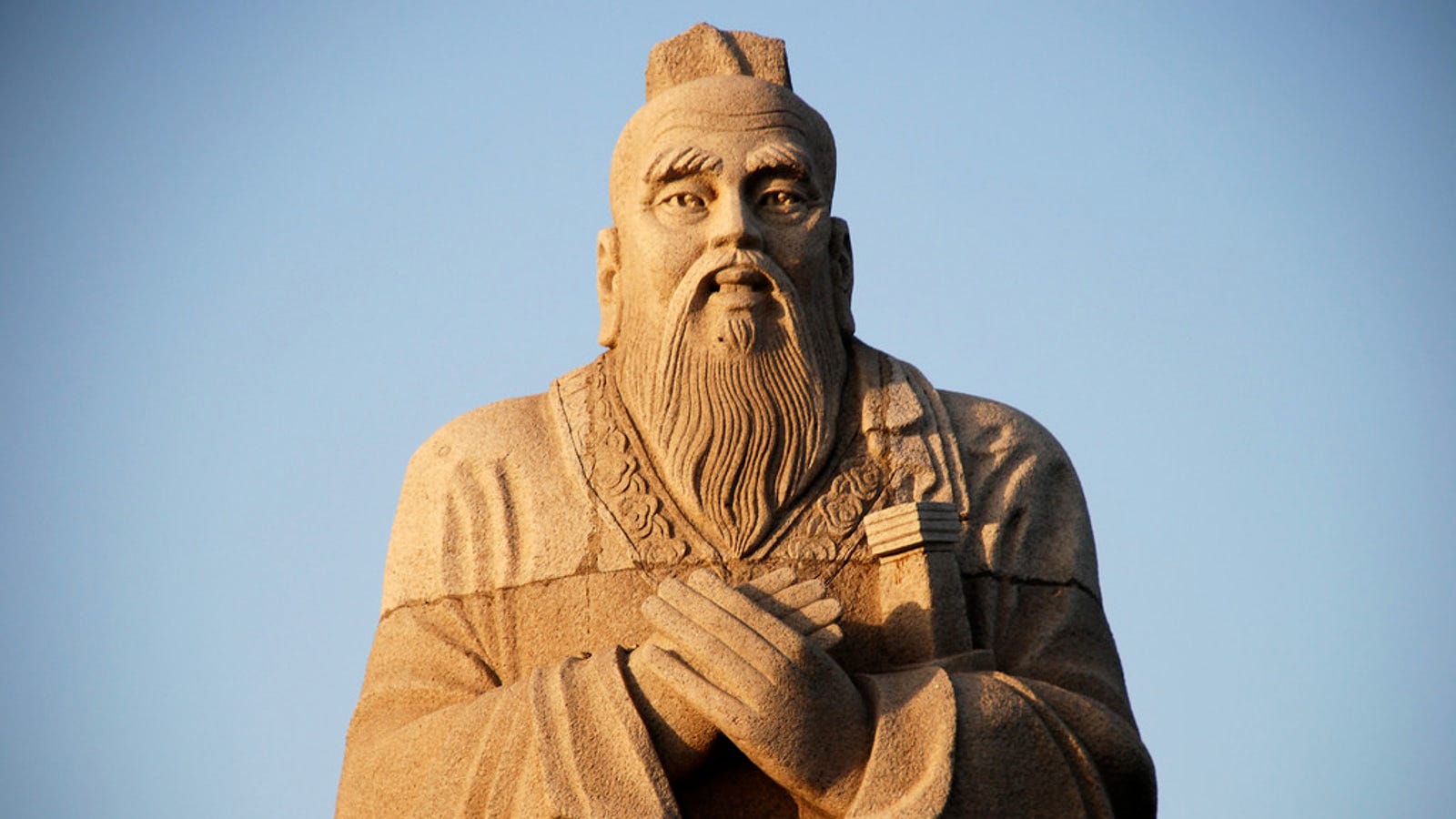
“If the people be led by laws, and uniformity sought to be given them by punishments, they will try to avoid the punishment, but have no sense of shame. If they be led by virtue... they will have the sense of shame, and moreover will become good.”
Two and a half thousand years after Confucius spoke those words, the Chinese Communist Party has erected over 500 Confucius Institutes globally, plastered his face on state propaganda, and declared him the bedrock of “socialist harmony.” The ancient critic who wrote that rulers must earn their legitimacy through moral virtue has been transformed into the official mascot of a one-party state.
But who was the real Confucius, and what happened to his philosophy?
In this episode, we step back from centuries of state dogma to examine the original political thought of Confucius as a serious thinker responding to an acute material crisis.
We explore:
* The Spring and Autumn Crisis: How Confucius developed his ideas amidst the violent collapse of traditional authority and the breakdown of social norms.
* Ren and Li: The structural relationship between inner moral character (Ren) and the external framework of ritual, social roles, and daily norms (Li) that hold a society together without relying on violence.
* The Hundred Schools of Thought: The ideological battle between Confucianism, Daoism, Mohism, and Legalism over how to restore political order.
* The Bible Comparison: Why the fragmented, recorded nature of the Analects left a doctrine uniquely vulnerable to being weaponised by opposing political factions.
* The Han Turn and State Capture: How the Han Dynasty constructed an enduring imperial system by merging Legalist state coercion with Confucian moral legitimacy.
* The Mandate of Heaven Asymmetry: How a concept designed to place built-in moral checks on absolute power was neutralised and weaponised retrospectively to justify whoever held the throne.
* The Radical vs. Conservative Debate: Whether his philosophy is fundamentally a tool for rigid patriarchal hierarchy, or a radical critique that conditions power entirely on ethical conduct.
We also look at the modern CCP’s selective revival of Confucian language under Xi Jinping, exploring how the state frames dissent as “disorder” to turn a philosophy of accountability into an instrument of compliance.
Ultimately, this episode asks a broader question:
Can an ethical framework survive absorption by the state - or will the ruling class always keep the hierarchy and remove the accountability?
Thanks for reading Fault Lines Politics! Subscribe free - essays and podcasts on political theory, history, and power, delivered fortnightly.