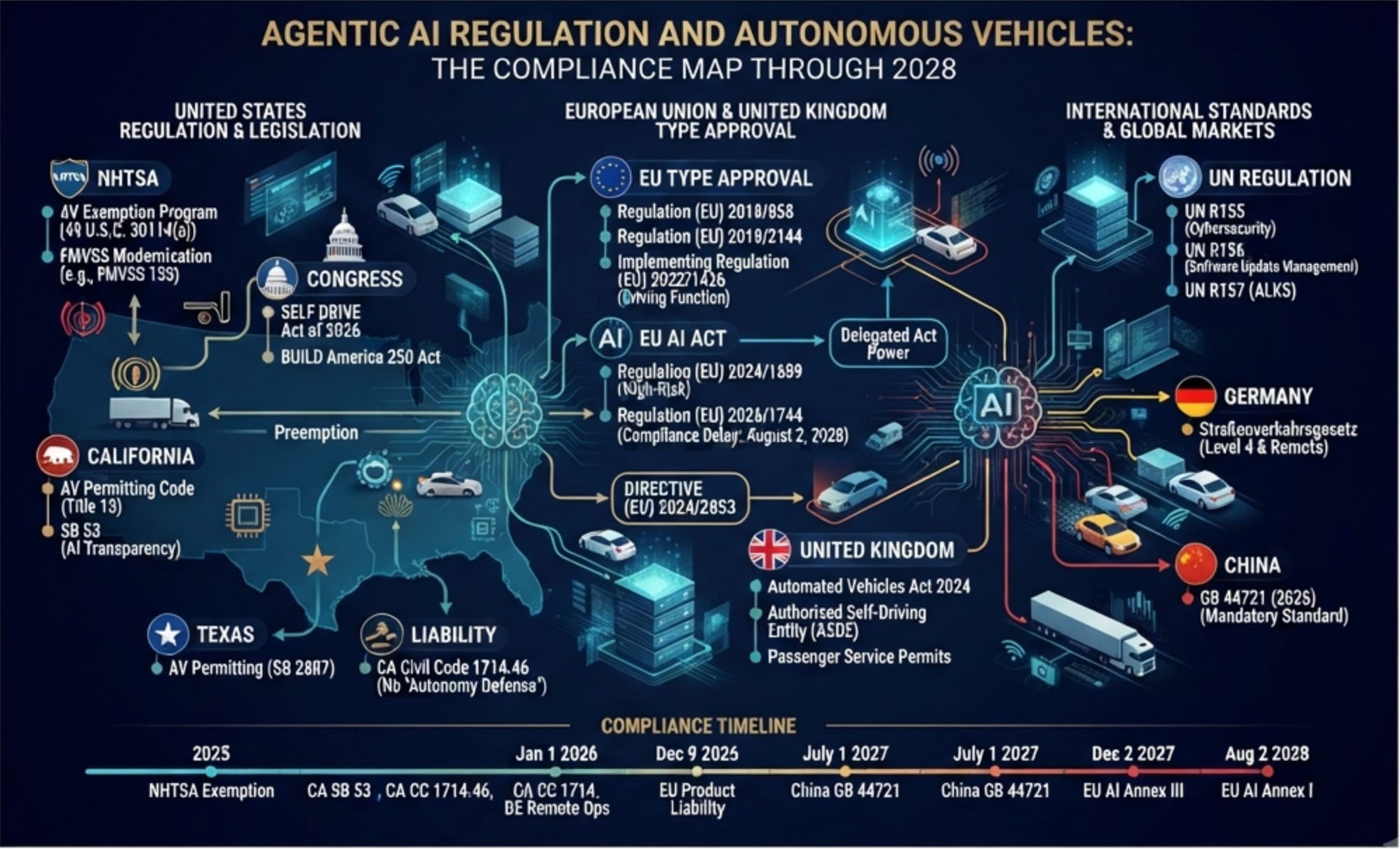
Agentic AI regulation reaches autonomous vehicles through vehicle type approval and product safety law, a route that Regulation (EU) 2026/1744 delayed to August 2, 2028 for automotive artificial intelligence. The artificial intelligence statutes moving through American legislatures were written for models and for decisions about people. Almost none of them govern the driving task. What governs the driving task is older and narrower: the Federal Motor Vehicle Safety Standards and the exemption sections of 49 U.S.C. Chapter 301, the state permit codes in California and Texas, the United Nations vehicle regulations, and the type approval rules underneath the European artificial intelligence rules. If you are budgeting compliance for a driving stack, that is where the money goes.
On June 26, 2026, the National Highway Traffic Safety Administration withdrew the voluntary oversight program it had proposed eighteen months earlier, at 91 Fed. Reg. 38619. The withdrawal notice is unusually candid. Industry commenters said the reporting burden outweighed the benefit. Safety commenters said a voluntary program was no substitute for approval of unproven technology on public roads. The agency agreed with both and killed it. What replaced it is narrower and harder to argue with: a standard by standard rewrite of the Federal Motor Vehicle Safety Standards for vehicles built without manual controls, starting with FMVSS No. 102, No. 103, and No. 104 in March 2026 and reaching the brake standard, FMVSS No. 135, in June. Stopping distance performance stays exactly where it was.
why do the new AI statutes barely touch self driving cars
Because they regulate the wrong thing. California Senate Bill 53, effective January 1, 2026, reaches developers training foundation models above 10 to the 26th floating point operations and imposes catastrophic risk reporting and civil penalties up to $1,000,000 per violation on those with more than $500,000,000 in annual revenue. Colorado’s replacement statute, Senate Bill 189, effective January 1, 2027, covers automated decision technology used in consequential decisions across seven domains. Vehicle operation is not one of them.
There is one artificial intelligence statute that will matter enormously to this industry, and it is one sentence long. California Civil Code Section 1714.46, effective January 1, 2026, provides that a defendant who developed, modified, or used an artificial intelligence system may not assert as a defense that the artificial intelligence autonomously caused the harm. Causation, foreseeability, and comparative fault survive. The autonomy argument does not. Every plaintiff’s firm building an automated driving practice read it the week it took effect.
what does agentic ai actually change about vehicle liability
It changes what can be proved. A rule based planner leaves an audit trail. Engineers point to the branch that fired and the threshold that produced it. A driving model trained end to end from sensor input to steering command produces a trajectory and nothing else. NHTSA engineering analysis EA26002, opened March 18, 2026 across roughly 3.2 million Tesla vehicles, is built on that gap. The alleged defect is that the system’s own degradation detection failed to recognize that glare and airborne obscurants had degraded its perception, and failed to warn the driver in time. Nine incidents, two injuries, one death.
Europe has already decided who carries that evidentiary burden. Directive (EU) 2024/2853, with transposition due December 9, 2026, brings software and artificial intelligence systems inside the definition of a product, extends it to post sale software updates, and creates rebuttable presumptions of defect and causation where technical complexity makes proof excessively difficult for the claimant. For a model whose reasoning cannot be reconstructed after a crash, that presumption decides the case before the expert reports are exchanged.
I spent my early career in a nuclear propulsion plant where the reactor protection system had written setpoints, and any watchstander could recite the exact condition that would trip the plant. Thirty years later, negotiating indemnity terms for automated driving components, the same question, what condition causes your system to hand control back, often draws a probability distribution instead of a setpoint. Contracts allocate that uncertainty. They do not remove it. The indemnity clauses that survive a real claim define the trigger by observable vehicle behavior, logged and timestamped, never by model confidence.
which regulation controls a software update to a driving model
UN Regulation No. 156, and almost nobody outside the type approval function is watching it. It requires a certified software update management system for any change to a type approved vehicle. A retrained driving model pushed over the air to a fleet is a software update. The obligation attaches whether the change fixes a bug or replaces the entire set of weights, which makes Regulation No. 156 the closest thing in force anywhere to a continuous certification requirement for a model that keeps changing. It applies in every market following the 1958 Agreement, including the European Union, the United Kingdom, Japan, and Korea.
The recall channel already runs on behavior instead of hardware. Waymo filed a voluntary software recall covering 3,067 vehicles in December 2025, recall 25E084000, after fifth generation software drove past stopped school buses displaying flashing red lights and deployed stop arms. Nothing broke. The vehicle did what its model told it to do, and the model was wrong about a rule every sixteen year old learns in a classroom.
where does the compliance work actually sit through 2028
In four files. The exemption petition, now governed by NHTSA interim guidance published July 31, 2026 in Docket NHTSA-2026-1552, which replaced lifetime exemption terms with operational authorizations the agency can modify as the system changes. The state permit, which in California since April 28, 2026 requires a heavy duty vehicle to log 1,000,000 testing miles, 200,000 of them in California, and since July 1, 2026 obliges an operator to answer a notice of autonomous vehicle noncompliance within 72 hours. The type approval file under Commission Implementing Regulation (EU) 2022/1426. And the software update management system under UN Regulation No. 156.
Congress may rearrange the first two. The SELF DRIVE Act of 2026, heard in the House Energy and Commerce subcommittee on January 13, 2026, would require a safety case for SAE Level 3 through Level 5 systems, bar states from restricting the sale of compliant vehicles, and raise the exemption ceiling above the current 2,500 vehicles per manufacturer per year. H.R. 8870, the BUILD America 250 Act, cleared the House Transportation and Infrastructure Committee on May 22, 2026 by 62 to 2. Both leave state authority over deployed vehicles intact, which means the reporting and enforcement conditions that actually constrain a robotaxi operator survive the bills written to end the patchwork.
Two things are worth watching before December. The Digital Omnibus that entered into force on July 27, 2026 lets the European Commission remove a product category from the parallel artificial intelligence duties by delegated act where sectoral law already carries equivalent requirements. Machinery was the first category removed. If vehicles follow, automotive compliance collapses back into type approval and the August 2, 2028 date loses most of its force. Separately, no enforcement action has yet tested whether a driving model trained above the Senate Bill 53 compute threshold is a foundation model within that statute.