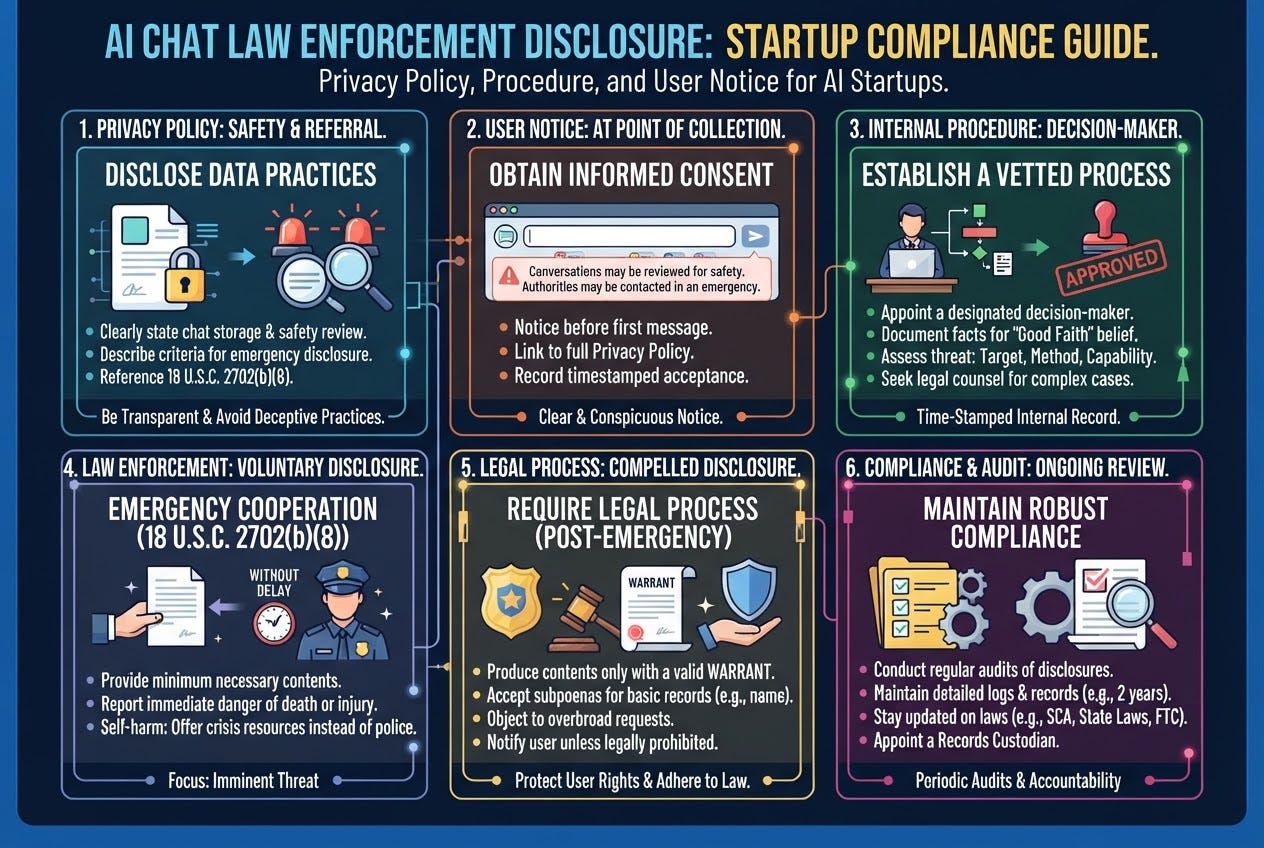
An AI startup should tell users in its privacy policy and at the input box that staff may review conversations and report credible threats to police under 18 U.S.C. 2702(b)(8). The Lee County case shows what happens when the user learns this from a deputy at the door.
On September 26, 2026, a woman in Bonita Springs, Florida, used Claude as a diary and wrote that she would shoot up the Lee County Sheriff’s Office. The next day she mentioned a new gun. Anthropic monitoring flagged the entries, a human reviewer judged the threat credible, and the company called law enforcement. She is charged with a second degree felony under Florida Statute 836.10, and the charge is an allegation that a court has not tested. It is at least the third referral of a Claude conversation to police since August, after San Antonio on August 11 and San Francisco on August 14.
The legal authority for that call is a single sentence of federal law. Section 2702(b)(8) of Title 18 lets a provider disclose the contents of a communication to a governmental entity if it believes, in good faith, that an emergency involving danger of death or serious physical injury requires disclosure without delay. The word is permits. No federal statute requires a provider to report a threat, unlike the duty to report child sexual exploitation under Section 2258A. Every referral is therefore a decision the company makes, and the company owns the record of why it made it.
Most startup privacy policies I review contain one borrowed line reserving the right to disclose information to prevent harm. The procedure the line assumes is almost never written. The first time a reviewer finds a threat at eleven at night, the company learns that nobody knows who decides, what the standard is, or what to send. A good faith belief is a state of mind, and a state of mind is proved by what the company wrote down at the time.
The Stored Communications Act also contains a trap in its own defense provision. Section 2707(e) makes good faith reliance a complete defense, but its third ground cross references paragraphs (b)(9) and (c)(7) of Section 2702, which cover foreign government orders, and does not name the emergency paragraphs. A startup that discloses under (b)(8) may argue that the exception is itself a statutory authorization, but no reported decision I located settles the point. Minimum damages under Section 2707(c) are $1,000 per plaintiff, with punitive damages for willful violations and attorney fees.
The next layer is the Fourth Amendment. A voluntary report by a private company needs no warrant under United States v. Jacobsen. Anything beyond that report is a different matter. Carpenter v. United States in 2018 required a warrant for location records held by a carrier, and Chatrie v. United States, decided June 29, 2026 by a 5 to 4 vote, held that acquiring Google location history was a search. An August 2026 analysis of the decision applies its reasoning to AI chat logs, which reveal at least as much as a map of places visited. A startup should promise users that it hands over the contents of conversations only against a warrant or a real emergency, and it should be ready to object to a subpoena for contents.
The Florida statute adds a wrinkle that matters to every company that reviews chats. Section 836.10 reaches a record sent, posted, or transmitted in any manner in which it may be viewed by another person. In a diary product, the reviewers at the provider may be the other persons. And under Counterman v. Colorado in 2023, the State must prove the speaker consciously disregarded a substantial risk that the words would be seen as threatening violence. A private journal entry gives a defendant an argument that a public post does not. The company review file, including reviewer notes and the excerpt sent to police, will be subpoenaed, and reviewers will be witnesses.
The consumer protection exposure is the part founders underestimate. Section 5 of the FTC Act reaches a policy that does not match practice. The Commission ordered BetterHelp to pay $7.8 million in 2023 over health data sharing that contradicted its promises, and FTC staff wrote on February 13, 2024 that a quiet retroactive change to terms can be unfair or deceptive. If a product markets itself for journaling and the policy says nothing about human review, the gap is the claim. California Civil Code Section 1798.100 requires notice at collection, and Section 1798.145 preserves the right to cooperate with police only for a business that has acted in good faith.
Three documents close the gap before the first conversation is stored. The policy states in ordinary words that conversations are stored, that automated systems and trained staff may review them, that the company may give police the relevant excerpt and account information when it believes someone faces death or serious injury, and that contents go out in response to legal process only on a warrant or an emergency. The procedure names a decision maker, requires a same day written memo of the target, the means, the timing, and the reason delay is unsafe, and limits the package to what relates to the emergency. The notice sits under the input box, in one sentence, and the account screen records acceptance with a time stamp and a policy version.
The sheriff in Lee County said that communications with AI are never truly anonymous. That sentence is the standard the notice has to meet, and a startup that markets privacy it cannot deliver will answer for the difference. A company that stores nothing has nothing to report and no duty to monitor. A company that stores and reviews needs the paperwork first.
The next piece covers the first hour after a police emergency request reaches a startup: the verification call, the certification of an emergency, what goes in the package, and what the company refuses to send.
Interested in analysis about the intersection of tech, policy and the law? Check out my Substack channel. https://theinnovationattorney.substack.com/