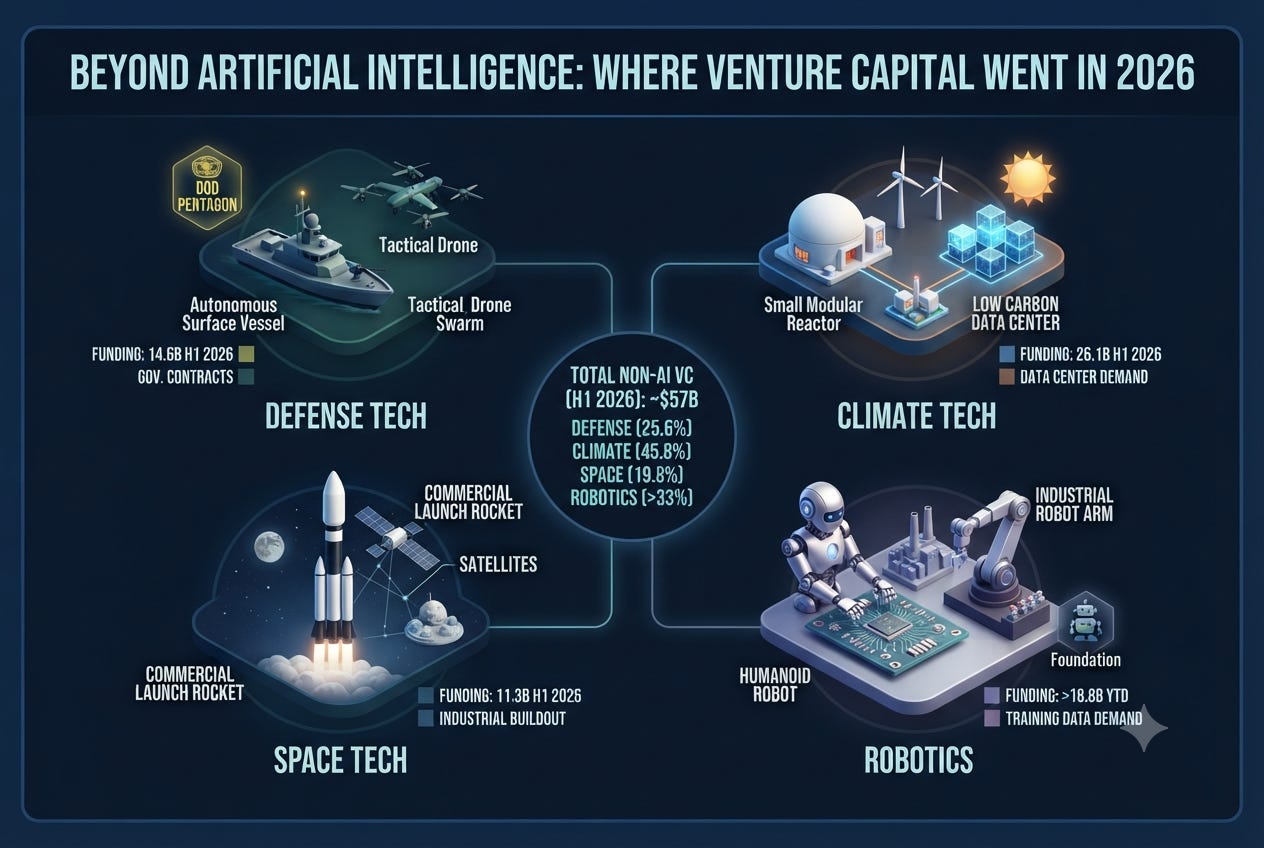
Defense technology and climate technology drew most non artificial intelligence venture capital in 2026, with defense startups raising $14.6 billion through May and climate companies $26.1 billion by June 30. Artificial intelligence companies took $355.9 billion of the $412.7 billion invested across United States venture deals in the first half of 2026, which left roughly $57 billion for every other category combined. Two sectors claimed most of that remainder. Defense technology passed its entire 2025 total of $9.6 billion before the end of May. Climate technology grew 55 percent year over year while its deal count fell 25 percent to a five year low.
The two sectors are funded for different reasons. Defense capital follows a customer with an $858.9 billion appropriation and a procurement system that Congress rewrote in December 2025 to favor commercial products and companies that have never held a prime contract. Climate capital follows electricity demand from data centers, which is why low carbon power for computing became the largest climate category in the first half of 2026 after growing more than 800 percent, while carbon removal funding fell 61 percent and low carbon fuels fell 56 percent as their tax credits sunset.
For founders the practical questions are narrower than the sector headlines suggest. What proof points move a defense company from a research contract to a production award. What happens to a fundraising timeline when a foreign limited partner sits in the fund that wants to lead. Which tax credit deadlines govern whether a climate company has a business at all. Those answers are written into statutes and regulations with dates attached, and they are more predictable than the valuations now being paid. Early stage defense companies are clearing 17 to 50 times revenue. That pricing assumes procurement reform works. Some of it will.
Detailed Findings
Which sectors beyond artificial intelligence attracted the most venture capital in 2026
Defense technology, climate and energy technology, space technology, and robotics absorbed the large majority of non artificial intelligence venture dollars in 2026. United States venture deal value reached $412.7 billion in the first half of 2026. Artificial intelligence companies took $355.9 billion of that, or 86 percent. Rounds of $100 million or more accounted for 87.5 percent of all value deployed, and everything below $100 million totaled $51.4 billion across the entire market.
Against that concentration, the four sectors below are large enough to matter and small enough that a single round moves the total. Defense technology recorded $14.6 billion across 107 announced rounds in the first five months of 2026. Climate technology recorded $26.1 billion in the first half. Space technology recorded $11.3 billion across 244 deals in the first half, which already exceeded the $10.1 billion raised across 433 deals in all of 2025. Robotics passed $18.8 billion by the middle of June against $15 billion for all of 2025 and a prior peak of $14.1 billion in 2021.
The category boundaries overlap, and the overlap is where most of the money sits. An autonomous surface vessel company is defense and robotics. A microreactor developer selling to a data center operator is climate, energy, and, when the customer is a military installation, defense. Sector totals published by different data providers diverge by billions for exactly this reason, and a founder benchmarking a round against a published sector total should first ask which definition produced it.
How much money actually went to defense technology in 2026
Defense technology raised $14.6 billion across 107 announced venture rounds between January and the end of May 2026, against $9.6 billion across 206 deals in all of 2025 and $1.6 billion in 2020. One widely reported alternative count puts first quarter 2026 defense investment at $19.8 billion across 262 deals, a figure that exceeds the five month total under the narrower definition. The gap is a definitional artifact. The broader count folds in dual use autonomy, industrial automation, and space companies with defense revenue. Both counts agree on direction and on order of magnitude for the year.
The individual rounds tell the story more precisely than the aggregates. In March 2026 an autonomous maritime systems developer raised $1.75 billion at a $9.25 billion valuation, and an autonomy software company raised $2 billion in a round led by a private equity firm and a money center bank rather than by venture funds. In August 2026 a defense manufacturing automation company raised $1.37 billion at roughly $8 billion, a hypersonics developer raised $1.05 billion in equity alongside a $250 million credit facility, and a tactical drone maker raised $250 million at about $2.5 billion. A European military autonomy company raised $1.8 billion in July at roughly $18 billion.
Two features of that list deserve attention. The first is the arrival of credit. A hypersonics company raising a quarter billion dollars of debt alongside its Series C is borrowing against contract backlog, which is what a manufacturer does and not what a software startup does. The second is the identity of the lead investors. Private equity firms, banks, and sovereign linked growth funds are now writing the largest checks, and their diligence standards, reporting requirements, and exit horizons differ from those of a traditional venture fund.
Exits arrived in 2026 as well. An artificial intelligence drone company went public and its shares rose more than 500 percent on the first trading day. Roughly four dozen defense companies are now credible public offering candidates. That is the first time since the sector reopened to venture capital that a fund can model a liquidity path that does not depend on acquisition by one of the five legacy primes.
What metrics and proof points make a defense technology company fundable
Fundable defense companies in 2026 show a signed production contract or a credible path to one within four fiscal quarters, and they show it with a contract vehicle, a program element number, and a customer who controls appropriated money. Research awards, prototype agreements, and pilots demonstrate technical merit and almost nothing about whether revenue repeats. The distinction that matters to a disciplined investor is whether the company has crossed from money that funds development to money that funds delivery.
The specific proof points that move a diligence file forward are these. A production or follow on production award under an other transaction agreement, because the fiscal year 2026 authorization act broadened the authority to award sole source follow on production across all commercial products and non developmental items. A named program of record or a documented insertion into one, which converts a company from a vendor into a line item. Delivered units in operational use, with a sustainment tail and a spares revenue line. A facility security clearance already granted rather than in process. Domestic supply chain documentation sufficient to survive a prime contractor flow down audit. And a unit economics model that survives the government’s cost realism review, because a company that wins on price and cannot produce at that price has bought itself a loss contract.
Revenue quality matters more than revenue growth in this sector, and the current pricing does not reflect that. Early stage defense startups are commanding 17 to 50 times revenue and higher. A software company at 20 times revenue with 90 percent gross margins and net revenue retention above 120 percent is one asset. A hardware manufacturer at 20 times revenue with 35 percent gross margins, a single customer, and an unfunded second production lot is a different asset entirely. The cofounder of the largest company in the sector said publicly in July 2026 that companies without production contracts should expect difficult down rounds when enthusiasm cools. That warning came from inside the trade.
One valuation data point illustrates how fast the marks are moving and how carefully a founder should read them. A May 2026 report placed the sector leader’s Series H at $5 billion on a $30.5 billion post money valuation. A July 2026 report carried the same company at $61 billion. Two published figures, sixty days apart, roughly double. Whichever is correct, a founder pricing a round against a competitor’s reported valuation is building on sand.
How does the government customer change a fundraising timeline
Government customer requirements add three to nine months to a defense fundraising timeline, and the delay comes from ownership review rather than from the term sheet. In thirty years of closing technology financings I have not seen a diligence item stall a round the way foreign limited partner composition now stalls defense rounds. The term sheet gets signed inside a week. Then someone asks who the limited partners are in the fund that just led, whether any of them are foreign persons, and at what percentage, and the answer takes six weeks to assemble because nobody built the capitalization chart to answer a national security question.
Four requirements drive the calendar. First, small business innovation research eligibility. A company must have fewer than 500 employees counting affiliates, must be majority owned and controlled by United States citizens or permanent residents, and must disclose foreign ownership at 5 percent or more under the extension act of 2022. When a venture investor takes a board seat, the Small Business Administration may count employees across that investor’s entire portfolio as affiliates, which can eliminate eligibility retroactively. A company that continues drawing federal funds after losing eligibility faces False Claims Act exposure at treble damages plus civil penalties.
Second, facility security clearance and foreign ownership, control, or influence mitigation, administered by the Defense Counterintelligence and Security Agency. Mitigation instruments include special security agreements, security control agreements, and proxy agreements, each of which requires cleared United States citizen directors, a government supervised security committee, and segregated information flows. The process runs several months and frequently longer. It also constrains who may sit on the board, which is a term sheet issue and not merely a compliance issue.
Third, export control. Classification of the company’s technology under the International Traffic in Arms Regulations or the Export Administration Regulations determines whether a foreign national employee may touch the source code, whether a foreign investor may receive technical information in diligence, and whether an offshore manufacturing partner is usable at all. Fourth, supply chain restriction, which now changes faster than a financing can close. In December 2025 the Federal Communications Commission imposed a categorical ban on foreign manufactured drones and drone components receiving federal equipment authorization, which created immediate exposure for companies whose bills of material had been compliant the week before.
The practical instruction for founders is to build the ownership and export control record before the term sheet, not after. A company that can hand a lead investor a completed foreign ownership chart, a classification determination, and a clearance status letter on day one closes months earlier than a company that starts assembling them under time pressure.
What did procurement reform actually change in 2026
The fiscal year 2026 authorization act, Public Law 119-60, signed December 18, 2025, rewrote the parts of the acquisition rules that had kept venture backed companies out of production. Section 1802 directs portfolio acquisition executives to prioritize commercial products and services. Sections 1821 through 1824 require the Pentagon to publish a list of defense unique contract clauses applicable to commercial products and prohibit clauses outside that list as mandatory flow downs, which removes the compliance overhead that made commercial companies decline defense work. Section 1823 broadens sole source follow on production authority to reach all commercial products and non developmental items. Section 824 requires that novel requirements be evaluated by methods other than past performance, which had been an absolute bar for any company that had never held a contract.
Section 1826 exempts nontraditional defense contractors from certified cost or pricing data, from the cost principles at Part 31 of the Federal Acquisition Regulation, and from certain business system requirements, subject to waiver approval by the head of the contracting activity and congressional notice. Sections 1804 and 1806 raise the certified cost or pricing data threshold to $10 million and lift cost accounting standards thresholds. Congress paired the authorization with $858.9 billion in base discretionary defense appropriations enacted in February 2026, adding $18.3 billion above the request across procurement and research accounts, and roughly $151 billion in reconciliation funds available in the same fiscal year.
That combination, a customer with money and a rulebook rewritten to admit new suppliers, is the substance behind the sector’s valuations. Whether it holds depends on execution inside the contracting workforce, which is a slower variable than the statute.
How does climate technology funding break down in 2026
Climate technology companies raised $26.1 billion in the first half of 2026, a 55 percent increase over the same period in 2025, while deal count fell 25 percent to a five year low and the ten largest deals accounted for 42 percent of all capital. The category is consolidating around fewer, larger, later companies. Series C rounds took $10.5 billion, nearly quadruple the prior period and a record half. Series A took $4.5 billion, up 55 percent, boosted by nuclear deals. Growth stage fell 18 percent to $3.6 billion as the largest companies moved to public markets instead.
The composition changed more than the total. Low carbon data centers became the largest single category after growing more than 800 percent, absorbing 34 percent of first half investment, with a $4.5 billion Series C and a $2 billion Series C leading the category. Grid technology recorded its strongest first half on record. Transportation rose 52 percent. Carbon funding fell 61 percent to its weakest period since 2020, and low carbon fuels fell 56 percent as their subsidies sunset. Earth observation funding tripled and robotics investment quadrupled inside the climate category, driven by demand for physical world training data.
Read plainly, climate technology in 2026 is an electricity and computing story wearing a climate label. Capital moved toward anything that puts firm power next to a data center and away from anything whose revenue depended on a tax credit that Congress terminated. Public market results confirmed the pattern. A geothermal developer’s offering raised $1.9 billion and traded up 35 percent, and an advanced reactor developer’s offering raised $1 billion and traded up 27 percent.
Why did nuclear and fusion capture so much of the energy total
Nuclear startups raised $4.5 billion across 81 companies through July 28, 2026, against $6.2 billion across 93 companies in all of 2025, and private fusion companies reached $11.52 billion in lifetime funding as of June 30, 2026, a $2.4 billion increase in twelve months that rose to roughly $12.18 billion after July announcements. Four fusion companies now exceed $1 billion in cumulative private capital, at $2.923 billion, $1.502 billion, $1.321 billion, and $1.040 billion respectively, and twelve companies exceed $250 million, up from eight a year earlier.
Two regulatory changes explain the timing. On March 30, 2026 the Nuclear Regulatory Commission published its risk informed, technology inclusive licensing rule at 91 Federal Register 15696, docket NRC-2019-0062, effective April 29, 2026, creating an alternative licensing pathway that accommodates designs other than light water reactors. The rulemaking was directed by Section 103(a)(4) of the Nuclear Energy Innovation and Modernization Act, Public Law 115-439, enacted January 14, 2019, and complemented by the ADVANCE Act of 2024, Public Law 118-76, enacted July 9, 2024. Executive Order 14300, issued May 29, 2025, added further procedural streamlining.
The commercial consequence is a race against a licensing queue. The commission took approximately six years to approve one small modular reactor design. The current target is eighteen months. If that target holds, the first movers lock in data center and utility offtake contracts before later entrants finish review, and the market resembles the gas turbine business, a handful of manufacturers and a long list of failures. Investors are pricing that outcome now.
I trained as a reactor officer aboard a fast attack submarine, and that experience makes me read fusion timelines differently than a purely financial investor reads them. The distance between a design that closes on paper and a plant that survives an operational review is measured in years, and it is measured in the unglamorous parts: materials qualification, instrumentation that works when it is hot, and a maintenance procedure someone can actually execute at three in the morning. No amount of venture capital compresses that. What venture capital can do is fund the qualification work, and that is what the largest fusion rounds are buying.
Which tax and licensing deadlines control climate technology fundraising
The reconciliation act enacted July 4, 2025 set hard dates that now determine whether a climate company can raise at all, and the nearest of them has already passed. Solar and wind projects must have begun construction before July 5, 2026 or be placed in service by December 31, 2027 to claim the technology neutral credits. The clean hydrogen production credit terminates for construction beginning after 2027. The consumer clean vehicle, commercial vehicle, charging property, and residential clean energy credits terminated on dates between September 30, 2025 and June 30, 2026. Wind component manufacturing credits end after 2027. Storage and geothermal escaped the near term cliff and face phase downs beginning for construction started after 2033, at 75 percent in 2034 and 50 percent in 2035.
The foreign entity restrictions are the provision most likely to break a financing. Credits are denied where a restricted foreign entity holds more than 25 percent alone or 40 percent in aggregate, holds 15 percent or more of aggregate debt, or controls board appointments at any percentage. Material assistance cost ratios apply to construction beginning after December 31, 2025, at 40 percent for qualified facilities and 55 percent for storage in 2026, rising to 60 percent and 75 percent after 2029. A 100 percent recapture applies to technology neutral investment credit value if payments conveying effective control occur within ten years of placement in service, effective for tax years beginning after July 4, 2027.
Those numbers convert directly into term sheet language. A climate company taking capital from a fund with restricted foreign limited partners can lose its tax credits, and the loss is retroactive through recapture. Any climate financing in 2026 needs a representation on investor composition, a covenant on aggregate ownership and debt thresholds, and a construction start certification tied to the specific date its technology faces. Founders who treat these as tax matters to be handled after closing are handling them too late. Credit transferability survived the statute, along with the energy community and domestic content adders and permanent accelerated depreciation, which preserves the financing structures that make project level capital available to companies that clear the ownership tests.
What did space technology and robotics raise in 2026
Space technology companies raised $11.3 billion across 244 deals in the first half of 2026, exceeding the $10.1 billion raised across 433 deals in all of 2025, and the composition shifted decisively toward later stage. Venture growth and late stage rounds captured 87.4 percent of all space investment. Seed funding fell to roughly 1.5 percent of deployed capital, the lowest share on record. Median round size doubled to $14.5 million from $7 million. Commercial launch took approximately $3 billion, satellites $2.8 billion, and infrastructure $1.2 billion.
That distribution describes an industrial buildout, not an early technology bet. Capital is flowing to companies with production capacity and signed contracts. It is not flowing to new formation, which creates a supply problem for the class of 2029. Robotics shows a similar late stage tilt with a healthier early stage, having passed $18.8 billion by mid June 2026 against $15 billion for all of 2025, with a $1.4 billion Series C at a valuation above $14 billion for a robot foundation model company, a $1.4 billion Series C for a European industrial robot developer, and a $520 million Series A extension for a humanoid robot maker.
What competitive advantages can companies in these sectors actually build
The advantages that hold up in defense and climate technology come from regulatory position, qualification status, and installed base. Software features do not hold up. Four are worth building deliberately.
The first is a completed regulatory qualification that a competitor must repeat from the beginning. A facility security clearance already granted, an export classification already determined, a reactor design already accepted for review under the new licensing pathway, a component already qualified to a military specification. Each of these is a multi year expense and a multi year delay for the next entrant, and none of them can be bought. This is the closest thing to a patent that exists in these sectors, and it is frequently more valuable than the patent.
The second is a domestic and audited supply chain. When the Federal Communications Commission banned foreign manufactured drone components from federal authorization in December 2025, the companies that had already qualified domestic suppliers took the competitors’ orders. Supply chain compliance looks like a cost until the rule changes, and then it is the entire market.
The third is position in a program of record with a sustainment tail. Delivered units generate spares, upgrades, training, and repair revenue for the life of the platform, and that revenue is far more predictable than new awards. It also raises the switching cost for the customer to a level that ordinary competition does not overcome.
The fourth, in climate, is a secured interconnection position and a signed power offtake agreement. Interconnection queues are the binding constraint on new generation in most of the country, and a company holding a queue position with an executed offtake contract owns something a better technology cannot replicate for years. Intellectual property matters in all four sectors, and it matters most where the government funding vehicle threatens it: companies performing under federal awards should confirm which technical data rights and march in provisions attach before signing, because a data rights clause accepted at the prototype stage is difficult to renegotiate at the production stage.
Open Questions
Whether procurement reform survives contact with the contracting workforce. The authorization act rewrote the rules in December 2025. Contracting officers apply them, and their incentives still reward risk avoidance. If the commercial preference in Section 1802 and the nontraditional contractor exemptions in Section 1826 are used sparingly, the valuations paid in 2026 assume a market that does not arrive. Founders should watch award data, not statutory text.
Whether defense revenue multiples of 17 to 50 times survive the first production contract that goes to a legacy prime instead of a startup. The sector has not yet experienced a public loss of a major competition by a venture backed company in a full and open competition. That result will reprice the class.
Whether the eighteen month nuclear licensing target is achievable. The commission has a new rule effective April 29, 2026 and no completed license under it. The first application to run the full course sets the market’s expectations for every reactor company’s capital plan.
Whether the foreign entity restrictions in the 2025 reconciliation act will be interpreted narrowly or broadly by Treasury guidance. The 25 percent, 40 percent, and 15 percent thresholds are written. How aggregation is computed across fund of funds structures and sovereign wealth allocations is not settled, and the answer determines which climate companies can accept which capital.
Whether space technology’s collapse in seed funding to 1.5 percent of deployed capital creates a company formation shortage that shows up as a growth stage shortage four years from now. The same pattern is developing in defense, where five late stage rounds took roughly 97 percent of August 2026 funding.
Whether the entry of private equity firms, banks, and credit funds into defense financing changes founder outcomes. Debt against contract backlog is cheaper than equity and it is also unforgiving. A missed delivery schedule against a credit facility is a different event than a missed milestone against a venture round.
Source List
1. Nuclear Regulatory Commission, Risk Informed, Technology Inclusive Regulatory Framework for Advanced Reactors, final rule, 91 Federal Register 15696, published March 30, 2026, effective April 29, 2026, docket NRC-2019-0062, RIN 3150-AK31. Primary source establishing the alternative licensing pathway at 10 CFR Part 53 that underlies advanced reactor investment timing.
2. National Defense Authorization Act for Fiscal Year 2026, Public Law 119-60, enacted December 18, 2025, Sections 824, 1802, 1804, 1806, 1821 through 1824, and 1826. Primary source for the acquisition reforms that admit venture backed companies to production contracting.
3. Nuclear Energy Innovation and Modernization Act, Public Law 115-439, enacted January 14, 2019, Section 103(a)(4); Accelerating Deployment of Versatile, Advanced Nuclear for Clean Energy Act of 2024, Public Law 118-76, enacted July 9, 2024; Executive Order 14300, May 29, 2025. Statutory and executive basis for nuclear licensing reform.
4. An Act to provide for reconciliation, enacted July 4, 2025, amending Internal Revenue Code Sections 45Y, 48E, 45V, 45X, 45U, 45Q, 45Z, 30D, 30C, 45W, and 25D. Primary source for clean energy credit termination dates, foreign entity restrictions, material assistance ratios, and recapture.
5. Small Business Innovation Research and Small Business Technology Transfer Extension Act of 2022. Primary source for foreign ownership disclosure obligations and due diligence requirements affecting early stage defense companies.
6. Federal Communications Commission order, December 2025, barring foreign manufactured drones and drone components from federal equipment authorization. Primary source for the supply chain restriction that reshaped the unmanned systems market.
7. Congressional Research Service and Senate Appropriations Committee materials on fiscal year 2026 defense appropriations, enacted February 2026, totaling $858.9 billion in base discretionary spending with $18.3 billion added above the request. Authoritative record of the defense customer’s purchasing capacity.
8. Crunchbase News sector analyses on defense technology venture funding, June 2, 2026, and robotics venture funding, June 22, 2026. Deal level data on round sizes, valuations, and deal counts.
9. PitchBook research on space technology venture funding, August 26, 2026, and PitchBook and NVCA first half 2026 United States venture monitor data reported July 9, 2026. Market level totals, stage distribution, and artificial intelligence concentration figures.
10. CTVC half year 2026 climate technology funding analysis, July 2026. Sector composition, stage breakdown, and category level growth and decline figures for climate technology.
11. Axios reporting on nuclear energy venture capital, July 28, 2026, and The Fusion Report mid year 2026 commercial fusion funding status, July 2026. Company level cumulative funding data for fission and fusion developers.
12. Fortune analysis of defense technology valuations, July 2, 2026, and Goodwin Procter client publication on scaling defense technology, May 2026. Revenue multiple benchmarks and practitioner analysis of security clearance, affiliation, and export control mechanics.
Bibliography
Accelerating Deployment of Versatile, Advanced Nuclear for Clean Energy Act of 2024. Public Law 118-76. Enacted July 9, 2024.
Axios. “Nuclear Energy Startup Funding Is Heating Up.” July 28, 2026. https://www.axios.com/2026/07/28/nuclear-energy-venture-capital.
Crowell and Moring LLP. “The FY 2026 National Defense Authorization Act.” Client Alert, January 2026. https://www.crowell.com/en/insights/client-alerts/the-fy-2026-national-defense-authorization-act.
CTVC. “H1 2026 Climate Tech Funding Up 55% to $26bn, Thanks to Data Centers.” July 2026. https://www.ctvc.co/h126-climate-tech-funding-up-55-to-26bn-thanks-to-data-centers/.
Executive Order 14300. “Ordering the Reform of the Nuclear Regulatory Commission.” May 29, 2025.
Forecast International, Defense Security Monitor. “Analyzing the Final FY26 Defense Appropriations Bill.” February 27, 2026. https://dsm.forecastinternational.com/2026/02/27/analyzing-the-final-fy26-defense-appropriations-bill/.
Fortune. “The Defense Tech Boom Has Become a Bubble, or It Will Be Soon.” July 2, 2026. https://fortune.com/2026/07/02/defense-tech-boom-bubble-startups-venture-capital/.
Goodwin Procter LLP. “Scaling US Defense Tech in 2026 and Beyond.” May 2026. https://www.goodwinlaw.com/en/insights/publications/2026/05/insights-technology-scaling-defense-tech-2026-beyond.
Latham and Watkins LLP. “One Big Beautiful Bill: New Law Disrupts Clean Energy Investment.” July 2025. https://www.lw.com/en/insights/one-big-beautiful-bill-new-law-disrupts-clean-energy-investment.
National Defense Authorization Act for Fiscal Year 2026. Public Law 119-60. Enacted December 18, 2025.
New Market Pitch. “Defense Tech Market Funding News.” August and September 2026. https://newmarketpitch.com/blogs/news/defense-tech-funding-news.
Nuclear Energy Innovation and Modernization Act. Public Law 115-439. Enacted January 14, 2019.
PitchBook. “Space Tech VC Funding Tops 2025 in Just Six Months.” August 26, 2026. https://pitchbook.com/news/articles/space-tech-vc-funding-tops-2025-in-just-six-months.
SiliconANGLE. “PitchBook: US Venture Funding Hits $412.7B in First Half as AI Deals Dominate.” July 9, 2026. https://siliconangle.com/2026/07/09/pitchbook-us-venture-funding-hits-412-7b-first-half-ai-deals-dominate/.
The Fusion Report. “Commercial Fusion Energy Funding Status: Mid Year 2026.” July 2026. https://thefusionreport.com/commercial-fusion-energy-funding-status-mid-year-2026/.
United States Crunchbase News. “Sector Snapshot: Defense Startup Funding Hits an All Time Record as VCs Begin to Eye Exits.” June 2, 2026. https://news.crunchbase.com/defense-tech/startup-venture-funding-all-time-record-ai-anduril/.
United States Crunchbase News. “Sector Snapshot: Robotics Startups on Fire as Venture Funding Surges to Record Numbers in 2026.” June 22, 2026. https://news.crunchbase.com/robotics/startup-venture-funding-surges-2026-data/.
United States Nuclear Regulatory Commission. “Risk Informed, Technology Inclusive Regulatory Framework for Advanced Reactors.” Final rule. 91 Federal Register 15696. March 30, 2026.
Interested in analysis about the intersection of tech, policy and the law? Check out my Substack channel. https://theinnovationattorney.substack.com/