Biographical Research Report
Executive Summary
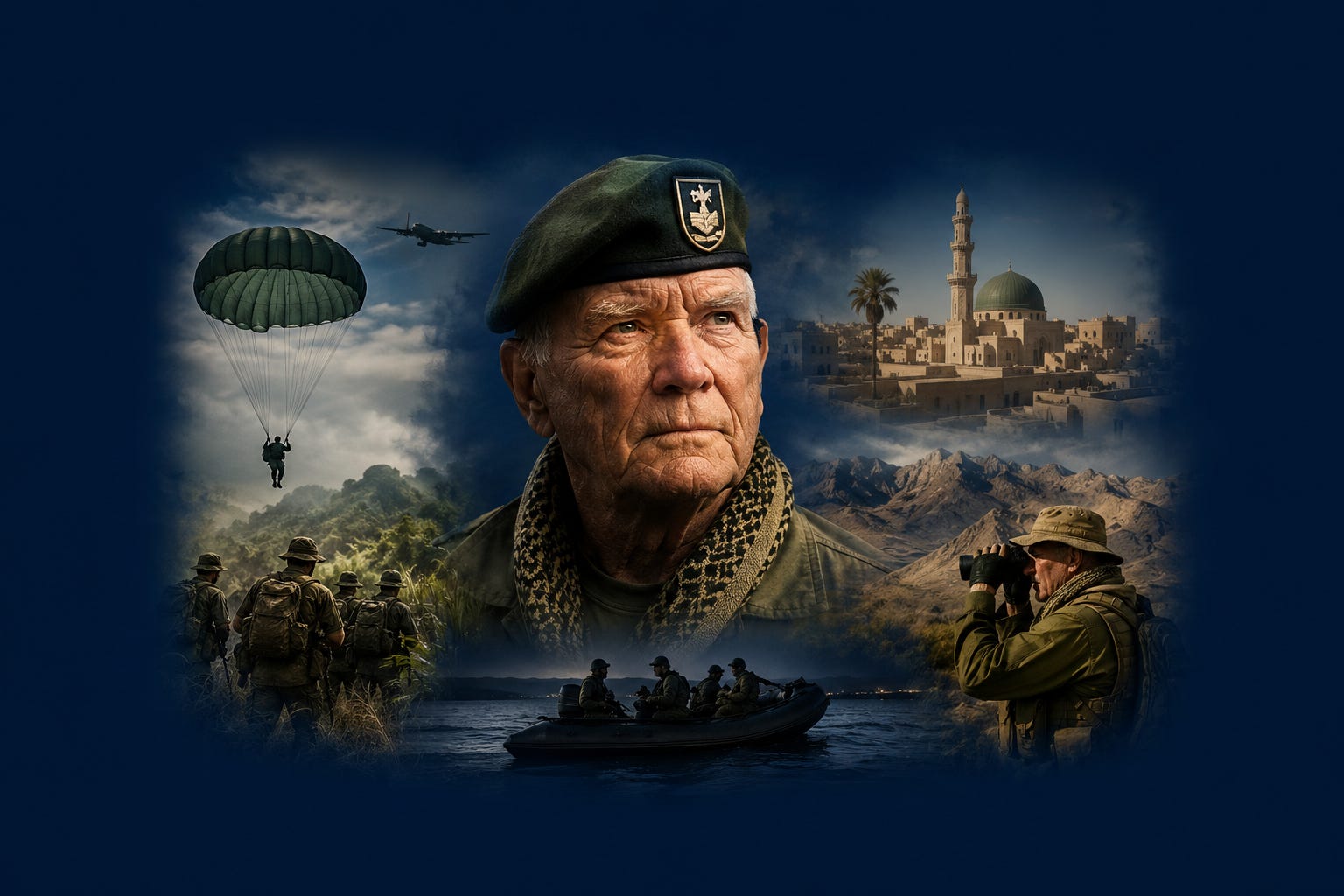
Billy Waugh, the United States Army Special Forces sergeant major who surveilled Osama bin Laden in Khartoum for the Central Intelligence Agency in 1991, died April 4, 2023, at age 93. He served under arms for more than fifty years across sixty four countries. He fought in Korea in 1951 with the 187th Airborne Regimental Combat Team, ran cross border reconnaissance out of the Military Assistance Command Vietnam Studies and Observations Group from 1966 to 1971, and deployed to Afghanistan in October 2001 as a Central Intelligence Agency paramilitary operations officer at the age of 71. He held eight Purple Hearts, which places him third among all Americans who have received that decoration.
Waugh occupies an unusual position in the history of American irregular warfare. He was present at the founding of three separate capabilities and outlived all three founding generations. He was among the early sergeants of the 10th Special Forces Group (Airborne) at Bad Toelz in 1954, when the Green Beret was not yet authorized headgear. He directed the program that produced the first combat military free fall infiltration in history on November 28, 1970, and he personally led the third such insertion into Laos on June 22, 1971. He then carried that same skill set into the civilian intelligence service, where the Special Activities Division was building a paramilitary arm out of exactly the population he came from.
The documented record is uneven, and the report says so at each point where it thins. His Army service is verifiable through official command histories, decoration counts, and the Medal of Honor narrative published for the officer who pulled him out of a rice paddy at Bong Son on June 18, 1965. His twenty eight years with the Central Intelligence Agency rest largely on his own 2004 memoir and on the accounts of colleagues, because the underlying operational record remains classified. Where the sourcing is single stream, this report identifies it as such.
Two matters of public record close the account. He was inducted as a Distinguished Member of the Special Forces Regiment on May 31, 2007. On June 17, 2025, the United States Postal Service facility at 1106 Main Street in Bastrop, Texas, was dedicated as the Sergeant Major Billy D. Waugh Post Office under Public Law 118-201.
Personal Background
Where was Billy Waugh born and what did his family do?
Waugh was born December 1, 1929, in Bastrop, Texas, a county seat on the Colorado River about thirty miles southeast of Austin. His father worked as a railroad brakeman. His mother served as a substitute teacher. The household sat squarely inside the wage economy of small town central Texas during the Depression, and nothing in his origins predicted a career that would end in the mountains south of Gardez.
The formative event came in 1945. Waugh, then fifteen years old, met Marines returning from the Pacific and decided he belonged with them. He tried to enlist. Rejected on age, he set out anyway, hitchhiking several hundred miles across the New Mexico desert before he was picked up and returned home. That episode is worth holding onto, because the same pattern repeats for the next fifty six years: he identified where the fighting was, he went, and administrative obstacles were treated as problems of routing.
He finished Bastrop High School in 1947 with a 4.0 grade average, which complicates the folk image of the country boy who could only soldier. He enlisted in the United States Army in 1948 at eighteen, completed basic training at Fort Ord, California, in August of that year, and qualified as a parachutist that December.
What formal education did Billy Waugh complete?
Waugh earned his degrees late, after the Army and during his intelligence career. He completed a bachelor of arts at Wayland Baptist University in 1987 in business and police science, and a master of arts at Texas State University in 1988 in interdisciplinary studies with a criminal justice specialization. He was fifty seven and fifty eight years old respectively. The choice of fields tracks the second half of his working life, the police and investigative half, and not the infantry years that preceded it.
What is known about his family life?
The public record on his private life is thin, which is consistent with the profession. He was married to Lynn Waugh, and the couple lived in northwest Florida during his later intelligence years and afterward. He died in Tampa, Florida, on April 4, 2023. Detailed family information was withheld from most published accounts, and this report does not supply what the sources do not contain.
Professional History
How did Billy Waugh’s Central Intelligence Agency career end?
Waugh retired from the Central Intelligence Agency in 2005 at the age of seventy five, closing a twenty eight year run as a paramilitary operations officer in what was then the Special Activities Division of the Directorate of Operations. His final operational period ran from 1977 to 2005 and covered Libya, the Marshall Islands, Sudan, Egypt, Cyprus, and Afghanistan, among a list of postings that he later summarized as sixty four countries over fifty years of combined military and civilian service.
What did Billy Waugh do in Afghanistan after September 11, 2001?
Waugh deployed to Afghanistan in October 2001 as a member of a Central Intelligence Agency liaison element working with Northern Alliance forces, and he remained in country through December of that year. He was seventy one when he arrived and turned seventy two in theater on December 1, 2001. He operated in the Gardez area and in the highlands around Tora Bora, the same target set that had occupied him a decade earlier in a different hemisphere.
The assignment carried a specific value beyond the physical. The Agency in the autumn of 2001 needed people who had personally observed the target, who could read terrain from photographs taken by hand, and who had run agents in Muslim majority countries where the Agency had thin infrastructure. Waugh had done all three. He described the deployment as a continuation of work he had already been conducting for close to fifty years, and he noted afterward that he was one of roughly one hundred fifty men who could say they had conducted combat operations in that opening phase.
What was Billy Waugh’s role in the Khartoum surveillance of Osama bin Laden?
From 1991 to 1992, Waugh ran fixed and mobile surveillance against Osama bin Laden in Khartoum, Sudan, at a point when bin Laden was was carried in American reporting as a financier and construction contractor, well below the priority he would later hold. Waugh used running as cover, moving past the target residence on a fitness routine that gave a man in his sixties a plausible reason to be on that street at that hour. He photographed the compound and its visitors with 35mm equipment, working the same collection method he had used across Africa: repeated passes over several weeks to build a pattern of life on ground the Agency had never covered.
His own account of the proximity is the most quoted line of his career. He put himself within roughly thirty meters of bin Laden and said he could have killed him with a rock. He advocated for lethal action and the request was declined, which is the version he told publicly for the rest of his life. That claim rests on his testimony and on colleague recollection. No declassified document confirms that a specific kill or capture proposal was submitted and rejected in 1991 or 1992, and this report treats the assertion as attributed to him, not as verified.
How did Billy Waugh contribute to the capture of Carlos the Jackal?
Waugh conducted the Khartoum surveillance that helped fix the location of Ilich Ramirez Sanchez, the Venezuelan terrorist known as Carlos the Jackal, before Sudanese authorities delivered him to French agents on August 14, 1994. Waugh and his team worked from a position opposite the residence and later from Cairo, developing photographic identification and movement patterns. Ramirez Sanchez was flown to Paris and convicted on December 23, 1997, of the 1975 killings of two French intelligence officers and a Lebanese informant. He received a life sentence.
The Carlos operation is the cleanest example of what Waugh actually did for a living. He did not conduct the arrest. He established, over months, that a specific man was in a specific building at predictable hours, and he documented it well enough that a foreign service would act on it. The memoir he published in 2004 takes its title from this case.
How did Billy Waugh join the Central Intelligence Agency?
Waugh entered intelligence work in 1977 through a contract arranged by Edwin P. Wilson, a former Agency officer then operating a private venture in Libya. The initial assignment involved training and intelligence collection on Soviet aligned elements of the Libyan state. He subsequently served as a staff paramilitary officer, with postings that included duty as deputy chief of police at Kwajalein Missile Range in the Marshall Islands, where the collection problem was Soviet maritime activity around a missile test range.
Between the Army and the Agency he worked five years as a letter carrier for the United States Postal Service in Austin, Texas, from 1972 to 1977. The detail is not decorative. It marks the only period in his adult life without an operational assignment, and it ended the moment a telephone call offered one.
What did Billy Waugh do in MACV-SOG?
Waugh served with the Military Assistance Command Vietnam Studies and Observations Group from approximately 1966 through 1971, ending as the senior noncommissioned officer at Command and Control North. His responsibilities covered a reconnaissance company of roughly twenty five teams operating across the border into Laos and North Vietnam, along with service at Khe Sanh and with the 3rd Mobile Guerrilla Force in the 3rd Military Region under the 5th Special Forces Group. He accumulated about seven and a half years in Vietnam across multiple tours.
The casualty arithmetic of that assignment explains the rest of his life better than any adjective. Waugh described the reconnaissance mission set plainly: anyone going across the fence was going to die or be shot to pieces, and every man in the outfit had been wounded once, twice, or three times. He came out of SOG with two Combat Infantryman Badges and a Purple Heart carrying seven oak leaf clusters.
What happened to Billy Waugh at Bong Son on June 18, 1965?
On June 18, 1965, Waugh was a master sergeant with Detachment A-321, 5th Special Forces Group (Airborne), advising the 883rd Regional Force Company on a night raid against a Viet Cong regional headquarters near Bong Son in Binh Dinh Province. The South Vietnamese company was on its first combat operation. The raid went wrong, the element was pinned in the open, and Waugh was shot in the knee, the foot, the ankle, and across the right side of the forehead. North Vietnamese soldiers stripped him of his equipment, having concluded he was dead.
He was not. The detachment commander, then Captain Paris Davis, refused evacuation and recovered three wounded Americans under fire, Waugh among them. Waugh received the Silver Star and his sixth Purple Heart for that night and spent 1965 into 1966 recovering at Walter Reed Army Hospital. Davis waited fifty seven years for the corresponding recognition; the Medal of Honor was presented to him at the White House on March 3, 2023, four weeks before Waugh died.
Where did Billy Waugh serve before Vietnam?
Waugh reached Korea in April 1951 with the 187th Airborne Regimental Combat Team and rose to infantry platoon sergeant during that war. In 1954 he earned the Special Forces tab and joined the 10th Special Forces Group (Airborne) at Bad Toelz in West Germany, placing him inside the branch within two years of its establishment. He served on Okinawa from 1960 to 1961 with the 2nd Airborne Battle Group of the 503rd Infantry and with the 1st Special Forces Group (Airborne), from which he made six deployments into Laos and Vietnam. His first Vietnam tour began in 1961, training indigenous forces. He retired from active duty on February 1, 1972, as a sergeant major in the grade of E-9.
Innovations and Contributions
What did Billy Waugh contribute to military free fall infiltration?
Waugh built and ran the combat high altitude low opening program at Command and Control North that produced the first free fall infiltration under combat conditions in military history. On November 28, 1970, six men of Recon Team Florida exited a C-130 at approximately 18,000 feet at 0200 hours over Laos on a mission to locate and tap a North Vietnamese Army communications line. The team came down roughly six miles from the intended drop zone, never found the wire, and completed a five day mission on the ground. Waugh had trained that team for more than a month and directed the effort. He was not on the aircraft.
He made his own combat free fall insertion on June 22, 1971, leading a four man element from a SOG modified aircraft at 19,000 feet into Laos. Two members were injured on landing and one, Sergeant Madison Strohlein, was never recovered. Popular accounts frequently compress these events and credit Waugh with the first jump. The accurate statement is narrower and more useful: he designed the capability, trained the men who proved it on November 28, 1970, and then used it himself seven months later.
The technical contribution was the demonstration that a team could be delivered accurately enough, at night, without the navigation and altimetry equipment that would become standard two decades later, to justify the risk against a defended border. Every American military free fall infiltration since inherits that finding. The Special Forces Underwater Operations and Military Free Fall schools institutionalized what SOG proved by trial in Laos.
What did Billy Waugh contribute to intelligence tradecraft?
Waugh carried infantry reconnaissance discipline into urban surveillance and applied it to individual human targets in denied areas. His method was repetition and patience: three weeks of photography over ground never previously covered, building the pattern before attempting anything else. He described the approach in those terms and applied it in Libya, across Africa, in Khartoum, and in Cairo.
The second contribution is institutional. Waugh is the clearest case of the pipeline that carried senior special operations noncommissioned officers directly into civilian paramilitary intelligence work. When the Special Activities Division needed people who could shoot, read terrain, photograph, run an agent, and survive alone in a hostile city, it recruited from the population that MACV-SOG had produced. That personnel pathway, sustained across the 1980s and 1990s, is the reason the Agency had anyone available in September 2001 who had already stood on the ground in Afghanistan and Sudan.
He also served as a source and author for the historical record. His 2004 memoir, written with a journalist, remains the primary published account of the Khartoum surveillance period. His 2018 book on Isaac Camacho, the Special Forces soldier who escaped Viet Cong captivity, preserved a case the Army itself had underdocumented.
Recognition and Public Profile
Waugh’s decorations include the Silver Star, the Legion of Merit, four Bronze Star Medals awarded for valor, and the Purple Heart with seven oak leaf clusters representing eight separate awards. Published counts of his Air Medals vary between twelve and fourteen, a discrepancy this report does not resolve. He also received four Army Commendation Medals for valor, two Combat Infantryman Badges, and a Presidential Unit Citation, along with foreign jump wings from multiple allied services. From the civilian side he received the Central Intelligence Agency Intelligence Star. The eight Purple Hearts place him third among all recipients in American history.
He was inducted as a Distinguished Member of the Special Forces Regiment on May 31, 2007, which is the branch’s formal recognition of career contribution to the regiment.
As an author he published three titles. The 2004 memoir written with a coauthor and issued by a major New York trade house is the best known and remains in print in multiple editions. A 480 page account of the Isaac Camacho escape appeared in March 2018. A third and shorter personal title appeared subsequently. He also contributed to a 2007 volume on border security in Iraq and appeared as a subject in book length histories of Central Intelligence Agency paramilitary operations and of the initial Afghanistan deployment.
His public profile grew substantially in the last decade of his life through long form podcast interviews, veteran community publications, and documentary features. He skydived at eighty nine. The Florida Senate marked his death with a moment of silence, and a memorial service was held at MacDill Air Force Base, home of United States Special Operations Command, presided over by that command’s commanding general. In accordance with his instructions, a free fall team scattered a portion of his ashes over the Raeford drop zone in North Carolina, and a portion returned to Bastrop.
The legislative honor followed. A Texas senator introduced S. 3946 in the 118th Congress to designate the Bastrop post office in his name, a House companion measure moved in parallel, and the bill was enacted as Public Law 118-201. The dedication ceremony took place at 1106 Main Street in Bastrop on June 17, 2025, at 10:00 a.m.
Controversies and Risk Factors
This research identified no litigation in which Waugh appeared as a party, no regulatory enforcement action, no professional disciplinary proceeding, and no criminal record. The search covered federal and state court databases, published biographical accounts, obituaries in national newspapers, and congressional records. Four areas nonetheless warrant qualification.
The first is the Edwin P. Wilson association. Waugh’s entry into intelligence work in 1977 came through a contract arranged by Wilson, a former Agency officer who was convicted in 1983 of illegally shipping twenty tons of C-4 explosive to Libya. A federal district judge in the Southern District of Texas vacated that conviction on October 27, 2003, finding that a sworn affidavit from a senior Agency official denying any post 1971 relationship with Wilson was false and had been presented knowingly by the prosecution. Nothing in the record connects Waugh to Wilson’s arms dealing, and Waugh’s Libya work preceded the conduct charged. The association is disclosed here because a due diligence review that omitted it would be incomplete.
The second is the Khartoum lethal action claim. Waugh stated repeatedly that he proposed killing bin Laden in 1991 or 1992 and was refused. The claim is uncorroborated by any declassified document, and it entered wide circulation only after September 11, 2001, when the counterfactual acquired enormous public interest. It may well be accurate. It should be cited as his testimony. It is not an established fact of the operational record.
The third is the general verification problem. Twenty eight years of Central Intelligence Agency service produced almost no releasable documentary trail. Substantial portions of the biography rest on a single memoir, on the recollections of colleagues published in veteran outlets, and on interviews given decades after the events. Numbers drift across accounts in ways that are diagnostic: the Air Medal count is reported as twelve and as fourteen, the Khartoum surveillance is dated to the late 1980s in some accounts and to 1991 and 1992 in others, and his age in Afghanistan is given as both seventy one and seventy two, which reflects a birthday that fell during the deployment.
The fourth concerns attribution of the first combat free fall jump. Several published profiles credit Waugh personally with the November 28, 1970, insertion. The operational records of the Studies and Observations Group place a different team on that aircraft and place Waugh in command of the program that trained them. Analysts citing his career should use the precise version, because the imprecise one is easy to falsify and casts doubt on better documented achievements.
Current Activities and Strategic Outlook
Waugh died on April 4, 2023, so the operative question is what happens to the record he left and what institutional effects survive him. Three matters are live.
The first is the archival one. His Central Intelligence Agency file remains classified, and the Khartoum reporting from 1991 and 1992 sits inside a body of material that the Agency has released only in fragments. The Studies and Observations Group records covering the free fall program have been partially declassified and are held in Vietnam era collections at university archives and at the National Archives. A researcher working this subject in 2026 has better access to his Army service than to his intelligence service, and that imbalance will persist until the Agency releases the Sudan station reporting from that period.
The second is the personnel question his career poses to the services now. Waugh was operationally employed at seventy one because his specific accumulated knowledge could not be reconstituted quickly, and the Agency accepted the physical risk to obtain it. That trade is being made again in a period when experience in denied area collection is scarce and where the technical tools have moved faster than the human ones. The pattern he set has no formal policy expression, which means each instance is negotiated individually and none of it appears in doctrine.
The third is the Bong Son case and what it says about how the Army corrects its own record. Paris Davis waited fifty seven years for the Medal of Honor covering the action in which he saved Waugh’s life, and the award came only after the original recommendation packet was reconstructed following its disappearance. Waugh testified for that effort. He lived to see the March 3, 2023, ceremony by four weeks. Anyone who has held a clearance and read a service record knows how much a record leaves out; my own submarine patrol reports recorded transit dates and material conditions and nothing whatever about what the boat had actually been doing, and the men who wrote them are the only remaining index to the operations. Waugh’s death removes that index for a large body of Cold War and post Cold War operations, and no archival release will fully replace it.
Two questions remain unanswered. Whether the Sudan station reporting from 1991 and 1992 will ever be released in a form that permits independent evaluation of the lethal action claim is one. Whether the Special Activities Center can continue to recruit from a special operations population that now spends its career inside a much larger and more heavily surveilled institutional structure is the other.
The next report in this sequence examines the statutory basis for Central Intelligence Agency covert action under Title 50 of the United States Code, section 3093, and what the vacatur of the Edwin Wilson conviction on October 27, 2003, established about the government’s evidentiary duties when it prosecutes its own former officers. That piece will identify the specific finding of misconduct the district court made and why it matters to anyone contracting with an intelligence service today.
Source List
Sources are ranked from most to least authoritative. Primary legislative, official military, and agency records appear first, followed by published obituaries of record, specialist historical accounts, and book length treatments.
Public Law 118-201, S. 3946, 118th Congress, enacted 2024, designating the United States Postal Service facility at 1106 Main Street, Bastrop, Texas, as the Sergeant Major Billy D. Waugh Post Office. Primary legislative record establishing the posthumous federal honor and the exact facility address.
United States Postal Service, Texas newsroom local release, June 13, 2025, announcing the dedication ceremony of June 17, 2025. Confirms the public law number, the ceremony date and time, the eight Purple Hearts, the Central Intelligence Agency Intelligence Star, and his Postal Service employment.
United States Army Medal of Honor page for Colonel Paris D. Davis, army.mil, published 2023. Official narrative of the June 18, 1965, action at Bong Son naming Master Sergeant Billy Waugh among the wounded recovered, the unit designation, the advised South Vietnamese company, and the March 3, 2023, White House ceremony.
United States Army John F. Kennedy Special Warfare Center and School, biographical sheet on Sergeant Major Billy Waugh, swcs.mil. Official service chronology giving enlistment, Fort Ord and airborne dates, unit assignments, the February 1, 1972, retirement date, and the May 31, 2007, Distinguished Member of the Special Forces Regiment induction.
Congressional Budget Office cost estimate for S. 3946, publication 60622, 2024. Confirms bill scope and legislative posture.
Special Operations Association archive copy of the New York Times obituary for Billy Waugh, April 2023. Provides parents’ occupations, the 1991 to 1992 Sudan dates, the Carlos the Jackal surveillance, the Afghanistan deployment length, and direct quotations.
Stars and Stripes obituary, April 6, 2023. Independent confirmation of enlistment year, the 1954 Green Beret date, the 1972 retirement, the 1977 Central Intelligence Agency entry, the 1994 Sudan capture of Ramirez Sanchez, and the eight Purple Hearts.
Military.com news article, April 6, 2023, on the five decade career. Source for the 1945 attempted Marine enlistment and the hitchhiking episode, the June 18, 1965, wounding, the Walter Reed recovery, and the decoration list.
Task and Purpose obituary, April 2023. Source for the 1951 Korea deployment with the 187th Airborne Regimental Combat Team, the fourteen Air Medal count, the four Army Commendation awards, the Presidential Unit Citation, and the 1977 Edwin Wilson recruitment.
Special Forces 78 historical article on the world’s first combat high altitude low opening jump. Gives the November 28, 1970, date, the C-130 aircraft, the exit altitude, the six man Recon Team Florida composition, the Laos target, and Waugh’s role directing the program.
MACV-SOG historical site compilation of SOG high altitude low opening operations. Independent listing of all five combat free fall insertions with dates, team leaders, altitudes, and outcomes, including the June 22, 1971, jump Waugh led and the loss of Sergeant Strohlein.
Watches of Espionage dispatch remembering Billy Waugh, April 2023. First hand recollections from colleagues covering the 1960 to 1961 Okinawa period, the 1998 Cyprus counter surveillance task, the Gardez operations, the 2005 Agency retirement at seventy five, and equipment detail.
Ghosts of the Battlefield biographical profile, The Shadow Warrior. Consolidated chronology including the 1972 to 1977 Postal Service employment in Austin, the sixty four country figure, and the disposition of his ashes.
SOFREP profile of Waugh as the seventy one year old bin Laden hunter. Source for the thirty meter proximity quotation, the five combat free fall jumps figure, the seven and a half years in Vietnam, and the Command and Control North senior enlisted role.
Wikipedia entry for Billy Waugh, accessed August 2026. Structured timeline with the December 1, 1929, birth date, the April 4, 2023, death in Tampa, the Wayland Baptist and Texas State degrees with years, and the MacDill Air Force Base memorial.
Billy Waugh and Tim Keown, Hunting the Jackal, William Morrow, 2004. The subject’s own memoir and the principal published account of the Khartoum surveillance of both Osama bin Laden and Ilich Ramirez Sanchez.
Billy Waugh, Isaac Camacho: An American Hero, Permuted Press, March 20, 2018, 480 pages. Establishes his authorship record and his role preserving Special Forces prisoner of war history.
Annie Jacobsen, Surprise, Kill, Vanish, Little, Brown and Company, 2019. Reported history of Central Intelligence Agency Special Activities Division operations providing external context for Waugh’s paramilitary assignments.
Bibliography
Coll, Steve. Ghost Wars: The Secret History of the CIA, Afghanistan, and Bin Laden, from the Soviet Invasion to September 10, 2001. New York: Penguin Press, 2004.
Congressional Budget Office. Cost Estimate: S. 3946, A Bill to Designate the Facility of the United States Postal Service Located at 1106 Main Street in Bastrop, Texas, as the Sergeant Major Billy D. Waugh Post Office. Publication 60622. Washington, DC: Congressional Budget Office, 2024.
Ghosts of the Battlefield. The Shadow Warrior: The Unbelievable Life of Billy Waugh. Accessed August 31, 2026. https://www.ghostsofthebattlefield.org/articles/the-shadow-warrior-the-unbelievable-life-of-billy-waugh.
Jacobsen, Annie. Surprise, Kill, Vanish: The Secret History of CIA Paramilitary Armies, Operators, and Assassins. New York: Little, Brown and Company, 2019.
MACV-SOG Historical Site. HALO Jumps. Accessed August 31, 2026. https://sogsite.com/halo-jumps/.
Military.com. From Korea to Afghanistan: Special Forces Legend Billy Waugh’s Amazing Career Spanned Five Decades. April 6, 2023. https://www.military.com/daily-news/2023/04/06/korea-afghanistan-special-forces-legend-billy-waughs-amazing-career-spanned-five-decades.html.
Plaster, John L. Secret Commandos: Behind Enemy Lines with the Elite Warriors of SOG. New York: Simon and Schuster, 2004.
Schroen, Gary C. First In: An Insider’s Account of How the CIA Spearheaded the War on Terror in Afghanistan. New York: Presidio Press, 2005.
SOFREP. Billy Waugh: The Legendary 71 Year Old Osama bin Laden Hunter. Accessed August 31, 2026. https://sofrep.com/news/billy-waugh-the-legendary-71-year-old-osama-bin-laden-hunter/.
Special Forces 78. From the Archive: The World’s First Combat H.A.L.O. Jump. Accessed August 31, 2026. https://www.specialforces78.com/the-worlds-first-combat-h-a-l-o-jump/.
Special Operations Association. Billy Waugh, 93, Godfather of the Green Berets, Is Dead. Archived obituary, April 2023. https://specialoperations.org/soa/wp-content/uploads/2023/04/Billy-Waugh-NYT-Obit.pdf.
Stars and Stripes. Special Forces, CIA Legend Who Hunted Carlos the Jackal and Osama bin Laden Dies at 93. April 6, 2023. https://www.stripes.com/veterans/obituaries/2023-04-06/billy-waugh-green-beret-obit-9725279.html.
Task and Purpose. Billy Waugh, Special Forces Legend, Passes Away at 93. April 2023. https://taskandpurpose.com/news/billy-waugh-korea-vietnam-afghanistan-special-forces-cia/.
United States Army. Colonel Paris D. Davis, Medal of Honor Recipient. Accessed August 31, 2026. https://www.army.mil/medalofhonor/davis/.
United States Army John F. Kennedy Special Warfare Center and School. SGM Waugh. Accessed August 31, 2026. https://www.swcs.mil/Portals/111/sf_waugh.pdf.
United States Congress. Public Law 118-201. S. 3946, 118th Congress, 2d Session. https://www.congress.gov/bill/118th-congress/senate-bill/3946.
United States Postal Service. Bastrop Post Office to Be Dedicated in Honor of Sergeant Major Billy D. Waugh. Texas Newsroom Local Release, June 13, 2025. https://about.usps.com/newsroom/local-releases/tx/2025/0613ma-bastrop-po-to-be-dedicated-in-honor-of-sergeant-major-billy-d-waugh.htm.
Watches of Espionage. Remembering the Legacy of Billy Waugh Through His Watches. April 2023. https://www.watchesofespionage.com/blogs/woe-dispatch/remembering-the-legacy-of-billy-waugh-through-his-watches.
Waugh, Billy. Isaac Camacho: An American Hero. Nashville: Permuted Press, 2018.
Waugh, Billy, and Tim Keown. Hunting the Jackal: A Special Forces and CIA Soldier’s Fifty Years on the Frontlines of the War Against Terrorism. New York: William Morrow, 2004.
Wikipedia. Billy Waugh. Accessed August 31, 2026. https://en.wikipedia.org/wiki/Billy_Waugh.
Interested in analysis about the intersection of tech, policy and the law? Check out my Substack channel. https://theinnovationattorney.substack.com/