Executive Summary
A call center works by routing customer contacts through automatic call distribution and staffing queues with Erlang C mathematics, and queued for a customer hold time based on the company’s desired hold time.
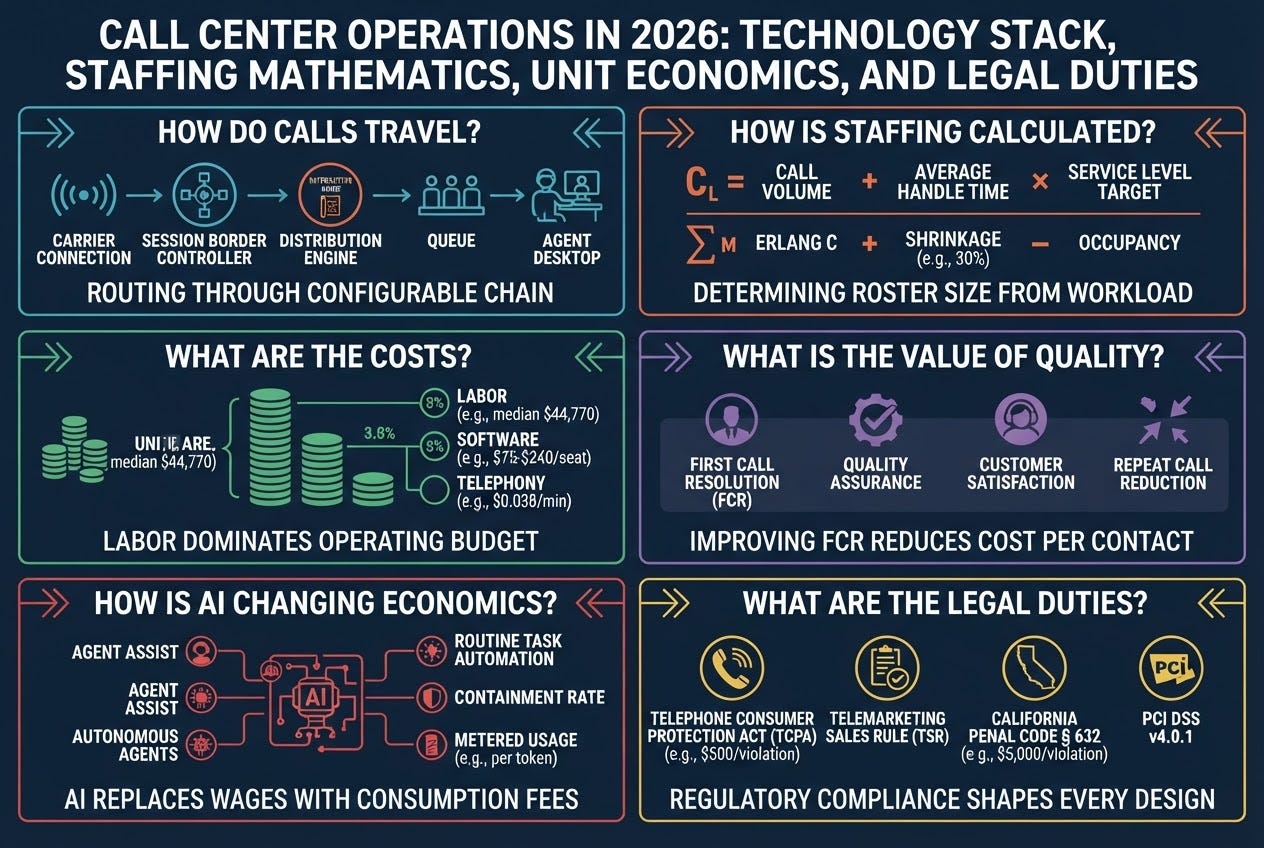
Every inbound call arrives over a carrier connection, passes a session border controller, meets an interactive voice menu, and lands in a queue where a distribution engine matches it to an agent by skill, priority, and availability.26,21 Staffing follows from call volume, average handle time, and a service level target: 100 calls in a half hour at 300 seconds each, answered within 20 seconds 80 percent of the time, needs 21 agents on the phones and 30 on the roster after 30 percent shrinkage.18,23 Labor consumes roughly three quarters of the operating budget, and a 100 agent floor at the federal median wage carries $4,477,000 in annual wages before software, benefits, or facilities.23,1
Commercially, one major cloud platform lists seats from $75 to $240 per user per month and another meters voice at $0.038 per minute, so software costs 2.0 to 6.4 percent of the wage bill for 100 seats.29,27 Artificial intelligence is the variable in dispute. A forecast dated March 5, 2025 predicts that autonomous agents will resolve 80 percent of common issues by 2029, while a survey of 321 service leaders dated December 2, 2025 found that 20 percent had cut staffing because of AI.9,11 The Telephone Consumer Protection Act, the Telemarketing Sales Rule, California Penal Code § 632, and PCI DSS version 4.0.1 shape every design choice, and statutory damages run from $500 to $5,000 per violation.2,3,8,36
How Did the Modern Call Center Develop?
The modern call center developed from a century old queueing formula, a telephone network that moved from physical circuits to internet protocol, a labor market that moved offshore, and a body of consumer protection law that began to reach automated calling with the Telephone Consumer Protection Act of 1991.18,2
A. K. Erlang, a Danish mathematician, developed the mathematics that planners still use more than a century ago, and the Erlang C variant answers one planning question: given a rate of call arrivals and a mean handle time, how many agents hold the chance of waiting to the level a service target allows.18 As a matter of queueing theory, the formula assumes that callers wait as long as necessary, that no caller redials after hanging up, and that every agent works at the same pace. Real queues violate all three assumptions, which is why every planner who uses the formula adjusts its output with shrinkage and occupancy rules.
The telephone network underneath the queue changed more than the queue did. Enterprises ran calls over PRI circuits, fixed bundles of voice channels delivered by a carrier, and carriers have pushed customers to SIP trunks through price increases and abrupt sunset notices.21 A SIP trunk carries calls as internet protocol traffic, which lets a company size call paths to actual demand, centralize connections at a few data centers, and add redundancy by geography. Each SIP location generally needs its own session border controller, and porting numbers from PRI to SIP takes about 20 to 30 days per order.21
Cloud delivery then converted a capital purchase into a metered subscription. Vendors now publish list tiers priced per user per month, per voice minute, per chat message, and per email, and they sell the same platform under named seat, concurrent seat, and consumption licenses.29,27,32 One platform vendor describes an omnichannel cloud contact center as a single system that unifies voice, chat, email, messaging, and social interactions so that customers can switch channels without starting over.30
Labor moved to wherever a wage and a language skill could be combined. The Philippine IT and business process management industry grew from $22.9 billion in revenue and 1.15 million workers in 2016 to $40.3 billion and 1.89 million workers in 2025, an increase of 76 percent in revenue and 64 percent in headcount, and its association forecasts $42.3 billion for 2026.22Domestically, the Bureau of Labor Statistics counted about 2,666,000 customer service representatives in 2025.1
The law arrived in layers. The Telemarketing Sales Rule amendments of 2008 made the abandonment safe harbor enforceable on October 1, 2008, the prerecorded message opt out requirements on December 1, 2008, and the prior express written agreement requirement on September 1, 2009.3 The Federal Communications Commission ruled on February 8, 2024 that AI generated voices are artificial voices under the Telephone Consumer Protection Act.4,5 The Eleventh Circuit vacated the one to one consent requirement on January 24, 2025, PCI DSS version 4.0.1 became the live payment card standard on March 31, 2025, and a federal court in the Northern District of California let a class action against an AI customer service provider proceed on August 11, 2025.6,36,7
In three decades of negotiating technology licenses, telecommunications service terms, and SaaS agreements, I have watched one clause move between vendor and customer each time a pricing model changed: the definition of a billable unit. When a contact center contract meters by the minute, the definition of a minute decides who pays for ring time, queue time, and the seconds after the caller hangs up. That clause draws less attention at signing than any other commercial term and more disputes at renewal, and it matters more as AI platforms meter by the message, the token, and the resolution.
Detailed Findings
The six findings below answer the head query in the order a caller experiences it. A call travels through a defined chain of systems, a staffing formula decides how many people wait at the end of that chain, a cost model prices both, a resolution rate decides whether the call was worth taking, artificial intelligence is rewriting the price of the answer, and a set of statutes decides how every call may be placed, recorded, and paid for. Each finding opens with the established position, explains the mechanism, supplies the evidence, works an example with real numbers, states where sources disagree, and closes with the practical consequence for a decision maker.
How Does a Call Travel from a Carrier to an Agent Desktop?
Established Position
A call center delivers each contact to a qualified agent through a chain of carrier trunk, border controller, interactive voice menu, distribution engine, queue, and agent desktop, and every cloud platform reproduces that chain as software configuration.26,28 Four roles interact with the platform. Customers contact the center by any channel, agents handle and document contacts, supervisors monitor and coach, and administrators provision phone numbers, define queues and routing profiles, and build the flows that connect them.28 Operations also employ workforce management specialists, quality assurance analysts, and data analysts.33
Mechanism
The carrier hands the call to the enterprise as a SIP session, and the session border controller authenticates it, protects the network edge, and passes it to the contact center platform.21 The interactive voice menu then gathers identifiers. Caller ID supplies a number and sometimes a name, automatic number identification can pull the customer record from a database, and menu prompts can ask for an account number before any agent is involved.26
The distribution engine applies routing criteria such as agent skill, availability, language, VIP status, and location. Round robin spreads calls evenly, skills based routing scores agents against the call and picks the best match, and priority routing sends high priority callers to the most qualified agents first.26 When no agent is free, the caller joins a queue ordered by urgency, language, time of day, or day of week, and the system assigns the next queued call in real time as an agent becomes available. Computer telephony integration then pops the customer record onto the agent’s screen, and recording and quality monitoring tools run beside the call.34
Supporting Evidence
Cloud pricing pages show the unit of account for each step. One provider lists $0.038 per voice minute, $0.010 per chat message, $0.080 per email, and $0.014 per SMS message, with standard telephony rates added to voice.27 One enterprise suite stores the customer record in a single data layer, adds a generative assistant for suggested replies and conversation summaries, and routes requests from any channel to the best suited representative.31 On the measurement side, a 2024 industry survey reported that 85 percent of centers measure abandonment rate, 84 percent measure average handle time, 77 percent measure quality, and 76 percent measure average speed of answer.14
The network layer carries its own evidence. A published migration guide states that SIP typically requires fewer call paths than the PRI channels in a legacy distributed network, that IP access should be sized for total call path load under failover, and that failover behavior varies by provider and access type, with private circuits sometimes outperforming internet access.21
Worked Example
Take the 100 call half hour at 300 seconds of handle time. A caller dials a toll free number that was ported to SIP, the border controller admits the session, and the menu captures an account number. With 21 agents staffed, the Erlang C model gives an average speed of answer of 16.0 seconds across all calls, a 23.2 percent chance that a given call waits at all, and 82.6 percent of calls answered within 20 seconds.18 The call lasts five minutes, so a platform that meters voice at $0.038 per minute bills $0.19 for it, before the standard telephony charge.27
The model output comes from my own calculation using the Erlang C formula, and each of those figures changes if the handle time moves by even 30 seconds: at 360 seconds the same 100 calls need 25 agents.
Contested Areas
Vendors and practitioners disagree on how much of the chain to automate. The same industry survey that reports 85 percent measuring abandonment found that only 14 percent of centers measure deflection rate and 13 percent measure self service accessibility, and it cites a 2024 finding that 73 percent of customers try self service while 14 percent of issues are fully resolved through self service alone.14 A center that routes every caller through a deep menu therefore adds handling steps to a path that resolves one issue in seven. Whether the menu earns its place is an empirical question each center answers with its own data.
Practical Significance
Executives buying a platform are buying a configuration of this chain, so the contract should name each element, its metered unit, and its failover behavior. Founders building a service organization should expect the carrier migration and number porting to take weeks, and 20 to 30 days per porting order is a schedule risk for a launch date.21 Investors evaluating a contact center business can ask for the routing profile count, the share of calls resolved in the menu, and the average speed of answer by queue, because those three numbers describe how well the chain converts spend into resolved calls.
How Do Erlang C, Shrinkage, and Occupancy Set Staffing Levels?
Established Position
Staffing follows from three inputs, call volume, average handle time, and a service level target, and Erlang C converts them into the minimum number of agents who must be on the phones.18 Handle time is talk time plus after call work. A common target is 80 percent of calls answered within 20 seconds, and the formula returns the smallest agent count that meets it, with the caution that some calls still wait when the target is met.18
Mechanism
The formula first computes workload in Erlangs: calls per interval multiplied by handle time and divided by interval length. It then finds the probability that an arriving call must wait, and converts that probability into the share of calls answered inside the target time. The result describes agents on the phones. Shrinkage, the share of scheduled time unavailable for interactions because of breaks, training, meetings, and absence, converts that number into a roster, and occupancy, the share of available time agents spend handling contacts, reports how hard the staffed agents are working.23,19
Workforce management software wraps this arithmetic in a process: forecast demand by channel and work type, plan capacity, build schedules, manage intraday variances by reforecasting and reoptimizing breaks, and monitor adherence, with performance tracking and coaching on top.23
Supporting Evidence
Occupancy is defined as total handle time divided by total time available for work, and published practice puts voice occupancy generally between 80 and 90 percent, email between 90 and 100 percent, and chat above 100 percent because agents handle several chats at once.19 Historical data show a consistent link between occupancy and service level, and larger teams reach higher occupancy at the same service level.19 A quality benchmarking firm reports an average agent utilization of 71 percent, a world class level of 69 percent, a good range of 70 to 75 percent, and an association between utilization at or above 80 percent and high turnover.16 One vendor guide states that modern workforce tools forecast demand with up to 95 percent accuracy, and gives an example in which each 1 percent of forecast error costs about $400,000 a year.23
Worked Example
For 100 calls in 1,800 seconds at 300 seconds each, workload equals 100 times 300 divided by 1,800, which is 16.7 Erlangs. With 21 agents the model returns 82.6 percent of calls answered within 20 seconds and 79.4 percent occupancy. With 20 agents it returns 72.9 percent, so one agent separates a passing interval from a failing one. At 30 percent shrinkage the roster needs 21 divided by 0.70, or 30 agents.
Extend the same arithmetic. A load of 400 calls per half hour needs 74 agents and runs at 90.1 percent occupancy, while 50 calls per half hour needs 12 agents at 69.4 percent occupancy. Doubling a team’s volume raised occupancy by ten points at the same service level, which is the large team effect that makes splitting a floor into specialist groups expensive.19 A target of 90 percent within 20 seconds on the 100 call load needs 23 agents, two more than the 80 percent target requires.
Contested Areas
Sources disagree on the right occupancy. One practitioner reference recommends 80 to 90 percent for calls, and warns that high phone occupancy causes stress, exhaustion, and attrition, while a benchmarking firm treats 80 percent as the threshold at which turnover rises.19,16 Practitioners also disagree about the formula itself. Erlang C ignores abandonment and retries, which makes it conservative for centers where many callers hang up and optimistic for centers where those callers redial, and a planner who relies on it alone misstates the staffing need in both cases. The formula also treats all agents as interchangeable, while skills based routing splits one floor into several queues that each follow their own, less favorable, arithmetic.
Practical Significance
A planning meeting that debates headcount without stating the service level, the handle time, and the shrinkage assumption debates nothing. Executives should ask for the three inputs and the output interval by interval, because a 30 second change in handle time changed the required count from 21 to 25 in the example above. Investors can test a target company’s cost per contact by rebuilding its staffing from the same three inputs and comparing the roster to the payroll, and any gap of more than a few agents points to either unreported shrinkage or an unreported service level.
What Does It Cost to Run a Call Center, and How Do Vendors Charge?
Established Position
Labor is the dominant cost of a call center, with resources accounting for roughly three quarters of the operating budget, and software and telephony fill most of the remainder.23 The Bureau of Labor Statistics reported a median annual wage of $44,770, or $21.53 an hour, for customer service representatives in May 2025.1 Vendors price the platform by named seat, concurrent seat, or consumption, and outsourcing providers price the labor itself.32,22
Mechanism
Cost per contact divides total operating cost by contacts handled, and cost per call adjusted for resolution multiplies that figure by the average number of calls needed to resolve an inquiry, which charges the center for repeat calls.16 On the software side, a named license assigns one seat to one designated user, a concurrent license lets any number of users share seats provided they are not signed in at the same moment, and consumption billing charges by each user’s login time regardless of headcount.32
The breakeven between these models depends on hours. One vendor example finds named seats about 30 percent cheaper than consumption for a 1,000 agent team logged in about six hours a day, finds concurrent licenses cheaper only while no more than about 750 of 1,000 agents sign in together, and finds consumption pricing cheaper when daily logins fall below about six hours.32Artificial intelligence features add a fourth meter, because one platform allots a fixed pool of AI tokens per organization per month and charges for more.29
Supporting Evidence
One major platform lists four editions at $75, $115, $155, and $240 per user per month, billed annually, and includes 250 named or 350 concurrent AI tokens per organization per month on the first three editions.29 A pricing compilation of published list prices reports a median published tier of $135 for the same platform, $169 for a second major platform, $135 for a third, and $139 for a fourth, and notes that deals above 20 seats typically land 15 to 40 percent below list.25 Per unit prices on a metered platform run $0.038 per voice minute, $0.010 per chat message, $0.080 per email, and $0.014 per SMS message.27
Outsourced labor operates at industrial size. The Philippine IT and business process management industry reported $40.3 billion in revenue and 1.89 million workers in 2025.22 Attrition adds a separate cost line. Reported annual agent attrition was 35 percent in 2021 and 38 percent in 2022, replacement costs are reported at $10,000 to $20,000 in direct costs and up to $46,000 with lost productivity, and one vendor guide puts replacement at up to 1.5 times annual wages.24,23
Worked Example
Build a 100 agent floor at the federal median. Wages total $4,477,000 a year before benefits, payroll taxes, and facilities. Software seats at the $75 tier cost $90,000 a year and at the $240 tier cost $288,000, which is 2.0 percent and 6.4 percent of the wage bill. A buyer who negotiates 15 to 40 percent off the $155 tier pays $111,600 to $158,100 instead of $186,000.29,25
Attrition at 38 percent means 38 replacements a year. At $10,000 to $20,000 each the direct cost is $380,000 to $760,000, and at $46,000 each it reaches $1,748,000, so attrition consumes between 8.5 and 39.0 percent of the wage bill across that range. On the 100 call half hour from the staffing example, the roster of 30 agents at $21.53 an hour costs $322.95, or $3.23 per call in wages alone, and the voice platform fee for a five minute call adds $0.19. A fully loaded figure sits well above those numbers: a published cost per resolved call example shows $860,000 of operating cost over 100,000 calls and 1.4 calls per resolution, which produces $12.04.16
In my practice reviewing enterprise software procurement, the commitment schedule in a seat license attracts less attention than the price per seat. A vendor that offers better terms for a committed volume is selling a minimum payment, and the center that shrinks, whether through attrition, automation, or a lost client, still owes the commitment.32
Contested Areas
Every figure in the cost model carries a dispute. List prices are published tiers, and negotiated prices sit 15 to 40 percent below them for larger buyers, so the true price of a seat is a negotiated number no compilation publishes.25 Replacement cost estimates range from $10,000 to $46,000 depending on whether lost productivity is counted, and the aggregate figures for a 100 agent center differ by a factor of several between sources.24 Whether outsourcing lowers cost per resolved call depends on repeat call rates, which a labor rate comparison omits.
Practical Significance
Founders pricing a support function should model wages first, because software at list is 2.0 to 6.4 percent of wages for 100 seats and the choice of license type moves that figure by tens of thousands of dollars. Executives approving a platform contract should ask for the metered unit definitions, the discount schedule, and the exit terms on committed volume. Investors diligencing a center should test the attrition assumption against the replacement cost range, because a 38 percent rate at $46,000 a head consumes 39.0 percent of the wage bill.
How Do First Call Resolution and Quality Assurance Convert to Dollars?
Established Position
First call resolution converts to dollars because each repeat call consumes agent capacity that the center pays for and the customer has already paid for once.17 A quality benchmarking firm reports an industry average first call resolution of 71 percent and a world class standard of 80 percent, an average top box customer satisfaction of 77 percent against a world class 85 percent, and a world class cost per resolved call that runs 20 percent below the North American average.16
Mechanism
A repeat contact adds handle time without adding a resolved issue, so the same agent hours produce fewer resolutions. The benchmarking firm states that repeat calls make up 23 percent of the average center’s operating budget, that each 1 percent improvement in first call resolution reduces operating costs by 1 percent and raises customer satisfaction by 1 percent, and that satisfaction drops about 15 percent each time a customer must contact the organization again.17 The same firm warns that a shorter average handle time is no gain when rushed calls lower resolution and satisfaction.16
Quality assurance supplies the feedback loop. Manual review covers about 5 percent of calls, reviewers can score the same call differently, and sampled calls can over or under represent escalations. Speech analytics evaluates every interaction and turns the transcript into searchable data.20
Supporting Evidence
A collections company case study reports a 10 percent reduction in call center operating costs within about a year of deploying speech analytics, a second company reports a return on investment nine to twelve months after implementation, and an unnamed retailer reports cutting its quality staff in half while shifting analysts toward coaching.35 A workforce management guide reports an insurer that cut attrition 30 percent and saved $4.5 million, and an example in the same guide prices a 1 point drop in net promoter score at about $2 million a year.23 The vendor figures describe individual customers, not a measured average.
Customer side evidence points the same direction. In a 2026 survey of more than 11,000 consumers and leaders, 85 percent of customer experience leaders said customers will leave brands that cannot resolve an issue on first contact, and 74 percent of consumers reported frustration at repeating information.13 A 2024 industry survey found that 54 percent of agents remain past the two year mark.14
Worked Example
Use the published example of $860,000 in operating cost and 100,000 calls. At 1.4 calls per resolution the cost per resolved call is $12.04. If better resolution lowers that to 1.3 calls per resolution the figure falls to $11.18, a saving of $0.86 per resolved inquiry or 7.1 percent. Separately, if repeat calls consume 23 percent of the $860,000 budget, that share equals $197,800, and a 5 point gain in first call resolution from 71 to 76 percent would save 5 percent, or $43,000, if the benchmarking firm’s one for one relation holds in that center.16,17
Contested Areas
The benchmarking firm publishes its relation between resolution and cost without describing its sample or method, and the vendors that sell speech analytics supply the case studies that quantify its value.17,35 The manual sampling rate of 5 percent comes from a 2013 article that advocates speech analytics.20 Newer measurement practice also questions the legacy metrics. One operations guide pairs average handle time with customer effort score, occupancy with agent wellness and burnout risk, and call volume with AI containment rate, and the shift changes what a center optimizes.33 Only about 14 percent of centers measure deflection rate in the survey cited earlier, so most centers lack the data to test the claim.14
Practical Significance
A center that cannot state its repeat call rate cannot price its own quality program. Executives should require a first call resolution measure that counts customer recontact across channels, because a customer who calls, then chats, then emails has produced three contacts and one issue. Investors can use the 23 percent repeat call share as a diligence prompt: if a target reports a materially lower share, the measurement method deserves inspection, and if it reports a higher share, the quality program has room to pay for itself. Founders choosing between a full coverage analytics tool and a larger manual QA team should compare the quoted subscription cost with the loaded cost of the reviewers it replaces.
How Is Artificial Intelligence Changing the Economics of Contact Centers?
Established Position
Artificial intelligence changes contact center economics by replacing the wage cost of a routine contact with a metered fee for a minute, a message, or a resolution, and published forecasts and surveys disagree on how far that replacement will go and how fast.9,11 A forecast dated March 5, 2025 predicts that autonomous agents will resolve 80 percent of common service issues by 2029 and cut operational costs 30 percent.9 A survey of 321 service leaders conducted in October 2025 found that 20 percent had reduced agent staffing because of AI.11
Mechanism
Three mechanisms operate at once. Agent assist tools suggest responses, summarize conversations, and surface knowledge during a call, which shortens handle time.31 Autonomous agents resolve contacts without a human, which removes the contact from the Erlang C workload entirely. Automation of back office work such as quality scoring and workforce operations changes the cost of supervision.31,23 Each mechanism changes a different term in the staffing equation, and each carries its own price meter, whether per token, per message, or per resolution.29,27
Demand changes as well. Consumers deploy their own AI agents to place calls, which raises arrival rates in bursts that historical forecasts never recorded.12
Supporting Evidence
A forecast dated June 10, 2025, drawn from a March 2025 poll of 163 service leaders, predicts that by 2027 half of the organizations that expected to cut their service workforce significantly will abandon those plans, and reports that 95 percent of leaders plan to retain human agents to define the role of AI.10 The December 2, 2025 survey adds that 55 percent of leaders held staffing stable while handling higher volumes and that 42 percent were hiring AI specific roles such as conversational AI designers and automation analysts.11
A 2026 prediction set expects one in four brands to see a 10 percent increase in successful simple self service interactions by the end of 2026, expects daily agent workloads to fall by an average of one hour, expects at least three major brands to see single day call volumes 100 times normal on six occasions, and expects 30 percent of enterprises to build parallel AI functions that mirror human service roles.12 The Bureau of Labor Statistics projects employment of customer service representatives to fall 5 percent from 2025 to 2035, a loss of about 141,800 jobs from a base of 2,666,000, with about 289,500 openings a year from turnover.1
Customer attitudes shape the ceiling. In a survey of more than 11,000 consumers and leaders across 22 countries, 81 percent of consumers want a representative to resume where the previous interaction ended, 95 percent expect clear explanations of AI decisions, and 80 percent of leaders expect transparency to become required for customer facing AI.13 A market study summary reports that customers still resist AI self service, even for simple transactional issues, and that employees spend too much time on routine issues and resist AI tools.15
Worked Example
Start from the 100 call half hour with a roster of 30 agents at $21.53 an hour, which costs $322.95 in wages and $3.23 per call. Suppose autonomous agents resolve 80 of the 100 calls, as the forecast for 2029 envisions. The 20 residual calls are the complex ones, and suppose their handle time rises to 450 seconds. Erlang C requires 8 agents on the phones for that load and, at 30 percent shrinkage, a roster of 12, which costs $129.18 per half hour, or $6.46 per residual call. Wages fall 60 percent, and the cost of each human handled call doubles from $3.23 to $6.46 because a smaller team gives up the pooling benefit and the remaining calls run longer.
If the residual handle time stays at 300 seconds, the same 20 calls need 6 agents on the phones and a roster of 9, which costs $96.89 per half hour and cuts wages 70 percent. The two scenarios, both mine, show why a forecast of 80 percent containment does not translate into an 80 percent labor saving, and the AI fee for the 80 automated calls sits on top of either figure.18,19
Contested Areas
The forecasts and surveys point in different directions on staffing. The prediction of 80 percent autonomous resolution by 2029 coexists with a survey in which 55 percent of leaders report stable staffing and a forecast that half of the organizations planning large cuts will abandon them.9,11,10 The forecasts are projections, and the survey measures what leaders had done by October 2025, so they answer different questions. The prediction of 80 percent also concerns common issues, and the share of all contacts that qualify as common varies by industry.
Vendor figures need the same discipline. One platform page claims a 20 percent reduction in handling time at a customer using its assistant, with no methodology stated, and an economic study that the vendor commissioned, cited on that page, uses a composite organization.31 A separate operations guide asserts that AI handles 60 to 70 percent of routine tasks without a source, and that figure is not used in this report.33
Practical Significance
Executives should model AI as a change to three terms, the number of contacts reaching humans, the handle time of the contacts that remain, and the pooling effect on occupancy, and should reject any business case that applies the containment rate directly to the wage bill. Founders building AI first service products should expect enterprise buyers to ask for resolution rates by issue type, escalation behavior, and the AI fee per resolution. Investors can use the 20 percent and 55 percent survey results as a reality check on any plan that assumes headcount reductions beyond the market’s reported behavior.
Which Laws and Standards Govern Call Center Operations?
Established Position
Four bodies of law and standards govern call center operations: the Telephone Consumer Protection Act, the Telemarketing Sales Rule, California’s Invasion of Privacy Act, and the PCI DSS payment card standard.2,3,8,36 The Federal Communications Commission ruled on February 8, 2024 that AI generated voices are artificial voices under the Telephone Consumer Protection Act, in a unanimous Declaratory Ruling, FCC 24 17, in CG Docket No. 23 362.4,5
Mechanism
Section 227 of Title 47 prohibits calls made with an artificial or prerecorded voice without the prior express consent of the called party, and the same section lets a person sue for the greater of actual loss or $500 per violation, with the court allowed to increase the award up to three times for willful or knowing violations.2 The 2024 ruling requires prior express consent for AI voice calls, identification of the caller, and opt out methods on telemarketing messages.5
The Telemarketing Sales Rule treats a call as abandoned when it is not connected to a sales representative within two seconds of the called person’s completed greeting, and the safe harbor caps abandoned calls at 3 percent of calls answered by a person, measured over a 30 day period for each campaign.3 Recording law runs through consent. California Penal Code § 632 protects confidential communications, § 631 reaches wiretapping and interception, and § 637.2 sets $5,000 per violation in civil damages.8,7 PCI DSS version 4.0.1 requires that sensitive authentication data never be stored after authorization, and a recording that holds the card verification code is a control failure.36
Supporting Evidence
On January 24, 2025, a unanimous Eleventh Circuit panel held that the FCC exceeded its statutory authority, vacated the one to one consent requirement from its December 2023 order, and rejected the requirement that consent be logically and topically related to the interaction that prompted it.6 On August 11, 2025, the United States District Court for the Northern District of California denied a motion to dismiss claims under California Penal Code §§ 631 and 632 against an AI customer service provider that serves a restaurant chain.7 The PCI DSS future dated requirements took effect on March 31, 2025, the same date version 4.0.1 became the live version.36
The Telemarketing Sales Rule amendments of 2008 also require prerecorded calls to ring at least 15 seconds or four rings, to begin the message within two seconds of the greeting, and to offer an automated opt out, with prior express written agreement required from September 1, 2009.3
Worked Example
The exposure arithmetic grows in proportion to call volume. If a court found that 1,000 calls used an AI generated voice without consent, damages at $500 per violation reach $500,000, and a willful finding raises the ceiling to $1,500,000.2 If a plaintiff class proved 1,000 recorded calls violated § 632, civil damages at $5,000 per violation reach $5,000,000.8 Under the abandonment safe harbor, a campaign that reaches 10,000 live answers in 30 days can abandon no more than 300 calls.3 Those figures come from the statutes and rules by simple multiplication, and they show why compliance is a design input and not a clean up task.
Contested Areas
Two contested points affect design. The first is whether an AI analytics vendor counts as a third party under California’s wiretap provisions. The court in the Northern District of California applied the capability approach, under which a vendor that can use communications for its own independent purposes is a third party, and found the allegations that the vendor used caller data to improve its own services enough to proceed.7 The second is the scope of the FCC’s consent rulemaking power, which the Eleventh Circuit narrowed on January 24, 2025, leaving the statutory standard of prior express consent as the governing text.6 A vendor claim that DTMF masking removes up to 96 percent of operations from PCI scope has no independent verification, and the PCI Security Standards Council documents govern the requirement language.36
Practical Significance
General counsel should map every call path against four questions: who consented, to what kind of voice, with what recording notice, and with what card data exposure. Executives buying AI analytics or voice agents should require contractual limits on a vendor’s reuse of caller data, because the capability approach turns vendor reuse into the fact that decides third party status. Founders selling into regulated enterprises should expect procurement to ask for recording consent flows, opt out handling, and PCI scope documentation before the first pilot. Investors can price the risk with the multiplication above: volume times a per violation figure of $500 to $5,000 produces an exposure number that any diligence memo should state.
What Do Real Cases Show About Call Center Legal Risk?
What Did the Eleventh Circuit Decide About One to One Consent?
On January 24, 2025, a unanimous three judge panel of the Eleventh Circuit vacated the one to one consent requirement that the Federal Communications Commission adopted in its December 2023 order under the Telephone Consumer Protection Act.6 The Insurance Marketing Coalition brought the challenge. The December 2023 order added two new consent restrictions: the one to one requirement and a requirement that consent be logically and topically related to the interaction that prompted it.6
The court held that the FCC exceeded its statutory authority. Its reasoning rested on the ordinary meaning of the statutory phrase prior express consent: under the court’s reading, a consumer needs only to state in unmistakable terms, before a robocall, a willingness to receive it.6 The court vacated the one to one portion, remanded the matter to the FCC, and rejected the logically and topically related element. The FCC had earlier postponed the rule’s effective date, and the stated aim of that postponement was to avoid exposing good faith callers to private suits seeking statutory damages while the rule was under judicial review.6
The case shows three things to a call center operator. First, an agency’s reading of consent can fall when a court reads the statutory words differently, so a consent program built to the strictest agency rule can be stricter than the law requires, and a program built to the narrowest court reading can be exposed when the rule changes again. Second, the statute continues to apply, and the statutory damages of $500 per violation, with a court allowed to triple the award for willful or knowing violations, remained available to any plaintiff throughout the dispute.2 Third, the FCC’s February 2024 treatment of AI generated voices as artificial voices stands apart from the vacated rule, so an outbound program using synthetic voices still needs prior express consent.4,5
For operations, the lesson concerns evidence. A center that records the consent language, the date, the channel, and the scope of each consent holds the proof that either standard demands, and the cost of keeping that record is small next to $500 per call across a campaign of tens of thousands of calls. The timeline also carries a planning lesson. The order was adopted in December 2023, the FCC postponed its effective date, and the court acted on January 24, 2025, so an operator who rebuilt consent flows for the new rule spent a year on a requirement that a court then removed. A compliance calendar for contact centers should therefore separate rules in force from rules proposed, adopted but postponed, or under review, and should assign each a named owner and a review date.
Can AI Call Analytics Violate California’s Wiretap Law?
On August 11, 2025, the United States District Court for the Northern District of California denied the motion to dismiss filed by ConverseNow Technologies, Inc., an AI customer service provider, in a putative class action alleging violations of California Penal Code §§ 631 and 632.7 Section 631 addresses wiretapping and the willful interception of communications in transit. Section 632 addresses the intentional recording of a confidential communication without the consent of all parties.7 The provider’s customer in the case was the restaurant chain Domino’s.7
The court applied the capability approach, under which a defendant counts as a third party to the conversation if it has the capability to use the communication for an independent purpose. It found that the complaint plausibly alleged that ConverseNow was more than an extension of its restaurant customer, because the complaint alleged that the company uses caller data to enhance its own services.7 That finding permitted both the § 631 and the § 632 claims to proceed.7 The ruling resolved a pleading stage question and decided nothing about the merits, which means discovery into what the vendor actually does with caller data comes next in cases of this kind.
The consequence for a contact center lies in the arithmetic of § 637.2, which sets civil damages at $5,000 per violation.8 A vendor that transcribes, scores, or summarizes calls can fall within this reasoning if the vendor’s contract lets it keep or reuse the data. A center running a transcription tool on 10,000 calls in a month faces a theoretical ceiling of $50,000,000 at the statutory figure if every call were a violation, and the number explains why plaintiffs file these cases as class actions.8 The ceiling is arithmetic, and the outcome of any case depends on proof of confidentiality, consent, and the vendor’s actual use of the data.
The practical response is contractual and operational. The vendor agreement should confine the vendor to processing on the customer’s behalf, bar the use of caller data to train the vendor’s own models, and require deletion on a stated schedule. The call opening should disclose recording and AI processing before the conversation begins, and the disclosure should be logged. I have drafted and negotiated data use limits of this kind in technology agreements for three decades, and the limit on a vendor’s reuse of data is the term vendors resist most and the term that decides whether the vendor is a service provider or a third party.
What Is the Strongest Case Against Automating Call Centers?
The strongest case against rapid automation rests on adoption data, customer behavior, and arithmetic, and the evidence runs more heavily on its side than the forecasts suggest. Its best form begins with what leaders have done. A survey of 321 service leaders conducted in October 2025 found that 20 percent had reduced agent staffing because of AI, that 55 percent held staffing stable while handling higher volumes, and that 42 percent were hiring AI specific roles.11 A June 2025 forecast from the same research practice predicts that half of the organizations that planned large workforce reductions will abandon them by 2027, and 95 percent of surveyed leaders plan to keep human agents.10
Customer behavior supplies the second leg. A 2025 market study summary reports that customers still prefer agents even for simple transactional issues, and that employees resist AI tools.15 A 2024 industry survey found that 73 percent of customers try self service while 14 percent of issues are fully resolved through it alone.14 In a 2026 consumer survey, 74 percent of consumers reported frustration at repeating information, which is the failure an AI front end produces whenever it hands off without context.13
Arithmetic supplies the third leg. The wage example in this report shows 80 percent containment producing a 60 percent wage reduction under one set of assumptions and 70 percent under another, because residual calls are longer and a smaller team loses the pooling benefit.19 The Bureau of Labor Statistics projects a 5 percent decline in employment over ten years, from 2,666,000 jobs in 2025, a pace consistent with gradual substitution.1
The opposing position holds that the forecast of 80 percent autonomous resolution by 2029, with a 30 percent operational cost reduction, describes where the economics will land, and that organizations must treat automation as the dominant strategy for all service teams.9 Its best form relies on cost: an AI contact billed per message or per resolution can cost far less than the $3.23 in wages the median agent consumes per call in the 100 call example, and any competitor that adopts the cheaper meter will reprice its market.27 It also points to demand side pressure, since a forecast of single day call volumes 100 times normal at three major brands cannot be met with human staffing at any plausible cost.12
The evidence supports a narrower reading than either side states. Automation of routine contacts has reduced staffing at one in five of the surveyed organizations, and the larger reductions in the forecasts have yet to appear in surveys that measure behavior. The projection of a 5 percent decline in federal employment data and the 289,500 annual openings from turnover supply the mechanism for reduction: a center that stops backfilling departures while volumes rise reaches a smaller floor without announcing a layoff.1 The forecast of 80 percent and the survey of 20 percent are consistent as a trajectory, and the variable is the speed at which the second number approaches the first.
A second contested position concerns recording and analytics. Operations leaders argue that full coverage analytics improves quality and compliance, and plaintiffs argue that the same tools create wiretap exposure at $5,000 per violation. Both positions rest on documented facts: the analytics vendor case studies report a 10 percent cost reduction and halved QA staff at individual customers, and the Northern District of California let the wiretap claims proceed.35,7 The facts do not conflict. They describe a technology whose value and whose exposure both depend on contract terms and call opening disclosures. Neither position requires a center to abandon analytics. Each position requires a center to read its vendor contract, to confirm who may keep the transcripts, and to decide before deployment which contract terms it will demand.
What Should Founders, Investors, Executives, Board Members, and General Counsel Do Now?
Founders building or buying a service function should decide this year whether the first agents are human or automated, and should price both on the same workload. The 100 call example gives the template: a $3.23 wage cost per call at the median wage, a $0.19 voice platform fee, a software seat bill of $90,000 to $288,000 a year for 100 users, and attrition of $380,000 to $1,748,000 a year at 38 percent. A founder who signs a seat license with a 12 month commitment before the support volume is known owns a minimum payment from the first day. A 20 seat team at the $155 tier costs $37,200 a year at list and $22,320 to $31,620 after a 15 to 40 percent negotiated discount, and the commitment term decides whether those seats can shrink when the first AI agent goes live.1,27,29,24,25
Investors diligencing a contact center business or a company with a large service organization should request five numbers before the term sheet: handle time, service level target and result, shrinkage, occupancy, and first call resolution. From those numbers an investor can rebuild the roster with Erlang C and compare it to payroll in an afternoon. The repeat call share of 23 percent of operating budget and the 38 percent attrition rate each convert directly to a dollar figure for a 100 agent center, $197,800 on an $860,000 budget and up to $1,748,000 in replacement costs, and both belong in the valuation model. A forecast error of 1 percent costs about $400,000 a year in the workforce vendor’s own example, which gives an investor a reason to ask how the target forecasts and how often it reforecasts within the day.17,24,23
Executives and senior operators should staff from the three inputs, publish the service level target by interval, and track average handle time next to first call resolution, since the benchmarking firm warns that a shorter handle time can lower both resolution and satisfaction.16 Platform decisions belong on a calendar. Porting numbers from PRI to SIP takes 20 to 30 days per order, a contract signed in the fourth quarter should not assume a January cutover, and a seat renewal negotiated against 15 to 40 percent below list is a negotiation worth running every renewal. On 100 seats at the $240 tier, that range equals $43,200 to $115,200 a year.21,25,29 Executives should also set the review cycle: forecast monthly, reforecast within the day, and compare actual voice occupancy to the 80 to 90 percent range that one practitioner reference recommends and the 70 to 75 percent range that a benchmarking firm calls healthy, because a center that runs above 80 percent invites turnover that costs $10,000 to $46,000 per replacement.19,16,24
Board members should ask management for the AI business case as three changes, contacts reaching humans, handle time of the residual calls, and pooling effect, and should treat a plan that applies a containment percentage to the wage bill as incomplete. The survey result that 20 percent of leaders have cut staffing and 55 percent have held it stable gives the board a benchmark for management’s assumptions, and the board can set the timing by asking for the model before the next budget cycle approves seat counts, since a license term of 12 months fixes the cost for the full year.11
General counsel should complete a consent and recording audit before any AI voice or analytics deployment. The audit covers four items: the consent evidence for every outbound call that uses a prerecorded or synthetic voice, the recording disclosure at the call opening, the vendor’s data reuse rights, and the PCI scope of every system that hears or records a card number. The exposure runs from $500 per call under 47 U.S.C. § 227 to $5,000 per recorded call under California Penal Code § 637.2, and a vendor contract amendment limiting data reuse costs a fraction of a single class action defense.2,8,36
Policy professionals should watch two matters. The first is the FCC’s response to the Eleventh Circuit’s vacatur, which determines whether consent rules return in a narrower form or the statutory standard stands alone.6 The second is the treatment of AI generated voices and AI analytics under state wiretap laws, which the Northern District of California ruling placed before more courts.7,4 Both questions bear on the cost of operating a contact center across state lines, and a national standard would replace a state by state compliance map priced in per violation damages.