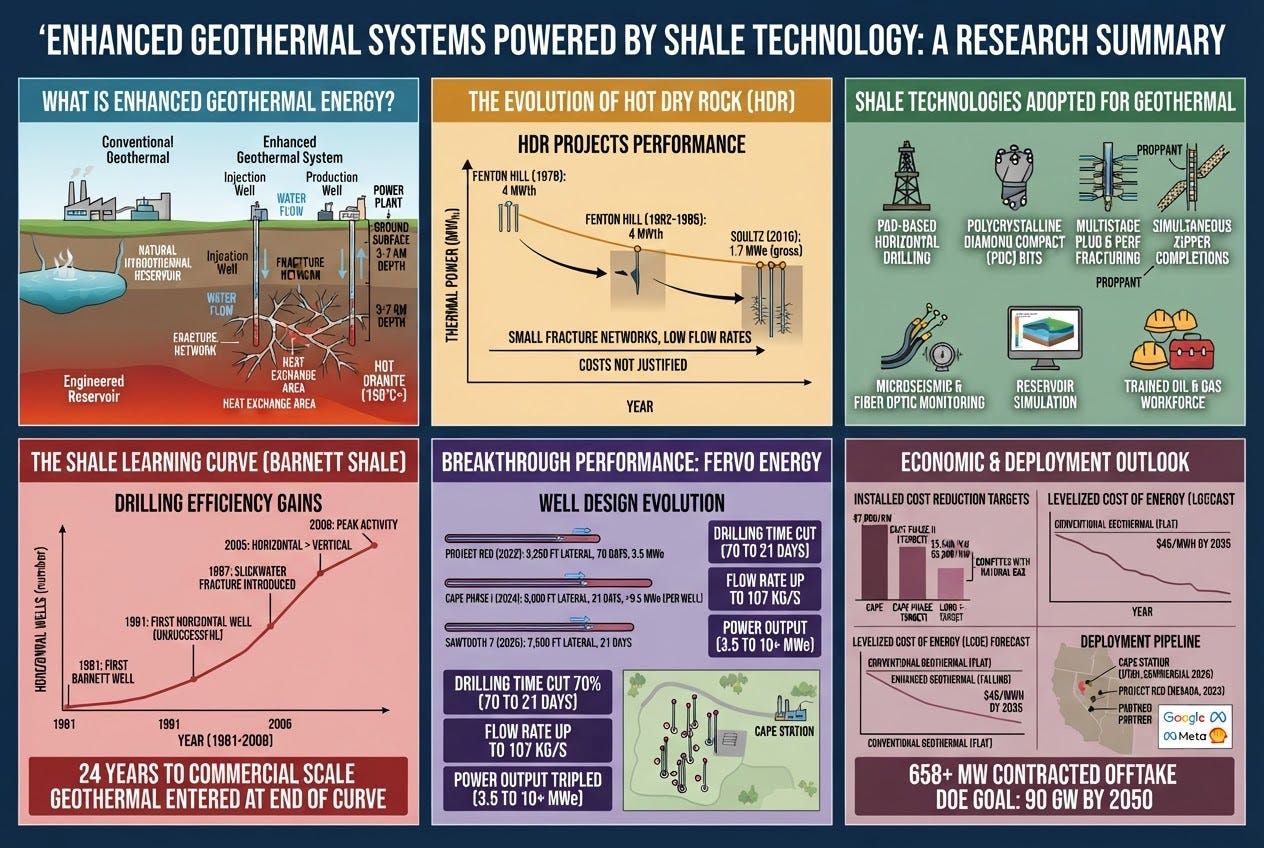
Fracking technology from shale drilling cut Fervo Energy’s geothermal well time from 70 days in 2022 to 21 days in 2024, and the 2026 Cape Station plant runs on it.
Geothermal energy needs three things underground: heat, water, and a path for the water to travel through hot rock. Heat exists nearly everywhere below the surface. The path was missing in most places until oil field crews applied horizontal drilling and multistage fracturing with diamond cutter bits to granite. Fervo announced first power from Cape Station in Utah on September 24, 2026.
Why Is Geothermal Energy a Small Share of U.S. Power Today?
The common explanation is geography. The National Laboratory of the Rockies counts 3,969 MWe of installed U.S. geothermal capacity across 99 plants, and 72 percent of it sits in California, where natural hot water reaches shallow depths. Geothermal looks like a resource for a few lucky places.
That explanation skips a fact from 1974. Los Alamos drilled into granite at Fenton Hill, New Mexico, to 2.929 kilometers and found 197 degrees Celsius. The laboratory fractured the rock, connected two wells, and ran a closed loop that produced about 4 MW thermal through 1995. Heat was available at depth. Published reviews conclude that the wells cost more than the flow could repay, and single stage stimulations of that era sent water through a few dominant paths instead of across a large rock surface.
What Changed Between Fenton Hill and Cape Station?
The shale industry spent 24 years teaching itself to do the same job in different rock. Mitchell Energy drilled its first Barnett well in 1981. A slickwater fracture design adopted in 1997 cut completion costs by roughly $75,000 to $100,000 per well. In 2005 new horizontal wells in the Barnett outnumbered vertical wells for the first time. Geothermal developers walked in at the end of that curve and took the tools.
Fervo applied them to granite in Nevada in 2023. Project Red flowed 63 liters per second at 191 degrees Celsius and produced 3.5 MW. In 2024 a single Cape production well flowed 107 kilograms per second, and Fervo reports more than 10 MW from it. Drilling cost across the first four horizontal Cape wells fell from $9.4 million to $4.8 million. The company’s third generation well, announced July 8, 2026, reached 19,448 feet and 460 degrees Fahrenheit in 21 days.
On a submarine reactor plant I learned that a heat source is worth only the surface area of the exchanger that couples it to the working fluid. A fractured granite reservoir is an exchanger, and each fracturing stage adds area to it. Fervo completed 80 stages in its Cape test area, and 95 percent placed the designed proppant volume. Shale completion crews had spent two decades learning to place proppant stage after stage. The Fenton Hill team worked without that experience.
What Does the Cost Curve Mean for Capital Allocation?
Installed cost tells investors where the risk sits. Fervo reports about $7,000 per kilowatt for the first 100 MW at Cape Station, a $5,500 target for the next 400 MW, and a $3,000 goal. The Department of Energy targets $45 per megawatt hour by 2035. The company raised about $2.2 billion in its May 14, 2026 offering, and reported first quarter revenue of $61 thousand against a net loss of $31.8 million. This is a business funded ahead of its revenue. The Department of Energy expects a national average of $60 to $70 per megawatt hour by 2030 and estimates that 90 GW could be economic by 2050, against 3.7 GW of conventional geothermal today. The International Energy Agency projects an 80 percent cost decline by 2035.
Drilling cost followed the shale curve. Two variables remain. An independent analysis of the Cape reservoir estimates a productivity index at the low end of the range for geothermal fields and ties it to a high well count per 100 MW. Thermal longevity needs 10 to 15 years of operating data to confirm. Project Red has run about 10 months with no observed decline. The $421.4 million of nonrecourse debt on Cape Phase I rests on a longer record than anyone holds.
Who Holds the Real Supply Chain for Geothermal Energy?
The supply chain belongs to oil field services. Fervo reported that fossil fuel workers accounted for more than 90 percent of on site labor hours at Cape. The International Energy Agency finds that up to 80 percent of geothermal investment involves capacity and skills transferable from oil and gas, and it sees global potential of up to 800 GW. Rig contractors, tubular suppliers, completion crews, and reservoir engineers are therefore geothermal suppliers already.
A completions engineer who designed zipper fractures in a shale basin holds a skill that Cape Station used in 2026 when six wells were stimulated at once from one pad. Operators with completion crews and rigs now serve a buyer base that includes Google, which signed a 396 MW agreement for Cape Station and an agreement for up to 3 GW through 2033.
Thermal Decline Is the Next Number to Watch
The next several years of geothermal capital will go to developers whose wells hold their temperature. My next piece examines thermal decline at Cape Station: which production temperature trend in the first 24 months of operation would confirm the 10 to 15 year longevity assumption behind $421.4 million of project debt. Subscribers will see those numbers as they arrive.
Interested in analysis about the intersection of tech, policy and the law? Check out my Substack channel. https://theinnovationattorney.substack.com/