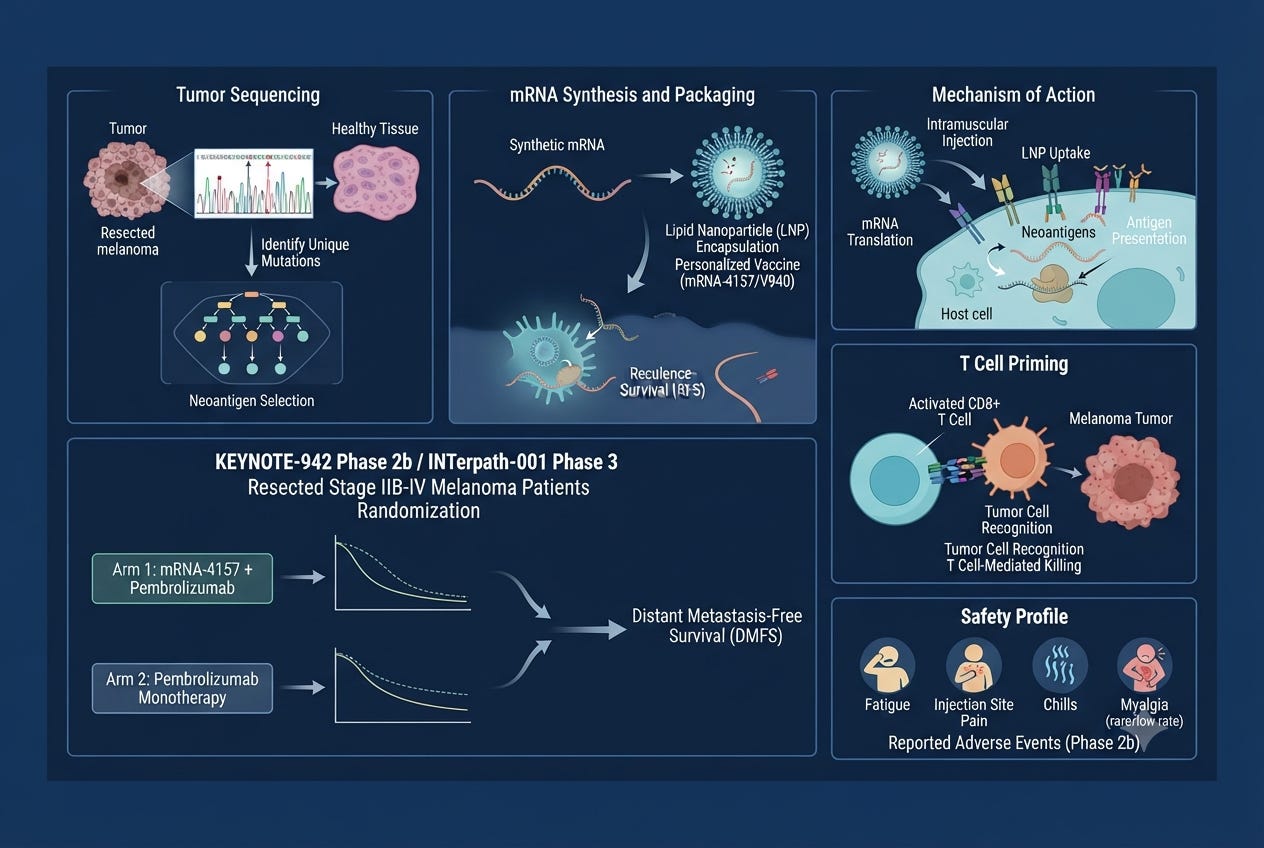
Merck and Moderna’s personalized mRNA cancer vaccine met its recurrence free survival and distant metastasis free survival endpoints in the Phase 3 INTerpath-001 melanoma trial announced on August 19, 2026. The vaccine, known as intismeran autogene or mRNA-4157, is manufactured individually for each patient from the mutations found in that patient’s own resected tumor, then paired with the checkpoint inhibitor pembrolizumab. In the earlier Phase 2b KEYNOTE-942 trial, the combination cut the three year risk of melanoma recurrence or death by 49 percent compared with pembrolizumab alone. The Phase 3 result confirms that finding in a larger, 1,137 patient population and moves the therapy toward a regulatory filing for adjuvant use in resected stage IIB through IV melanoma.
An estimated 112,000 Americans will be diagnosed with invasive melanoma in 2026, and a share present at the high risk stage where recurrence after surgery remains common even after checkpoint immunotherapy. The mRNA delivery method behind intismeran autogene is the same nucleoside modified, lipid nanoparticle platform that carried the Pfizer BioNTech and Moderna COVID-19 vaccines, work recognized by the 2023 Nobel Prize in Physiology or Medicine. This report also examines what a decade of mRNA vaccine use in the general population, mostly through the COVID-19 program, has shown about the safety of that technology, including the myocarditis finding in young men.
The melanoma data below rest on a Phase 2b trial with three and five year follow up and a Phase 3 trial not yet published in full. The myocarditis association is established through multiple surveillance systems and is no longer detected above the general population baseline in the current vaccine formulation. Clinicians and patients should weigh the specific, quantified risk described here rather than the surrounding public debate. This report is confined to the clinical medical evidence; readers seeking FDA regulatory, insurance, or litigation analysis should consult a legal domain analysis.
Detailed Findings
How Does Merck and Moderna’s Personalized mRNA Melanoma Vaccine Work?
Intismeran autogene works by teaching a patient’s own immune system to recognize as many as 34 mutation derived proteins unique to that patient’s tumor. DNA and RNA sequencing of a patient’s resected melanoma, compared against sequencing of that same patient’s healthy tissue, identifies the specific mutations present only in the cancer. A selection process ranks those mutations by their likelihood of provoking a T cell response and encodes the strongest candidates, up to 34 of them, into a single strand of synthetic messenger RNA manufactured specifically for that patient.
The synthetic mRNA is packaged in a lipid nanoparticle, the same delivery method used in the Pfizer BioNTech and Moderna COVID-19 vaccines, and given by injection on a schedule of nine doses every three weeks, a course lasting about six months. Host cells take up the lipid nanoparticle, and the cell’s own ribosomes translate the mRNA into the neoantigen proteins. The cell’s normal antigen processing machinery then displays fragments of those proteins on its surface, where they prime CD8 positive T cells to recognize and destroy any melanoma cell carrying the same mutations.
Pembrolizumab, a PD-1 checkpoint inhibitor given every three weeks for up to 18 cycles, is added because tumors routinely display proteins that suppress that same T cell response. Blocking PD-1 keeps the T cells primed by the vaccine active long enough to find and kill residual melanoma cells that might otherwise cause a recurrence. The nucleoside modified mRNA chemistry that keeps the injected genetic material from triggering an immediate innate immune shutdown is the same chemistry that earned the 2023 Nobel Prize in Physiology or Medicine, awarded for the discoveries that made the COVID-19 mRNA vaccines possible.
What Do the Melanoma Clinical Trial Results Actually Show?
The strongest published evidence for intismeran autogene comes from the Phase 2b KEYNOTE-942 trial, which randomized 157 patients with resected stage IIIB through IV melanoma, two to one, to receive the vaccine plus pembrolizumab or pembrolizumab alone. At three years, 74.8 percent of patients on the combination remained free of recurrence compared with 55.6 percent on pembrolizumab alone, a 49 percent reduction in the risk of recurrence or death, hazard ratio 0.510, 95 percent confidence interval 0.288 to 0.906. Distant metastasis free survival showed a larger effect, a 62 percent reduction in the risk of distant spread or death, hazard ratio 0.384, 95 percent confidence interval 0.172 to 0.858. An exploratory overall survival analysis at two and a half years favored the combination, 96.0 percent versus 90.2 percent, though the confidence interval crossed one, hazard ratio 0.425, 95 percent confidence interval 0.114 to 1.584, a reminder that the trial was not statistically powered to detect a survival difference at that stage.
A five year follow up of the same trial, reported alongside the Phase 3 announcement, held at a 49 percent reduction in recurrence or death, hazard ratio 0.51, 95 percent confidence interval 0.294 to 0.887, and a 59 percent reduction in distant metastasis or death, hazard ratio 0.411, 95 percent confidence interval 0.200 to 0.843, indicating the benefit persists rather than fading as more patients are followed. On August 19, 2026, Merck and Moderna announced that the confirmatory Phase 3 INTerpath-001 trial, which enrolled 1,137 patients with resected stage IIB through IV melanoma under trial identifier NCT05933577, met both the recurrence free survival and distant metastasis free survival endpoints against pembrolizumab alone at a pre-specified interim analysis. The companies reported no new adverse events beyond those already documented in the Phase 2b trial, where fatigue, 60.6 percent, injection site pain, 56.7 percent, and chills, 49.0 percent, were the most common reactions attributed to the combination, but stated that the specific Phase 3 hazard ratios and confidence intervals would be presented at a future medical meeting rather than in the announcement itself.
A second Phase 3 trial, INTerpath-002, initiated in December 2023, is testing the same vaccine and pembrolizumab combination as adjuvant treatment after surgery in patients with certain types of resected non-small cell lung cancer who already received neoadjuvant pembrolizumab and chemotherapy, extending the platform beyond melanoma into the cancer that kills more Americans than any other malignancy. Neither trial has yet produced a peer reviewed publication of its primary results, so the melanoma efficacy figures above rest on the Phase 2b trial and company announcements rather than a completed Phase 3 manuscript, a distinction clinicians should hold onto before treating the therapy as an established standard of care.
What Does a Decade of mRNA COVID-19 Vaccine Use Show About mRNA Safety, Including Myocarditis?
The clearest established risk of mRNA vaccination is a small increase in myocarditis and pericarditis, concentrated in male adolescents and young adults in the days following a second dose. Active surveillance through a major health system network detected myocarditis at a rate of approximately 38 cases per million doses after the second dose of the original 2021 to 2022 monovalent mRNA vaccines in people ages 12 to 39, an increase over the background rate. With the 2023 to 2024 and 2024 to 2025 updated vaccine formulations, that rate fell to approximately 2 to 5 cases per million doses, a level statistically similar to the rate seen in unvaccinated populations.
Context matters in reading that number. A study of 5.1 million children in England found approximately 11 excess myocarditis cases per million in unvaccinated adolescent boys who contracted COVID-19, compared with approximately 9 excess cases per million in vaccinated boys, meaning the infection itself carried a comparable or larger myocarditis risk than the vaccine during that period. A separate study of 4,635 hospitalized myocarditis patients in France found zero in hospital deaths among the cases linked to vaccination. Beyond myocarditis, the most common adverse events after mRNA vaccination are injection site pain, fatigue, headache, chills, and muscle or joint pain that resolve within one to three days, along with a documented but rare increase in febrile seizures in children between 6 and 23 months of age that the Centers for Disease Control and Prevention continues to monitor.
Public reporting of suspected vaccine reactions flows into the Vaccine Adverse Event Reporting System, a passive system that any clinician or patient can submit to without confirming that the vaccine caused the reported event. The Centers for Disease Control and Prevention states plainly that reports to that system are useful for forming a hypothesis but require a separate study comparing vaccinated and unvaccinated people before any reported event can be attributed to the vaccine, and that reporting volume rises and falls with media coverage independent of any underlying change in risk. A raw count of reports to that system, without that comparison, does not establish that a vaccine caused a given death or injury, which is the central reason public discussion of the system’s numbers so often diverges from the peer reviewed epidemiology.
What Compensation, Advisory Committee, and Public Confidence Issues Affect mRNA Vaccine Use Today?
Patients who believe they were injured by a COVID-19 vaccine cannot sue the manufacturer directly and instead file a claim with the Countermeasures Injury Compensation Program, a federal administrative program with a substantially higher evidentiary bar than the older Vaccine Injury Compensation Program used for most other immunizations. The countermeasures program received 13,333 claims during the pandemic, roughly 27 times its typical volume, and as of a June 2024 data release had completed action on only about one quarter of them. Of the claims decided by that point, 92 were approved, a 2.6 percent approval rate, for a combined 6.5 million dollars in compensation. Fifty two of those approvals, 57 percent of the total, were for COVID-19 vaccine injuries, most commonly myocarditis, totaling approximately 400,000 dollars.
The federal Advisory Committee on Immunization Practices, whose recommendations determine which vaccines insurers must cover without cost sharing, changed its COVID-19 vaccine guidance in September 2025 from a universal recommendation to a description of vaccination as an individual decision made with a clinician. A federal court found in a preliminary ruling in early 2026 that most of the committee’s newly appointed members were not qualified to serve, and the committee’s governing charter was rewritten in April 2026 to broaden membership criteria to include expertise in toxicology, pediatric neurodevelopment, and recovery from vaccine injury, while adding several vaccine skeptical liaison organizations and nearly tripling the committee’s budget. Litigation over the validity of the committee’s current membership and recommendations remains active.
That institutional turbulence has coincided with a measurable drop in public confidence. A national survey fielded in April 2025 found that 56 percent of American adults were at least somewhat confident that COVID-19 vaccines are safe, with confidence varying sharply by political affiliation, from a high of 87 percent in one group to a low of 30 percent in another, a gap wide enough to affect booster uptake independent of the clinical evidence. For a clinician recommending intismeran autogene, a therapy that depends on the same lipid nanoparticle and modified mRNA platform, the practical implication is that patient counseling may need to address platform level concerns inherited from the COVID-19 experience even though the melanoma vaccine carries its own distinct risk and benefit profile.
Clinical Practice Implications
The melanoma evidence supports discussing intismeran autogene plus pembrolizumab with patients who have high risk resected stage IIB through IV melanoma, particularly those already candidates for adjuvant pembrolizumab, while making clear that the therapy is not yet approved and that the Phase 3 confirmatory data have not been published in full. Patients considering a future non-small cell lung cancer program should understand that indication rests on the ongoing INTerpath-002 trial with no efficacy readout yet available.
For any patient offered intismeran autogene, the safety discussion should center on the documented Phase 2b profile of fatigue, injection site pain, and chills rather than on extrapolations from COVID-19 vaccine controversy, since no melanoma vaccine trial to date has reported a myocarditis case. For patients due for a COVID-19 mRNA booster, the current formulation’s myocarditis rate of approximately 2 to 5 cases per million doses in the highest risk group, adolescent and young adult males, is the number to communicate, alongside the finding that COVID-19 infection itself carries a comparable myocarditis risk in that same age group.
Clinicians should expect the Advisory Committee on Immunization Practices’ shift toward describing COVID-19 vaccination as an individual decision, rather than a universal recommendation, to affect insurance coverage and patient uptake independent of the underlying safety data, and should be prepared to walk patients through the quantified risk rather than defer to a recommendation that may itself be in litigation. Anyone filing or advising on a COVID-19 vaccine injury claim should know that the Countermeasures Injury Compensation Program, not the more established Vaccine Injury Compensation Program, governs those claims, and that its 2.6 percent approval rate reflects a program design issue as much as it reflects the underlying medical evidence.
Open Questions
Will the Phase 3 INTerpath-001 hazard ratios, once published, match the 0.51 recurrence hazard ratio seen in the Phase 2b trial, or regress toward a smaller effect size as is common when a larger, more representative Phase 3 population replaces an earlier trial. The answer determines whether payers and clinical guideline bodies treat intismeran autogene as a substantial or a marginal addition to adjuvant pembrolizumab.
Whether individualized neoantigen manufacturing, which requires sequencing, selection, and patient specific production for every dose, can meet the volume needed for non-small cell lung cancer, a disease diagnosed in roughly ten times more patients each year than resectable stage IIB through IV melanoma, has not yet been demonstrated. INTerpath-002 will be the first real test of manufacturing capacity outside melanoma.
How the Food and Drug Administration will weigh a Phase 3 trial whose efficacy data were announced by press release, and not yet published or presented at a peer reviewed medical meeting, when the companies file for approval, given that breakthrough therapy designation shortens review time but does not lower the evidentiary bar.
Whether the Advisory Committee on Immunization Practices’ newly broadened charter and pending litigation over its current membership produce a stable, evidence based structure for future mRNA vaccine indications, including any cancer vaccine platform that shares chemistry with the COVID-19 vaccines, or whether continued turnover leaves clinicians without a dependable, current federal recommendation to cite to patients.
Whether the Countermeasures Injury Compensation Program’s processing pace and 2.6 percent approval rate improve enough, following reported hiring and portal upgrades, to give patients confidence that an actual mRNA vaccine injury will be recognized and paid, a confidence gap that could shape uptake of intismeran autogene if it reaches approval.
Source List
1. Weber JS, et al. Individualised neoantigen therapy mRNA-4157 (V940) plus pembrolizumab versus pembrolizumab monotherapy in resected melanoma (KEYNOTE-942): a randomised, phase 2b study. The Lancet, 2024. PMID 38246194. The primary peer reviewed publication of the Phase 2b trial’s recurrence and metastasis free survival data.
2. Three-Year Update of a Randomized Phase IIb Study of the Individualized Neoantigen Therapy Intismeran Autogene (mRNA-4157, V940) Plus Pembrolizumab Versus Pembrolizumab in Resected Melanoma. JCO Oncology Advances, 2025, doi 10.1200/OA-25-00008. Peer reviewed three year follow up confirming the durability of the Phase 2b effect size.
3. ClinicalTrials.gov registry record for trial identifier NCT05933577 (INTerpath-001). U.S. National Library of Medicine. The registered protocol, patient population, and design for the Phase 3 confirmatory trial.
4. Merck news release, August 19, 2026, announcing that the Phase 3 INTerpath-001 trial met its recurrence free survival and distant metastasis free survival endpoints. The primary company disclosure of the Phase 3 topline result.
5. Coverage of the February 22, 2023 Food and Drug Administration breakthrough therapy designation for mRNA-4157/V940 plus pembrolizumab in high risk melanoma. Confirms the date and scope of the designation.
6. Centers for Disease Control and Prevention, Safety Considerations for COVID-19 Vaccines, cdc.gov, accessed August 2026. Federal agency reference on myocarditis, pericarditis, and other documented adverse events.
7. Centers for Disease Control and Prevention, Manual for the Surveillance of Vaccine-Preventable Diseases, Chapter 21, Vaccine Adverse Event Reporting System. Federal methodology reference on the limitations of passive vaccine safety reporting.
8. Congressional Research Service, Compensation for COVID-19 Vaccine Injuries, Report R46982, updated April 16, 2025. Legislative branch summary of the Countermeasures Injury Compensation Program’s structure and claims data.
9. U.S. Government Accountability Office, COVID-19: Information on HHS’s Medical Countermeasures Injury Compensation Program, Report GAO-25-107368, 2025. Independent federal audit of program processing and claims outcomes.
10. National tracking poll on health information and trust, vaccine safety and trust module, fielded April 8 to 15, 2025, sample of 1,380 U.S. adults. Public confidence survey data on COVID-19 vaccine safety perception.
11. Melanoma Research Alliance, citing American Cancer Society data, 2026 melanoma incidence estimate of over 112,000 new invasive diagnoses. Epidemiological context for the disease burden.
12. Nobel Prize Outreach, The Nobel Prize in Physiology or Medicine 2023, press release, October 2, 2023. Confirms the mechanism and recognition underlying the nucleoside modified mRNA chemistry used by both the cancer vaccine and the COVID-19 vaccines.
Bibliography
American Cancer Society. Cancer Facts & Figures 2026. American Cancer Society; 2026.
Centers for Disease Control and Prevention. Safety Considerations for COVID-19 Vaccines. Accessed August 20, 2026.
Centers for Disease Control and Prevention. Manual for the Surveillance of Vaccine-Preventable Diseases. Chapter 21: Vaccine Adverse Event Reporting System (VAERS). Accessed August 20, 2026.
Congressional Research Service. Compensation for COVID-19 Vaccine Injuries. Report R46982. Updated April 16, 2025.
Khattak A, et al. Three-Year Update of a Randomized Phase IIb Study of the Individualized Neoantigen Therapy Intismeran Autogene (mRNA-4157, V940) Plus Pembrolizumab Versus Pembrolizumab in Resected Melanoma. JCO Oncol Adv. 2025. doi:10.1200/OA-25-00008.
Melanoma Research Alliance. Over 112,000 Americans Estimated to Be Diagnosed with Invasive Melanoma in 2026. 2026.
Nobel Prize Outreach. The Nobel Prize in Physiology or Medicine 2023: Press Release. Nobel Prize Outreach; October 2, 2023.
U.S. Government Accountability Office. COVID-19: Information on HHS’s Medical Countermeasures Injury Compensation Program. Report GAO-25-107368; 2025.
Weber JS, Carlino MS, Khattak A, et al. Individualised neoantigen therapy mRNA-4157 (V940) plus pembrolizumab versus pembrolizumab monotherapy in resected melanoma (KEYNOTE-942): a randomised, phase 2b study. Lancet. 2024. PMID: 38246194.
“FDA Grants Breakthrough Therapy Designation to mRNA-4157/V940 Plus Pembrolizumab in High-Risk Melanoma.” Trade press coverage, February 22, 2023.
“KFF Tracking Poll on Health Information and Trust: Vaccine Safety and Trust.” Health policy research organization, 2025.
“Merck and Moderna Announce Phase 3 INTerpath-001 Trial of Intismeran Autogene Plus KEYTRUDA Met Endpoints of Recurrence-Free Survival and Distant Metastasis-Free Survival in Patients With Completely Resected Stage IIB-IV Melanoma.” News release, August 19, 2026.
“New ACIP Charter: Broader Membership, Focus on Vaccine Injuries.” Health policy news coverage, April 9, 2026.
“Review of US Vaccine Injury Reimbursement Program Shows Less Than 3% of Claims Eligible for Compensation.” Infectious disease policy news coverage, 2024.
Interested in analysis about the intersection of tech, policy and the law? Check out my Substack channel. https://theinnovationattorney.substack.com/