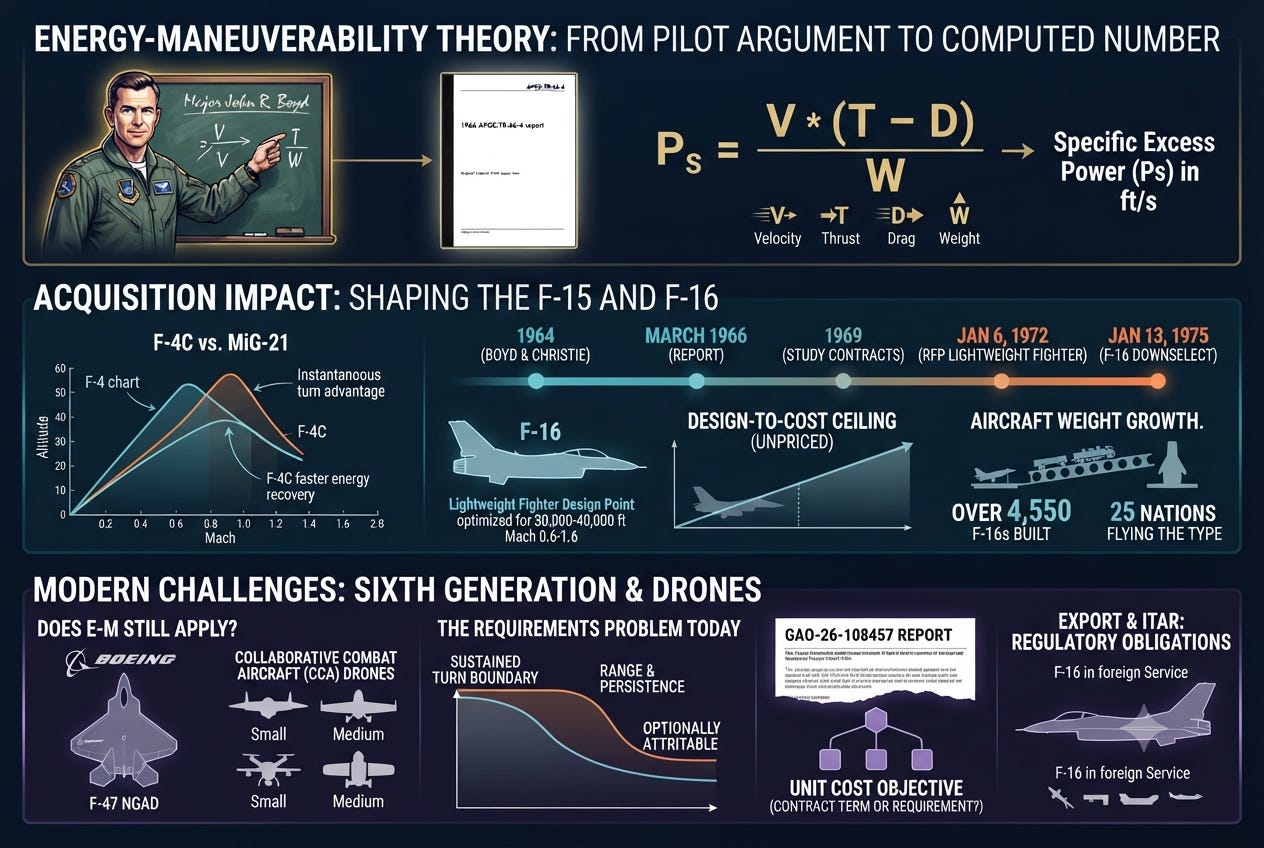
Energy Maneuverability theory converted a fighter pilot’s argument into a computed number, and the number won. The method that Major John R. Boyd and mathematician Thomas P. Christie built at Eglin Air Force Base, published in March 1966 as Air Proving Ground Center report APGC-TR-66-4, let the Air Force compare any two aircraft at any point in the flight envelope on a single quantity. That capability reshaped the F-15, produced the F-16, and set the pattern American fighter requirements have followed for sixty years. The pattern is under stress right now. The Air Force asked Congress for $2.37 billion in fiscal 2027 for Collaborative Combat Aircraft, and no published equivalent of the Ps chart exists that would let a congressional staffer, a protest attorney, or an outside analyst test whether the aircraft being bought meet the requirement being claimed.
Executive Summary
Energy Maneuverability theory, published by the Air Proving Ground Center at Eglin Air Force Base in March 1966 as report APGC-TR-66-4, made fighter performance measurable and therefore contestable. The method reduces an airframe’s combat potential to specific excess power, written as Ps equals velocity multiplied by thrust minus drag, divided by weight. Compute that value across altitude and Mach number and the result is a map of what the aircraft can do at every point it can reach. Overlay two maps and the comparison becomes an argument no program office can answer with adjectives.
Boyd, Christie, and First Lieutenant James E. Gibson ran the first such comparison for the F-4C against the MiG-21. The charts showed the Soviet aircraft holding a large instantaneous turn advantage while the American aircraft recovered energy faster across most of the envelope. That result is a tactical instruction. It tells a squadron commander what to do, and it does not turn on anyone’s opinion of either airframe.
The consequences ran in two directions. Technically, the method gave the F-X program a way to trade wing area against thrust against gross weight, and it gave the Lightweight Fighter program a design point: an airframe under 20,000 pounds gross weight, optimized between 30,000 and 40,000 feet at Mach 0.6 to 1.6. Commercially and legally it did something less appreciated. It created an analytical record outsiders could audit. A requirement expressed as a curve is falsifiable. A requirement expressed as a capability statement is a matter of taste.
Two things in this history are settled and two are contested. Settled: the equation, the March 1966 report, the Lightweight Fighter design point, and the production record of more than 4,550 F-16s with 25 nations still flying the type. Contested: whether Boyd originated the energy method, since a Douglas Aircraft aerodynamicist published an energy approach to the general aircraft performance problem in 1954, and whether the close in turning fight that the method was tuned to optimize was the right lesson to carry into the missile era.
The stake today is measurable. Report GAO-26-108457, issued July 2, 2026, found that the Pentagon’s costliest weapon programs now carry more than $2.4 trillion in planned investment and an average delivery timeline exceeding twelve years. Section 1801 of the National Defense Authorization Act for Fiscal Year 2026, signed December 18, 2025, now directs that capability requirements be validated through direct engagement, experimentation, and iteration with end users. That statutory language asks for exactly what Boyd and Christie produced without authorization in 1964, and it does not say who computes the number or who gets to see it.
Detailed Findings
what is energy maneuverability theory and how does the Ps equation work
Energy Maneuverability theory treats a fighter as a machine that manages an energy budget, and its output is a single computed quantity: specific excess power, Ps equals V times the quantity T minus D, divided by W. Thrust available minus drag gives the surplus force at that instant. Multiply by velocity to convert force into power. Divide by aircraft weight to normalize across airframes of different mass. The result carries units of feet per second, and it states how fast the aircraft can climb at that speed and altitude without trading airspeed for height.
The useful contour is Ps equal to zero. That line is the sustained maneuver boundary, the set of conditions where an aircraft can hold a turn without losing energy. Inside the line the aircraft is gaining. Outside it the aircraft is bleeding speed or altitude to keep turning, and every second spent there is borrowed. Instantaneous turn rate, the number pilots quote in the bar, tells you what the airframe can do once. Ps tells you what it can do again thirty seconds later.
Anyone who has stood watch on a nuclear reactor plant recognizes this accounting on sight. On a submarine the operator manages a stored energy budget against a demand curve, and the question that decides the next hour is never how much power the plant can produce. It is how much is left after the load is served, and how fast the margin recovers once you spend it. Boyd asked precisely that question about an airframe. The governing discipline is thermodynamics, and the aerodynamics supplies only the drag term.
The comparative step is where the method acquired institutional force. A single Ps chart describes one aircraft. Two charts on the same axes describe a fight. The March 1966 report put the F-4C and the MiG-21 on shared coordinates and produced a result a squadron commander could act on: avoid the turning engagement, use the energy advantage, fight in the vertical.
who developed the energy method and does the attribution matter
Boyd did not invent the energy approach to aircraft performance. He invented the comparison, and the comparison is what changed procurement. A Douglas Aircraft aerodynamicist published an energy approach to the general aircraft performance problem in 1954, ten years before the Eglin work, solving climb and range optimization with the same state variables. Boyd acknowledged the derivation only after years of denying it.
For an acquisition lawyer the attribution dispute matters less than the document. The 1954 paper sat in a journal. The 1966 work sat in the record as an Air Proving Ground Center report with a control number, produced inside the service, comparing American hardware against Soviet hardware. Program offices, source selection authorities, and congressional staff respond to documents that carry an organizational imprint and a citation. That is not a comment on scientific priority. It is a comment on where analytical authority actually lives inside a procurement system.
Christie’s later career reinforces the point. The mathematician who ran the numbers at Eglin became Director of Operational Test and Evaluation in June 2001, the office charged by statute with independent assessment of whether a system performs as claimed. The through line from a stolen block of computer time in 1964 to a Senate confirmed testing office is a story about who is permitted to check the government’s arithmetic.
how did energy maneuverability theory change the F-15 and produce the F-16
The theory changed the F-15 by giving its critics a quantitative basis for arguing the F-X design was growing too heavy, and it produced the F-16 by supplying a defensible design point for an aircraft that did not yet have a requirement. The Lightweight Fighter effort began with study contracts in 1969 worth roughly $149,000 total, split as $49,000 to General Dynamics and $100,000 to Northrop. The request for proposals followed on January 6, 1972, specifying an airframe under 20,000 pounds gross weight.
The design point came straight off the charts: optimize between 30,000 and 40,000 feet across Mach 0.6 to 1.6, which is where the analysis said air combat was actually occurring. The YF-16 first flew on February 2, 1974, the YF-17 on June 9, 1974, and the Air Force selected the General Dynamics entry as the Air Combat Fighter on January 13, 1975.
The production record is the part no analysis in 1972 predicted. More than 4,550 F-16s have been built, more than thirty countries have operated the type, and 25 fly some version of it today. The Greenville production line carries 128 Block 70 and Block 72 aircraft on order, reaching 136 with Jordan’s letter of offer and acceptance. The Air Force plans to keep roughly 600 F-16s in service into the 2030s. An airframe sized against a 1972 energy chart is still generating sustainment revenue in 2026, which is a longer commercial tail than any business case in the file contemplated.
why did the design to cost ceiling on the lightweight fighter fail
The Lightweight Fighter’s $3 million per aircraft design to cost ceiling failed because it was never written into a contract. An unpriced ceiling binds nobody. Boyd and Pierre Sprey objected when the production aircraft grew a radar and a multirole mission set, and they were correct about the engineering. They had no instrument to stop it.
Thirty years of drafting development agreements produces one reliable rule about this failure mode. A number that appears in a requirements document and nowhere in the terms and conditions has no enforcement path. There is no measurement date, no defined method of computation, no party bearing the consequence of exceeding it, and no remedy. I have watched the identical loss play out across commercial technology development agreements, where a founder accepts a unit economics target in a statement of work, the specification grows through change orders that each look reasonable in isolation, and by the time anyone reconciles the number the original target has no contractual life at all. The physics held. The cost discipline did not, because cost discipline lives in the terms and not in the analysis.
The current parallel is exact. Collaborative Combat Aircraft carry a stated unit cost objective of roughly $30 million, about one third of an F-35, and Air Force officials have said they expect to come in under $25 million. Whether that figure survives Increment 2 depends on a question nobody has answered publicly: is it a contract term with a measurement date, or an objective in a requirements document.
does energy maneuverability still apply to sixth generation fighters and combat drones
The equation still holds, because Ps is physics and applies to any thrust producing airframe, but the weighting of its terms has moved decisively. When engagements begin beyond visual range and the planform is driven by signature control, the sustained turn boundary matters less than range, persistence, and the ability to hold a firing position without a tanker. Weight in the denominator now buys fuel and mission systems instead of buying structure to survive a nine g turn.
For Collaborative Combat Aircraft the governing term is thrust class against fuel fraction, and the Air Force has split the difference in procurement language. Increment 2 is developing two engine classes: small engines producing 1,400 to 1,600 pounds of thrust, with work continuing through May 2027, and medium engines producing 5,000 to 6,000 pounds. That thrust split is an energy decision expressed as a contracting strategy. The small class buys quantity and accepts a short combat radius. The medium class buys a wingman that can follow a manned fighter through a supersonic dash. Nine vendors sit under concept refinement contracts, with a downselect to roughly six expected for prototyping.
The manned side of the portfolio moves on a different clock. The Air Force awarded Boeing the Next Generation Air Dominance contract on March 21, 2025, designating the aircraft the F-47, at a reported value near $20 billion for engineering and manufacturing development. The Navy’s F/A-XX received $74 million in unclassified authorization for fiscal 2026. The fiscal 2026 authorization act requires a comprehensive F-47 program report by March 1, 2027 covering requirements, employment concepts, projected cost and schedule, acquisition pathway options, and fielding strategy.
The program executive for Collaborative Combat Aircraft has described the design posture as optionally attritable, with the choice between a longer service life platform and an expendable one deferred to the operational commander. That is a candid statement of an unfinished trade. It is also, in Boyd’s terms, a refusal to pick a design point, and the Lightweight Fighter history suggests what happens to a program that leaves the design point open while the specification keeps growing.
how does the F-16 export record shape arms transfer practice today
Every F-16 transfer above the statutory thresholds runs through Section 36(b)(1) of the Arms Export Control Act, 22 U.S.C. 2776(b)(1), which requires certification to Congress before a letter of offer and acceptance may issue. A Federal Register notice published February 6, 2026 illustrates the mechanics: transmittal 25-84, a $445 million case for Bahrain covering aircraft components, missile containers, radar receiver parts, guidance and control spares, ground handling equipment, software, technical documentation, and sustainment, with the report delivered to Congress on December 1, 2025.
The technical data underlying those transfers is controlled under the International Traffic in Arms Regulations at 22 C.F.R. Parts 120 to 130. For a defense contractor or its counsel the practical consequence is that a performance decision made against an energy chart in 1972 now determines export classification, license scope, and offset exposure across 25 customer nations in 2026. Design choices carry regulatory obligations that outlive the engineers who made them by decades.
what risks should counsel and contractors price into requirements driven programs
The dominant risk is an unpriced target, and the Lightweight Fighter is the reference case. Where a program’s central requirement is unit cost, counsel should insist that the cost figure appear in the contract with a defined computation method, a measurement date, an exclusion list, and a consequence, because a target that lives only in the requirements document will not survive the first three change orders.
Technology maturity is the second exposure, and it is now quantified. Report GAO-26-108457 found that between 2018 and 2025, eighteen of forty programs entered the middle tier acquisition pathway with immature technologies, and seven of the eight currently on that pathway still carry immature technologies. A rapid fielding pathway does not make an immature technology mature. It removes the milestone at which someone was required to say so.
Classification is the third, and it cuts against outside review in a way the 1966 report did not. Boyd’s charts were classified, but the method was published and the arithmetic was reproducible by anyone with the performance data. The analytical basis for sixth generation requirements sits inside special access channels, which means a congressional staffer assessing the March 1, 2027 F-47 report may receive conclusions without the computation that produced them.
Threshold changes compound all three. Section 1804 of the fiscal 2026 authorization act raises the certified cost or pricing data threshold to $10 million from the inflation adjusted $2.5 million and lifts the approval threshold for noncompetitive awards to $100 million, effective after June 30, 2026. Section 1806 raises full Cost Accounting Standards coverage to $100 million and the applicability threshold to $35 million. For a program buying hundreds of unmanned aircraft priced near $25 million each, the practical effect is fewer certified price data points entering the record at exactly the moment unit cost is the requirement being defended.
Open Questions
First, whether the Collaborative Combat Aircraft unit cost objective becomes a contract term. The Air Force set a production decision for September 30, 2026 and has said it expects to come in below $25 million per aircraft. Nothing in the public record establishes how that figure is computed, what it excludes, or what happens if it is exceeded. A contractor bidding Increment 2 and a lender financing that contractor need the answer before award, not after.
Second, what analytical measure replaces Ps for a manned fighter operating with autonomous wingmen. Specific excess power describes one airframe. No published successor metric characterizes the combined formation, where the relevant quantity may be sortie cost per firing opportunity, a figure nobody measures in feet per second. Requirements written without such a measure cannot be tested by anyone outside the program office.
Third, whether the F-47 report due March 1, 2027 will contain enough performance basis for congressional staff to test the requirement, or whether the substance stays in classified annexes. The statutory reporting obligation is satisfied either way. Only one of the two outcomes creates the auditable record that made the 1966 method consequential.
Fourth, how the Section 1804 threshold increases interact with a program whose central requirement is price. Raising the certified cost or pricing data threshold fourfold reduces contracting burden across a large band of subcontracts. It also removes the mechanism by which the government has historically verified that a claimed unit cost is real. Which effect dominates in an unmanned aircraft portfolio is untested.
Fifth, whether the Increment 2 downselect from nine concept refinement vendors to roughly six preserves enough competitive pressure to discipline price. Two engine classes and six airframe competitors is a wide field by current standards. Whether it stays wide through prototyping determines whether the cost target has any market force behind it.
Source List
1. Boyd, Christie, and Gibson, Energy-Maneuverability (U), Air Proving Ground Center report APGC-TR-66-4, Eglin Air Force Base, Florida, March 1966. Primary source for the Ps formulation and the F-4C against MiG-21 comparison. https://archive.org/details/Energy-Maneuverability
2. Arms Export Control Act, Section 36(b)(1), 22 U.S.C. 2776(b)(1). Controlling statute for congressional certification of Foreign Military Sales cases above statutory thresholds. https://uscode.house.gov/
3. International Traffic in Arms Regulations, 22 C.F.R. Parts 120 to 130. Controlling regulation for defense article and technical data export authorization. https://www.ecfr.gov/current/title-22/chapter-I/subchapter-M
4. National Defense Authorization Act for Fiscal Year 2026, Public Law 119-60, signed December 18, 2025, Sections 1801, 1804, 1806, 1811, and 1822. Statutory basis for requirements validation reform and the certified cost or pricing data and Cost Accounting Standards threshold increases. https://www.congress.gov/
5. Arms Sales Notification, 91 Fed. Reg. (February 6, 2026), transmittal 25-84, Bahrain, $445 million. Illustrative current Foreign Military Sales notification for F-16 related articles and sustainment. https://www.federalregister.gov/documents/2026/02/06/2026-02400/arms-sales-notification
6. Government Accountability Office, Weapon Systems Annual Assessment, GAO-26-108457, July 2, 2026. Source for the $2.4 trillion portfolio figure, the twelve year average delivery timeline, and the middle tier technology maturity findings. https://www.gao.gov/
7. Congressional Research Service, U.S. Air Force Next-Generation Air Dominance (NGAD) Fighter, IF12805. Source for F-47 program status and congressional issues. https://www.congress.gov/crs-product/IF12805
8. Congressional Research Service, U.S. Air Force Collaborative Combat Aircraft (CCA), IF12740. Source for Collaborative Combat Aircraft program structure and increment planning. https://www.congress.gov/crs-product/IF12740
9. Air and Space Forces Magazine, Air Force Wants Nearly $1 Billion to Start Buying CCAs in 2027. Source for the $996.5 million procurement request, the $2.37 billion fiscal 2027 total, and the unit cost objective. https://www.airandspaceforces.com/air-force-nearly-1-billion-to-start-buying-ccas-2027/
10. DefenseScoop, Air Force could tap up to 6 vendors for second increment of CCA drone program, July 30, 2026. Source for the Increment 2 vendor count, the engine thrust classes, and the optionally attritable design posture. https://defensescoop.com/2026/07/30/air-force-cca-drone-program-increment-2-downselect/
11. Defense News, Boeing wins contract for NGAD fighter jet, dubbed F-47, March 21, 2025. Source for the Next Generation Air Dominance award date, contractor, and reported value. https://www.defensenews.com/air/2025/03/21/boeing-wins-contract-for-ngad-fighter-jet-dubbed-f-47/
12. Hankins, Flying Camelot: The F-15, the F-16, and the Weaponization of Fighter Pilot Nostalgia, Cornell University Press, 2021. Academic reassessment of the Fighter Mafia and the doctrinal claims attached to the Lightweight Fighter program. https://www.jstor.org/stable/10.7591/j.ctv1hw3wvv
Bibliography
Air and Space Forces Magazine. “Air Force Wants Nearly $1 Billion to Start Buying CCAs in 2027.” Accessed September 6, 2026. https://www.airandspaceforces.com/air-force-nearly-1-billion-to-start-buying-ccas-2027/.
Air and Space Forces Magazine. “First F-16 Block 70 Emerges From Lockheed Martin’s New Factory, 128 More on Order.” Accessed September 6, 2026. https://www.airandspaceforces.com/first-f-16-block-70-emerges-from-lockheed-martins-new-factory-128-more-on-order/.
Arms Export Control Act, 22 U.S.C. 2776(b)(1) (2024).
Arms Sales Notification, 91 Fed. Reg. (Feb. 6, 2026) (transmittal 25-84, Bahrain).
Boyd, John R., Thomas P. Christie, and James E. Gibson. Energy-Maneuverability (U). Report APGC-TR-66-4. Eglin Air Force Base, FL: Air Proving Ground Center, March 1966.
Congressional Research Service. U.S. Air Force Collaborative Combat Aircraft (CCA). Report IF12740. Washington, DC: Library of Congress.
Congressional Research Service. U.S. Air Force Next-Generation Air Dominance (NGAD) Fighter. Report IF12805. Washington, DC: Library of Congress.
Defense News. “Boeing Wins Contract for NGAD Fighter Jet, Dubbed F-47.” March 21, 2025. https://www.defensenews.com/air/2025/03/21/boeing-wins-contract-for-ngad-fighter-jet-dubbed-f-47/.
DefenseScoop. “Air Force Could Tap Up to 6 Vendors for Second Increment of CCA Drone Program.” July 30, 2026. https://defensescoop.com/2026/07/30/air-force-cca-drone-program-increment-2-downselect/.
Government Accountability Office. Weapon Systems Annual Assessment. GAO-26-108457. Washington, DC: GAO, July 2, 2026.
Hankins, Michael W. Flying Camelot: The F-15, the F-16, and the Weaponization of Fighter Pilot Nostalgia. Ithaca, NY: Cornell University Press, 2021.
International Traffic in Arms Regulations, 22 C.F.R. pts. 120 to 130 (2026).
National Defense Authorization Act for Fiscal Year 2026, Pub. L. No. 119-60 (Dec. 18, 2025).
Rutowski, Edward S. “Energy Approach to the General Aircraft Performance Problem.” Journal of the Aeronautical Sciences 21, no. 3 (March 1954): 187 to 195.
The Aviationist. “FY2026 NDAA: Congress Pushes Back on Aircraft Cuts and Seeks Clarity on Next-Gen Programs.” December 13, 2025. https://theaviationist.com/2025/12/13/fy2026-ndaa-review/.
Interested in analysis about the intersection of defense, national security, tech, policy and the law? Check out my Substack channel. https://theinnovationattorney.substack.com/