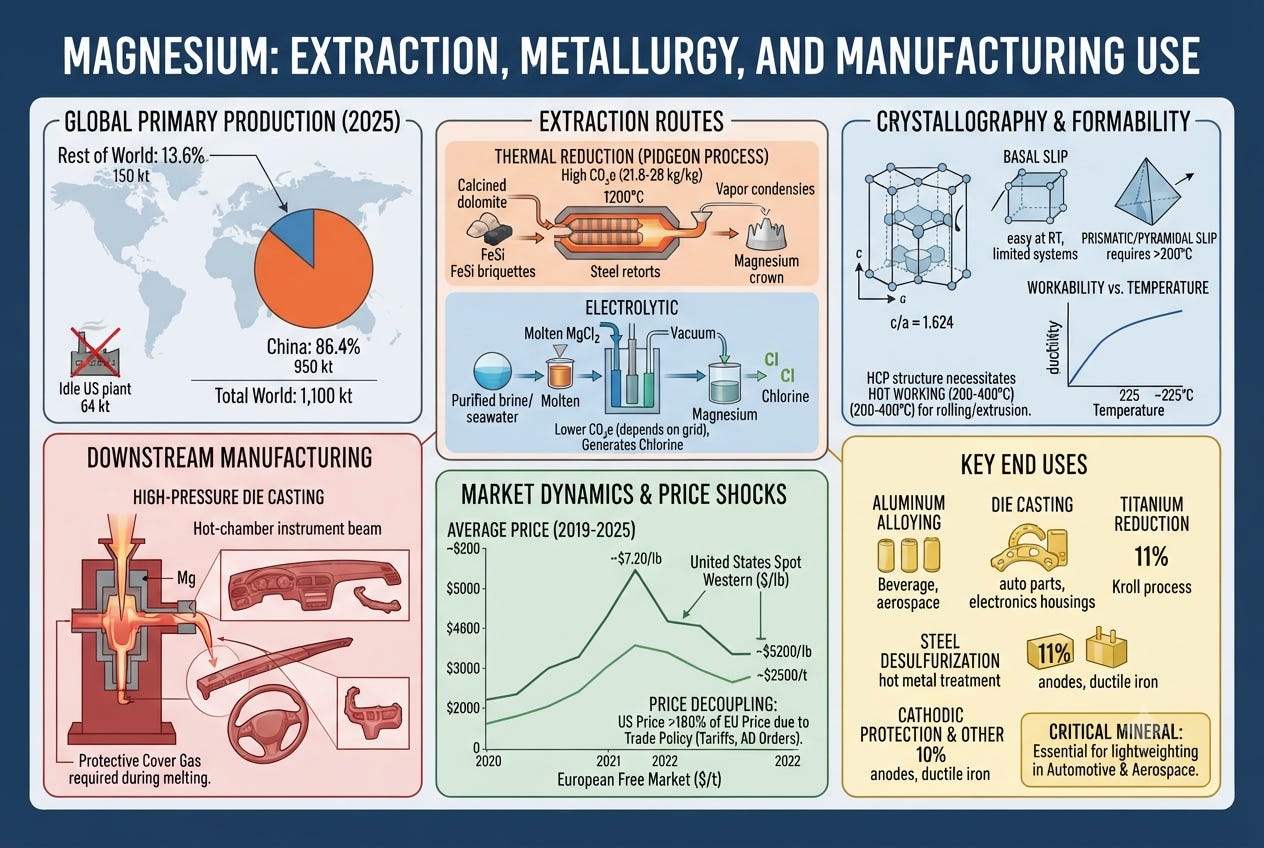
China produced 950,000 of the 1,100,000 metric tons of primary magnesium made worldwide in 2025, while the United States produced none after its sole smelter filed for bankruptcy. American primary magnesium output has been zero since limited operations at the Rowley, Utah electrolytic plant ended in 2022, following critical equipment failures in 2021 and a force majeure declaration on supply contracts dated September 29, 2021. The operator filed for Chapter 11 protection in September 2025, and on January 28, 2026 the State of Utah acquired the assets for $30 million, taking 4,500 acres on the southwest shore of the Great Salt Lake and water rights to just over 144,000 acre feet. Domestic demand is now met by 82,000 tons of imports, 110,000 tons of secondary metal recovered from scrap, and inventory.
Two findings drive the analysis that follows. First, the dominant production route is thermal rather than electrolytic. The Pidgeon process, a batch silicothermic reduction of calcined dolomite carried out in steel retorts at roughly 1,200 degrees Celsius under vacuum, accounts for the large majority of Chinese output and carries a reported carbon intensity of 21.8 to 28 kilograms of carbon dioxide equivalent per kilogram of metal, against 0.56 to 0.59 kilograms per kilogram for European secondary metal. Second, price formation in the United States has decoupled from the rest of the world. The 2025 annual average United States spot Western price of $3.20 per pound works out to roughly $7,055 per metric ton, while the European free market average was $2,500 per metric ton, a spread of about 182 percent created by an 8 percent most favored nation duty on unwrought metal layered on antidumping orders that have covered Chinese pure magnesium since 1995 and Chinese magnesium metal since 2005.
For anyone allocating capital to lightweight structures, titanium production, or steel finishing, the operative question is not whether magnesium is useful. It is whether a manufacturer can obtain it at a predictable price from a source that does not sit inside a single national grid.
Definition, Scope, and Technical Context
Magnesium is the lightest structural metal in commercial use, with a density of 1.738 grams per cubic centimeter at 20 degrees Celsius, about 36 percent below aluminum and roughly 78 percent below carbon steel. It melts at 650 degrees Celsius and boils at 1,091 degrees Celsius, a narrow liquid range by metallurgical standards and one that shapes both how the metal is won from ore and how it is cast. This analysis covers primary extraction, alloying, forming, and industrial end use of magnesium metal. It excludes magnesium compounds such as magnesia refractories, magnesium hydroxide, and pharmaceutical salts, which follow separate production chemistry and separate markets.
The metal is classified as a light nonferrous structural metal and, for purposes of federal minerals policy, as a critical mineral. Magnesium appears on the final 2025 List of Critical Minerals published under section 7002 of Public Law 116 260 as amended by Public Law 118 233, codified at 30 U.S.C. 1606, effective November 7, 2025, one of sixty minerals on that list.
Two production families exist and they share almost no equipment. Thermal reduction takes a calcined carbonate ore and strips oxygen from magnesium oxide using silicon, producing magnesium as a vapor that is condensed as crystalline metal. Electrolysis takes anhydrous magnesium chloride, derived from brine or seawater, and splits it into liquid metal and chlorine gas in a molten salt cell. The choice between them is not a matter of preference. It determines the plant’s feedstock, its energy source, its byproduct stream, its capital intensity, and its emissions profile, and those differences explain most of the geography of the industry.
The scope also covers downstream forming, because magnesium is unusual in that the crystal structure that makes it light also makes it difficult to roll and extrude at room temperature. Any commercial assessment of the metal that stops at the smelter gate misses the constraint that actually governs where it can be used.
Underlying Scientific and Engineering Principles
Magnesium crystallizes in a hexagonal close packed lattice with an axial ratio of 1.624, slightly below the ideal value of 1.633, and this single fact governs the metal’s mechanical behavior. Plastic deformation in a polycrystal requires five independent slip systems to accommodate an arbitrary shape change, a condition known as the von Mises criterion. Basal slip in magnesium supplies only two independent systems. At room temperature the critical resolved shear stress for basal slip in single crystals is on the order of half a megapascal, while prismatic and pyramidal slip require stresses one to two orders of magnitude higher. The lattice compensates by twinning, which accommodates strain along the c axis but produces a strong tension compression asymmetry in yield strength and a sharp texture in rolled sheet.
Raising temperature closes the gap. Above roughly 200 to 250 degrees Celsius the resistance to prismatic and pyramidal slip falls toward the basal value, five independent systems become available, and the metal becomes workable. This is why extrusion, forging, and rolling of magnesium are performed hot, typically between 200 and 400 degrees Celsius, and why cold formed magnesium sheet has never become a commodity product. The constraint is set by crystallography and is fundamental. What is contingent is the size of the workable temperature window, which alloying and grain refinement can widen.
The reduction chemistry runs in the opposite direction from most metallurgy. Magnesium oxide is thermodynamically stable, so carbon cannot reduce it at ordinary furnace temperatures without the product reoxidizing on cooling. Silicothermic reduction sidesteps the problem by combining magnesium oxide and calcium oxide with silicon at low pressure: two moles of magnesium oxide and two moles of calcium oxide react with silicon to yield two moles of magnesium vapor plus dicalcium silicate and iron. Removing the magnesium as vapor under vacuum drives the equilibrium forward. The vacuum is not a convenience. It is what makes the reaction proceed at 1,200 degrees Celsius instead of a temperature no industrial retort could survive.
Electrolysis follows a simpler equation and a harder engineering problem. Molten magnesium chloride decomposes into liquid magnesium and chlorine gas at a theoretical decomposition voltage near 2.5 volts at 700 degrees Celsius, corresponding to a thermodynamic minimum around 5.5 kilowatt hours per kilogram of metal. Industrial cells run at higher voltages and consume a reported 12 to 18 kilowatt hours per kilogram. The difficulty lies upstream. Magnesium chloride hydrolyzes on heating, converting to magnesium hydroxychloride and then magnesium oxide instead of dehydrating cleanly, so the salt must be dried under a hydrogen chloride atmosphere or converted through carnallite. Every producer that has failed at electrolytic magnesium has failed at dehydration, not at the cell.
Corrosion behavior follows from the oxide. The Pilling Bedworth ratio for magnesium oxide is 0.81, meaning the oxide occupies less volume than the metal it consumed and cannot form a continuous protective film, unlike aluminum oxide at 1.28. Magnesium also sits at the anodic end of the galvanic series, with a standard electrode potential of negative 2.37 volts. Those two properties make the metal a superb sacrificial anode and a difficult structural material in any assembly that contains steel fasteners and an electrolyte.
System Architecture and Process Flow
A Pidgeon plant is a set of horizontal or vertical steel retorts arranged in a fired furnace bank, and its architecture is closer to a coke battery than to a modern smelter. Dolomite, a calcium magnesium carbonate, is calcined at roughly 1,100 to 1,200 degrees Celsius to drive off carbon dioxide and produce a mixed calcium and magnesium oxide. The calcine is ground, blended with ferrosilicon and a fluorite flux, briquetted, and charged into retorts that are then evacuated and heated. Magnesium vapor migrates to a water cooled condenser section outside the hot zone and deposits as a crystalline crown. The cycle runs ten to fourteen hours, after which the retort is opened, the crown is pulled, the spent charge is raked out, and the sequence repeats.
The consequences of that architecture are severe and often understated. Reported charge to metal ratios run about 6.4 to 1, meaning more than six tonnes of solid material move through the retort for every tonne of metal produced. Calcination alone releases 3.62 tonnes of process carbon dioxide per tonne of magnesium from carbonate decomposition, before any fuel is burned. Roughly 1.1 tonnes of 75 percent ferrosilicon are consumed per tonne of metal, and ferrosilicon is itself an electric furnace product carrying its own embedded energy. The retorts operate near the creep limit of the alloy steel from which they are made and are consumable items. The process is thermally inefficient, labor intensive, and almost infinitely divisible, which is exactly why it proliferated in coal producing regions of Shaanxi and Shanxi and why capacity there can be switched off by a provincial power directive, as happened in Yulin in September 2021 when smelters were ordered to halt or cut output by half.
An electrolytic plant is a chemical works. Brine or seawater is concentrated, purified of sulfate, boron, and calcium, and converted to magnesium chloride. The salt is dehydrated in stages, the last of which must be conducted in a hydrogen chloride atmosphere to suppress hydrolysis, and the anhydrous product is fed continuously to sealed molten salt cells. Liquid magnesium, being less dense than the electrolyte, rises and is skimmed or siphoned; chlorine is collected at the anodes and, in a well designed plant, returned to the chlorination step so the chlorine circulates rather than accumulating as waste. The metal is then refined under flux or inert gas and cast into ingots. Capital intensity is high and the plant does not tolerate stop start operation, which is why an equipment failure at Rowley in 2021 became a permanent shutdown rather than an outage.
Downstream, the dominant fabrication route is high pressure die casting. Hot chamber machines, in which the injection system sits in the melt, handle smaller parts at high cycle rates and are practical for magnesium because the metal does not attack the steel gooseneck the way aluminum does. Cold chamber machines handle the larger structural castings such as instrument panel beams and door inners. Both require a protective atmosphere over the melt, historically sulfur hexafluoride blended at 0.3 to 0.4 percent by volume in carbon dioxide and dry air, now increasingly sulfur dioxide or fluorinated ketone alternatives. Wrought production, meaning extrusion, forging, and rolling, is a smaller share of the market and runs hot for the crystallographic reasons described above.
On the bill of materials, magnesium production depends on dolomite and magnesite, which are abundant and geographically widespread, on brines and seawater, which are effectively unlimited, and on ferrosilicon, aluminum, zinc, manganese, and in some alloy families rare earth elements. The resource base is not the constraint. Refining capacity is.
Quantitative Performance Metrics
World primary magnesium production reached 1,100,000 metric tons in 2025 against a world smelter capacity of about 1,800,000 tons, an overall utilization rate near 61 percent. The distribution of that capacity is the central fact of the market.
Recycled magnesium therefore carries roughly one fortieth the carbon burden of Pidgeon metal. Every kilogram of magnesium made by electrolysis also generates 2.92 kilograms of chlorine, which is an asset when the plant is integrated with a chlorine consuming process and a liability when it is not.
Die casting alloy properties set the boundary of what the metal can carry. AZ91D, nominally 9 percent aluminum and 0.7 percent zinc, delivers about 230 megapascals tensile strength, 160 megapascals yield strength, and 3 percent elongation at a density of 1.81 grams per cubic centimeter. AM60B at 6 percent aluminum trades strength for ductility at 220 megapascals tensile, 130 megapascals yield, and 6 to 8 percent elongation, which is why it appears in energy absorbing parts such as instrument panel beams and steering wheel armatures. AM50A pushes elongation to 6 to 10 percent. AS41B, with 1 percent silicon, and AE44, with 4.4 percent rare earth content and 8.3 percent elongation, exist to hold strength at elevated temperature.
In cathodic protection, the theoretical current capacity of magnesium is 2,205 ampere hours per kilogram from the two electron oxidation, and practical anodes deliver roughly half that at about 1,100 ampere hours per kilogram because of self corrosion. Standard alloy anodes present an open circuit potential near negative 1.55 volts against a copper copper sulfate reference, and high potential manganese bearing alloys reach approximately negative 1.7 volts, which is what allows them to polarize steel in high resistivity soil where zinc cannot.
Key Advantages and Limitations
The strength to weight advantage is real and quantifiable, and it comes from density rather than from strength. AZ91D yields at 160 megapascals against roughly 150 megapascals for common aluminum die casting alloy A380, but does so at 1.81 grams per cubic centimeter against 2.71. On a specific strength basis magnesium wins by about 45 percent, and on a specific stiffness basis it is roughly equal to aluminum, because elastic modulus scales with density across the light metals. A designer who substitutes magnesium for aluminum one for one in a stiffness limited part gains nothing. A designer who redesigns the section to exploit the density difference gains mass.
Castability is the second advantage and it is underappreciated. Magnesium has low heat content per unit volume and low affinity for iron, so die life in magnesium high pressure die casting can run several times that of aluminum, cycle times are shorter, and wall sections down to about one millimeter are achievable. This is why the metal took over instrument panel structures and electronics housings rather than engine blocks. Damping capacity is high, machinability is the best of any structural metal by cutting force per unit volume removed, and electromagnetic shielding is adequate for consumer enclosures.
The limitations divide cleanly between those set by chemistry and those set by industrial maturity. Galvanic corrosion is intrinsic. Magnesium will always be anodic to steel, and any assembly that couples the two in the presence of an electrolyte will corrode at the magnesium. What is contingent is impurity control: iron, nickel, and copper above tolerance limits create local cathodes inside the casting, and the shift to high purity AZ91D with iron held near 0.005 percent improved salt spray performance by roughly two orders of magnitude without changing the base chemistry. Coatings, isolation washers, and design rules handle the rest.
Creep resistance is the limitation that has kept magnesium out of powertrain. Aluminum bearing alloys precipitate the magnesium aluminide beta phase at grain boundaries, and above roughly 125 degrees Celsius that phase softens and permits grain boundary sliding, so bolted joints lose clamp load. Rare earth and alkaline earth additions in AE44 and related alloys address this, at a cost that tracks rare earth pricing. Room temperature formability is intrinsic to the hexagonal lattice, though shear assisted extrusion developed at a national laboratory has demonstrated room temperature ductility above 25 percent in tubing produced without rare earth additions, using frictional heating that cuts extrusion force to roughly one tenth of conventional practice.
Flammability is the limitation most often exaggerated and least often understood. Bulk magnesium castings are difficult to ignite. Molten magnesium, chips, and fines are not, and the metal reacts with water to liberate hydrogen, which is why die casting cells that handle magnesium require different fire protection and different scrap handling from aluminum cells. The engineering answer has been the protective cover gas, and that answer created its own problem.
Technical Failure-Mode Analysis
Failure in magnesium systems clusters into five mechanisms, and the interactions among them matter more than any one in isolation.
Galvanic and pitting corrosion is the most common field failure in structural applications. The mechanism is ordinary electrochemistry: the nonprotective oxide, with a Pilling Bedworth ratio of 0.81, cannot passivate the surface, and the metal’s position at negative 2.37 volts makes it the anode in any couple. Consequences run from cosmetic pitting to loss of section at fastener bosses. Detection is by salt spray qualification and field teardown; mitigation is by high purity alloy chemistry, conversion coating, and mechanical isolation of dissimilar metals. Failure of this mode is gradual and is the reason magnesium appears in dry interior automotive structures far more often than in exposed body panels.
Creep relaxation in bolted joints is the second mode and it is a design failure rather than a material defect. Above about 125 degrees Celsius, discontinuous precipitation of the beta phase at grain boundaries permits sliding under sustained load, the joint loses preload, and the assembly develops noise, vibration, and eventual leakage in housings. It is detected by bolt load retention testing and mitigated by alloy selection, by steel inserts, and by keeping magnesium out of hot zones.
Molten metal incidents are the acute mode. The reaction of molten magnesium with water is strongly exothermic and produces hydrogen, so any moisture entering a crucible, whether from wet scrap, from a die cooling line leak, or from ambient humidity in flux, can produce an explosion rather than a spill. Frequency is low and consequence is catastrophic, which places this mode in the same insurance and regulatory category as molten aluminum water events. Detection is procedural rather than instrumental: scrap drying protocols, leak detection on cooling circuits, and cover gas monitoring.
Cover gas failure is the mode that links safety to environmental compliance. Sulfur hexafluoride suppresses surface oxidation and burning, and it works well. Measured die casting operations fed cover gas at 0.3 to 0.4 percent sulfur hexafluoride by volume in carbon dioxide and dry air and destroyed only about 10 percent of the gas in the furnace, rising to 16 to 20 percent during ingot feeding and falling to about 1 percent at shutdown. The remaining 80 to 90 percent vents. Sulfur hexafluoride has an atmospheric lifetime measured in millennia and one of the highest global warming potentials of any regulated gas, so a small leak rate produces a large reported emissions number, and that arithmetic drove the substitution to sulfur dioxide and fluorinated ketone systems. Substitution introduces its own failure mode, since sulfur dioxide is acutely toxic and corrosive to plant equipment and requires monitoring that sulfur hexafluoride never did.
Process side failures at the smelter are the fifth mode and the one that has proven most consequential commercially. In thermal reduction the retort itself is the weak element, operating near the creep rupture limit of its alloy steel at 1,200 degrees Celsius while being thermally cycled every ten to fourteen hours; retort life is measured in a few months and a failed retort ends that unit’s campaign. In electrolysis the failure chain runs through the dehydration section: incomplete drying feeds magnesium oxide into the cell, the oxide forms sludge, the sludge shorts electrode gaps, current efficiency falls, and the cell must be dug out. Equipment failures of this class shut the Rowley plant in 2021 and it never restarted, which demonstrates the asymmetry that matters for capital planning. A thermal retort bank degrades one retort at a time. An electrolytic plant fails as a unit.
Real-World Applications and Deployment Context
The largest single use of magnesium is not as magnesium. Roughly one third of world consumption goes into aluminum alloys, where magnesium at 0.5 to 5 percent produces the 5000 series and 6000 series: 5083 at about 4.5 percent magnesium for marine hulls and pressure vessels, 5182 at similar magnesium content for beverage can ends, 3004 at about 1 percent for can bodies, and 6061 and 6082 at around 1 percent for extruded structures. This use is invisible to most observers of the magnesium market and it is the reason a magnesium supply interruption hits the aluminum packaging industry first. When Rowley went down, an Indiana aluminum can plant closed temporarily and regional prices doubled.
Structural die casting is the visible application. Instrument panel beams, steering wheel armatures, seat frames, transfer case and transmission housings, and closure inner panels are in production across multiple vehicle programs, and consumer electronics enclosures use the same alloys for stiffness and shielding at low mass. North American vehicles carry only a few kilograms of magnesium on average, far below aluminum, and the gap is explained by cost volatility and by the corrosion and creep constraints described above rather than by any lack of engineering interest.
Titanium production is the application with no substitute. The Kroll process reduces titanium tetrachloride with magnesium to yield titanium sponge and magnesium chloride, at a stoichiometric requirement of about one kilogram of magnesium per kilogram of titanium, with industrial practice using an excess. Integrated titanium plants electrolyze the magnesium chloride byproduct back to metal and chlorine and recirculate both, so the magnesium is a working fluid rather than a consumable, but the initial inventory and the makeup requirement are real. Any constraint on magnesium supply is a constraint on titanium sponge, and therefore on airframes, and this is the pathway by which magnesium reaches defense industrial planning.
Steel desulfurization consumes magnesium as a reagent in hot metal treatment, injected as granules or coated powder, alone or blended with lime, at rates on the order of a few tenths of a kilogram to just under one kilogram per tonne of hot metal depending on the sulfur specification. Magnesium is thermodynamically stronger at sulfur removal than lime and reaches lower final sulfur levels, which is what line pipe and automotive sheet grades require. Calcium carbide substitutes at lower cost and lower performance.
Sacrificial anodes are the oldest continuous application. Buried steel pipelines, water heaters, underground storage tanks, and ship hulls in fresh and brackish water use magnesium anodes because the metal’s driving potential is high enough to polarize steel in soil resistivity where zinc anodes cannot deliver current. Cast iron nodularization, where magnesium added to molten iron converts graphite flakes to spheroids and turns gray iron into ductile iron, consumes roughly 6 percent of world supply and has no practical substitute.
Economic and Scalability Considerations
Magnesium is a low margin commodity produced by a high fixed cost process, and that combination explains the industry’s structure better than any account of technology. Pidgeon plants have low capital cost per tonne of capacity and high variable cost dominated by coal, ferrosilicon, and labor. Electrolytic plants invert the ratio: capital cost per tonne is high, variable cost is dominated by electricity, and the economics require continuous operation at high utilization. When the price falls, a Pidgeon operator banks the retorts and waits. An electrolytic operator burns capital.
That asymmetry is why the Chinese thermal industry survived every price cycle since the 1990s and why the Western electrolytic industry did not. The Dow seawater plant at Freeport closed in 1998. The Norsk Hydro plant at Becancour closed in 2007. Rowley stopped in 2021 and its owner filed for Chapter 11 in September 2025. The State of Utah bought the assets on January 28, 2026 for $30 million, principally for the 144,000 acre feet of water rights attached to a shrinking Great Salt Lake, and the state official who led the transaction stated that there was little initial intent to continue producing magnesium. The purchase price is worth holding in mind: a 64,000 tonne per year integrated magnesium facility with land and water rights cleared at roughly $469 per annual tonne of nameplate capacity, which is a fraction of what greenfield construction would cost and a reasonable estimate of what the market thinks idle Western capacity is worth.
New entrants are pursuing electrolysis with a different feedstock argument. Magrathea Metals received $19.6 million in federal financing in February 2024 to develop electrolytic magnesium from seawater and brines, achieved production milestones, and in December 2025 signed a term sheet with TETRA Technologies for a joint venture at the Evergreen brine site near Stamps, Arkansas, with the first commercial phase funded through Defense Production Act Title III authority. The brine there is already being developed for bromine production of 75 million pounds per year with operations projected by the end of 2027. The economic logic is coproduction: if the brine handling, purification, and evaporation infrastructure is paid for by bromine, the marginal cost of pulling magnesium chloride out of the same stream falls substantially, and the chlorine byproduct has an internal home in the bromine circuit.
Scaling constraints are not geological. Resources from which magnesium can be recovered range from large to effectively unlimited and are widely distributed, and seawater alone contains about 1.3 kilograms of magnesium per cubic meter. The binding constraints are electricity price and reliability, dehydration technology, chlorine offtake, permitting, and the willingness of a customer to sign a multiyear offtake at a price above the delivered Chinese price. That last item is the real gate. No amount of process improvement produces a Western plant that beats Pidgeon metal made with $40 coal in a province with surplus power, so every credible Western project is premised on either a coproduct subsidy, a defense procurement preference, a carbon price, or a tariff.
On the cost of carbon, the arithmetic is worth stating precisely. At 21.8 to 28 kilograms of carbon dioxide equivalent per kilogram of Pidgeon metal, a carbon price of $100 per tonne of carbon dioxide adds $2,180 to $2,800 per tonne of magnesium, which is roughly the entire 2025 European market price. No other input in the magnesium cost stack is that sensitive to a single policy variable.
Regulatory Environment and Compliance Considerations
Magnesium is regulated in the United States through four distinct channels, and trade remedy law currently has more effect on domestic pricing than any environmental rule. Antidumping order A 570 832 has covered pure magnesium from China since May 12, 1995, and was continued following the International Trade Commission determination of May 19, 2023, with the next sunset review due before May 25, 2028. Antidumping order A 570 896 has covered magnesium metal from China, including primary and secondary alloy magnesium containing 50 to 99.8 percent magnesium by weight, since April 15, 2005, and was continued effective November 26, 2021. The parallel order on Russian magnesium metal was revoked on March 10, 2011 following a five year sunset review. Ordinary customs duties add 8 percent ad valorem on unwrought magnesium, 6.5 percent on unwrought alloys, and 4.4 percent on powders and granules, while waste and scrap enters free, a differential that quietly rewards importing scrap over metal.
Section 232 of the Trade Expansion Act of 1962 is the second channel and it remains undecided in a way that matters. The Commerce Department initiated an investigation into processed critical minerals and derivative products in April 2025 and delivered its report on October 24, 2025. A proclamation issued January 14, 2026 declined to impose an additional tariff at that time and instead directed the Secretary of Commerce and the United States Trade Representative to negotiate supply chain arrangements with trading partners over 180 days. That clock expires in mid July 2026. Any project financing decision made before then is being made without knowing whether imported magnesium will carry a sectoral tariff on top of the existing orders.
The third channel is critical minerals policy. Magnesium’s presence on the final 2025 List of Critical Minerals under 30 U.S.C. 1606, published November 7, 2025, is the predicate for Defense Production Act Title III awards, for permitting priority, and for a range of tax and financing preferences. It is the reason a startup with a laboratory scale electrolytic cell can obtain federal capital that no commodity metal project would attract on its own merits.
Environmental regulation is the fourth channel and it operates on both ends of the process. The Rowley facility was added to the Superfund National Priorities List in 2009 and has been subject to a Resource Conservation and Recovery Act corrective action order, a history that will follow the site through the state’s ownership and any redevelopment. On the emissions side, sulfur hexafluoride use in magnesium melting has been progressively restricted, with the European Union banning it in magnesium die casting and recycling for facilities above a small usage threshold and successive fluorinated gas regulations tightening the remaining allowances, while the United States pursued reduction through a voluntary partnership that achieved near complete substitution among participating domestic casters. A casting operation that still uses sulfur hexafluoride faces reporting obligations under the greenhouse gas reporting rule and, for any part destined for a European customer, a supply chain question it will be asked to answer.
Internationally, the European Union designated magnesium a strategic raw material under its Critical Raw Materials Act, with domestic processing and diversification benchmarks for 2030, on the basis that the bloc imports substantially all of its primary magnesium and the overwhelming majority of that from a single country. That designation creates a second regulated demand pool for non Chinese metal, and it is the most plausible source of premium pricing for a North American producer other than defense procurement.
Future Development Trajectory
Three technical milestones would change the competitive position of Western magnesium, and they are separable. The first is a dehydration step that produces reliably anhydrous magnesium chloride from a natural brine at low energy cost without a hydrogen chloride circuit. This is the historical failure point of every Western electrolytic project, and it is a contingent constraint rather than a fundamental one. The second is continuous or semicontinuous thermal reduction. Developmental vacuum processes report cycle times of one to one and a half hours against ten to fourteen for batch retorts, recovery above 90 percent, and coal consumption reduced from about 5 tonnes to 3 or 3.5 tonnes per tonne of metal, with carbothermal variants reporting 2.675 tonnes coal equivalent and 8.777 kilograms of carbon dioxide per kilogram. If any of those reach commercial scale, the carbon argument against thermal magnesium weakens considerably, and it weakens first in China, where the plants are.
The third milestone is room temperature formability in wrought magnesium without rare earth additions. Shear assisted processing and extrusion has produced tubing with room temperature ductility above 25 percent and energy absorption comparable to aluminum, using frictional heating rather than external heaters, at roughly one tenth the extrusion force and with the electricity for a foot of two inch tubing equivalent to a residential oven running one minute. Moving that from laboratory demonstration to a qualified automotive supply base is a matter of tonnage, tolerance capability, and joining, not of physics.
The most probable path through the rest of this decade is that primary production stays concentrated in China while non Chinese capacity is rebuilt in small increments justified by defense procurement and coproduction economics rather than by commodity pricing. Secondary supply will keep growing, since United States secondary output of 110,000 tons already exceeds imports of 82,000 tons and carries roughly one fortieth the carbon of Pidgeon metal, and a recycled tonne now competes on both cost and compliance. Aluminum alloying demand is stable and grows with packaging and vehicle body sheet. Die casting demand grows with electric vehicle body structures, where mass reduction pays for itself in battery size, provided the corrosion and joining problems are engineered rather than avoided.
The risk that Western primary magnesium fails to reach commercial scale in this cycle is moderate to high. The technical obstacles are contingent and solvable. The economic obstacle is that a plant must sell into a market whose reference price is set by producers with structurally lower cash costs, and no announced project has yet demonstrated a signed multiyear offtake at a price that supports its capital. Federal money changes the cost of the first plant and does nothing about the price of the tenth year of production. The variable most likely to resolve this is not technology. It is whether the July 2026 trade negotiation deadline produces a sectoral tariff or a quota arrangement that gives a domestic producer a floor.
In thirty years of drafting supply agreements for companies buying single source materials, the clause that most often decides who survives a shock is not price. It is the force majeure definition and the qualification language that follows it. A buyer whose contract excuses the seller for equipment failure, and whose engineering specification names one supplier’s material by lot, has bought a metal and sold an option on its own production line. The September 29, 2021 force majeure declaration at Rowley converted that abstract drafting point into closed plants, and I would expect the next generation of magnesium offtake agreements to carry qualification obligations and dual source requirements that the last generation did not.
Open Questions
Five matters remain unsettled and each of them changes the analysis materially.
First, whether the 180 day negotiation period that began with the January 14, 2026 proclamation ends in a sectoral tariff on processed critical minerals. Resolution comes by mid July 2026 and determines whether a domestic producer has a price floor. Without one, federal capital funds a plant that cannot clear its variable cost against imports.
Second, whether continuous vacuum reduction reaches commercial scale in China and at what carbon intensity. Reported pilot figures cut coal consumption by 30 percent or more and shorten cycle time by an order of magnitude. If those figures hold in commercial operation, the carbon differential that underpins the European strategic raw material case narrows, and the premium a Western producer can charge narrows with it. Resolution requires operating data from a commercial installation, which is not yet public.
Third, whether brine coproduction economics actually work. The Arkansas joint venture presumes that bromine revenue carries the shared infrastructure and that magnesium is a marginal cost addition. That has never been demonstrated at commercial scale in the United States, and the answer depends on brine chemistry, on the cost of the dehydration step, and on whether the chlorine byproduct finds an internal home. Resolution should come with the first commercial phase, which follows the bromine facility projected for end of 2027.
Fourth, what happens to the Rowley site. The state bought 4,500 acres and 144,000 acre feet of water rights principally for lake restoration, and the National Priorities List listing and corrective action obligations remain attached. Whether any successor operator can restart magnesium production there, and under what water withdrawal limits, is undetermined and affects whether the 64,000 tonnes of idle United States capacity is an asset or a liability on the national balance sheet.
Fifth, whether creep resistant and formable magnesium alloys can be qualified without rare earth additions at automotive volumes. Rare earth dependence transfers the supply concentration problem from one metal to another, and shear assisted extrusion suggests processing can substitute for chemistry. Resolution depends on tonnage scale demonstration and on original equipment manufacturer qualification cycles that typically run three to five years.
Source List
Primary technical and government sources. United States Geological Survey, Mineral Commodity Summaries 2026, magnesium metal chapter, for world production, capacity, price, import, recycling, and end use data. United States Geological Survey, Mineral Commodity Summaries 2024, magnesium metal chapter, for the 2019 through 2023 price series and the force majeure chronology. Department of the Interior, Final 2025 List of Critical Minerals, 90 Fed. Reg. 51033, November 7, 2025, for the statutory listing of magnesium under 30 U.S.C. 1606. Environmental Protection Agency, Measured Sulfur Hexafluoride Emissions from Magnesium Die Casting Operations, for cover gas composition, destruction rates, and emission behavior. Environmental Protection Agency Superfund site profile and Resource Conservation and Recovery Act corrective action case summary for the Rowley, Utah facility. Pacific Northwest National Laboratory, Shear Assisted Processing and Extrusion program materials, for wrought magnesium ductility, force reduction, and energy data.
Peer reviewed and technical literature. Research on the Process, Energy Consumption and Carbon Emissions of Different Magnesium Refining Processes, Materials, volume 16, issue 9, article 3340, 2023, for Pidgeon, carbothermal, and continuous vacuum reduction energy and emissions comparisons. Comparative Evaluation of Energy and Resource Consumption for Vacuum Carbothermal Reduction and the Pidgeon Process Used in Magnesium Production, Journal of Magnesium and Alloys, 2020. International Magnesium Association, Carbon Footprint of Magnesium Production and Its Use in Transport Applications, 2020, for weighted life cycle carbon intensity of Pidgeon and secondary metal. Literature on critical resolved shear stress and non basal slip activation in polycrystalline magnesium, for the crystallographic basis of hot forming.
Trade, regulatory, and market sources. Magnesium Metal from the People’s Republic of China, Continuation of Antidumping Duty Order, 86 Fed. Reg. 67397, November 26, 2021. Pure Magnesium from the People’s Republic of China, Continuation of Antidumping Duty Order, 88 Fed. Reg. 33802, May 25, 2023. Magnesium Metal from the Russian Federation, Revocation of Antidumping Duty Order Pursuant to Five Year Sunset Review, 76 Fed. Reg. 13113, March 10, 2011. Presidential Proclamation of January 14, 2026 on processed critical minerals and derivative products under section 232 of the Trade Expansion Act of 1962. United States International Trade Commission working paper on the 2021 magnesium price spike, for Chinese price movement, the Yulin curtailment, and end use distribution. North American Die Casting Association product specification standards for magnesium die castings, for alloy composition and mechanical property data.
Industry and press sources. TETRA Technologies and Magrathea Metals joint announcement of December 2025 regarding the Arkansas magnesium joint venture. Chemical and Engineering News coverage of United States magnesium startup development, December 2025. Deseret News and KSL reporting of January 28, 2026 on the State of Utah acquisition of the US Magnesium assets. Grist reporting on the consequences of the Rowley shutdown for domestic supply. European Union Critical Raw Materials Act materials on strategic raw material designation and 2030 benchmarks.
Bibliography
Department of the Interior. 2025. “Final 2025 List of Critical Minerals.” Federal Register 90 (214): 51033, November 7, 2025.
European Parliament and Council. 2024. Regulation (EU) 2024/1252 on Critical Raw Materials. Official Journal of the European Union.
Gao, Feng, Zuoren Nie, Zhihong Wang, Xianzheng Gong, and Tieyong Zuo. 2009. “Assessing Environmental Impact of Magnesium Production Using the Pidgeon Process in China.” Transactions of Nonferrous Metals Society of China 19 (6): 1575 to 1583.
International Magnesium Association. 2020. Carbon Footprint of Magnesium Production and Its Use in Transport Applications. Wauconda, Illinois: International Magnesium Association.
Magnesium Metal from the People’s Republic of China: Continuation of Antidumping Duty Order, 86 Fed. Reg. 67397 (Nov. 26, 2021).
Magnesium Metal from the Russian Federation: Revocation of Antidumping Duty Order Pursuant to Five Year Sunset Review, 76 Fed. Reg. 13113 (Mar. 10, 2011).
North American Die Casting Association. 2021. Product Specification Standards for Die Castings, Magnesium Alloy Section A 3 9 21. Arlington Heights, Illinois: NADCA.
Pacific Northwest National Laboratory. 2017. “Shear Assisted Processing and Extrusion of Magnesium Alloys.” Richland, Washington: PNNL.
Proclamation on Adjusting Imports of Processed Critical Minerals and Derivative Products into the United States, January 14, 2026.
Pure Magnesium from the People’s Republic of China: Continuation of Antidumping Duty Order, 88 Fed. Reg. 33802 (May 25, 2023).
Trade Expansion Act of 1962, section 232, 19 U.S.C. 1862.
United States Environmental Protection Agency. 2002. Measured Sulfur Hexafluoride Emissions from Magnesium Die Casting Operations. Washington, DC: EPA Office of Air and Radiation.
United States Environmental Protection Agency. 2009. US Magnesium Superfund Site Profile, Rowley, Utah. EPA Region 8.
United States Geological Survey. 2024. “Magnesium Metal.” In Mineral Commodity Summaries 2024. Reston, Virginia: USGS.
United States Geological Survey. 2026. “Magnesium Metal.” In Mineral Commodity Summaries 2026. Reston, Virginia: USGS.
United States International Trade Commission. 2022. Magnesium Price Spike: A Flash in the Pan? Office of Industries Working Paper. Washington, DC: USITC.
Wang, Chao, Shaojun Zhang, Yuan Zhang, and colleagues. 2023. “Research on the Process, Energy Consumption and Carbon Emissions of Different Magnesium Refining Processes.” Materials 16 (9): 3340.
Energy Act of 2020, section 7002, Pub. L. No. 116 260, as amended by Pub. L. No. 118 233, codified at 30 U.S.C. 1606.
Interested in analysis about the intersection of tech, policy and the law? Check out my Substack channel. https://theinnovationattorney.substack.com/