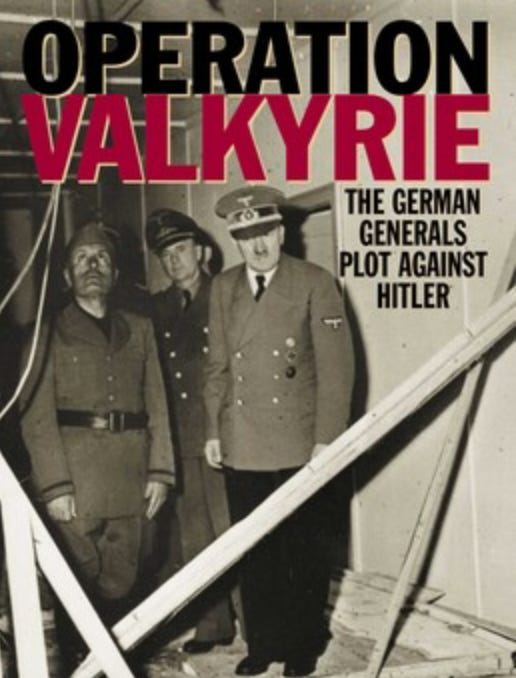
Operation Valkyrie was an internal security plan approved by Hitler, and German staff officers rewrote it between August 1943 and July 1944 into a coup blueprint. The attempt failed on July 20, 1944 for reasons that had little to do with the bomb and much to do with authority, authentication, and control of communications. More than 7,000 arrests followed, and the German officer corps ceased to function as an independent institution. The operative lesson for anyone who holds emergency authority documents is that a plan written to preserve an institution can be turned against that institution by the people trusted to hold the pen.
A. Executive Summary
The July 20, 1944 attempt on Hitler’s life failed at 12:42 pm inside a wooden briefing hut at the Wolfsschanze headquarters near Rastenburg in East Prussia. Roughly one kilogram of plastic explosive detonated beneath a heavy oak conference table. A stenographer and three officers died. Hitler walked out with a perforated eardrum, singed trousers, and conjunctivitis in one eye; the coup that depended on his death collapsed in Berlin over the following eleven hours.
The plan the conspirators used was not their own invention, and Valkyrie was drawn up inside the General Army Office under Friedrich Olbricht as an emergency plan for the Replacement Army, and it carried approval at the highest level of the German state. Its stated purpose was maintaining order during civil breakdown caused by Allied bombing, sabotage, or a rising among the more than seven million foreign workers and prisoners inside German industry. Authority to release the plan rested with two men: Hitler and Colonel General Friedrich Fromm, commander of the Replacement Army since 1938.
Henning von Tresckow drafted the supplementary orders that converted the plan into a coup instrument, working between August and September 1943, and those orders directed mobilized units onto ministries, telephone and telegraph exchanges, broadcasting sites, and Nazi Party offices. Claus von Stauffenberg refined the text after his appointment as chief of staff to Fromm on July 1, 1944, an appointment that delivered both access to Hitler’s briefings and proximity to the single signature that could release the plan. Three compounding failures then decided the day. Colonel Heinz Brandt moved the briefcase behind the table support, only one of two explosive packs was armed, and the communications blackout attempted by chief of communications Erich Fellgiebel did not cover the SS circuits that carried word to Berlin.
What followed was the most extensive internal purge of the German officer corps during the war, and scholarship differs sharply on the totals, and the difference matters for how the event is understood.
B. Detailed Findings
What was Operation Valkyrie designed to do before the conspirators changed it?
Valkyrie was an internal security and continuity plan for the Replacement Army, the training and depot organization that held Germany’s uniformed manpower inside the borders of the Reich. Its object was keeping state functions running during civil breakdown, whether caused by Allied bombing, sabotage, or a rising among the foreign labor force that exceeded seven million people by the summer of 1944. The plan was developed in the General Army Office under Friedrich Olbricht and approved at the top of the state. Execution authority rested with two men.
That authority structure is the whole story of July 20, and a plan releasable only by two named individuals carries a single point of failure by design; the conspirators understood the problem precisely. Their operational design reduced to one question: whether Fromm would sign, or whether his signature could be bypassed long enough to make the mobilization irreversible. Olbricht added a second stage after March 1943, identified in the orders as Valkyrie II, which converted alerted units into deployable battle groups. The original text addressed readiness only. The second stage addressed movement, and movement was what a coup required.
The original plan was legitimate. Every large state maintains arrangements for continuity when ordinary administration fails, and the German arrangement was neither unusual in concept nor secret in existence. The vulnerability lay in three properties combined. The plan mobilized armed formations inside the capital; it was activated by a written order rather than by a verified event; and the officers who drafted the implementing text were not the officers who held release authority. Those three properties together made subversion possible without a single forged document.
Who rewrote the plan, and when?
Henning von Tresckow drafted the supplementary orders that turned Valkyrie into a coup instrument, working between August and September 1943 while serving on the staff of Army Group Centre. The added text directed mobilized units to occupy ministries, telephone and telegraph exchanges, broadcasting stations, concentration camps, and Nazi Party headquarters, and documents recovered by Soviet forces and examined in later scholarship indicate Tresckow had the revised plan substantially complete before the end of 1943. That evidence revises the older account that credited Stauffenberg with primary authorship of the coup text. Stauffenberg refined and updated the orders through the spring of 1944.
Tresckow had already tried to kill Hitler. In March 1943 he and his adjutant Fabian von Schlabrendorff placed a British made explosive charge disguised as a package of brandy aboard Hitler’s aircraft as it left Smolensk. The detonator failed in the unheated baggage compartment; Schlabrendorff recovered the package the following day at considerable personal risk. Tresckow’s judgment about the value of a second attempt, delivered in July 1944, is the most quoted statement of the entire conspiracy. The assassination had to be attempted at any cost; even if it failed, the seizure of power in the capital had to be undertaken, because what mattered was that the German resistance had dared the decisive stroke before the world and before history.
Stauffenberg came to the conspiracy late and carried it operationally, and severely wounded in Tunisia in April 1943 he lost his left eye, his right hand, and two fingers of his left hand. He was appointed chief of staff to Fromm on July 1, 1944 and promoted to colonel, which placed him inside Hitler’s briefing conferences for the first time. That appointment is the hinge. A conspiracy that had spent years searching for a member with both access to the target and access to the release authority acquired both in a single personnel action, and it acted nineteen days later.
What actually happened at the Wolfsschanze on July 20, 1944?
Stauffenberg carried explosives to Hitler’s presence three times before July 20 without acting. On July 6 and again on July 11 at the Berghof he withheld, on the generally accepted account because Heinrich Himmler and Hermann Goering were not present and the conspirators had resolved to remove the succession at the same time. On July 15 he attended with the charge but the practical difficulty defeated him: arming the fuse required pliers worked with three fingers, and the operation could not be performed unobserved. By July 20 that had changed. The attempt would proceed whether or not the other principals attended.
The briefing convened in a wooden hut rather than the concrete bunker because of the summer heat, which dispersed rather than contained the blast. Twenty four officers stood around a large map table. Stauffenberg crushed a pencil detonator containing cupric chloride, a device that corroded a retaining wire over roughly ten minutes before releasing the firing pin, then placed the briefcase under the table and excused himself for a telephone call. He was interrupted while arming the charges and primed only one of the two packs he carried, and Colonel Heinz Brandt, needing room at the table, moved the briefcase to the far side of the heavy oak support.
The charge detonated at 12:42 pm. Brandt died of his injuries, as did two other officers and a stenographer, and more than twenty people were wounded; Hitler sustained a perforated eardrum, burns, and damage to one eye, and he was on the telephone within hours. Stauffenberg watched the explosion from outside, concluded that no one inside could have survived, bluffed his way past the outer checkpoints, and was airborne toward Berlin by about one o’clock. The flight took roughly three hours, and during those three hours the conspiracy had no leader in the capital and no verified information anywhere.
Why did the coup collapse in Berlin within eleven hours?
The coup collapsed because the conspirators lost the contest for authenticated communications, not because the bomb underperformed, and Erich Fellgiebel, chief of communications for the armed forces high command, attempted to isolate the Wolfsschanze from the telephone and teleprinter network. It failed. SS circuits remained open, word of Hitler’s survival reached Joseph Goebbels in Berlin, and Fellgiebel’s own report to General Fritz Thiele carried the operative fact in six words: something dreadful has happened, the Fuehrer lives.
Olbricht did not issue the Valkyrie mobilization orders until about four o’clock in the afternoon, more than three hours after the detonation, and Stauffenberg reached the Bendlerblock at approximately 4:40 pm and began telephoning district commanders personally, insisting Hitler was dead. Fromm, having confirmed by telephone that Hitler had survived, refused to release the plan and was placed under arrest by his own subordinates; the orders that did go out over the teleprinter reached commanders who were simultaneously receiving contrary instructions from Nazi Party channels. Two sets of orders arrived, both apparently valid; no mechanism existed for deciding between them.
The decisive moment came at roughly seven o’clock in the evening. Major Otto Ernst Remer, commanding the Guard Battalion Grossdeutschland, had been ordered to arrest Goebbels and instead found himself handed a telephone. Hitler spoke to him directly; Remer recognized the voice, and the battalion reversed sides within minutes. Remer was promoted to colonel on the spot. By about eleven o’clock that night his troops had ringed the Bendlerblock, officers inside had begun shooting at one another, and the conspiracy had ceased to exist as an organized enterprise.
Two operational omissions compounded the failure. The conspirators never seized the Berlin broadcasting facilities, which meant the state retained the only instrument capable of settling the central factual question for the entire country at once. They also never established a means by which a district commander could verify which of two competing orders was genuine. Naval nuclear practice aboard a fast attack submarine requires two independent persons to authenticate a release order before any action occurs, precisely because a chain of command under stress cannot distinguish a valid instruction from an invalid one by its appearance alone. The Valkyrie orders had no such property, and neither did the counterorders.
Who were the principal figures, and what did each of them decide?
Ludwig Beck resigned as chief of the Army General Staff in 1938 over Hitler’s war plans and was designated provisional head of state by the conspirators. At the Bendlerblock on the night of July 20 he asked to keep his pistol, fired twice at his own head, failed to kill himself, and was finished by a sergeant on Fromm’s instruction. Carl Friedrich Goerdeler, mayor of Leipzig from 1930 to 1937, was designated chancellor. He went into hiding, was arrested in August 1944, and was hanged at Ploetzensee on February 2, 1945, and Erwin von Witzleben, designated commander in chief, arrived at the Bendlerblock, observed that nothing was under control, argued with Stauffenberg, and left.
Friedrich Fromm is the study in institutional self preservation. He knew of the conspiracy, declined to join it, declined to report it, and moved decisively only once he had confirmed which side would win. Freed by loyalist troops shortly before midnight, he convened an impromptu court martial and had Olbricht, Stauffenberg, Werner von Haeften, and Albrecht Mertz von Quirnheim shot in the courtyard by the headlights of a staff car at about ten minutes past midnight on July 21. The speed served Fromm rather than the state, since the dead could not testify about what he had known and when, and SS officer Otto Skorzeny arrived twenty minutes later and stopped further shootings for exactly that reason. Fromm was tried, convicted, and executed by firing squad on March 12, 1945.
Tresckow drove to the front line near Ostrow on July 21, walked into no man’s land, and killed himself with a hand grenade to protect the network under interrogation. Fellgiebel refused under three weeks of torture to name a single conspirator, received a death sentence on August 10, 1944, and was executed at Ploetzensee on September 4. Remer ended the war as a major general, co founded the Socialist Reich Party in the Federal Republic, and remained a prominent extremist and Holocaust denier until his death in 1997. The moral distribution of the July 20 conspiracy does not sort neatly by rank, and it does not sort at all by who survived.
Erwin Rommel remains the most contested figure in the record. Peter Hoffmann concluded that Rommel had become a resolute opponent of Hitler and supported the coup; Ralf Georg Reuth concluded that the conspirators misread an ambiguous man who remained attached to the head of state. Ian Beckett found no credible evidence of more than limited and superficial knowledge, and Richard Evans concluded that Rommel knew of a plot without being part of it. Four points are documented. Rommel was strafed by Allied aircraft on July 17 and hospitalized; his name appeared in conspirators’ papers; he opposed assassination in favor of arrest and trial; and on October 14, 1944 he took cyanide rather than face the People’s Court. The state buried him with full military honors and left his family alone.
What did the conspirators intend to negotiate, and would the Allies have listened?
The strongest evidence against the conspirators’ political program is their own paperwork. Goerdeler’s peace proposals sought restoration of Germany’s 1914 frontiers together with permanent retention of Austria and the Sudetenland, return of the Polish Corridor and Memelland, and recovery of the African colonies. British officials who read his memoranda found the territorial claims incompatible with the war they were fighting, and one internal comment reduced the offer to a transaction in which the Allies delivered the goods and Germany issued promissory notes. Those terms were drafted by the man designated to lead the postwar German state. Any assessment of what a successful coup would have produced has to begin there.
The Allied position had also been fixed eighteen months before the bomb. At the Casablanca Conference of January 14 to 24, 1943, the American president announced at the closing press conference on January 24 that the war would end only with the unconditional surrender of Germany, Italy, and Japan. That formulation was designed to reassure the Soviet Union that no separate peace would be arranged in the west; it succeeded at that purpose, and it also removed the negotiating room the German conspirators had been trying to create since 1938. Adam von Trott zu Solz and others continued to seek contacts through Swedish, Swiss, and Vatican channels, and they were consistently told there was nothing to discuss.
Two readings of that policy have persisted in the scholarship, and the first holds that unconditional surrender prolonged the war by depriving German opponents of the regime of any achievable objective, and that the policy was therefore a strategic error with a measurable human cost. The second holds that no Allied government could have negotiated with a German successor state demanding 1914 borders while the Red Army was fighting toward Warsaw, and that the resistance overestimated its standing with governments that had watched the Munich settlement collapse. The second reading has the stronger documentary support. The first retains force on one narrow point: the policy was announced without consultation about its effect on internal German opposition, and no mechanism was ever built to test whether a credible alternative government could be identified.
The Western response to the attempt itself was cool. The British prime minister described the events to the House of Commons on August 2, 1944 as the highest personalities of the German state murdering one another while Allied armies closed on their shrinking circle of power. Official broadcasting treated the plot as evidence of German disintegration rather than as the emergence of a partner. No Allied government offered the conspirators recognition, terms, or public support before or after July 20, and the Soviet Union subsequently promoted a rival organization of captured German officers as the legitimate alternative.
How many people died in the purge, and why do the totals differ?
The Gestapo arrested more than 7,000 people in the weeks following the attempt, and the figure most frequently cited for executions connected to the investigation is 4,980. That total is contested because it counts a sweep far broader than the conspiracy. Arrests under the operation launched on July 22, 1944 gathered former political officeholders of the Weimar parties who had no connection to Valkyrie, and searches of conspirators’ homes produced letters and diaries that exposed earlier plots from 1938, 1939, and 1943. Estimates limited to persons with demonstrable involvement in the July 20 plot itself run between roughly 180 and 200 executed.
Both figures are correct within their own definitions, and the gap between them carries the analysis. A count of 4,980 measures what the state did with the opportunity. A count of 200 measures the size of the conspiracy. The state used a failed coup by roughly 200 people to eliminate a political class numbering in the thousands, which is the ordinary behavior of an unconstrained security apparatus presented with a pretext. Any modern reader assessing the exposure created by an internal plot should assume the response will be scoped by the investigating authority’s ambitions rather than by the plot’s actual membership.
The machinery was purpose built. Officers were first expelled from the army by a Court of Military Honor, which removed their entitlement to court martial, then delivered to the People’s Court under Roland Freisler. The first trials opened on August 7 and 8, 1944 in Berlin, with defendants stripped of uniforms, denied belts and dentures, and filmed for propaganda. Hitler directed that the condemned be hanged like cattle, and the executions at Ploetzensee were recorded on film. Himmler formalized collective family liability, and an order signed by Wilhelm Keitel on February 5, 1945 extended penalties up to death to the families of servicemen convicted of high treason.
What did the plot change about the German state and the German army?
The attempt destroyed the last institutional independence of the German army, and Himmler was given command of the Replacement Army, which placed the SS in direct control of the organization that had been the coup’s instrument. Every member of the armed forces was required to swear the personal oath again by name; the military salute was abolished and replaced with the Nazi Party salute effective July 24, 1944. Political officers modeled on the Soviet system were introduced into the command structure, and the officer corps spent the final ten months of the war under supervision rather than in command of itself.
The military consequence was a war fought to the end without any internal mechanism for stopping it. Between July 20, 1944 and the surrender in May 1945, German military and civilian deaths exceeded the total for the preceding five years by most reconstructions; the destruction of German industry, housing stock, and transport occurred overwhelmingly in that final period. The failure of the plot therefore has a measurable cost that is separable from its moral standing. The conspirators were correct that only removal of the head of state could end the war early; they were correct that no other actor inside Germany retained the capacity to attempt it.
West German reception of the plot took four decades to settle. An Allensbach survey in 1951 found only about one third of respondents holding a positive opinion of the conspirators; a proposal in 1956 to name a school after Stauffenberg was opposed by a majority of the town’s citizens. The first official state commemoration was held on the tenth anniversary in 1954, and the federal president’s address that year, which defended disobedience to unlawful orders as an act capable of historic greatness, marked the beginning of the shift. The first all German commemoration took place in 1990. The armed forces of the Federal Republic now swear recruits at the Bendlerblock courtyard on July 20 each year, on the ground where the four officers were shot.
Why does a failed coup from 1944 still matter to anyone running an institution today?
Valkyrie is the clearest documented case of a legitimate emergency plan repurposed by the people who wrote it, and the subversion required no forgery, no external actor, and no breach of any physical control. It required only that the drafting authority and the release authority sit in different offices, and that the drafters retain the pen. Thirty years of drafting crisis authority documents for companies developing sensitive technologies produces a consistent observation on this point: organizations spend their attention on who may invoke an emergency plan and almost none on who controls the implementing text between invocations.
Three properties made the plan subvertible, and all three recur in modern emergency arrangements. First, the plan mobilized real capability rather than merely conferring status, which meant that executing it produced facts on the ground before anyone could evaluate the underlying justification. Second, it activated on a written order rather than on a verified condition, so no independent event had to occur for the plan to become operative. Third, the implementing annexes could be revised by staff without the approval authority reading them, which is how occupation of broadcasting stations entered a document about civil order.
The counterargument deserves a full hearing. Emergency plans exist because ordinary decision procedures fail under time pressure, and any plan hardened enough to resist subversion is generally too slow to serve its purpose. A continuity plan requiring multiparty authentication, verified triggering conditions, and change control over every annex will not execute in the four hours available during an actual crisis. That tension is real and it does not resolve cleanly. What the July 20 record establishes is that the tradeoff should be made deliberately and reviewed by the people who bear the risk, rather than inherited from a document that no principal has read since it was approved.
The second lasting lesson concerns information rather than authority. The conspiracy controlled troops, ministries, and telephone exchanges in Berlin for several hours and still lost, because it never controlled the answer to a single binary question that every participant needed settled. Whoever can authenticate the state of the world commands the outcome; that capacity is distinct from formal authority, physical control, and force. A modern equivalent sits in identity systems, out of band verification channels, and the ability to confirm that an instruction originated where it claims. The party that owns authentication owns the decision, and on July 20, 1944 that party was on the telephone from East Prussia.
Source List
1. Records and orders of the Replacement Army and the General Army Office relating to Operation Valkyrie, including the supplementary orders drafted between August and September 1943, held in German federal military archives. Primary planning documents establishing the plan’s original purpose, its two stage structure, and the text of the coup annexes.
2. Proceedings and filmed record of the People’s Court trials of August 1944 and after, presided over by Roland Freisler, together with the Gestapo investigation reports compiled for the Reich Security Main Office. Contemporaneous state records establishing the scope of the purge, the legal mechanism used, and the identities of those tried.
3. Keitel order of February 5, 1945 extending penalties to families of servicemen convicted of high treason, and the July 1944 orders replacing the military salute and requiring renewal of the personal oath. Primary documents establishing the institutional consequences for the armed forces.
4. Peter Hoffmann, The History of the German Resistance 1933 to 1945. The standard scholarly reconstruction of the conspiracy, its planning documents, and the July 20 timeline, by the historian who has worked longest in the primary record.
5. Peter Hoffmann, Stauffenberg: A Family History, 1905 to 1944. Authoritative biography establishing Stauffenberg’s appointment chronology, his injuries, and his role in refining the Valkyrie annexes.
6. Nigel Jones, Operation Valkyrie: A Military History of the 20 July 1944 Plot. Recent military historical treatment drawing on documentation recovered by Soviet forces and reassessing the authorship of the revised plan.
7. Ian Kershaw, Hitler: 1936 to 1945, Nemesis. Standard biographical scholarship on the events at the Wolfsschanze, the state’s response, and the concentration of authority in the SS after July 20.
8. Fabian von Schlabrendorff, The Secret War Against Hitler. First person account by Tresckow’s adjutant and a survivor of the purge, and the principal source for the March 1943 aircraft bomb.
9. Richard J. Evans, The Third Reich at War. Peer reviewed synthesis addressing the purge, the reach of collective family liability, and the contested question of Rommel’s involvement.
10. Ralf Georg Reuth, Rommel: The End of a Legend, and Ian Beckett, Rommel: A Reappraisal. The two principal revisionist treatments arguing against material Rommel involvement in the conspiracy.
11. United States Holocaust Memorial Museum, Holocaust Encyclopedia entry on the July 20, 1944 plot. Institutional reference work with editorial accountability, used for arrest and execution figures and for the plan’s original purpose.
12. German Resistance Memorial Center, Bendlerblock, Berlin. Institutional documentation of the conspirators, the site, and the postwar commemorative record of the Federal Republic.
13. Foreign Relations of the United States, The Conferences at Washington, 1941 to 1942, and Casablanca, 1943. Official documentary series establishing the conference dates and the unconditional surrender announcement of January 24, 1943.
14. Hansard, House of Commons Official Report, August 2, 1944. Verbatim parliamentary record of the British government’s public characterization of the attempt.
15. Institut fuer Demoskopie Allensbach survey data, 1951, and Federal Republic commemorative records from 1954 onward. Polling and official records documenting the slow shift in West German public opinion toward the conspirators.
Bibliography
Beckett, Ian F. W. Rommel: A Reappraisal. Barnsley: Pen and Sword Military, 2013.
Bundesarchiv Militaerarchiv, Freiburg im Breisgau. Records of the Allgemeines Heeresamt and the Ersatzheer relating to Operation Walkuere, 1942 to 1944.
Evans, Richard J. The Third Reich at War, 1939 to 1945. New York: Penguin Press, 2009.
Gedenkstaette Deutscher Widerstand. Documentation and permanent exhibition, Bendlerblock, Berlin. Accessed August 2026. https://www.gdw-berlin.de/en/.
Hoffmann, Peter. The History of the German Resistance, 1933 to 1945. 3rd ed. Montreal: McGill Queen’s University Press, 1996.
Hoffmann, Peter. Stauffenberg: A Family History, 1905 to 1944. 3rd ed. Montreal: McGill Queen’s University Press, 2008.
Institut fuer Demoskopie Allensbach. Survey data on public attitudes toward the July 20, 1944 conspirators. Allensbach, 1951.
Jones, Nigel. Operation Valkyrie: A Military History of the 20 July 1944 Plot. Berlin: De Gruyter Oldenbourg, 2021.
Kershaw, Ian. Hitler, 1936 to 1945: Nemesis. New York: W. W. Norton, 2000.
Reuth, Ralf Georg. Rommel: The End of a Legend. London: Haus Publishing, 2005.
Schlabrendorff, Fabian von. The Secret War Against Hitler. Translated by Hilda Simon. New York: Pitman, 1965.
United Kingdom. Parliament. House of Commons. Parliamentary Debates, 5th ser., vol. 402. London: HMSO, August 2, 1944.
United States Department of State. Foreign Relations of the United States: The Conferences at Washington, 1941 to 1942, and Casablanca, 1943. Washington: Government Printing Office, 1968.
United States Holocaust Memorial Museum. “The July 20, 1944, Plot to Assassinate Adolf Hitler.” Holocaust Encyclopedia. Accessed August 2026. https://encyclopedia.ushmm.org/content/en/article/the-july-20-1944-plot-to-assassinate-adolf-hitler.
Wheeler Bennett, John W. The Nemesis of Power: The German Army in Politics, 1918 to 1945. London: Macmillan, 1953.