Prepared by The Innovation Attorney | March 2026
A. Executive Summary
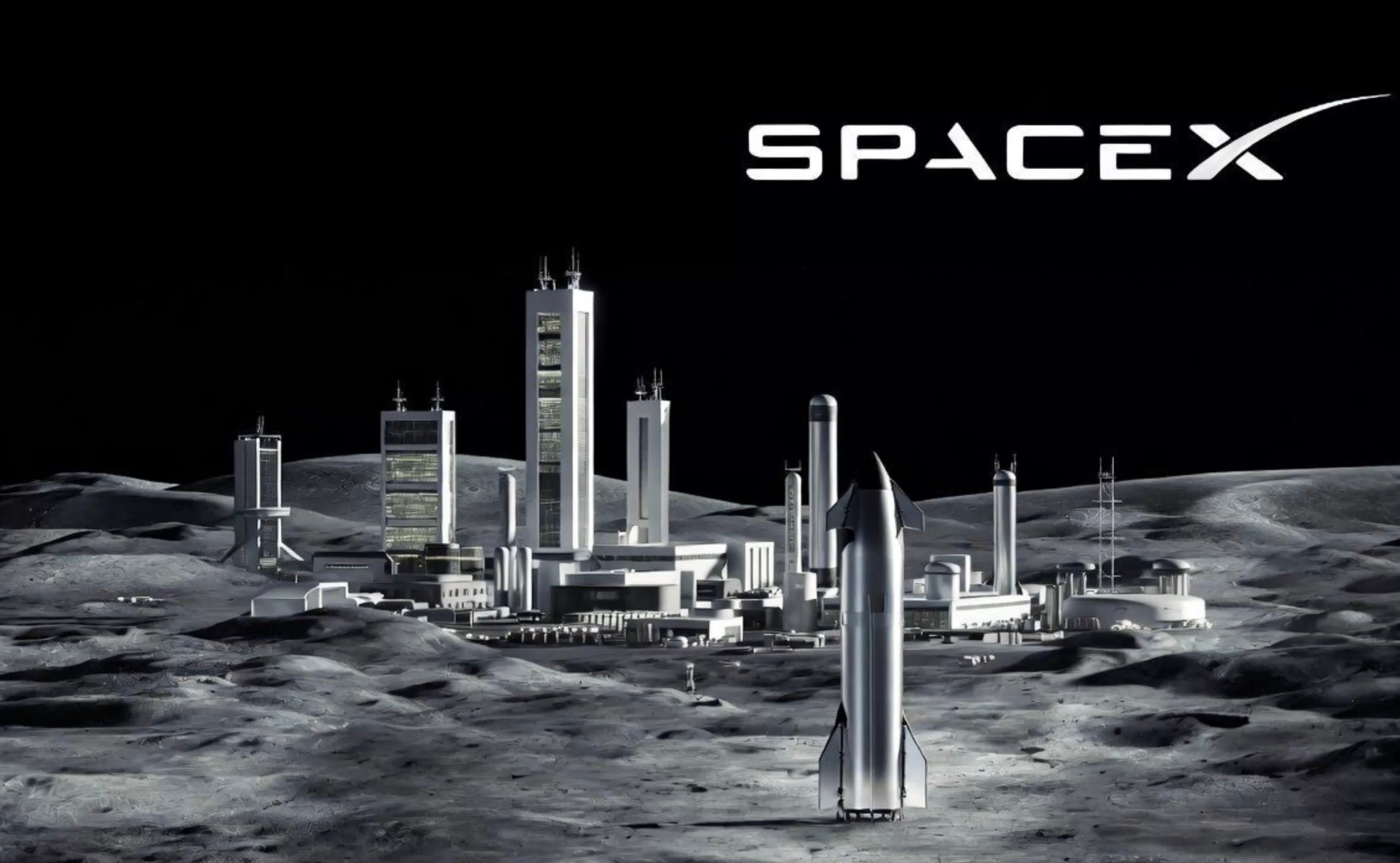
On February 8 and 9, 2026, SpaceX chief executive Elon Musk announced that the company was formally redirecting its long-term settlement ambitions away from Mars and toward the Moon. The stated goal is a self-sustaining, self-growing lunar city to be operational within ten years, at an estimated capital cost of between $100 billion and $500 billion. The strategic rationale is rooted in logistics: the Moon offers a 10-day resupply cycle versus the 26-month synodic window for Mars, enabling an iteration rate that is roughly 13 times faster. That compounding advantage, combined with confirmed water ice deposits at the lunar south pole sufficient to produce both propellant and life support consumables in situ, transforms the Moon from a destination into a platform for proving and scaling the entire commercial space supply chain.
The engineering path runs through Starship, SpaceX’s fully reusable heavy-lift vehicle. Each lunar cargo mission currently requires 10 to 15 tanker flights in low Earth orbit to load 1,200 tons of liquid methane and liquid oxygen before the ship departs for the Moon. Starship Version 3 delivers 100 metric tons to the lunar surface per flight; Version 4, targeted for 2027, is designed to raise that figure to 200 metric tons while cutting required tanker flights to 5 or 6. The first 20 to 30 missions are planned as uncrewed cargo runs, establishing solar power arrays, nuclear fission backup power, in situ resource utilization (ISRU) equipment, and pressurized habitat modules. Each landed Starship vehicle, standing 50 meters tall and enclosing 1,100 cubic meters of pressurized volume, is intended to remain on the surface as permanent infrastructure.
The commercial economics hinge on a single transformation: once ISRU propellant production reaches operational scale, the tanker requirement per mission drops from approximately 15 to approximately 4. Every ton of oxygen and hydrogen produced on the Moon frees one ton of Earth-launched payload capacity for construction hardware, food systems, and mining equipment. The base then begins to finance its own expansion through compounding logistics savings. SpaceX, currently valued at approximately one trillion dollars, is betting that proving this supply chain at the Moon will build the operational playbook and investor confidence required for the longer and riskier Mars program.
B. Detailed Findings
B.1 Site Selection and Resource Geography
SpaceX has identified the rims and floors of south polar craters, principally Shackleton and Cabeus, as the primary construction zones. The engineering logic is threefold. First, NASA scientists estimate that 600 million metric tons of water ice are deposited in permanently shadowed crater floors under approximately 40 centimeters of dry regolith, providing the feedstock for oxygen, drinking water, radiation shielding mass, and 78 percent of the propellant mass for methalox rockets. Second, crater rim elevations receive near-continuous solar illumination for most of the lunar year, making them the most viable sites for photovoltaic power generation on a world where equatorial locations experience 14-day night cycles with temperatures dropping to minus 173 degrees Celsius. Third, constructing at the pole minimizes thermal cycling stress on materials and structures compared to equatorial sites where surface temperatures swing by 400 degrees Celsius between day and night.
The Intuitive Machines IM-2 mission, launched in early 2025, carried a suite of instruments including a NASA drill payload designed to prospect for water ice at Malapert Massif near the south pole. Results from that mission and the concurrent Lunar Trailblazer water-mapping orbiter are expected to sharpen the resource map SpaceX will use for ISRU site selection.
B.2 Starship Vehicle Architecture and Payload Capacity
Starship is a two-stage, fully reusable vehicle consisting of the Super Heavy booster and the Starship upper stage. In its cargo variant for lunar surface delivery, the upper stage is optimized for propellant storage and landing legs rather than crew systems. Key performance parameters as of early 2026 are as follows.
• Starship Version 3 lands approximately 100 metric tons per flight on the lunar surface.
• Starship Version 4, targeted for a 2027 debut, is designed to deliver 200 metric tons per landing and to require only 5 to 6 orbital propellant transfers rather than the current 10 to 15, because of improved fuel efficiency targeting 20 percent propellant reserve at departure.
• Each landed Starship vehicle measures 50 meters in height and 9 meters in diameter and encloses 1,100 cubic meters of pressurized volume. By comparison, the International Space Station contains 916 cubic meters of habitable volume assembled over 13 years. Three landed Starships immediately exceed that figure.
• The Starship Human Landing System (HLS) variant docks in near-rectilinear halo orbit with an Orion capsule or a propellant depot before descending to the surface.
A NASA Office of Inspector General audit released in March 2026 confirmed that the Starship HLS program faces additional delays and is unlikely to meet a June 2027 milestone. The first crewed Artemis III landing is now targeted no earlier than 2028. An uncrewed Starship HLS demonstration flight, including in-orbit propellant transfer, is a prerequisite for that crewed mission.
B.3 Orbital Propellant Transfer and Logistics Chain
The most technically novel element of the SpaceX lunar architecture is on-orbit cryogenic propellant transfer. A single lunar cargo mission under current parameters requires a Starship depot to be parked in low Earth orbit and filled by 10 to 15 Starship tanker flights, each launched within a tight window to minimize boiloff of liquid methane and liquid oxygen. The tanker flights must be rapid and sequential because cryogenic boiloff losses compound over time in the thermal environment of low Earth orbit.
SpaceX has not yet demonstrated ship-to-ship propellant transfer at scale. The required demonstration campaign, originally planned for mid-2025, has been delayed. This remains the single most critical undemonstrated technical milestone between the current program state and the first uncrewed lunar landing. Without demonstrated on-orbit transfer, no lunar mission of the required scale is achievable.
The commercial significance of this logistics architecture is substantial. At a nominal launch cost of $100 million per Starship mission and 15 tanker flights per lunar delivery, the logistics overhead per cargo delivery is approximately $1.5 billion before accounting for the cost of the cargo Starship itself. Reducing tanker flights from 15 to 4 through Version 4 improvements cuts that overhead by roughly 73 percent. Every iteration of the Starship vehicle therefore has direct and calculable impact on the cost per kilogram delivered to the lunar surface and on the economic viability of the entire program.
B.4 In Situ Resource Utilization: The Economic Inflection Point
ISRU is the mechanism by which the lunar city transitions from a heavily Earth-subsidized outpost to a commercially self-reinforcing operation. The core process is electrolysis of water extracted from permanently shadowed crater regolith, splitting H2O into hydrogen and oxygen using electrical power generated from solar arrays on the crater rim. The oxygen is the critical product: it constitutes approximately 78 percent of the mass of methalox propellant by weight. Producing oxygen locally eliminates the need to launch that mass from Earth on every resupply mission.
The economic cascade works as follows. Each ton of oxygen produced on the Moon frees one ton of payload capacity on the next inbound Starship, which can instead carry additional ISRU equipment, agricultural systems, or construction hardware. That additional hardware increases production capacity, which frees more payload capacity on subsequent flights. The base begins to fund its own expansion through compounding logistics savings rather than requiring proportionally increasing Earth investment. Musk has described this as the system becoming self-growing, meaning that each delivery makes the next delivery more economically efficient.
ISRU technology at the required scale has not yet been demonstrated on the lunar surface. The primary technical obstacles are mining frozen regolith at temperatures below minus 230 degrees Celsius, separating ice from mineral grains without losing water to sublimation in the vacuum environment, and operating electrolysis systems continuously through the 14-day lunar night using stored power or nuclear backup. Current flight-ready nuclear fission reactors produce between 1 and 10 kilowatts, which is far below the hundreds of kilowatts a growing ISRU operation would require.
B.5 Power Systems: Solar, Nuclear, and the Lunar Night Problem
Power is the foundational constraint on every aspect of lunar city construction and operation. Solar photovoltaic arrays sited on south polar crater rims receive near-continuous illumination and represent the primary power source for early mission phases. SpaceX plans to target 100 kilowatts or more of continuous solar capacity in the initial uncrewed buildup phase. However, even near-polar crater rims experience periodic shadowing, and a growing base cannot rely solely on solar power.
The lunar night challenge at equatorial or non-polar sites is severe: 14 Earth days of darkness at temperatures reaching minus 173 degrees Celsius would kill all solar generation and freeze or damage unprotected systems. At polar sites the situation is better but not eliminated. Nuclear fission reactors are the planned backup and eventual primary baseload power source as the base scales. NASA’s Kilopower and follow-on fission surface power programs are developing reactors in the 10 to 40 kilowatt range. Scaling to the megawatt class required by a city-scale operation represents a major engineering gap that has not been publicly bridged by any existing program.
B.6 Construction Methods: Landed Starships, Robotics, and Regolith Printing
SpaceX’s construction strategy for the first phase relies on treating each landed Starship as a permanent pressurized structure. Because the vehicles are not designed to return to Earth from the lunar surface in the early cargo configuration, each one contributes immediately to the pressurized habitat inventory. The first 20 to 30 uncrewed cargo missions deliver solar arrays, nuclear reactor units, ISRU rigs, pressurized habitat modules attachable to the Starship airlock systems, and autonomous rovers.
Autonomous robotic systems, including Tesla Optimus humanoid robots mentioned in Musk’s public communications about Moonbase Alpha, are planned to perform the majority of surface construction prior to human arrival. Regolith-based additive manufacturing (3D printing using sintered lunar soil) is a proposed method for building radiation shielding berms and structural walls around habitat modules. Concentrated solar heat or microwave sintering can fuse lunar regolith into structural material without requiring Earth-launched cement or steel. This is a technology that has been demonstrated at laboratory scale but not yet in the lunar thermal and vacuum environment.
B.7 Unresolved Engineering Challenges
Lunar Dust
Lunar regolith particles are electrostatically charged, angular, and less than 20 microns in size, giving them the abrasive properties of ground glass. They adhere to surfaces through electrostatic attraction, penetrate mechanical seals, clog filtration systems, and embed in respiratory tissue. NASA research has documented that no long-duration dust mitigation system currently exists that is ready for flight. This is not a minor engineering inconvenience. It is a potential program-stopping challenge because it affects every mechanical system on the surface, every spacesuit, every airlock, and every piece of life support equipment.
Radiation Exposure
The lunar surface receives approximately 200 times Earth’s radiation dose because the Moon has no global magnetic field and no substantial atmosphere to attenuate charged particle flux and galactic cosmic rays. Habitats may need to be buried 2 to 3 meters below the regolith surface to bring long-duration occupant radiation exposure to acceptable levels. Subsurface construction adds enormous complexity and mass requirements to the construction timeline.
Long-Duration Low-Gravity Physiology
The effects of years or decades of habitation at one-sixth of Earth’s gravity on human bone density, cardiovascular function, muscle mass, and vestibular systems are completely unknown. The longest human exposure to lunar gravity on record is 74 hours from Apollo 17. A city assumes indefinite residence. The medical and life support systems required to manage these effects, and the question of whether humans can remain permanently healthy at lunar gravity, is an open question with no currently available answer.
B.8 Commercial Economics and Investment Context
SpaceX is currently valued at approximately one trillion dollars following its most recent private funding rounds. The lunar city program is positioned to investors not as a near-term revenue generator but as a capital infrastructure investment that unlocks downstream commercial opportunities in propellant production, telecommunications relay, scientific platform services, and eventually tourism and permanent residency.
The total capital cost estimate of $100 billion to $500 billion over a decade implies an average annual expenditure of $10 billion to $50 billion, roughly comparable to the combined annual budgets of NASA and the European Space Agency. No single company has previously financed infrastructure at this scale without government partnership. SpaceX’s NASA contracts for the Artemis Human Landing System and commercial lunar payload delivery services represent a meaningful fraction of the early mission economics, but they do not scale to city-level construction.
The commercial model described in the attached source document relies on the compounding effect described in Section B.4: ISRU-driven propellant production progressively reduces the per-mission cost of lunar access, making the base increasingly affordable to expand. If propellant production reaches the scale needed to serve arriving Starships, the lunar city becomes a fueling hub for onward missions to Mars and the asteroid belt, creating a strategic asset whose value extends far beyond the Moon itself.
B.9 Program Timeline as Currently Projected
1. 2027: First uncrewed Starship cargo landing on the lunar surface, as communicated to SpaceX investors in March 2027 projections.
2. 2028 to 2030: Robotic cargo buildup phase. Thirty to fifty uncrewed deliveries establish solar power, nuclear backup, ISRU prototype operations, and the first pressurized habitat cluster.
3. 2030 to 2032: First human crews arrive, initially 6 to 12 persons on 6-month rotations, focused on equipment maintenance and scaling propellant production.
4. 2033 to 2035: Permanent population reaches 50 to 100 persons. A low lunar orbit propellant depot becomes operational, allowing arriving Starships to refuel before final descent and reducing surface-to-orbit mass requirements.
5. 2035 onward: Population exceeds 100. Agricultural systems come online. The base approaches partial self-sufficiency in food and propellant.
These projections assume successful on-orbit propellant transfer demonstration, sustained Starship flight cadence at commercial rates, no program-stopping regulatory or safety interruptions, and successful ISRU technology maturation. Historical spaceflight programs have consistently required more time and capital than initial projections.
C. Source List
Primary Technical and Agency Sources
6. SpaceX, “Mission: Moon,” SpaceX official website (accessed March 2026): https://www.spacex.com/humanspaceflight/moon. Primary source on Starship HLS mission architecture.
7. NASA Office of Inspector General, audit report on Starship HLS program delays (March 2026): https://www.bloomberg.com/news/articles/2026-03-10. Official government assessment of program status and timeline risk.
8. NASA, “Dust: An Out-of-This-World Problem,” NASA Human Research Program publication: https://www.nasa.gov/humans-in-space/dust-an-out-of-this-world-problem/. Authoritative documentation of lunar dust hazard.
9. Jones, Harry W., “Take Material to Space or Make It There?” NASA Technical Reports Server (2023): https://ntrs.nasa.gov/api/citations/20230013555. ISRU versus Earth-launch trade analysis.
Reputable Science and Engineering Publications
10. Space.com, “A city on the moon: Why SpaceX shifted its focus away from Mars” (2026): https://www.space.com/astronomy/moon/a-city-on-the-moon-why-spacex-shifted-its-focus-away-from-mars. Detailed technical analysis of the strategic pivot.
11. Scientific American, “Elon Musk says SpaceX will prioritize establishing a city on the moon instead of building a Mars colony” (2026): https://www.scientificamerican.com/article/elon-musk-says-spacex-to-prioritize-landing-on-the-moon-instead-of-mars-city/. Reporting on the February 2026 announcement.
12. npj Space Exploration, “Key technological challenges and systemic solutions for lunar base energy systems” (2026): https://www.nature.com/articles/s44453-026-00030-3. Peer-reviewed analysis of power system constraints.
13. Wikipedia, “Starship HLS,” continuously updated: https://en.wikipedia.org/wiki/Starship_HLS. Comprehensive technical reference for mission architecture and timeline.
News and Industry Sources
14. Bloomberg Law, “NASA plans bigger SpaceX moon mission role” (March 19, 2026): https://www.bloomberg.com/news/articles/2026-03-19/nasa-plans-bigger-spacex-moon-mission-role-in-blow-to-boeing. Breaking news on NASA program restructuring.
15. Interesting Engineering, “As Starship prepares to fly, orbital refueling may be its biggest threat”: https://interestingengineering.com/space/starship-spacex-launch-test-flight. Technical assessment of on-orbit propellant transfer risks.
16. Elon Musk, attached source document provided by client: “A city on the Moon will cost somewhere between $100B and $500B...” Firsthand technical narrative authored by the project lead.
D. Open Questions
17. Can on-orbit cryogenic propellant transfer be demonstrated at the scale required for lunar missions? This is the critical near-term technical gate. Without a successful ship-to-ship transfer demonstration, no Starship lunar landing of meaningful cargo mass is achievable. The demonstration has already been delayed from its original 2025 target. Every month of further delay pushes the entire program timeline.
18. At what cost and cadence can Starship achieve commercial launch rates? The economics of the entire lunar city model depend on dramatically lowering the cost per kilogram to the lunar surface. If the Starship program cannot achieve a launch cadence of multiple flights per week and a cost per launch of under $50 million, the 10-to-15-tanker-flights-per-lunar-mission overhead makes the program economically unsustainable without permanent and massive government subsidy.
19. Can ISRU water ice extraction be demonstrated at commercially relevant throughput? Laboratory demonstrations of regolith electrolysis and ice extraction exist. No system has operated in the actual lunar thermal and vacuum environment. The economic inflection point of the lunar city model requires ISRU to reach production scale within the first decade. The gap between laboratory readiness and operational scale remains very large.
20. What is the commercial funding structure beyond NASA contracts? SpaceX’s Artemis HLS and commercial lunar payload service contracts represent billions of dollars in government revenue but are insufficient to fund a city. Private capital at the scale of $100 billion to $500 billion over a decade will require either SpaceX to go public, a sovereign wealth fund partnership, or a new category of space infrastructure bond. None of these mechanisms currently exist at the required scale.
21. How will dust mitigation be solved for long-duration operations? Lunar dust is arguably the most underappreciated engineering constraint on the entire program. It affects every mechanical seal, every spacesuit, every optical system, every ISRU component, and every human respiratory system. No flight-ready long-duration mitigation system exists. This challenge does not have a publicly identified solution pathway with a credible timeline.
22. What are the health effects of permanent habitation at one-sixth gravity? The longest human lunar surface exposure on record is approximately 74 hours. A city implies permanent residency. There are no data on what years of 1/6 gravity do to human physiology. If the answer is that permanent lunar habitation is medically unsafe, the entire premise of a city rather than a rotating research outpost is called into question.
E. Bibliography
Elon Musk, unpublished narrative, “A city on the Moon will cost somewhere between $100B and $500B” (provided by client, 2026).
Interesting Engineering. “As Starship prepares to fly, orbital refueling may be its biggest threat.” Interesting Engineering. https://interestingengineering.com/space/starship-spacex-launch-test-flight.
Jones, Harry W. “Take Material to Space or Make It There?” NASA Technical Reports Server, 2023. https://ntrs.nasa.gov/api/citations/20230013555.
NASA. “Dust: An Out-of-This-World Problem.” NASA Human Research Program. https://www.nasa.gov/humans-in-space/dust-an-out-of-this-world-problem/.
NASA Office of Inspector General. Audit of Starship HLS Program. March 2026. https://www.bloomberg.com/news/articles/2026-03-10.
npj Space Exploration. “Key technological challenges and systemic solutions for lunar base energy systems designed for long-term deployment needs.” Nature, 2026. https://www.nature.com/articles/s44453-026-00030-3.
Patel, Neel V. “NASA plans bigger SpaceX moon mission role in blow to Boeing.” Bloomberg, March 19, 2026. https://www.bloomberg.com/news/articles/2026-03-19.
Scientific American. “Elon Musk says SpaceX will prioritize establishing a city on the moon instead of building a Mars colony.” Scientific American, 2026. https://www.scientificamerican.com/article/elon-musk-says-spacex-to-prioritize-landing-on-the-moon-instead-of-mars-city/.
Space.com. “A city on the moon: Why SpaceX shifted its focus away from Mars.” Space.com, 2026. https://www.space.com/astronomy/moon/a-city-on-the-moon-why-spacex-shifted-its-focus-away-from-mars.
SpaceX. “Mission: Moon.” SpaceX.com. https://www.spacex.com/humanspaceflight/moon. Accessed March 2026.
Wikipedia. “Starship HLS.” Wikimedia Foundation. https://en.wikipedia.org/wiki/Starship_HLS. Accessed March 2026.
Interested in analysis about the intersection of tech, policy and the law? Check out my Substack channel. https://theinnovationattorney.substack.com/