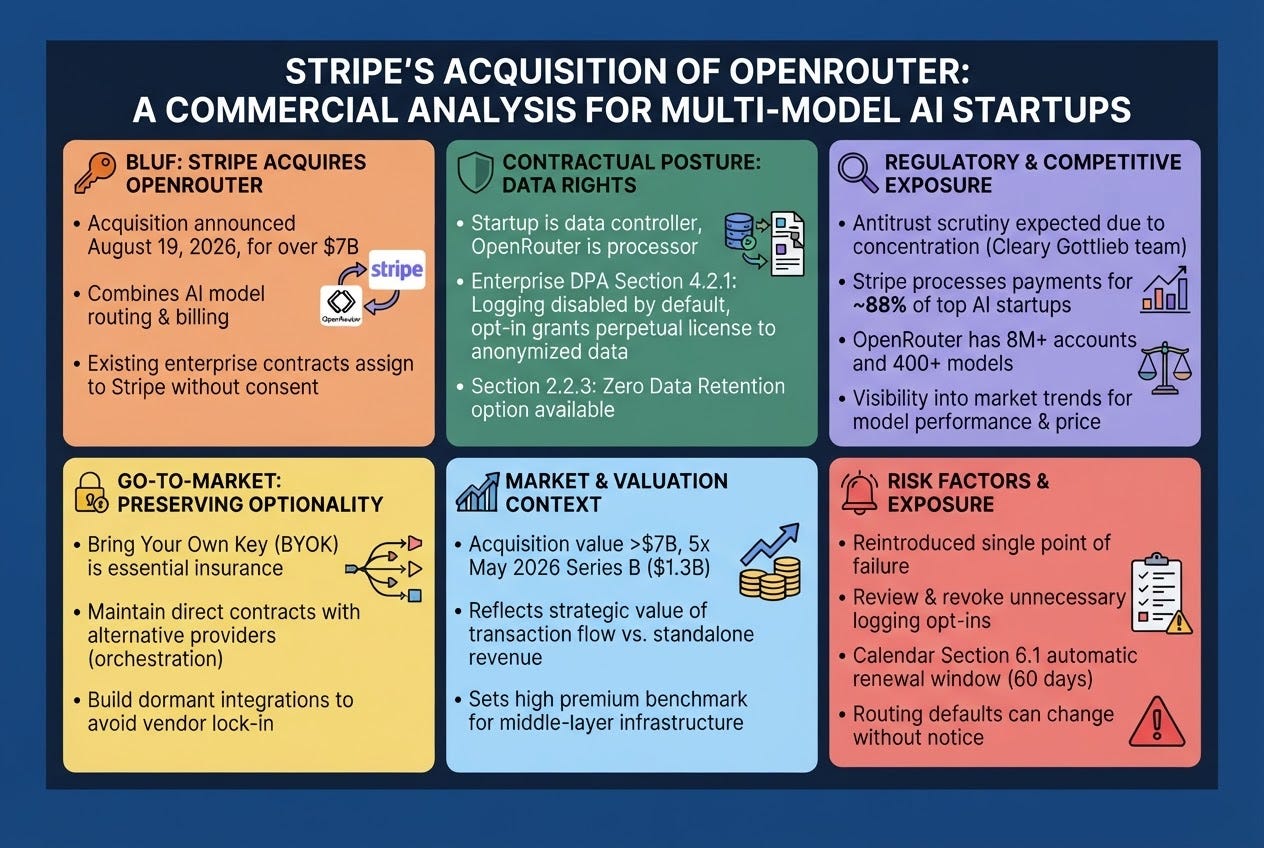
Stripe’s agreement to acquire OpenRouter for more than $7 billion, announced on August 19, 2026, places the metering, billing, and routing layer that many startups use to reach competing AI models inside the commercial structure of a single payments company. The acquisition does not rewrite OpenRouter’s published enterprise contract today, but it does activate an assignment clause that lets the existing agreement transfer to Stripe without the customer’s separate consent. Any founder or general counsel whose product depends on OpenRouter’s routing across more than 400 models now has a narrow window to read that contract, confirm its data handling terms, and decide whether multi-model independence survives a single-owner routing layer.
A. Executive Summary
Stripe’s agreement to acquire OpenRouter for more than $7 billion, announced on August 19, 2026, requires every startup routing AI traffic through the platform to audit its data processing agreement. OpenRouter connects customer applications to more than 400 AI models from more than 80 providers, and the enterprise version of that service already contains an assignment clause, at section 11.8 of its terms, that permits a merger or an asset sale to transfer the contract without the customer’s individual consent. Stripe’s own August 19 announcement names NVIDIA, Zoom, and Lovable as existing customers of the combined offering, and OpenRouter’s chief executive stated publicly that the company would keep its current name, product, and roadmap.
The assignment clause already resolves whether the contract survives the deal. The routing defaults, the fee structure, and the data handling commitments that made OpenRouter useful in the first place now have to survive contact with a payments company that already processed OpenRouter’s own billing before the acquisition and that counts a large share of the current generation of well funded AI companies among its payment customers. This report sets out the established facts of the transaction, the specific contract terms a multi-model customer should review before the deal closes, the antitrust and data privacy exposure that the transaction’s own counsel staffing indicates, and the go to market choices available to a company that wants to preserve optionality across model providers regardless of who owns the routing layer.
OpenRouter’s prior financing, a $113 million Series B round in May 2026 that valued the company at $1.3 billion, makes the acquisition price more than five times that mark roughly three months later, a valuation jump that carries its own commercial information about what Stripe believes the routing layer is worth once it sits beside a billing system Stripe already owns.
B. Detailed Findings
Intellectual Property, Data Rights, and Contractual Posture
The document that controls a multi-model startup’s position after this acquisition is not the acquisition agreement itself: it is the enterprise Data Processing Agreement OpenRouter already has in place with its customers. Under that agreement, the customer is the data controller and OpenRouter is the processor, so OpenRouter may handle customer prompts and completions only on the customer’s documented instructions. Section 4.2.1 keeps prompt and chat logging disabled by default; a customer must affirmatively opt in through the admin dashboard before OpenRouter retains any input content beyond the categorization step needed to route the request. Opting in carries a cost the contract states plainly: once logging is enabled, the same section grants OpenRouter a broad, perpetual, irrevocable, and sublicensable license to the resulting de-identified and aggregated content, including the right to license or sell anonymized user content that is not tied back to the customer. Section 2.2.3 separately lets a customer select Zero Data Retention to opt out of having an underlying model provider train on its inputs and outputs, an option that is available but not the default state of an account.
The clause with the most immediate consequence for this transaction is section 11.8, the assignment provision. It bars either party from assigning the agreement without the other party’s consent, with one carve out: an assignment to an entity that merges with OpenRouter or that acquires all or substantially all of its assets requires no customer consent at all. That carve out is what lets Stripe absorb OpenRouter’s existing enterprise book of business without renegotiating individual contracts one at a time, and a customer who wants to raise an objection before the data processing terms change has no contractual right to demand that conversation. Section 7.2 separately permits either party to disclose the agreement’s terms in confidence to an actual or prospective acquirer, the provision that let Stripe conduct diligence on OpenRouter’s customer contracts before signing. Cleary Gottlieb’s public description of its deal team for OpenRouter names a dedicated intellectual property and data privacy practice group alongside its antitrust group, staffing that indicates contract portability and data rights were negotiated issues in the transaction rather than an afterthought.
Regulatory and Competitive Exposure
Antitrust review is already a live consideration in this transaction. The Cleary Gottlieb team representing OpenRouter in the sale includes a named antitrust partner, staffing that would not appear on a deal of this kind absent an expectation of regulatory scrutiny. The underlying commercial fact that generates that scrutiny is concentration: Stripe’s own August 19 announcement states that eighty eight percent of the companies on a recent ranking of the fifty most valuable private AI companies already use Stripe for payments, and OpenRouter brings roughly 8 million developer accounts and connections to more than 400 models into the same corporate family. Combining the metering and billing layer with the routing layer gives one company visibility into which AI models are winning which workloads and at what price, a form of market information no single routing vendor or payments vendor holds on its own today.
Data privacy exposure sits beside the antitrust question. OpenRouter’s enterprise Data Processing Agreement already commits to Standard Contractual Clauses and a United Kingdom international transfer addendum for cross border transfers, to notifying customers of new subprocessors with thirty days to object, and to notifying a customer of a legally binding government request for that customer’s data unless the law forbids disclosure. None of those commitments is automatically void because OpenRouter’s parent changes. What changes, as a practical matter, is the subprocessor list itself: once OpenRouter sits inside Stripe’s corporate structure, Stripe affiliates handling payment, tax, or billing functions may need to be added to that list, which triggers the thirty day objection window and gives an enterprise customer a concrete, time limited opportunity to review the new arrangement rather than simply filing a notice away unread.
Go to Market and Commercial Structure
A startup that built its product on OpenRouter’s promise of switching between competing models without rewriting integration code now faces a go to market choice that did not exist in the same form before the acquisition was announced. Bring your own key, the feature that lets a customer route through OpenRouter using its own direct account and pricing with an individual model provider rather than OpenRouter’s blended account, remains the most direct insurance against a single owner controlling the routing layer. A startup that already holds direct contracts with two or three model providers and uses OpenRouter only for orchestration keeps the ability to route around OpenRouter entirely if its terms change. A startup that routes exclusively through OpenRouter’s own blended account has delegated both its vendor selection and its negotiating position to a platform a payments company now owns, a position that becomes visible only at the next contract renewal or the next unannounced pricing change.
The commercial middle path is a direct contract with at least one alternative routing or gateway provider, maintained as a working integration even while OpenRouter remains the primary path. Keeping that second integration current, rather than treating it as a one time proof of concept, is what turns a future migration into a scheduling decision instead of an engineering project. The economics support this hedge: OpenRouter’s own structure already takes a platform fee of roughly 5 percent of the inference spend it routes, a figure that was public before the acquisition and that a startup should expect to climb once that fee sits alongside Stripe’s existing payment processing economics on the same transaction.
Market and Valuation Context
The price itself tells a founder something concrete about how a strategic acquirer values a routing layer, even though the final consideration has not been confirmed in a public filing. OpenRouter raised $113 million in a Series B round in May 2026 at a $1.3 billion valuation, led by CapitalG, Alphabet’s growth investment arm, alongside Sequoia Capital and Andreessen Horowitz. An agreement reached roughly three months later at more than $7 billion values the same company at more than five times its most recent primary round, a markup that reflects strategic value to Stripe beyond what OpenRouter’s own revenue would support on a standalone multiple. For comparison, Stripe’s previous largest acquisition was Bridge, a stablecoin infrastructure company it bought for $1.1 billion in 2024; the OpenRouter price is more than six times that figure, a change in how large an acquisition Stripe is willing to make outside its core payments business.
A founder negotiating a term sheet or a strategic partnership with any infrastructure vendor that sits between the company and its customers or suppliers should read this transaction as evidence that acquirers will pay a premium for a position in the middle of a transaction flow, a premium that exceeds what the underlying technology alone would command on a standalone sale. That premium is relevant to any multi-model AI startup’s own valuation conversations when its product occupies a similar position between customers and model providers.
Risk Factors and Commercial Exposure
A startup whose entire AI model access runs through one routing vendor, now owned by one payments company, has reintroduced the single point of failure that OpenRouter was originally built to eliminate: concentration in the routing layer defeats the purpose of using it. The enterprise agreement’s logging opt in carries a broad and transferable license to de-identified content, so a company that enabled logging for debugging or analytics purposes before the acquisition has already granted rights that do not expire when it changes its mind after the deal closes; reviewing and revoking that opt in, where the original business reason for it no longer applies, is a low cost step available immediately. Section 5.1’s annual minimum spend requirement for enterprise status, combined with section 6.1’s automatic one year renewal unless a customer gives sixty days’ written notice, means a company that wants to renegotiate its terms in light of the acquisition needs to calendar that sixty day window now, rather than discover later that its account has already rolled into another year on the prior terms. A fourth exposure sits in the routing defaults themselves: nothing in the published contract commits OpenRouter to any particular mix of model providers in its default routing path, which means the token share shift already visible in the market, where the portion of OpenRouter’s traffic going to United States origin models fell from roughly 70 percent in mid-2025 to roughly 30 percent about a year later as cheaper Chinese open weight models gained share, could move again in either direction under new ownership without any change to the contract language a customer actually signed.
C. Open Questions
Whether OpenRouter’s current Data Processing Agreement terms, including the logging default and the thirty day subprocessor notice period, change once Stripe’s own data practices and subprocessor relationships sit underneath OpenRouter’s contract: the current protections were negotiated by OpenRouter alone and have not been tested against a parent company whose core business is processing payment and transaction data at a far larger scale.
Whether OpenRouter’s routing defaults continue to favor price and performance scoring or begin to favor model providers with which Stripe maintains a separate commercial billing relationship: a founder’s product behavior changes meaningfully depending on which answer holds, because routing defaults determine which model answers a given request when the customer has not specified one.
Whether the transaction draws a formal second request from antitrust authorities, given the overlap between Stripe’s existing payments relationships with most well funded AI companies and OpenRouter’s position as the routing layer many of those same companies use: the staffing of a dedicated antitrust team on the OpenRouter side indicates the parties expect scrutiny, but no public review timeline has been disclosed.
Whether OpenRouter’s roughly 5 percent platform fee on inference spend changes once it can be bundled with Stripe’s existing payment processing fees on the same underlying transaction: a combined take rate, even an implicit one, affects the margin of any startup whose cost of goods sold includes AI inference routed through the platform.
Whether enterprise customers can use the sixty day renewal notice window under section 6.1 as practical leverage to renegotiate pricing or data terms in light of the acquisition, or whether Stripe will hold OpenRouter’s existing form contract fixed for the remainder of the current term.
Whether maintaining a dormant second integration with an alternative AI gateway becomes standard engineering practice across the multi-model startup community following this acquisition, the way maintaining a secondary cloud region became standard practice after earlier single-vendor concentration incidents in cloud infrastructure.