A Project Health Research Report by The Innovation Attorney
March 2026
A. Executive Summary
The da Vinci Surgical System, manufactured by Intuitive Surgical, Inc., is the dominant platform in robotic-assisted minimally invasive surgery worldwide. Introduced in the late 1990s and first cleared by the U.S. Food and Drug Administration in 2000, the system now spans multiple generations, most recently the da Vinci 5, which the FDA cleared via 510(k) in March 2024. Intuitive holds approximately 60 percent of the global surgical robotics market, generated $8.35 billion in revenue in 2024, and facilitated approximately 2.68 million procedures that year. The company operates a vertically integrated business model in which hospitals that purchase or lease a da Vinci system are also contractually bound to purchase proprietary instruments and service agreements, a practice at the center of high-stakes antitrust litigation now proceeding in the Northern District of California.
The da Vinci 5 represents a generational advance: it introduces force feedback technology for the first time in the product line, enabling surgeons to sense tissue tension during procedures, which early data suggests reduces applied force by up to 40 percent. The system has received multiple new FDA clearances in 2024 and 2025, expanding its approved indications to include colorectal, hernia repair, cholecystectomy, and cardiac procedures.
The legal landscape is as significant as the clinical one. A federal antitrust class action brought by hospital purchasers was certified on March 21, 2025, covering purchases from 2017 to 2021. A parallel suit by a surgical instrument servicer was dismissed in January 2025 after the court applied the Epic v. Apple aftermarket doctrine. The most pressing regulatory issue is that Medicare and Medicaid do not separately reimburse for robotic equipment, meaning the cost of owning and operating a da Vinci system must be absorbed by hospitals within standard surgical procedure reimbursement rates. This tension between the system’s clinical promise, its high capital cost, and the antitrust scrutiny of its consumables model defines the current landscape for any hospital system, insurer, or investor evaluating this technology.
B. Detailed Findings
1. The da Vinci System: Technology and Clinical Applications
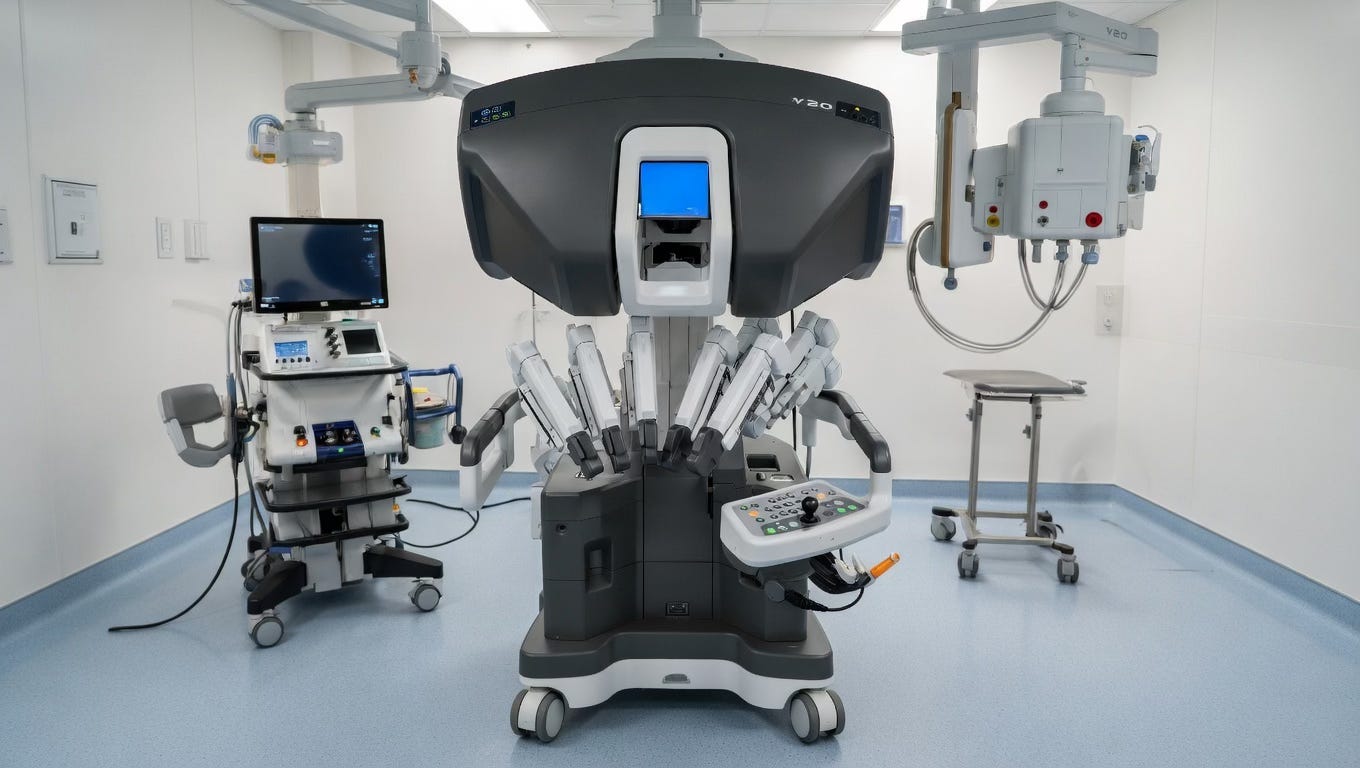
The da Vinci Surgical System is a robotic-assisted surgical platform that translates a surgeon’s hand movements, made at a console, into precise movements of miniaturized instruments inside the patient’s body. The surgeon operates from an ergonomic console equipped with a high-definition 3D visualization system; the patient-side cart, which holds three to four robotic arms, performs the actual manipulation of instruments. The system is designed for minimally invasive surgery, meaning procedures performed through small incisions or natural orifices rather than large open cuts.
The current product family includes three primary platforms: the da Vinci Xi, the multi-quadrant workhorse of the line; the da Vinci SP (Single Port), which operates through a single small incision or natural orifice; and the da Vinci 5, the newest and most advanced generation. Cleared by the FDA in March 2024, the da Vinci 5 introduces force feedback capability, a significant clinical advance. Prior da Vinci systems provided no haptic feedback, meaning surgeons could not feel the resistance of tissue during a procedure. The da Vinci 5 addresses this limitation by transmitting tactile sensations back to the surgeon’s hands, and early clinical data indicates this results in up to 40 percent less force applied to tissue during procedures. (Intuitive Surgical, da Vinci 5 Product Page, 2024.)
Approved surgical specialties include urology (radical prostatectomy is among the most performed robotic procedures globally), gynecology, colorectal surgery, thoracic surgery, general surgery, and, with a December 2025 clearance for non-force feedback cardiac instruments, cardiac surgery. The FDA cleared the SP system for transanal local excision in May 2025 and for inguinal hernia repair, cholecystectomy, and appendectomy in December 2025, expanding the portfolio further.
Approximately 2.68 million procedures were performed with da Vinci systems globally in 2024, a 17 percent increase from 2023. (Intuitive Surgical, Preliminary Fourth Quarter and Full Year 2024 Results, January 2025.) The company placed 1,526 da Vinci systems during 2024, of which 362 were the new da Vinci 5.
2. FDA Regulatory Pathway and Classification
The da Vinci Surgical System is regulated by the FDA as a Class II medical device and has been cleared through the 510(k) substantial equivalence pathway rather than the more demanding Premarket Approval (PMA) process applicable to Class III devices. The 510(k) pathway requires a manufacturer to demonstrate that its device is substantially equivalent to a legally marketed predicate device. It does not require clinical trial evidence of safety and effectiveness on the same scale as a PMA. Critics of the robotics industry have argued that this regulatory pathway is insufficiently rigorous for a system that introduces novel surgical interventions. The FDA has not formally reclassified robotic surgical systems to Class III.
Each generation of the da Vinci system and each new indication requires a separate 510(k) clearance. In 2024 and 2025, Intuitive filed and received clearances for the da Vinci 5 (March 2024), for revised prostatectomy labeling on the Xi and X (June 2024), for expanded SP indications in colorectal surgery (November 2024), for the SP in transanal excision (May 2025), and for SP in hernia repair, cholecystectomy, and appendectomy (December 2025). The pace of clearance activity demonstrates both the FDA’s active engagement with this technology and Intuitive’s strategy of expanding indications to entrench its installed base.
The FDA’s MAUDE (Manufacturer and User Facility Device Experience) database shows 66,651 adverse event reports associated with the da Vinci system from January 2015 through June 2025, across an estimated 15.9 million procedures during that period. (Journal of Robotic Surgery, 2025.) Historically, from 2000 to 2013, reported events included 144 deaths, 1,391 patient injuries, and 8,061 device malfunctions. Among specific failure modes, burnt or broken instrument fragments fell into patients in approximately 14.7 percent of reported cases, electrical arcing of instruments occurred in approximately 10.5 percent, and unintended instrument operation in approximately 8.6 percent. At least 186 recalls related to the da Vinci system have been issued since 2005.
A 2024 wrongful death lawsuit filed in federal court alleged that a defective da Vinci instrument burned and tore a patient’s small intestine during a colon cancer surgery performed in September 2021, ultimately causing her death in February 2022. The lawsuit alleged that cracks in the rubber insulation covering metallic instruments allowed electrical current to escape, a failure mode that had been identified in prior adverse event reports.
3. Market Structure and Competition
Intuitive Surgical is the dominant force in the global surgical robotics market, holding an estimated 60 percent share. The company’s 2024 annual revenue was $8.352 billion, a 17.24 percent increase from 2023. Revenue is generated across three segments: instruments and accessories, which is the largest and most recurring segment at $5.08 billion (61 percent of total revenue); services at $1.31 billion (16 percent); and systems at $1.97 billion (24 percent). The instruments and accessories segment generates recurring revenue each time a procedure is performed, because da Vinci EndoWrist instruments are programmed with a use limit and must be replaced after a set number of procedures. This business model is the core of the antitrust controversy discussed in Section 4 below.
The global surgical robotics market was estimated at $2.9 billion in 2024 and is forecast to grow to $9.2 billion by 2034. (Medical Device Network, 2025.) Despite Intuitive’s entrenched position, meaningful competition is emerging. Medtronic’s Hugo Robotic-Assisted Surgery system received FDA clearance in 2024 for its first U.S. indication. Hugo has been commercially deployed in Europe since 2022 and is now in hospitals in more than 25 countries. Hugo is designed to be more modular and cost-effective than the da Vinci, targeting hospitals that want an alternative to Intuitive’s high capital and consumables costs. CMR Surgical received FDA clearance for its Versius system in gallbladder removal in October 2024, and for its Versius Plus platform in December 2025. Johnson and Johnson’s Ottava platform is anticipated to enter the market in the near term.
Despite the emergence of competitors, industry analysts assess that Intuitive’s vast installed base, long-standing hospital relationships, surgeon training investments, and procedural outcomes data give it a durable competitive advantage. New entrants are more likely to capture incremental volume than to displace existing da Vinci installations in the near term.
4. Reimbursement, Hospital Economics, and Access Implications
The cost structure of the da Vinci system creates a reimbursement challenge that has significant implications for hospital economics and patient access. A da Vinci surgical system costs between $500,000 and $2.5 million depending on the model and configuration, and is subject to ongoing service and maintenance fees. Hospitals also bear the per-procedure cost of disposable EndoWrist instruments.
Medicare and Medicaid do not provide a separate reimbursement increment for the use of robotic equipment. Robotic-assisted surgeries are reimbursed at the same rates as conventional minimally invasive procedures, meaning the added capital and consumables costs of robotic surgery must be absorbed within standard procedure reimbursement. Industry analysis indicates that a hospital generally needs to perform three to five robotic procedures per week to achieve financial sustainability for a da Vinci installation. (PMC, Robotic Surgery and Hospital Reimbursement, 2024.) This creates an access disparity: large academic medical centers and high-volume specialty hospitals can support the economics, while smaller community hospitals and safety-net facilities may struggle to justify the investment.
Intuitive publishes a da Vinci reimbursement and coding guide annually to assist hospitals and physicians in navigating procedure coding. The 2026 guide is publicly available on the Intuitive website and reflects the company’s active engagement in helping healthcare systems optimize billing for robotic procedures within existing reimbursement frameworks. The lack of a robotic-specific reimbursement add-on has been a persistent policy concern raised by hospital systems and medical device advocates, who argue that without differential reimbursement, adoption will remain concentrated among financially strong institutions.
C. Legal and Regulatory Implications
1. FDA Device Classification and Post-Market Surveillance
The classification of the da Vinci system as a Class II device under the 510(k) pathway raises questions about the adequacy of regulatory oversight for a system that performs complex, life-critical surgical interventions. The 510(k) pathway requires substantial equivalence to a predicate device but does not mandate the randomized controlled trials required for PMA approval. As new generations introduce novel features such as force feedback, the FDA’s substantial equivalence determination increasingly requires the agency to assess genuinely new capabilities against older predicates. There is no pending FDA proposal to reclassify robotic surgical systems to Class III, but the volume of adverse event reports and product recalls suggests that post-market surveillance will remain an area of agency focus.
Under the FDA’s Medical Device Reporting regulations at 21 C.F.R. Part 803, manufacturers are required to report deaths, serious injuries, and certain malfunctions to the MAUDE database. The 66,651 adverse event reports generated between 2015 and 2025 for the da Vinci system represent a significant reporting volume, though the denominator of approximately 15.9 million procedures over that period yields an adverse event report rate of approximately 0.4 percent. The rate metric alone does not capture the severity distribution of reported events or the degree of underreporting inherent in the voluntary reporting component of the MAUDE system.
D. Open Questions
The following unresolved questions will shape the legal, regulatory, and commercial trajectory of the da Vinci system and the broader surgical robotics industry over the next several years.
1. Will the hospital class action in In re Da Vinci Surgical Robot Antitrust Litigation proceed to trial or result in a negotiated settlement? Class certification is a watershed event that substantially increases Intuitive’s legal exposure and the likelihood of settlement. The case’s outcome will define the permissible scope of equipment-consumables tying arrangements in the medical device industry, with implications far beyond surgical robotics.
2. Will Congress or CMS create a differential reimbursement mechanism for robotic surgery? The current structure, in which robotic procedures receive no premium over conventional minimally invasive surgery, creates access disparities and distorts hospital purchasing incentives. Whether and how the Centers for Medicare and Medicaid Services address this is a significant open policy question.
3. How will the FDA respond to the growing volume of adverse event data as the da Vinci installed base expands and new high-risk indications such as cardiac surgery are approved? The agency has several available tools, including enhanced post-market surveillance requirements, device class reclassification, and special controls, but has not to date imposed significantly more rigorous oversight on robotic surgical systems than it applies to other Class II devices.
4. Will Medtronic Hugo, CMR Surgical Versius, or Johnson and Johnson Ottava meaningfully erode Intuitive’s market share, and if so, what will be the implications for the antitrust claims? The emergence of genuine competition in the robotic surgery market could undermine Intuitive’s monopoly power argument, but it could also validate the plaintiffs’ contention that Intuitive’s installed base and tying arrangements have delayed competition.
5. Is the EndoWrist use-limit programming, which the court in the SIS case found not to constitute an unlawful aftermarket restriction under current Ninth Circuit doctrine, subject to challenge under different legal theories or before different tribunals, such as the Federal Trade Commission? The right-to-repair movement in medical devices is gaining policy traction, and the FTC has broadly signaled interest in anti-competitive repair restrictions across industries.
6. What is the appropriate standard of care for surgeon training on the da Vinci system, and how will courts resolve product liability and medical malpractice disputes that turn on whether a given complication was caused by device malfunction versus operator error? The force feedback limitation of prior-generation systems, now addressed in the da Vinci 5, has been cited as a contributing factor in instrument misapplication events.
Interested in analysis about the intersection of tech, policy and the law? Check out my Substack channel.