A. Executive Summary
Helion Energy’s Polaris reported 150 million degrees Celsius in February 2026 with no published Q value, so the 2028 Microsoft delivery date rests on schedule, not measured fusion gain.
Polaris is Helion’s seventh generation pulsed field reversed configuration machine in Everett, Washington, and the February 2026 result ran on deuterium tritium fuel, not the deuterium helium 3 mixture the commercial design requires. Helion has published no target gain and no recirculating power figure for Polaris or for Orion, the fifty megawatt electric plant under construction in Chelan County, Washington, that carries the 2028 obligation to Microsoft. Chief executive David Kirtley and coauthor R. Milroy’s 2023 Journal of Fusion Energy scaling paper argues deuterium helium 3 can outperform deuterium tritium in fusion power density above 10 to 20 kiloelectronvolts, without a measured gain from Polaris.
Three facts bear on 2028. Helion already missed one prior target, a 2024 net electricity demonstration on Polaris that did not occur. The company raised 425 million dollars in January 2025 and 465 million dollars in June 2026 to fund Orion’s construction, reaching 1.5 billion dollars against a 15.5 billion dollar valuation. Washington issued Orion’s state radioactive material and air emissions licenses in June 2026 under the byproduct material treatment the Commission set for fusion machines in October 2023, while the Commission’s own implementing rule for that treatment sat as a proposal past its May 27, 2026 deadline.
The principal technical dispute is whether a temperature milestone on the wrong fuel mixture, with no published Q or recirculating power number, supports an inference about grid ready electricity three years later. The most consequential fact for Microsoft is that Helion’s dollar exposure for missing 2028, described by Kirtley as carrying financial penalties, has never been made public, and no independent party has metered a single Polaris figure.
B. What Question Does This Report Answer
Does Helion Actually Deliver Electricity To Microsoft In 2028
Helion Energy says Polaris leads to electricity delivered to Microsoft in 2028 under their power purchase agreement. Where does that actually stand technically and legally, and how credible is the date.
This report reads the question as a request for three distinct findings: the measured technical state of Polaris and its bearing on Orion, the legal instruments, licenses, and contract terms that currently govern the Microsoft delivery obligation, and an assessment of how much weight the 2028 date can bear given the schedule and funding history on the record. It does not survey the fusion field, and it does not resell Helion’s own marketing account of its technology. A reader who wants the answer to change should look for three things: a published Q, target gain, or facility gain figure for Polaris measured by a party other than Helion, a public capital cost or recirculating power figure for Orion, and a final Nuclear Regulatory Commission rule implementing byproduct material licensing for fusion machines instead of a proposed one.
C. Device and Confinement Approach
How Does Helion Polaris Actually Work
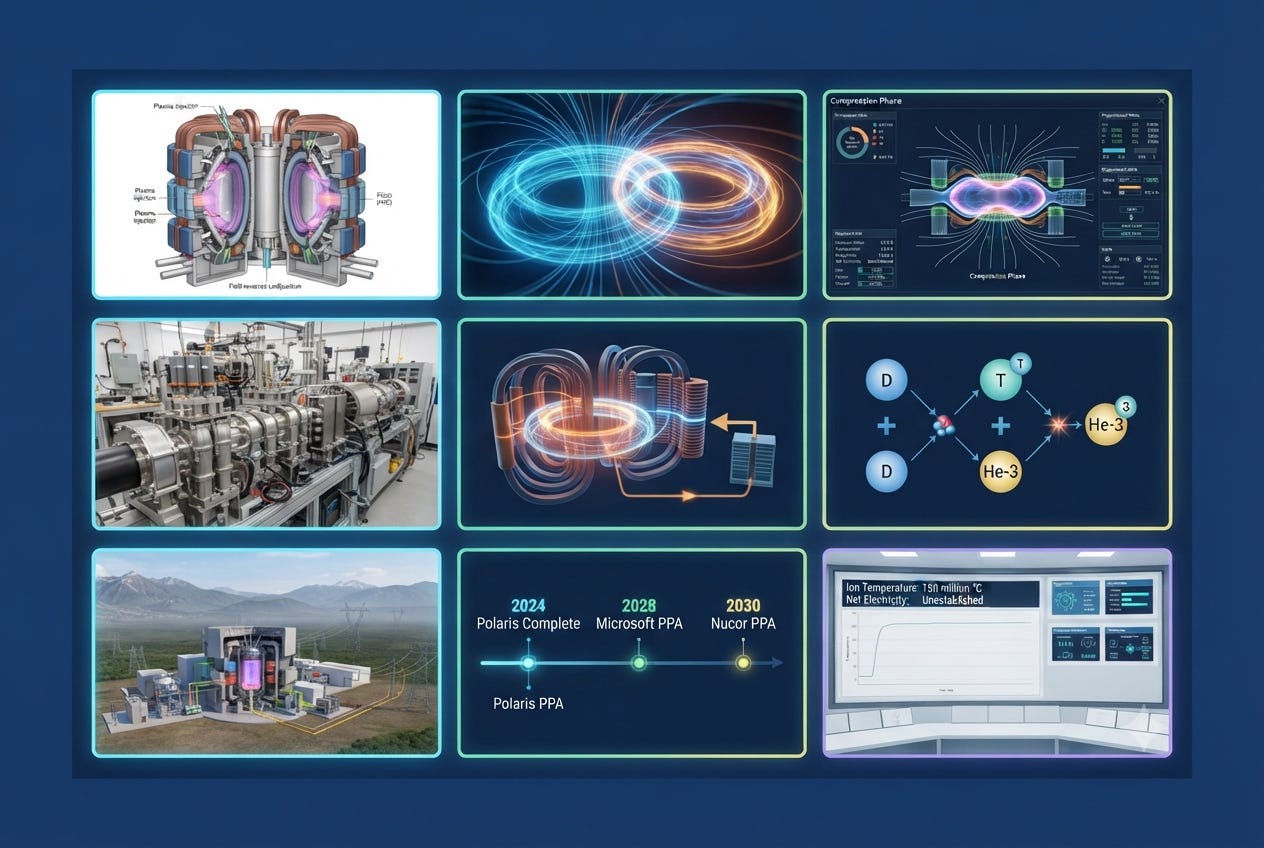
Polaris is Helion Energy’s seventh generation machine, a nineteen meter, hourglass shaped device that forms two magnetized plasma rings, called field reversed configurations, at opposite ends of a linear chamber, drives each ring toward the center at roughly 1.6 million kilometers per hour, merges them, and compresses the merged plasmoid with a rising external magnetic field in under one millisecond. The approach belongs to the magneto inertial fusion family: it borrows the pulsed, transient character of inertial confinement while using magnetic fields rather than a laser or a liner to compress the fuel, and it runs the entire cycle, injection, merging, compression, burn, and expansion, as a repeated pulse rather than as a steady state plasma the way a tokamak or a stellarator does.
Helion’s commercial design target is a deuterium helium 3 fuel mixture, chosen because the dominant reaction, deuterium plus helium 3 yielding helium 4 plus a proton, releases its energy almost entirely as charged particles rather than as neutrons. Helion’s stated recovery mechanism uses the expanding plasmoid’s own magnetic field, pushing outward against the confining coils, to drive current directly back into the machine’s capacitor banks, a claim the company frames as bypassing a steam cycle and turbine entirely. Helion Energy and its cofounder Anthony Pancotti describe this mechanism in company materials and in a February 2026 Nature feature on private fusion companies; no third party has published a measured conversion efficiency for it. Because natural helium 3 is scarce, on the order of tens of kilograms in known civilian inventories worldwide, Helion’s commercial fuel plan does not depend on an external helium 3 supply. It depends instead on breeding helium 3 inside the machine itself through deuterium deuterium side reactions, then burning that bred fuel in a subsequent pulse, a catalyzed cycle rather than a purchased fuel cycle.
The February 2026 milestone that produced the 150 million degree Celsius figure was not run on this target mixture. Helion reported the result using a deuterium tritium fuel load, the company’s first public use of tritium, which its chief executive David Kirtley described as producing a larger fusion power output as heat than the deuterium helium 3 mixture does at comparable conditions. The physics advantage Helion’s approach claims, high beta operation permitting a favorable power density even where the fusion cross section for deuterium helium 3 is lower than for deuterium tritium, is modeled in the company’s own 2023 Journal of Fusion Energy paper. The penalty the approach accepts, in exchange, is a pulsed rather than continuous operating cycle, a linear rather than closed magnetic geometry that has not been demonstrated at the size a commercial plant requires by any operator, and a fuel breeding step, deuterium deuterium to helium 3, that has not yet been run to completion at the fuel quantities a fifty megawatt electric plant would require.
D. Physics Performance and the Measured Record
Polaris and Its Predecessors: What Has Actually Been Measured
The measured record spans five device generations and eighteen years, and it is entirely company reported. No figure below has been confirmed by an independent laboratory, a peer reviewed measurement paper describing the specific shot, or a third party instrument reading.
No Helion device, and no fusion machine of any kind, has delivered net electricity to a grid as of this report’s research date
The gap between the two headline company figures, the 100 million degree Celsius result on Trenta in 2021 and the 150 million degree Celsius result on Polaris in February 2026, and the complete absence of a Q, a target gain, or a facility gain figure at either point, is the central fact the Milestone Verification Discipline exists to surface. A temperature is a measure of the energy per particle in the plasma; it says nothing on its own about how much fusion power that plasma produced relative to the power spent creating and compressing it. Helion’s public materials, and the trade press coverage that followed the February 2026 announcement, report the temperature figure without a paired power or gain figure at any point in the retrieved record.
The February 2026 result was also run on deuterium tritium fuel, a fact Kirtley stated openly, rather than on the deuterium helium 3 mixture Orion’s commercial design requires. A result on the easier fuel does not transfer directly to a result on the harder one: deuterium helium 3 carries a materially lower fusion cross section at a given ion temperature than deuterium tritium does, which is precisely the tradeoff Helion’s own 2023 scaling paper models as requiring high beta operation to compensate. Kirtley described the deuterium tritium result as evidence of engineering progress toward the commercial design point, not as a demonstration of the commercial design point itself, and the distinction is the one a reader evaluating the 2028 date needs to hold onto.
E. Engineering Systems, Magnets, and Materials
What Systems Still Have To Work For Orion To Generate Power
Orion sits between a plasma physics result and a fifty megawatt electric plant, and the systems in between have published almost no public figures. Helion’s design uses pulsed, resistive electromagnet coils driven by capacitor banks rather than the high temperature superconducting magnets that competing tokamak designs, including Commonwealth Fusion Systems’ SPARC, depend on; this removes a cryogenic magnet qualification burden but places the entire compression and recovery cycle on capacitor switching hardware operating at a repetition rate the company has not published for Orion. No first wall, divertor, or neutron shielding figure has been published for Polaris or Orion in megawatts per square meter or in displacements per atom, a gap that matters less for Helion’s approach than it would for a steady state tokamak, because a pulsed machine with a low duty cycle sees a lower integrated neutron fluence per year of operation, but the record still contains no quantified component lifetime assumption for either machine.
Helion’s direct energy recovery claim, capturing the expanding plasmoid’s field energy as electric current rather than converting fusion heat through a steam cycle, is the single engineering claim on which the entire schedule case for a fast, turbine free plant rests. No measured conversion efficiency for this mechanism has been published by Helion or by any independent party in the retrieved record; the claim currently rests on the same company disclosures that report the temperature figures, not on a metered output at Polaris or at any predecessor device.
Remote handling, component replacement interval, and vacuum vessel qualification for Orion have not been addressed in any public Helion disclosure located for this report. Where a design asserts a component lifetime elsewhere in the fusion field, the assertion typically rests on an irradiation campaign, a fission reactor surrogate test, or a model; for Orion, the retrieved record does not establish which of these, if any, underlies the plant’s operating assumptions.
F. Fuel Cycle, Tritium, and Fuel Supply
How Does Helion Solve The Tritium And Fuel Supply Problem
Helion’s commercial fuel target, deuterium helium 3, sidesteps the tritium breeding problem that governs a steady state deuterium tritium reactor design like ITER or SPARC, but it substitutes a different, equally unsettled fuel supply question: helium 3 exists in known civilian inventories worldwide on the order of tens of kilograms, sourced almost entirely from tritium decay in weapons stockpile maintenance and from Canadian heavy water reactor byproduct streams, and no commercial market supplies helium 3 at the volume a fleet of fifty megawatt electric plants would require. Helion’s answer, stated in company materials, is to breed its own helium 3 inside the machine by running deuterium deuterium reactions, which branch roughly evenly between a tritium producing path and a helium 3 producing path, and then burning the bred fuel in a later pulse. This is a catalyzed cycle internal to the machine, not a purchased fuel supply chain, and it is the reason Helion’s February 2026 milestone used deuterium tritium fuel directly: the company appears to be qualifying performance on the intermediate fuel step before closing the full catalyzed cycle.
No public Helion disclosure states a startup tritium inventory in kilograms, its source, a target breeding ratio for the deuterium deuterium step, a burn fraction, or a processing throughput figure for Orion. Because Helion’s architecture does not use a lithium breeding blanket in the sense that governs a deuterium tritium power reactor, the breeding ratio accounting the fusion field typically applies elsewhere does not map directly onto Helion’s machine, but the absence of any published fuel accountancy figure, tritium possession limit, or helium 3 production rate for Polaris or Orion means the fuel cycle claim that underlies the entire commercial design cannot currently be checked against a number.
Deuterium supply itself is not a constraint for any fusion approach at the volumes contemplated here; it is extracted from ordinary water at a cost that does not bind a fifty megawatt electric plant’s economics. The constraint, for Helion specifically, sits entirely on the helium 3 side of the cycle and on the tritium accountancy the company has not yet made public.
G. Machine Status and Milestone Timeline
What Has Helion Actually Promised And When Did It Promise It
Schedule revision history is the most informative indicator a reader has about a private fusion company’s credibility, because a company’s own prior statements set the baseline against which its current statement has to be measured.
Two items, not a survey of every public statement, actually control whether 2028 holds. The first is whether Helion can complete and qualify the deuterium helium 3 catalyzed fuel cycle, bred tritium into bred helium 3 into a sustained burn, at the size Orion requires, given that the February 2026 milestone was run on deuterium tritium fuel directly rather than on the catalyzed cycle itself. The second is whether Washington’s Department of Health licensing and the Nuclear Regulatory Commission’s still proposed implementing rule convert into a stable operating authorization before 2028 without a rulemaking delay; Washington has already issued the state level licenses Orion needs to operate as an Agreement State matter, but the federal rule the state licensing arrangement depends on has not been finalized as of this report’s research date. Every other item in the public narrative, including the fifty megawatt electric capacity figure and the one year ramp period, is downstream of these two.
H. Path to the Grid: Balance of Plant and Engineering Gain
What Stands Between A Plasma Result And A Metered Electron At Orion
No recirculating power budget has been published for Polaris or for Orion. Helion’s direct energy recovery claim implies a materially different power budget than a thermal plant would carry, since it claims to skip a steam cycle and turbine entirely, but the company has not published the electrical draw its capacitor charging, plasma injection, compression coils, or vacuum and cooling systems require per pulse, nor has it published a projected capacity factor or availability figure for Orion’s first operating year. Constellation Energy has been named as the power marketer for the arrangement, and Chelan County Public Utility District has been named as the interconnection counterparty, chosen for the site’s existing transmission access near the Rock Island Dam, but no interconnection queue position, transmission capacity figure, or interconnection agreement date has been made public. A power claim carried this far into construction without a public recirculating power number is not something a reader can independently check; it is a claim that has to be taken on the company’s own accounting once the plant is running, which is a materially different position than a plant whose balance of plant figures are public before construction finishes.
A submarine reactor plant runs on the same underlying discipline this gap violates: an operator does not log a design figure as an operating figure until an instrument confirms it under load, because the gap between a projected number and a metered one is exactly where a casualty report gets written. Applied to Orion, the practice derived point is concrete: a fifty megawatt electric capacity figure that has never been paired with a published recirculating power number is a design projection, not yet an operating claim, regardless of how many press releases restate it.
I. Capital, Funding, and Cost Structure
How Much Money Is Behind The 2028 Date And What Does It Buy
Helion has raised 1.5 billion dollars in disclosed venture financing as of June 2026, across a November 2021 Series E of 500 million dollars carrying an additional 1.7 billion dollars in milestone contingent commitments led by OpenAI’s Sam Altman, a January 2025 Series F of 425 million dollars led by Altman and SoftBank Vision Fund 2 with Nucor Corporation and Lightspeed Venture Partners participating, and a June 4, 2026 round of 465 million dollars led by Thrive Capital with Lux Capital, Peak XV Partners, and existing investors including SoftBank Vision Fund 2 and Lightspeed participating. The June 2026 round brought Helion’s valuation to 15.5 billion dollars, and Helion stated the proceeds fund completion of Orion on the current 2028 schedule. No public figure discloses Orion’s capital cost directly; the closest public proxy is the pace and size of the raises themselves, which show a company financing construction one milestone at a time, with no single disclosed plant budget published to date.
Helion has not been named among the eight companies the Department of Energy selected in the first round of its Milestone Based Fusion Development Program, announced May 31, 2023: Commonwealth Fusion Systems, Focused Energy, Princeton Stellarators, Realta Fusion, Tokamak Energy, Type One Energy Group, Xcimer Energy, and Zap Energy. Helion’s commercial financing, unlike that of several competitors, is not currently paired with a federal public private partnership award in the retrieved record, which places the entire cost of qualifying Orion’s fuel cycle and balance of plant on its own venture investors and its two named commercial counterparties, Microsoft and Nucor Corporation.
No levelized cost of electricity figure has been published for Orion by Helion or by an independent assessment body. The Fusion Industry Association’s most recent industry survey reports a record 4.48 billion dollar annual private investment figure across the sector, bringing cumulative private fusion investment to 14.24 billion dollars, a methodology the association discloses in its annual report; Helion’s 1.5 billion dollars sits inside that total as the largest single company figure the association has reported for any private fusion developer.
J. Regulatory and Licensing Position
Who Actually Regulates Orion And Under What Authority
The Nuclear Regulatory Commission determined in October 2023, in a Federal Register notice at 88 FR 68382, that fusion machines are properly regulated as byproduct material producers and users under the existing licensing structure at 10 CFR Part 30, instead of as utilization facilities under the reactor licensing provisions of the Atomic Energy Act of 1954 as amended. Congress reinforced that determination through the Fusion Energy Act provisions enacted as part of the ADVANCE Act of 2024, Public Law 118-67, which codified the distinct regulatory treatment of fusion machines separate from fission reactors. The Commission subsequently published a proposed rule at 91 FR 9476 on February 26, 2026, that would amend 10 CFR Parts 20, 30, 37, 50, 51, 72, 110, 150, 170, and 171 to implement a technology inclusive, performance based licensing structure for fusion machines nationally, including new definitions, environmental report requirements, and waste disposal provisions. That rule’s comment period closed May 27, 2026, and as of this report’s research date in September 2026, no final rule has been published; the implementing regulation for fusion licensing remains a proposal four months past its own comment deadline.
Washington operates as an Agreement State handling this authority directly. The Washington State Department of Health, Office of Radiation Protection, granted Helion a Large Broad Scope radioactive byproduct materials license in 2024 covering research operation of Polaris in Everett, and granted Orion, the commercial plant in Malaga, Washington, a radioactive materials license and a radioactive air emissions license in June 2026, confirming that Helion has the shielding, safety analyses, operating procedures, and trained personnel the state licensing process requires. Washington’s legislature separately enacted House Bill 1018, signed in May 2025, classifying fusion as a clean energy technology distinct from fission for state siting and permitting purposes, which opened the Chelan County local permitting pathway Orion is using. Orion therefore holds the state licenses it needs to operate under the current interim federal licensing treatment, even though the Commission’s own implementing rule for that treatment is still proposed instead of final.
Whether the Price Anderson Act’s indemnification provisions reach a fusion byproduct material licensee like Orion has not been settled by the Commission, by Congress, or by a court as of this report’s research date. Price Anderson’s public liability provisions were built around utilization facility licensees and contractors under the Atomic Energy Act, and a fusion machine licensed instead under Part 30 as a byproduct material user sits outside the plain language the Act was written for; a Colorado Technology Law Journal analysis of the question identifies specific ambiguities in how the Act’s provisions would apply to a hypothetical fusion accident without resolving them. The practical consequence for Orion is that the party bearing third party liability in the event of an incident, Helion, Constellation, Chelan County Public Utility District, or some combination among them, is not currently fixed by a statute written with fusion in mind, and the power purchase agreement’s own indemnification terms, which have not been made public, are the only place that allocation may currently be addressed.
Export control exposure under 10 CFR Part 810, the Export Administration Regulations, and the International Traffic in Arms Regulations for Helion’s magnet, capacitor, and pulsed power design data has not been addressed in any public disclosure located for this report. Not established in the retrieved record.
K. Intellectual Property and Commercial Arrangements
What Intellectual Property And Contract Terms Actually Govern The Microsoft Deal
Helion and Microsoft announced their power purchase agreement on May 10, 2023, with Orrick, Herrington and Sutcliffe advising Helion and Hogan Lovells also credited in connection with the arrangement. The publicly confirmed terms are narrow: fifty megawatts electric or greater after a one year ramp, first delivery targeted for 2028, and Constellation Energy serving as the power marketer that will handle delivery logistics on Microsoft’s behalf. Kirtley has stated publicly that the agreement carries financial penalties if Helion fails to deliver, describing Helion’s exposure as having put the company’s own capital at risk, but neither the penalty structure, the pricing terms, nor the contingency provisions governing a schedule delay have been made public in the retrieved record. Nucor Corporation’s separate agreement, announced in September 2023, targets a 500 megawatt electric plant at a Nucor manufacturing site for 2030 and is structured independently of the Microsoft delivery obligation.
Helion’s core patent position rests on staged magnetic compression of field reversed configuration plasma targets, the subject of its 2015 ARPA E ALPHA program award, and on the direct energy recovery mechanism the company has described in public materials; the specific patent numbers, assignees, and claim scope have not been catalogued in the sources reachable for this report; not established in the retrieved record. Helion’s federal funding history, including NASA, Department of Energy, and ARPA E awards dating to the company’s 2013 founding, carries the government funded invention rights and data rights questions that attach to any federally funded research and development recipient, though no march in rights proceeding or dispute has been identified. A June 2026 trade report describes Helion as also in discussion with OpenAI over a substantially larger, multi gigawatt supply arrangement targeted for 2030; that report is not corroborated by a primary source and is treated here as an unconfirmed company discussion, not a contracted commitment.
L. What the Record Does Not Yet Settle
What The Technical And Legal Record Does Not Yet Establish
Seven matters remain unsettled on the current record, and each has a specific party who could settle it.
First, no Q, target gain, or facility gain figure exists for Polaris at any fuel mixture; Helion, or an independent laboratory measurement of a specific shot, would settle it by publishing the figure with its numerator and denominator stated.
Second, the deuterium helium 3 catalyzed fuel cycle, breeding helium 3 from a deuterium deuterium reaction and burning it in a subsequent pulse, has not been demonstrated end to end at any Helion device; only Helion can settle this, by running and disclosing a full cycle campaign.
Third, no recirculating power, capacity factor, or direct energy recovery efficiency figure has been published for Polaris or Orion; Helion would settle it by disclosing a balance of plant accounting, ideally reviewed by an independent engineering assessment.
Fourth, Orion’s capital cost has not been disclosed as a single figure; Helion or a securities filing triggered by a future public offering would settle it.
Fifth, whether the Price Anderson Act’s indemnification provisions reach a fusion byproduct material licensee has not been settled; the Nuclear Regulatory Commission, Congress, or a court presented with an actual claim would settle it.
Sixth, the Nuclear Regulatory Commission’s implementing rule for fusion byproduct material licensing remains proposed instead of final four months past its own comment deadline; only the Commission can settle it, by publishing a final rule.
Seventh, the dollar penalty Helion bears for missing the 2028 delivery date has been described in general terms by its chief executive but never quantified; only Helion and Microsoft, jointly or through a future public disclosure, could settle it.
M. Source List
United States Nuclear Regulatory Commission. Regulatory Framework for Fusion Systems. Federal Register 88, no. 191 (October 4, 2023): 68382. Establishes fusion machines as byproduct material licensees under 10 CFR Part 30 rather than utilization facilities.
United States Nuclear Regulatory Commission. Regulatory Framework for Fusion Machines. Federal Register 91, no. 38 (February 26, 2026): 9476. Proposed rule amending 10 CFR Parts 20, 30, 37, 50, 51, 72, 110, 150, 170, and 171; comment period closed May 27, 2026, no final rule identified as of this report’s research date.
ADVANCE Act of 2024, Public Law 118-67, 138 Stat. 1449 (2024). Codifies the Fusion Energy Act provisions separating fusion regulatory treatment from fission.
Washington State Department of Health, Office of Radiation Protection. Large Broad Scope radioactive materials license issued to Helion Energy, 2024, covering Polaris research operations in Everett, Washington.
Washington State Department of Health, Office of Radiation Protection. Radioactive materials license and radioactive air emissions license issued to Helion Energy for the Orion commercial fusion plant, Malaga, Washington, June 2026.
Washington State House Bill 1018 (2025), signed into law May 2025, classifying fusion as a clean energy technology distinct from fission for state siting and permitting purposes.
Lipinski, Pearle M. Considering the Price-Anderson Act’s Federal Public Liability Action Provisions in the Future of Nuclear Fusion Power. Colorado Technology Law Journal, retrieved September 2026. Identifies specific ambiguities in whether Price Anderson indemnification reaches a fusion byproduct material licensee, without resolving them.
Kirtley, D., and R. Milroy. Fundamental Scaling of Adiabatic Compression of Field Reversed Configuration Thermonuclear Fusion Plasmas. Journal of Fusion Energy 42 (2023). Peer reviewed scaling model of compressed field reversed configuration plasma behavior authored by Helion Energy personnel.
United States Department of Energy, Office of Fusion Energy Sciences. Milestone-Based Fusion Development Program, first round award announcement, May 31, 2023, naming Commonwealth Fusion Systems, Focused Energy, Princeton Stellarators, Realta Fusion, Tokamak Energy, Type One Energy Group, Xcimer Energy, and Zap Energy.
Helion Energy. Announcing Helion’s fusion power purchase agreement with Microsoft and Constellation. Company blog, 2023.
Helion Energy. Helion Achieves New Industry-First Fusion Energy Milestones, Accelerating Path to Commercial Fusion. Company newsroom, February 13, 2026.
Helion Energy. Helion Granted Fusion Energy Safety License from Washington State Department of Health. Company newsroom, 2024.
CNBC. Microsoft agrees to buy electricity generated from Sam Altman backed fusion company Helion in 2028. May 10, 2023.
S&P Global. Helion Energy breaks ground on fusion power plant, slated to be online in 2028. July 30, 2025.
HeraldNet. State grants Everett based Helion a fusion energy license. 2024.
American Nuclear Society, Nuclear Newswire. Helion secures new licenses from Washington. June 23, 2026.
TechCrunch. Fusion startup Helion hits blistering temps as it races toward 2028 deadline. February 13, 2026.
TechCrunch. Helion, the Sam Altman backed fusion startup, raises 465 million dollars to build a power plant for Microsoft. June 4, 2026.
Fortune. Sam Altman’s fusion bet, Helion’s milestone, and its doubters, on the road to grid power in 2028. February 13, 2026.
GeekWire. Sam Altman, SoftBank invest in 425 million dollar round for Helion, a Seattle area startup chasing fusion power. January 2025.
Nucor Corporation. Nucor and Helion to Develop Historic 500 MW Fusion Power Plant. Investor relations press release, September 2023.
Nature. A raft of start-up firms is betting on nuclear fusion. February 2026. Quotes Helion cofounder Anthony Pancotti.
Wood Mackenzie. Nuclear fusion power approaches critical moment. Energy Pulse blog, 2026.
Fusion Industry Association. Fusion Industry Attracts Record Annual Funding of 4.48 Billion Dollars, Raising Total to 14.24 Billion Dollars. Global Fusion Industry Report commentary, 2026.
Wikipedia. Helion Energy. Retrieved September 2026, used only as a cross referenced index and corroborated against primary sources before use.
N. Bibliography
United States Nuclear Regulatory Commission. Regulatory Framework for Fusion Systems. Federal Register 88, no. 191 (October 4, 2023): 68382. Establishes fusion machines as byproduct material licensees under 10 CFR Part 30 rather than utilization facilities.
United States Nuclear Regulatory Commission. Regulatory Framework for Fusion Machines. Federal Register 91, no. 38 (February 26, 2026): 9476. Proposed rule amending 10 CFR Parts 20, 30, 37, 50, 51, 72, 110, 150, 170, and 171; comment period closed May 27, 2026, no final rule identified as of this report’s research date.
ADVANCE Act of 2024, Public Law 118-67, 138 Stat. 1449 (2024). Codifies the Fusion Energy Act provisions separating fusion regulatory treatment from fission.
Washington State Department of Health, Office of Radiation Protection. Large Broad Scope radioactive materials license issued to Helion Energy, 2024, covering Polaris research operations in Everett, Washington.
Washington State Department of Health, Office of Radiation Protection. Radioactive materials license and radioactive air emissions license issued to Helion Energy for the Orion commercial fusion plant, Malaga, Washington, June 2026.
Washington State House Bill 1018 (2025), signed into law May 2025, classifying fusion as a clean energy technology distinct from fission for state siting and permitting purposes.
Lipinski, Pearle M. Considering the Price-Anderson Act’s Federal Public Liability Action Provisions in the Future of Nuclear Fusion Power. Colorado Technology Law Journal, retrieved September 2026. Identifies specific ambiguities in whether Price Anderson indemnification reaches a fusion byproduct material licensee, without resolving them.
Kirtley, D., and R. Milroy. Fundamental Scaling of Adiabatic Compression of Field Reversed Configuration Thermonuclear Fusion Plasmas. Journal of Fusion Energy 42 (2023). Peer reviewed scaling model of compressed field reversed configuration plasma behavior authored by Helion Energy personnel.
United States Department of Energy, Office of Fusion Energy Sciences. Milestone-Based Fusion Development Program, first round award announcement, May 31, 2023, naming Commonwealth Fusion Systems, Focused Energy, Princeton Stellarators, Realta Fusion, Tokamak Energy, Type One Energy Group, Xcimer Energy, and Zap Energy.
Helion Energy. Announcing Helion’s fusion power purchase agreement with Microsoft and Constellation. Company blog, 2023.
Helion Energy. Helion Achieves New Industry-First Fusion Energy Milestones, Accelerating Path to Commercial Fusion. Company newsroom, February 13, 2026.
Helion Energy. Helion Granted Fusion Energy Safety License from Washington State Department of Health. Company newsroom, 2024.
CNBC. Microsoft agrees to buy electricity generated from Sam Altman backed fusion company Helion in 2028. May 10, 2023.
S&P Global. Helion Energy breaks ground on fusion power plant, slated to be online in 2028. July 30, 2025.
HeraldNet. State grants Everett based Helion a fusion energy license. 2024.
American Nuclear Society, Nuclear Newswire. Helion secures new licenses from Washington. June 23, 2026.
TechCrunch. Fusion startup Helion hits blistering temps as it races toward 2028 deadline. February 13, 2026.
TechCrunch. Helion, the Sam Altman backed fusion startup, raises 465 million dollars to build a power plant for Microsoft. June 4, 2026.
Fortune. Sam Altman’s fusion bet, Helion’s milestone, and its doubters, on the road to grid power in 2028. February 13, 2026.
GeekWire. Sam Altman, SoftBank invest in 425 million dollar round for Helion, a Seattle area startup chasing fusion power. January 2025.
Nucor Corporation. Nucor and Helion to Develop Historic 500 MW Fusion Power Plant. Investor relations press release, September 2023.
Nature. A raft of start-up firms is betting on nuclear fusion. February 2026. Quotes Helion cofounder Anthony Pancotti.
Wood Mackenzie. Nuclear fusion power approaches critical moment. Energy Pulse blog, 2026.
Fusion Industry Association. Fusion Industry Attracts Record Annual Funding of 4.48 Billion Dollars, Raising Total to 14.24 Billion Dollars. Global Fusion Industry Report commentary, 2026.
Wikipedia. Helion Energy. Retrieved September 2026, used only as a cross referenced index and corroborated against primary sources before use.