Research Report | The Innovation Attorney | March 2026
A. Executive Summary
The Hughes Glomar Explorer stands as one of the most remarkable vessels ever constructed, representing a singular convergence of Cold War intelligence imperatives and frontier ocean engineering. Built between 1971 and 1974 at the Sun Shipbuilding and Drydock Company in Chester, Pennsylvania, at a declared cost exceeding 350 million dollars, the ship was designed and operated for a single extraordinary purpose: the clandestine recovery of the Soviet Golf II ballistic missile submarine K-129 from a depth of approximately 16,000 feet in the North Pacific Ocean.
The vessel incorporated engineering systems that did not exist before its construction, including a 199 by 42 foot internal moon pool, a gimbaled heavy lift platform rated at 8,000 tons, a 17,000 foot articulated pipe string, and the Clementine capture vehicle, a massive mechanical claw fabricated from maraging steel that was transported and installed under cover of darkness using a specially constructed submersible barge. The ship was publicly presented as a deep sea manganese nodule mining platform operated on behalf of the billionaire industrialist Howard Hughes, a cover story that successfully concealed the true mission from the Soviet Union, the press, and most of the United States government for nearly a year after operations concluded.
The recovery mission, conducted in the summer of 1974, succeeded in lifting a significant portion of K-129 from the ocean floor before a mechanical failure caused the loss of most of the target section during ascent. Following the declassification of the program, the ship transitioned to the United States Navy reserve fleet before being leased and converted to a commercial deep water drilling vessel in 1996. Renamed GSF Explorer under Transocean’s ownership, the ship compiled an 18 year record of deepwater drilling operations across multiple continents before being sold for scrapping in 2015. The Glomar Explorer remains the definitive example of purpose built covert engineering achievement in twentieth century American history.
B. Detailed Findings
1. Origins and Intelligence Background
On March 8, 1968, the Soviet Golf II class diesel electric ballistic missile submarine K-129 sank approximately 1,560 miles northwest of Hawaii under circumstances that have never been conclusively determined. K-129 was armed with three SS-N-4 ballistic missiles carrying nuclear warheads and two nuclear tipped torpedoes. The acoustic event associated with its loss was recorded by the United States Navy’s Sound Surveillance System, a network of hydrophone arrays positioned on the ocean floor throughout the Pacific and Atlantic Oceans. Triangulation from multiple SOSUS stations gave analysts a probable wreck location, which was subsequently confirmed by the submarine USS Halibut (SSGN-587), which conducted a covert survey of the wreck site beginning in August 1968 and produced more than 20,000 close range photographs of the sunken vessel.
The wreck was found at a depth of approximately 4,900 meters, or approximately 16,000 feet, on the floor of the central North Pacific Ocean. Intelligence officials determined that K-129 represented an extraordinary opportunity: if the submarine or substantial portions of it could be recovered, the operation might yield nuclear weapons, cryptographic materials, and signals intelligence equipment of extraordinary value. In 1970, following detailed feasibility analysis by Central Intelligence Agency engineers and contractors, officials determined that a large surface ship equipped with a mechanical capture system and a heavy lift pipe string represented the only technically viable approach.
2. Design and Engineering Concept
The engineering challenge was without precedent. No vessel had ever attempted to lift a payload of such mass from such a depth. The target section of K-129 that planners hoped to recover was estimated to weigh approximately 1,750 tons and extended roughly 138 feet in length. Lifting this object from a depth of nearly three miles required the development of an entirely new class of ocean engineering systems across multiple disciplines simultaneously.
The core system concept required a surface ship large enough to house an internal well opening, termed a moon pool, through which all lifting operations would be conducted entirely out of view of satellite or surface observation. The ship would maintain precise station over the wreck site through dynamic positioning. A heavy lift pipe string would be assembled section by section from the ship, extending downward 17,000 feet to the ocean floor. At its lower end, a specially designed mechanical capture vehicle would secure the target object. The entire assembled string, capture vehicle, and target object would then be raised hydraulically into the ship’s internal well, where they could be examined under cover of the vessel’s superstructure.
3. Vessel Construction at Sun Shipbuilding
In April 1971, the Central Intelligence Agency selected Sun Shipbuilding and Drydock Company of Chester, Pennsylvania, as the prime contractor for construction of the ship. The keel was laid on November 16, 1971, and the vessel was launched in November 1972. Sea trials and integrated systems testing were completed by June 20, 1974, when the ship entered operational readiness. The total construction cost exceeded 350 million dollars, approximately 1.7 billion dollars in 2024 equivalent value. Global Marine Development, Inc., a subsidiary of Global Marine Inc., was engaged as the nominal contractor and operator, with Howard Hughes’s various corporate entities providing the public facing identity for the enterprise.
The finished vessel measured 618 feet in overall length with a beam of 115 feet and an operational draft of approximately 35 feet. The ship carried a complement of 172 crew members during its operational mission. A distinctive feature of the construction was the requirement for a purpose built crane vessel, the Sun 800, to lift and install the massive gimbal structure, which weighed approximately 630 tons, into position within the ship’s hull during the building process.
4. The Moon Pool System
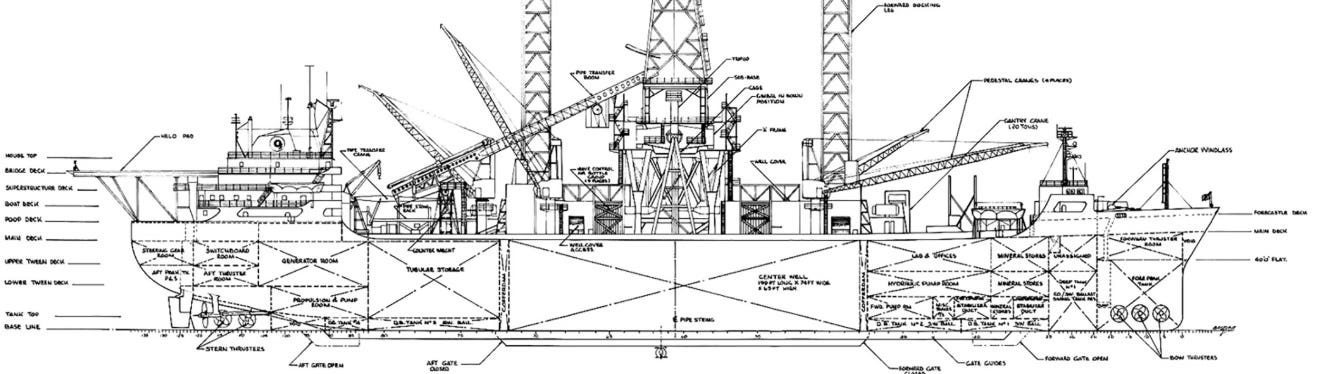
The defining structural feature of the Glomar Explorer was its moon pool, an internal well opening in the center of the hull measuring approximately 199 feet in length by 42 feet in width. This opening extended through the full depth of the hull and could be sealed at the keel by large clamshell doors, allowing the internal well to be dewatered once the target object had been lifted inside. The moon pool was sized to accommodate the widest cross section of the K-129 target section while leaving working clearance around its perimeter for the docking leg system.
The derrick structure that provided the lifting force was mounted amidships directly over the moon pool. This arrangement allowed all lifting operations to be conducted entirely within the ship’s hull, with no external indication of the nature of the work being performed. The moon pool’s sealing system, including its large sliding and hinged hull closure mechanisms, represented a significant structural engineering accomplishment in itself, as the doors had to maintain watertight integrity under the hydrostatic pressure at operating draft while also being capable of rapid actuation.
5. Heavy Lift Pipe String and Hoisting System
The heavy lift pipe string was one of the most demanding components of the entire system. It was required to extend 17,000 feet from the ship’s derrick to the ocean floor, support the combined weight of the string itself, the capture vehicle, and the target object at depth, and transmit hydraulic pressure to operate the capture vehicle’s mechanical systems. The pipe string was tapered along its length, with larger diameter and heavier wall sections near the ship transitioning to smaller sections lower in the water column, optimizing the weight and strength distribution across the full length.
The pipe string incorporated a six inch internal bore through which pressurized seawater was supplied to operate the Clementine capture vehicle’s hydraulic systems. This pressurized seawater was generated by two 1,600 horsepower oilfield mud pumps installed aboard the ship. The tool joints connecting pipe sections were designed, manufactured, and proof tested to standards far exceeding normal oilfield practice, as any single joint failure during the lift would result in the loss of the entire pipe string and target object.
The hydraulic and pneumatic hoisting system was rated at 8,000 tons of total capacity, representing the combined anticipated weight of a 17,000 foot pipe string, the capture vehicle, and the target object in the water column. This rating made it the largest purpose built marine heavy lift system constructed to that point in history. The system incorporated heave compensation to counteract ship motions from waves up to 20 feet in height, preventing the pipe string from experiencing dynamic loading that would have exceeded its design limits.
6. The Gimbal Platform System
A critical engineering challenge was the ship’s motion at sea. Even modest wave conditions impart roll, pitch, and heave motions to a surface vessel that, if transmitted directly to a 17,000 foot pipe string, would generate enormous dynamic forces at the lower end of the string and at the interface with the capture vehicle. To isolate the lifting system from ship motions, engineers developed a gimbaled work platform system installed in the moon pool area.
The gimbal platform’s outer ring measured 40 by 40 feet and was supported on four gimbal bearings, each with a capacity of 5,000 tons. These bearings, unique in both size and design at the time of their manufacture, allowed the platform to remain effectively level while the ship rolled and pitched around it. The gimbal system was described by ASME, which designated the Hughes Glomar Explorer an Historic Mechanical Engineering Landmark, as providing effective isolation of the suspended load from the roll, pitch, and heave motions of the ship. The 630 ton gimbal assembly was so large that its installation during construction required a dedicated purpose built crane vessel.
7. The Capture Vehicle: Clementine
The Clementine capture vehicle was the most mechanically complex single component of the recovery system. The device consisted of eight large mechanical arms, or claws, each fabricated from assemblies of I beams measuring three feet deep and two feet wide, constructed from two inch maraging steel plate. Maraging steel was specified because of its exceptional combination of high tensile strength, toughness, and resistance to stress corrosion, all critical properties for a component that would be operated at extreme ocean depth under the corrosive conditions of seawater.
The assembled capture vehicle had a mass comparable to a World War II era destroyer, and was designed to grip and support payloads of up to 2,000 short tons. The eight claws were mechanically articulated and operated using pressurized seawater delivered through the bore of the heavy lift pipe string from the ship’s mud pumps. The use of seawater rather than oil as a hydraulic fluid was a design choice driven by the operating environment: seawater was available in unlimited quantity at depth and eliminated the risk of hydraulic fluid contamination affecting the recovered materials.
The docking leg system was a separate but closely integrated component that supported the weight of the capture vehicle and controlled its motions during the transition from open water conditions to the shelter of the ship’s moon pool. As Clementine and the target object rose into the moon pool from below, the docking legs gradually transferred the load from the dynamic ocean environment to the controlled internal structure of the ship. This transition was identified as one of the highest risk phases of the entire operation.
8. The Hughes Mining Barge: HMB-1
The secrecy requirements for the program extended beyond the ship itself to encompass the construction and installation of the Clementine capture vehicle. Because the device’s true purpose would have been immediately apparent to any observer, it could not be constructed or installed in any location accessible to public view. The solution was the Hughes Mining Barge, or HMB-1, a purpose built submersible barge measuring approximately 324 feet in length, 106 feet in width, and more than 90 feet in height.
Clementine was constructed inside the HMB-1, which was equipped with a retractable roof to maintain concealment during fabrication. When the capture vehicle was complete, the HMB-1 was towed to a position near Catalina Island off the coast of California, where it was submerged onto stabilizing piers that had been pre-positioned on the seafloor. The Glomar Explorer was then maneuvered directly above the submerged barge, the HMB-1’s retractable roof was opened, and Clementine was lifted directly up through the water column into the Glomar Explorer’s moon pool. The entire transfer was conducted below the surface, invisible from any external vantage point.
9. Propulsion and Station Keeping
The Hughes Glomar Explorer was equipped with diesel electric propulsion machinery developing 13,200 horsepower, driving two propeller shafts. Station keeping during the recovery operation, which required the ship to maintain a fixed position over a target more than three miles below while subject to wind, current, and wave forces, was accomplished by a dynamic positioning system. This system used multiple thrusters to apply corrective forces in any horizontal direction as needed, continuously computing and responding to position drift detected by the ship’s navigation systems.
The precision required for station keeping was driven by the geometry of the pipe string. Any horizontal offset of the ship from its position directly above the target object would impose bending stress at the lower end of the pipe string and at the interface with the capture vehicle. Maintaining acceptable position tolerances throughout the weeks long recovery operation was therefore a continuous and technically demanding task for the dynamic positioning team.
10. The Cover Story: Deep Sea Mining
The operational security architecture for the program was as sophisticated as its engineering. The ship was presented to the public, the press, and foreign intelligence services as a commercial deep sea manganese nodule mining vessel being developed under the sponsorship of Howard Hughes, whose various business ventures in aerospace, hotels, and aviation provided a plausible context for a large, technologically advanced, and secretive maritime project. The cover name for the public enterprise was Summa Corporation, and Global Marine Development, Inc., served as the nominal marine contractor.
The cover story exploited genuine industry interest in seabed mineral resources during the early 1970s. Manganese nodules, potato sized mineral formations found on the deep ocean floor in vast quantities, were at the time seriously discussed as a potentially commercial mineral resource. The technical characteristics of a vessel designed to harvest them, specifically a large moon pool, a heavy lift system, and a dynamic positioning capability, were plausibly similar to those of the actual recovery system. The story was sufficiently credible that it was accepted by the Soviet intelligence services, the press, and the public for the duration of the program.
11. The Recovery Operation: Summer 1974
The Hughes Glomar Explorer departed Long Beach, California, and arrived at the recovery site in the summer of 1974. The operation was conducted under the official project name Azorian. The crew assembled the 17,000 foot pipe string section by section through the moon pool over a period of days, guiding Clementine to the ocean floor using the ship’s sonar and navigation systems. The capture vehicle was then maneuvered into position around the target section of K-129 and its eight claws were closed to grip the submarine’s hull.
The intended target for recovery was the forward two thirds of the broken submarine, a section approximately 138 feet in length designated as the Target Object. This section was expected to contain the three nuclear armed ballistic missiles, cryptographic equipment, signals intelligence materials, and operational documents. The lifting operation began, and the pipe string began the long ascent from the ocean floor. However, at a depth of approximately 2,000 feet, mechanical failure of part of the capture vehicle caused the loss of most of the target section. The recovered section was limited to approximately 38 feet of the bow, which did not include the ballistic missile compartment.
Despite the partial recovery, the operation yielded material of intelligence value. The recovered section contained two nuclear tipped torpedoes and a number of cryptographic machines and documents. The remains of six Soviet submariners were also found in the recovered section and were given a formal burial at sea, filmed for later transmission to Soviet authorities as a gesture of respect. The total cost of Project Azorian was approximately 800 million dollars, equivalent to approximately 3.9 billion dollars in 2024 values, making it one of the most expensive single intelligence collection operations in United States history.
12. Public Disclosure and Transition to Navy Custody
The program became public in February 1975 when the Los Angeles Times published an account of the operation, which the press identified by the security compartment name Jennifer rather than the program’s actual name, Azorian, which was not publicly confirmed until the declassification of the CIA’s own internal history in 2010. Following the breach of operational security, interest in continuing covert operations with the vessel largely ceased.
Between March and June 1976, the General Services Administration published invitations for commercial entities to submit proposals for leasing the ship. No acceptable proposals were received during this period. In September 1976, the GSA transferred the Hughes Glomar Explorer to the United States Navy, and in January 1977, following preparation for dry docking at a cost of more than two million dollars, the ship entered the Navy’s Suisun Bay Reserve Fleet in California, where it would remain in custody for nearly two decades.
13. Ocean Minerals Company Lease: 1978
In September 1978, the Ocean Minerals Company, a consortium based in Mountain View, California, announced that it had leased the Hughes Glomar Explorer and would begin testing a prototype deep sea mining system in the Pacific Ocean beginning in November of that year. The consortium included subsidiaries of Standard Oil Company of Indiana, Royal Dutch Shell, and Royal Boskalis of the Netherlands. This lease represented the first time the vessel’s original public cover story of deep sea mining operations was actually implemented in practice, albeit on a reduced, prototype scale.
The deep sea mining trials demonstrated the genuine technical capability of the ship’s heavy lift and station keeping systems for commercial mineral extraction applications, even though the commercial viability of seabed mining remained in question. After the conclusion of the Ocean Minerals Company trials, the ship was returned to Navy custody and remained in the Suisun Bay Reserve Fleet.
14. Conversion to Deep Water Drill Ship: 1996 to 1998
In late 1996, the United States Navy entered into a 30 year lease agreement with Global Marine Drilling at a cost of one million dollars per year, initiating the ship’s conversion to a commercially operated deep water drilling vessel. The ship was towed from the Suisun Bay mothball fleet to San Francisco Bay, where much of the original rig structure surrounding the moon pool, including the massive gimbal system, was removed. The ship was then towed north to Portland, Oregon, for drydocking, where significant portions of the submarine sized moon pool were closed, engine repairs were performed, and structural modifications were made.
In June 1997, the ship departed Portland under its own power for the first time in years and sailed around South America to Atlantic Marine’s shipyard in Mobile, Alabama, where the primary conversion work was completed. The conversion transformed the vessel from a specialized covert recovery platform into a state of the art dynamically positioned deepwater drill ship. The conversion was completed in 1998, at which point the ship re-entered active service under Global Marine Drilling’s management.
15. Commercial Drilling Career: 1998 to 2015
Beginning in 1998, the former covert recovery vessel operated as a commercially competitive deepwater drill ship. Global Marine Inc. merged with Santa Fe International Corporation in 2001 to form GlobalSantaFe Corporation, and the vessel was renamed GSF Explorer. When GlobalSantaFe merged with Transocean Inc. in November 2007, the ship became part of Transocean’s fleet, which at that time was among the largest deepwater drilling fleets in the world.
During its 18 year commercial drilling career, the GSF Explorer operated in the Gulf of Mexico, Nigeria, the Black Sea, Angola, Indonesia, and India, serving major international oil company clients across multiple basins. Its dynamic positioning system, though substantially upgraded from the original 1974 configuration, reflected the same fundamental design philosophy as the original mission equipment. In 2010, Transocean purchased the vessel from the United States Navy for 15 million dollars in cash, acquiring outright ownership of a ship it had been operating under lease.
In April 2015, Transocean announced that the GSF Explorer would be retired from service and sold for scrapping. The ship was subsequently delivered to a Chinese shipbreaking yard, where it was demolished later that year. Its final disposition attracted coverage in offshore industry publications that noted the extraordinary trajectory of the vessel, from covert Cold War intelligence platform to ASME Historic Mechanical Engineering Landmark to productive commercial deepwater drill ship.
C. Source List
Primary and Secondary Sources (ranked by authority):
1. Central Intelligence Agency, “Project Azorian: The Story of the Hughes Glomar Explorer,” declassified internal history, originally classified Top Secret, released 2010. Primary source documenting the design requirements, engineering decisions, and operational conduct of the recovery program.
2. American Society of Mechanical Engineers (ASME), “Hughes Glomar Explorer: An ASME Historic Mechanical Engineering Landmark,” designation document, 2014. Authoritative technical summary of the ship’s engineering innovations recognized by ASME.
3. National Security Archive, George Washington University, “Project Azorian: The CIA’s Declassified History of the Glomar Explorer,” Electronic Briefing Book No. 305, available at nsarchive2.gwu.edu. Repository of declassified primary source documents relating to the program.
4. American Oil and Gas Historical Society, “Secret History of Drill Ship Glomar Explorer,” aoghs.org. Industry historical account of the vessel’s construction and operational history.
5. Offshore Magazine, “Steeped in History, Glomar Explorer Finally Returns to Industry,” offshore-mag.com. Trade publication account of the ship’s conversion and commercial drilling career.
6. United States Naval Institute, Naval History Magazine, “Inside Project Azorian,” December 2025, Vol. 39, No. 6. Detailed operational account from a peer reviewed naval history publication.
7. United States Naval Institute News, “Former CIA Spy Ship Hughes Glomar Explorer Sold for Scrap,” September 9, 2015. Contemporaneous reporting on the ship’s final disposition.
8. Smithsonian Magazine, “During the Cold War, the CIA Secretly Plucked a Soviet Submarine from the Ocean Floor Using a Giant Claw,” smithsonianmag.com. Secondary historical account with detail on the engineering and operational aspects of the recovery.
9. CIA Legacy Museum, “Project Azorian,” official CIA exhibit, cia.gov/legacy/museum/exhibit/project-azorian. Official agency public account of the program.
10. Engineering and Technology History Wiki (ETHW), “ASME Landmark: Hughes Glomar Explorer,” ethw.org. Peer reviewed engineering history entry summarizing the vessel’s mechanical engineering significance.
D. Open Questions
1. Complete Inventory of Recovered Materials
The full inventory of materials recovered from K-129 during the 1974 operation has not been publicly disclosed. Official accounts confirm the recovery of two nuclear tipped torpedoes, cryptographic equipment, and the remains of six crew members, but the extent of signals intelligence, documentation, and other materials remains classified. Business leaders and technologists who work on national security adjacent contracts or policy should understand that significant portions of this history remain opaque.
2. Disposition of the K-129 Target Object after Recovery
The ultimate disposition of the 38 foot bow section of K-129 that was successfully recovered has not been publicly confirmed. Whether it was analyzed at a secure facility, transferred to another agency, or otherwise disposed of has not been officially disclosed. This gap in the public record reflects the continuing sensitivity of the technical intelligence derived from the operation.
3. Fate of the Hughes Mining Barge HMB-1
The Hughes Mining Barge HMB-1, the submersible barge constructed to house and transfer the Clementine capture vehicle, was a substantial and technically sophisticated vessel in its own right. Its disposition following the conclusion of the program and subsequent commercial testing operations has not been comprehensively documented in publicly available sources. For those interested in the engineering legacy of the program, the fate of this component is a significant open question.
4. Soviet Knowledge of the Recovery Operation
The extent of Soviet knowledge of the Glomar Explorer’s true mission during and after the recovery operation has not been definitively established. Accounts differ as to whether Soviet naval vessels that observed the Glomar Explorer on station reported accurate intelligence about its activities. Declassified Soviet era materials on this question remain incomplete, and the full counterintelligence picture has not been publicly reconstructed.
5. Engineering Legacy and Knowledge Transfer
The extent to which the engineering innovations developed for the Glomar Explorer program, including the gimbal system, the tapered heavy lift pipe string, the seawater hydraulic system, and the docking leg transition system, were transferred to commercial deepwater drilling and subsea engineering practice is not fully documented. Given the scale and sophistication of these innovations, their influence on the subsequent development of deepwater offshore technology is a legitimate historical and technical question that merits further research.
6. Commercial Feasibility of Seabed Mining Using Derived Technology
The Ocean Minerals Company’s 1978 prototype trials aboard the Glomar Explorer represented an early test of the commercial viability of deep sea nodule harvesting. As international attention to seabed mineral resources has renewed in recent years, the technical baseline established by those trials and by the engineering systems of the Glomar Explorer itself remains relevant to assessments of what future commercial operations would require.
E. Bibliography
American Oil and Gas Historical Society. “Secret History of Drill Ship Glomar Explorer.” American Oil and Gas Historical Society, n.d. https://aoghs.org/oil-almanac/secret-offshore-history-of-the-glomar-explorer/.
American Society of Mechanical Engineers. “Hughes Glomar Explorer: An ASME Historic Mechanical Engineering Landmark.” ASME, 2014. https://www.asme.org/about-asme/engineering-history/landmarks/239-hughes-glomar-explorer.
Central Intelligence Agency Legacy Museum. “Project Azorian.” Central Intelligence Agency, n.d. https://www.cia.gov/legacy/museum/exhibit/project-azorian/.
Engineering and Technology History Wiki. “ASME Landmark: Hughes Glomar Explorer.” Engineering and Technology History Wiki, n.d. https://ethw.org/ASME-Landmark:Hughes_Glomar_Explorer.
National Security Archive, George Washington University. “Project Azorian: The CIA’s Declassified History of the Glomar Explorer.” Electronic Briefing Book No. 305, 2010. https://nsarchive2.gwu.edu/nukevault/ebb305/index.htm.
Offshore Magazine. “Steeped in History, Glomar Explorer Finally Returns to Industry.” Offshore Magazine, 1998. https://www.offshore-mag.com/vessels/article/16756518/steeped-in-history-glomar-explorer-finally-returns-to-industry.
Smithsonian Magazine. “During the Cold War, the CIA Secretly Plucked a Soviet Submarine from the Ocean Floor Using a Giant Claw.” Smithsonian Institution, 2022. https://www.smithsonianmag.com/history/during-cold-war-ci-secretly-plucked-soviet-submarine-ocean-floor-using-giant-claw-180972154/.
United States Naval Institute. “Inside Project Azorian.” Naval History Magazine, Vol. 39, No. 6. December 2025. https://www.usni.org/magazines/naval-history/2025/december/inside-project-azorian.
United States Naval Institute News. “Former CIA Spy Ship Hughes Glomar Explorer Sold for Scrap.” USNI News, September 9, 2015. https://news.usni.org/2015/09/09/former-cia-spy-ship-hughes-glomar-explorer-sold-for-scrap.
United States Naval Institute. “The Loss and the Mysteries of the K-129.” Naval History Magazine, Vol. 38, No. 4. August 2024. https://www.usni.org/magazines/naval-history/2024/august/loss-and-mysteries-k-129.
Interested in analysis about the intersection of tech, policy and the law? Check out my Substack channel. https://theinnovationattorney.substack.com/