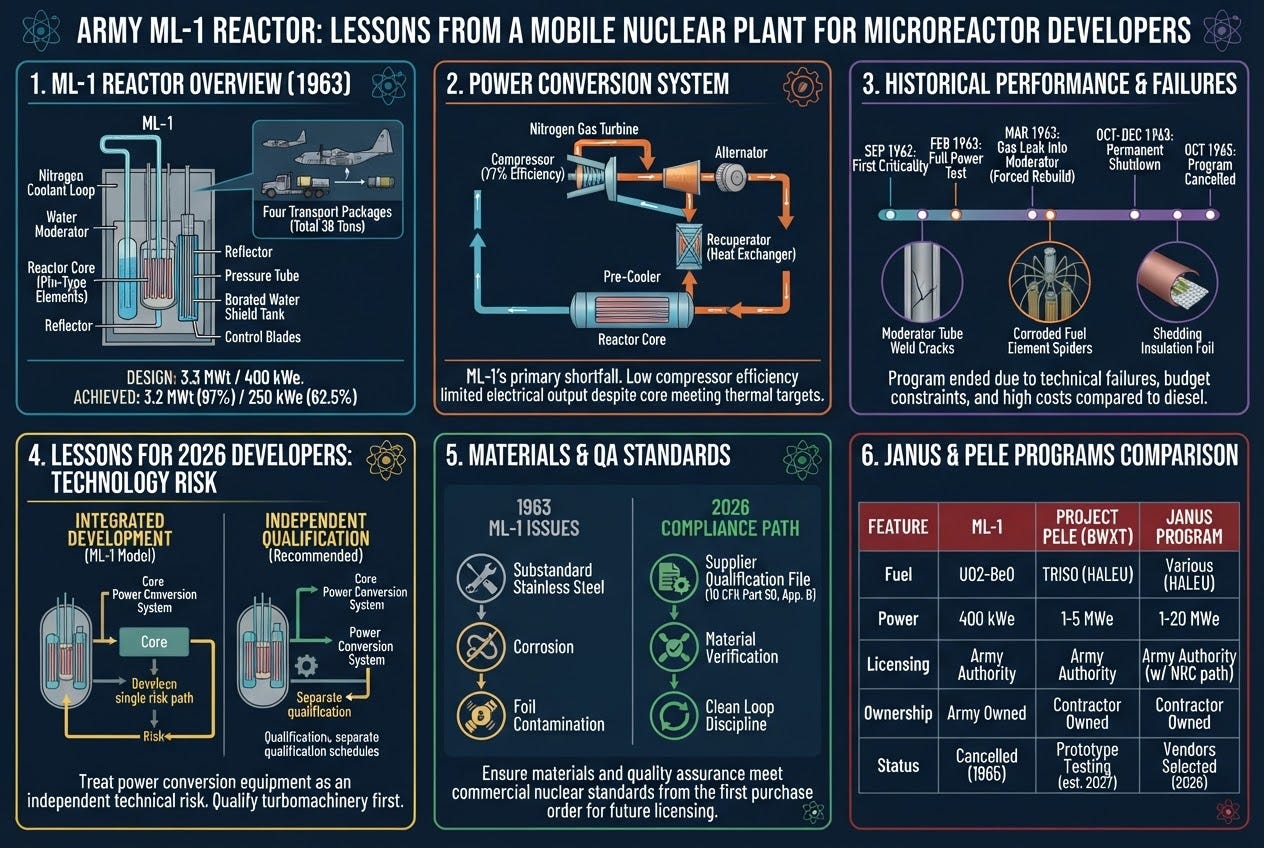
The Army ML-1 reactor reached 3.2 megawatts thermal in 1963 and delivered only 250 kilowatts electric, which tells microreactor developers to qualify their turbomachinery before they finance a core. The core produced 97 percent of its design heat, and the compressor, running at 77 percent efficiency, held the plant to 62.5 percent of its 400 kilowatt electric target. The Army cancelled the program in 1965 without fielding a unit.
On August 26, 2026, the Army named five installations and five vendors for its Janus microreactor program, with about $2.2 billion committed over fiscal years 2027 to 2031 and a requirement that at least one reactor operate by September 30, 2028. Every one of those schedules assumes that the hardware between the core and the wire works the first time it runs together. The Army has made that assumption before.
How Did the ML-1 Work?
Aerojet General Nucleonics built the ML-1 at the National Reactor Testing Station in Idaho as a mobile plant that could ride in four transport packages, weighing about 38 tons in total. Nitrogen with 5 percent oxygen flowed through 61 pin type fuel elements of enriched uranium dioxide and beryllium oxide, left the core near 1,200 degrees Fahrenheit, and spun a closed cycle gas turbine. Water around the pressure tubes moderated the neutrons. A 500 foot exclusion zone replaced the heavy shield a normal plant would carry.
What Happened in the March 1963 Test?
The March 1963 test report shows 3.2 megawatts thermal against a 3.3 megawatt design, and 250 kilowatts electric against a 400 kilowatt design. Reactor inlet pressure came in at 274 pounds per square inch absolute against a design value of 315. The test report puts the shortfall on compressor efficiency, and I read that as the most important number in the file. The nuclear island delivered 97 percent of its design heat, and the machinery that converted that heat to electricity was custom built for the plant.
The next failures arrived quickly. Coolant gas leaked into the moderator water after the first 100 hour high power run, which forced a rebuild. Foil that covered the regenerator insulation tore loose under aerodynamic buffeting and sent particles through a closed gas loop. The quarterly report of February 15, 1964 recorded massive corrosion on fuel element lower spiders and traced it to substandard material, and it recorded that the plant had not operated at all in the preceding quarter.
Why Does a 1963 Gas Loop Matter to a 2026 Investor?
It matters because the Janus vendors carry the same chain of risk, and the capital goes in before the chain has run once. In my years as a submarine nuclear officer, foreign material exclusion around any closed system was the discipline we drilled hardest, since loose debris in a loop does not stay where it was left. The ML-1 foil is that hazard in a different plant.
In thirty years of counseling technology companies, I have watched first customers ask for the supplier qualification file before they ask for the technical specification. A nuclear buyer will ask for the same file, and a developer who expects to move from an Army authorization to a commercial license should hold its suppliers to the quality assurance criteria in Appendix B to 10 CFR Part 50 from the first purchase order.
Fuel adds a constraint that the ML-1 program never faced. Janus reactors use high assay low enriched uranium to make TRISO fuel, and an Army official has said that national supply cannot yet fuel all 20 planned reactors. The Department of Energy plans to spend $2.7 billion over 10 years on enrichment services. Project Pele, the BWXT transportable reactor, received 40,000 TRISO fuel compacts at Idaho National Laboratory on November 5, 2025, and it can begin formal testing as early as 2027.
Who Licenses and Insures a Microreactor on an Army Base?
The Army licenses the Janus reactors under its own nuclear authority, and it says it is working with the Nuclear Regulatory Commission so vendors can later seek commercial licenses. The Commission’s Part 53 final rule, published at 91 Federal Register 15696 on March 30, 2026 and effective April 29, 2026, supplies an optional technology inclusive pathway for that later step, including Section 53.250 on defense in depth. The Price-Anderson Act, 42 U.S.C. 2210, runs through December 31, 2065, and covers Commission licensees. A contractor owned reactor on an Army installation needs a different indemnity, such as Public Law 85-804 relief or a Department of Energy contractor indemnity, and I found no public statement of which one the Janus agreements use.
The ML-1 ended in 1965 when budgets tightened and the plant still had not finished a sustained run. A 1964 economic analysis put its ten year cost near ten times that of a diesel plant, and an Army official said on June 18, 2026 that a microreactor at $1 per kilowatt hour would not work against natural gas that costs the Army about 40 cents in austere locations. The 1964 cost comparison and the 2026 fuel price point to the same hurdle for any fielded nuclear plant.
What Should Founders and Investors Ask Before the First Power Test?
Ask for the measured efficiency of the first compressor or turbine on a test stand. Ask for the supplier qualification file on every pressure boundary material. Ask which indemnity covers the plant and who holds the risk when the contract ends. Ask how the Army operating record will convert into a Part 53 application. The ML-1 produced 62.5 percent of its target power in 1963, and a developer who can state its own equivalent number before the test deserves more confidence than one who cannot.
The next piece in this series covers Vandellos I in Spain, a gas cooled reactor that a turbine hall fire ended in 1989, and it will show how the placement of rotating machinery and oil systems near a nuclear core decides whether one equipment failure stays one equipment failure.
Interested in analysis about the intersection of tech, policy and the law? Check out my Substack channel. https://theinnovationattorney.substack.com/