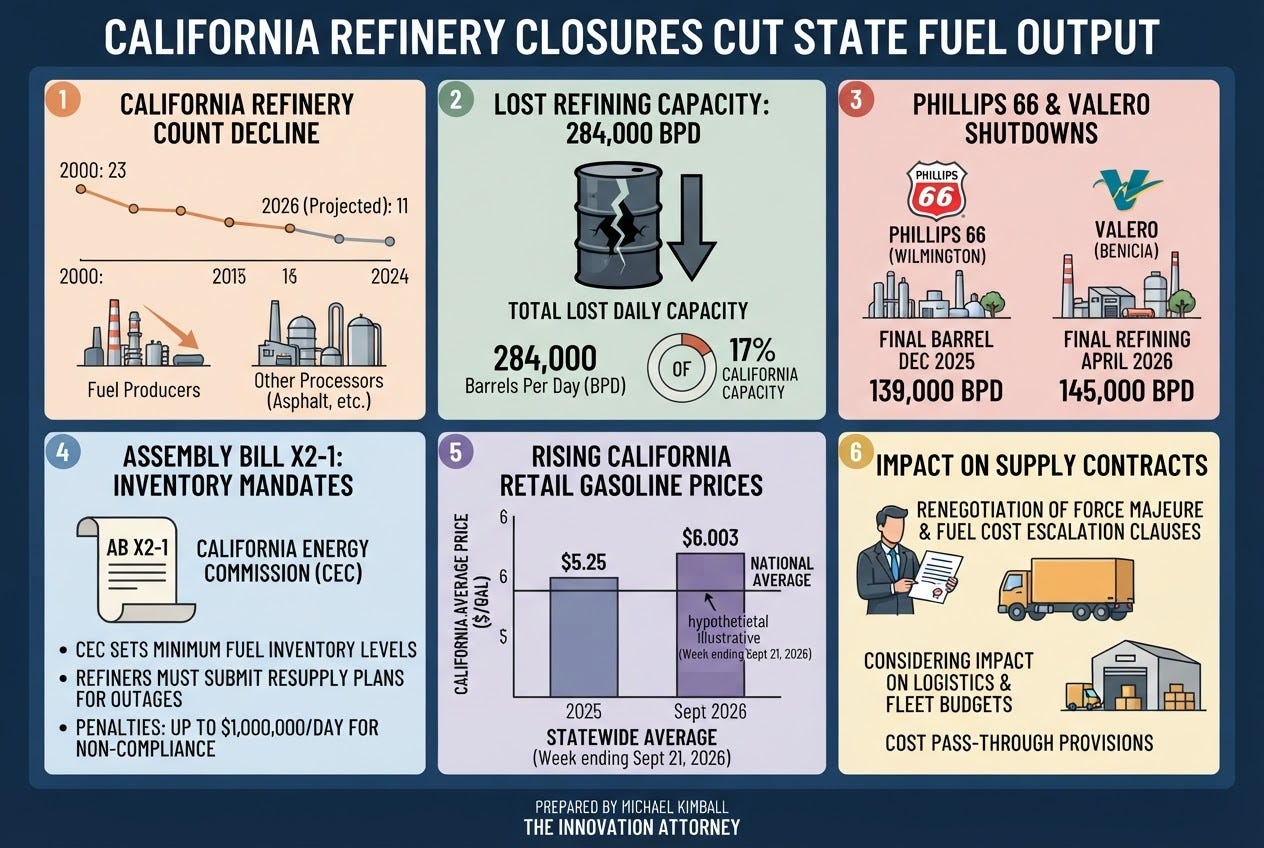
California lost 284,000 barrels per day of refining capacity when Phillips 66 closed its Los Angeles refinery in 2025 and Valero shut Benicia in April 2026. The two shutdowns removed roughly seventeen percent of the state’s operable refining capacity within a six month span, leaving eight refineries to supply California’s gasoline and diesel market. Federal government data puts total operable capacity at 1,637,871 barrels per calendar day at the start of 2025 and 1,499,171 barrels per calendar day at the start of 2026, a count that does not yet reflect the Benicia exit. Two economic analyses of what this means for pump prices reach very different conclusions, and the state legislature has responded with inventory mandates rather than new refining capacity.
This report separates the confirmed capacity numbers from the contested price forecasts, traces the two closures to their regulatory and financial causes, and identifies a third Valero refinery in Wilmington whose future is not yet decided. It also examines Assembly Bill X2-1, the 2024 law that gives the California Energy Commission authority to set minimum fuel inventory levels, and the Low Carbon Fuel Standard amendment that took effect on July 1, 2025 with its own contested cost estimate. The audience for this analysis is the founder, investor, or executive whose supply chain, facilities budget, or logistics contracts touch California fuel markets, whether directly through fleet diesel purchases or indirectly through vendor cost pass through provisions.
Detailed Findings
How many refineries in California still make gasoline and diesel
Eight oil refineries in California produce transportation fuel as of the California Air Resources Board’s most recent facility inventory, updated May 5, 2026. Four sit in the Los Angeles basin: Marathon Petroleum in Los Angeles, Chevron in El Segundo, PBF Energy in Torrance, and Valero in Wilmington. Two sit in the Bay Area: Chevron in Richmond and PBF Energy in Martinez. Two smaller, non integrated plants operate in Bakersfield: Kern Energy and San Joaquin Refining Company. Three additional California refineries process asphalt or other non transportation output, not gasoline or diesel, bringing the state’s total refinery count to eleven, a figure the American Petroleum Institute projects for the end of 2026 and that the Air Resources Board’s own inventory independently confirms.
The count has been falling for a quarter century. The American Petroleum Institute puts the statewide refinery total at 23 in 2000 and 14 at the start of 2024. Phillips 66 alone accounted for two exits in that span: its Rodeo plant converted to exclusive renewable fuel production in 2024, and its separate Los Angeles refinery in Wilmington processed its final barrel of crude oil in December 2025. Both moves removed conventional gasoline and diesel capacity even though only one, the Wilmington shutdown, is a full closure of a fuel producing facility.
How much capacity did the Phillips 66 and Valero shutdowns remove
The Phillips 66 Los Angeles refinery in Wilmington processed 139,000 barrels of crude oil a day before its final shutdown in December 2025, following an October 16, 2024 closure announcement. Valero’s Benicia refinery, a plant built for Humble Oil in 1969 and acquired by Valero in 2000, is scheduled to stop refining by the end of April 2026 at a rate the U.S. Energy Information Administration puts at 145,000 barrels a day, a figure the agency ties to a April 2025 closure notice. Combined, the two facilities equal 284,000 barrels a day, which the Energy Information Administration calculates as seventeen percent of California’s refinery capacity and eleven percent of capacity across the five state West Coast petroleum district that includes Alaska, Washington, Oregon, California, and Hawaii.
Government capacity data confirms the scale of the decline independent of either company’s own figures. Operable atmospheric crude distillation capacity in California stood at 1,748,171 barrels per calendar day as of January 1, 2021, held near that level through 2022, then began falling: 1,740,371 in 2023, 1,680,371 in 2024, 1,637,871 in 2025, and 1,499,171 as of January 1, 2026. That final figure captures the Phillips 66 exit but predates the Benicia shutdown, since the Energy Information Administration’s snapshot is taken each January and Valero does not stop refining until April. Absent any new capacity coming online in the meantime, the January 2027 snapshot should fall to roughly 1,354,000 barrels per calendar day once Benicia’s exit is counted, a reduction of nearly 350,000 barrels per calendar day from the 2021 baseline in six years.
A third refinery adds uncertainty to that trajectory. Valero’s own Wilmington plant, a separate 135,000 barrel a day facility from the shuttered Phillips 66 site and one of the eight refineries still listed as a transportation fuel producer, remains open for now, but Valero has indicated it could close as well. Chief executive Lane Riggs has described California’s regulatory environment as the most stringent of any jurisdiction the company operates in across North America, a comment made after Valero booked a combined 1.1 billion dollar asset impairment on the Benicia and Wilmington properties in its first quarter 2025 financial results.
What does Assembly Bill X2-1 require refiners to do before they cut output or close
Assembly Bill X2-1, signed October 14, 2024 and effective the following January, gives the California Energy Commission authority to set minimum inventory levels for refined transportation fuel at each refinery in the state. A refiner planning a maintenance turnaround or other planned outage must show the commission a resupply plan demonstrating that the gap will not damage the state fuel market before the outage begins. The commission can tailor minimum volumes by region, season, refinery size, and available storage, and it may consider tradable compliance instruments similar to the state’s existing Low Carbon Fuel Standard credit market, but the statute bars the commission from ordering a refiner to build new storage infrastructure it does not already have.
The law also carries a real penalty structure. A refiner that falls short of its inventory requirement gets a three day cure period after notice from the commission; failure to cure exposes the company to administrative penalties of up to 1,000,000 dollars for every day the violation continues. The statute sunsets on January 1, 2033, giving California roughly seven years to determine whether inventory mandates alone can smooth out the price spikes that closures and unplanned outages produce, or whether the state needs additional refining or import capacity to do that job instead.
How much have the closures raised pump prices, and how high could they go
California’s regular gasoline averaged 6.003 dollars a gallon for the week ending September 21, 2026, according to the Energy Information Administration’s weekly retail survey, a spread that has widened steadily against the national average. University of California Davis economists writing in the Giannini Foundation’s ARE Update calculate that California’s premium over the national average grew from 0.25 dollars a gallon in 2000 to 1.50 dollars a gallon by 2025, and their model projects an additional 1.21 dollars a gallon increase by August 2026 once both the Phillips 66 and Valero closures are fully reflected in the market, including an estimated 0.40 dollar a gallon jump tied to the first closure alone. The economists, Armando Colina, Bulat Gafarov, and Jens Hilscher, caveat their own model by noting it assumes no further changes in the market and that regulatory adjustments allowing more fuel imports could blunt the increase, though existing port and pipeline infrastructure may limit how much relief imports alone can provide.
A more severe forecast comes from University of Southern California business professor Michael Mische, whose May 2025 ana…