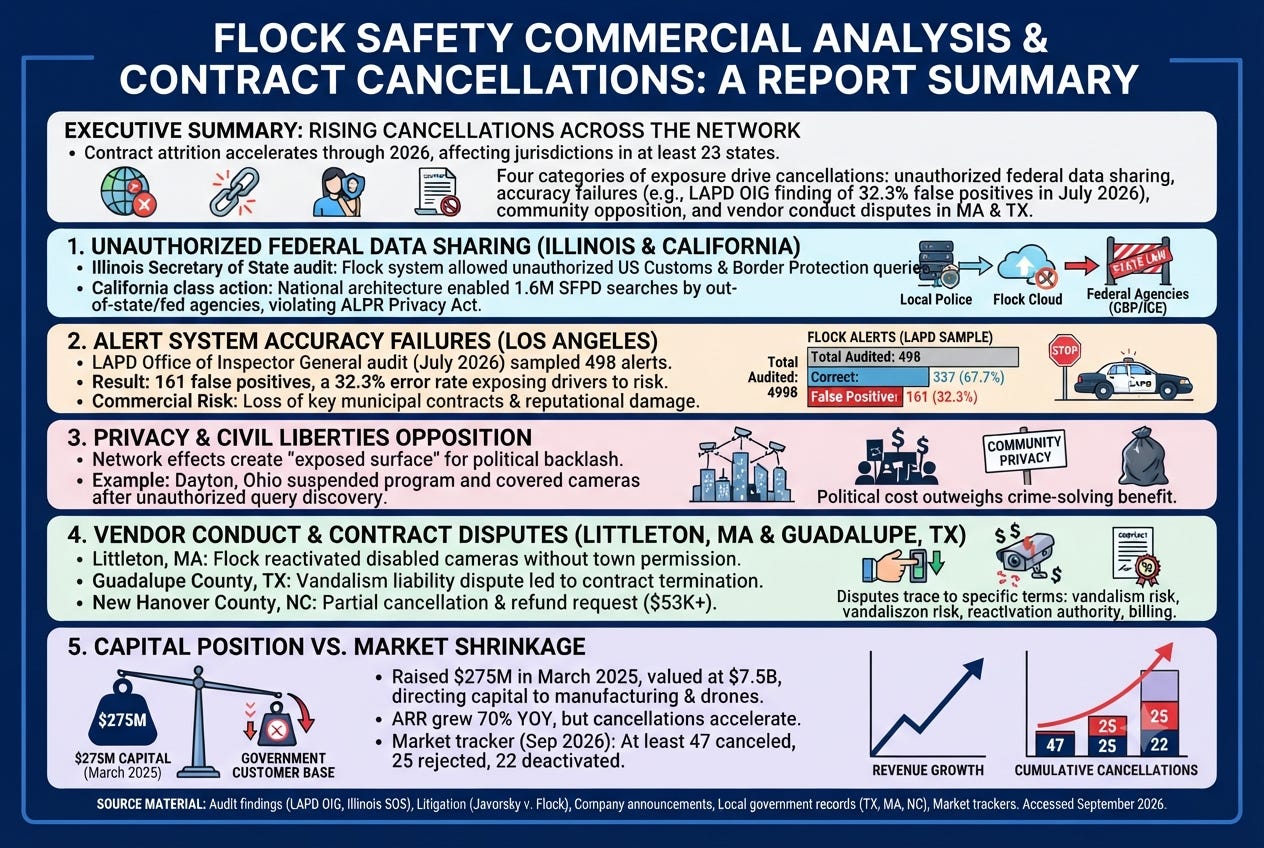
Flock Safety, valued at $7.5 billion, faces widening municipal contract cancellations after the Los Angeles Police Department’s Office of Inspector General found a 32.3 percent false positive rate in July 2026. The company’s own conduct now drives much of that attrition: audits in Illinois and litigation in California allege that Flock let outside agencies query local camera databases without the permissions state law requires. Hardware disputes in Massachusetts and Texas show gaps in how the company installs, services, and bills for its equipment. A $275 million funding round completed in March 2025 committed Flock to manufacturing and drone investments sized for a customer base that is now shrinking.
Flock Safety built its subscription business on a feature most of its own customers never had to name: the ability of one department’s cameras to answer a search run by a department two states away. That cross jurisdiction lookup is the mechanism that state audits and private litigation now describe as the path through which federal agencies reached camera data that state law was written to keep local. The Illinois Secretary of State’s office audited a sample of twelve law enforcement agencies and found that Flock’s system lacked the jurisdiction specific permissions the Illinois TRUST Act requires, which let United States Customs and Border Protection query Illinois camera data without the consent the statute demands. The Illinois Secretary of State’s office ordered Flock to shut off that access in August 2025, and the company paused its federal pilot data sharing programs nationwide.
California presents the same exposure through private litigation rather than a state audit. A class action filed in San Francisco County Superior Court in February 2026 alleges that Flock’s national lookup architecture let out of state and federal agencies run more than 1.6 million searches of the San Francisco Police Department’s camera data between August 2024 and February 2025. The same complaint alleges that in April 2025 the California Highway Patrol ran a search on behalf of United States Immigration and Customs Enforcement across 845 separate California agency databases, in claimed violation of the California ALPR Privacy Act codified at Civil Code section 1798.90.5. The Los Angeles Police Department’s Office of Inspector General found a 32.3 percent false positive rate in Flock hot list alerts, and the department let its contract expire on July 11, 2026 rather than renew it. A false positive rate published by a major department’s own oversight office becomes a citable figure for every other customer’s city council and every plaintiff’s expert witness in a wrongful stop claim, regardless of what Flock’s engineering team has since changed.
Not every cancellation traces back to data policy or accuracy. Several disputes turn on how Flock installs and services hardware once a contract is signed. In Littleton, Massachusetts, the town shut down its Flock cameras on public roads, and Flock turned them back on without telling the town, a reactivation the town discovered in August 2026. Cambridge, Massachusetts canceled its license plate reader agreement outright in December 2025. In Guadalupe County, Texas, every Flock camera in the city of Seguin was vandalized, and the company, according to the county sheriff, would not cover the replacement cost, so the commissioners terminated the contract in August 2026 for a cost of roughly $8,500 against projected annual savings of at least $48,500. New Hanover County, North Carolina paid $100,000 in May 2026 toward a $219,000 contract, then voted on September 8, 2026 to cancel the license plate reader portion of the deal and asked Flock for a $53,571.43 refund on the unused term. Each of these disputes comes back to a specific term in Flock’s own contract: who bears vandalism risk, who may reactivate hardware a customer has disabled, and how a partial cancellation gets priced.
Flock raised its $275 million round in March 2025 with Andreessen Horowitz leading a group that included Founders Fund, Kleiner Perkins, Tiger Global, and Y Combinator, at the same time the company reported more than $300 million in annual recurring revenue, up 70 percent year over year. The company directed that capital toward a domestically produced drone line built on its Aerodome acquisition, a 100,000 square foot manufacturing facility in Georgia, and its Nova investigative data platform. That plan assumed a customer base that kept growing. An independent tracker counted at least 47 canceled Flock contracts, 25 rejected proposals, and 22 deactivated systems by late July 2026, with jurisdictions across 23 states rejecting or canceling agreements in 2026 alone.
I have watched enough venture backed hardware companies raise a large round on a growth curve and then discover that the curve was measuring adoption, not durability, to know which number matters more here. A subscription business selling into elected local government does not lose customers the way a consumer application loses users. It loses them in public commission meetings, on the record, with a specific vote and a specific dollar figure attached, which is exactly the trail the preceding paragraphs just walked through. Flock’s cross jurisdiction search architecture is the company’s most valuable asset and its largest liability at the same time, because the interoperability that makes the product worth buying is the same interoperability that let one jurisdiction’s federal access reach into another jurisdiction’s statute.
Two questions will decide whether the current wave of cancellations is a correction or the start of something durable. Whether Flock can build a technically partitioned architecture that gives each customer exclusive control over which outside agencies may query its own data, without losing the cross jurisdiction value that differentiates the product, is the first. Whether the class action pending in San Francisco County Superior Court establishes a per search damages theory that reaches beyond the San Francisco Police Department’s account to Flock’s full California customer base is the second, and it is the one I will take up directly in the next piece, alongside what the California ALPR Privacy Act’s statutory damages provision actually allows a court to award per unauthorized search.
Interested in analysis about the intersection of venture capital, tech, artificial intelligence, public policy and the law? Check out my Substack channel. https://theinnovationattorney.substack.com/