If you missed the first post, start with 001. Becoming a Microsoftie (Chapter I). A Prologue has been added offering just a bit about my own history with computing. There is also a Roadmap/Table of Contents. If you need an overview and guide to subscriptions with discount codes, see Introducing "Hardcore Software".
Back to 001. Becoming a Microsoftie [Chapter I]
When I first arrived in Redmond, I lived about three blocks from campus, in company-provided temporary housing at an apartment complex called Bellevue Meadows, a block from the Residence Inn I had almost burned down during my interview. It was still light out at 9 p.m. on my first night (welcome to the Northwest), so I walked over to campus to check it out.
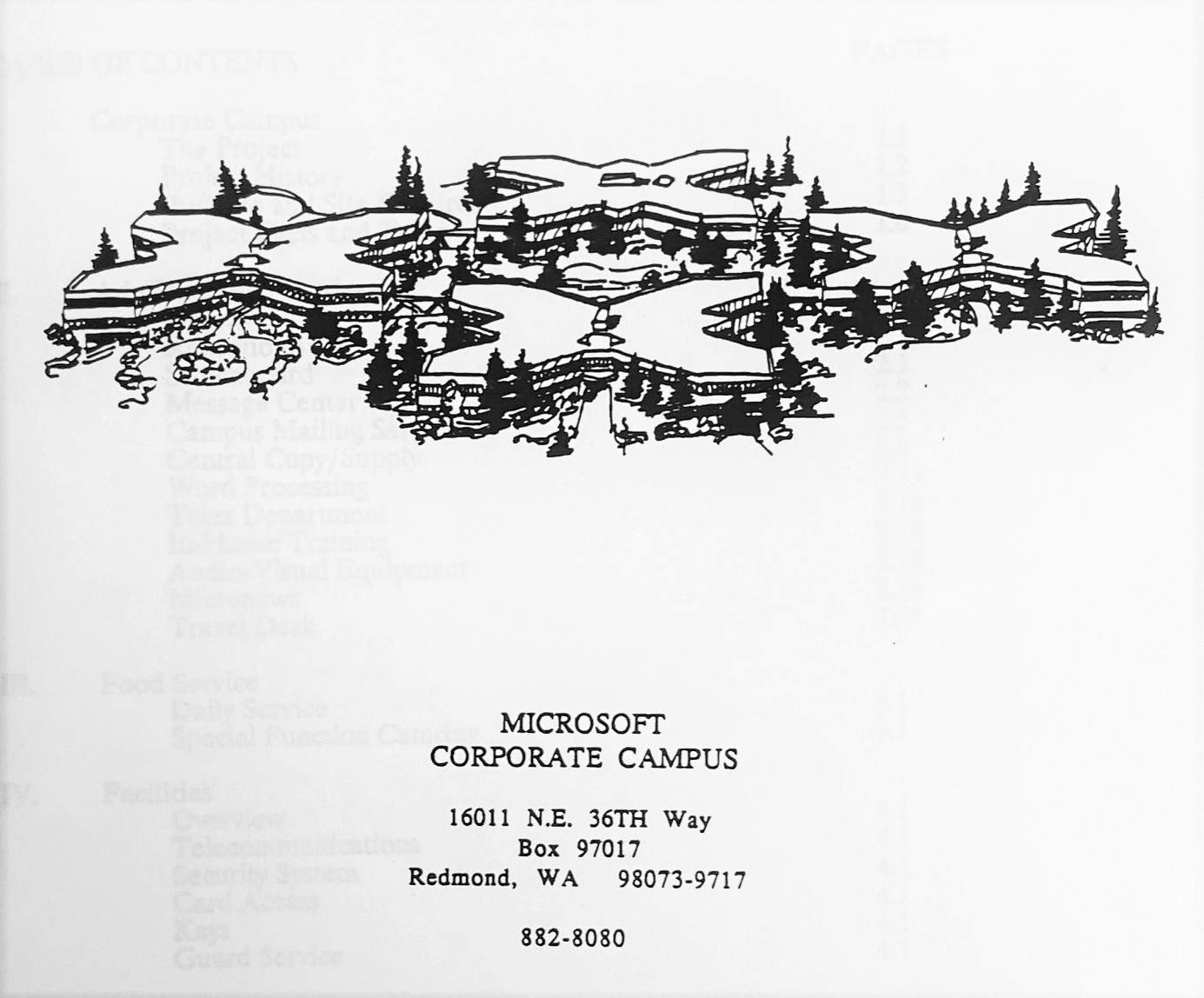
Microsoft’s three-year-old campus was made up of the original X-wing buildings, 1 through 6, and the recently completed double X-wing 8 and and 9. There was no building 7. Nobody knew exactly why, though there were a bunch of theories tossed around over the years. Sending a new person to meet up at building 7 was an ongoing prank. The real buildings surrounded a fountain and the small-but-infamous Lake Bill (which, looking back, is much smaller than I recalled from that first night). There was a basketball court near the lake, which always seemed to be in use. The buildings, connected by tree-lined sidewalks, were known for their design, which was meant to maximize the number of private offices with windows.
In a nod to Microsoft’s culture of self-reliance, the next day, my first day, after a two-hour orientation session (that felt like forever), I and about 20 other college hires were left to fend for ourselves. While I had been told how to set up direct deposit (paychecks were still hand delivered for many) and learned some details about my healthcare plan, I literally had no idea where to go. Fortunately, a more studious fellow new hire noticed, buried in the paperwork, that there was a map and an old-style printout with name (Steve Sinofsky), telephone extension (x67768), manager (Scott Randell, listed as SCOTTRA), and an email ID and password (yes, printed). The floor plan and numbering system made MIT’s infinite corridor look understandable.
As I flipped through the paperwork, I noticed my assigned email name was STEVESI on the printout, which immediately irked me as I was steven in all my previous systems (all lower case because of Unix). Obviously, I was not going to complain.
As I came to understand it, SteveSi was officially, and forever, my new name. Email names were how people wrote and spoke about others. Where a previous generation might have used only a last name out of casual respect or mister in person, Microsoft used email from BillG to SteveB on down. Aside from the free drinks, private offices, and khakis with button-downs, email names remained one of the iconic cultural identifiers of those days (and still used among alumni.) Given names no longer mattered at Microsoft. I was SteveSi. Cris Wittress was CrisWit—I finally got what she meant.
Before I started, Steven Schwartz had landed the name StevenS, a fact for which I was always jealous. After he left I even tried to secure the name, but there was a no-recycle policy. A coworker named Bill Gallagher was given BillGa, and for years he got crazy mail intended for (the real) BillG. As the company grew, it began to wrestle with the complexities of people getting married (or divorced) and how to deal with email name changes—much trickier than they’d imagine. Ultimately, in the late 1990s with the move to Microsoft’s email product, we finally moved to friendly names like steven.sinofsky@microsoft.com.
There was a list of email aliases (an early Unix-ism) to get help, like benefits, sickday, vacation, supply (office supplies), recept1 (recept2, recept3, etc. for the receptionists), stock (stock option sales), espp (employee stock purchase plan), payroll (for help with direct deposit), and, best of all, pcrepair, which could help with computer hardware. Perhaps that was second best, as I soon discovered library, which mailed the Microsoft librarians any topic to research or a request to send copies of articles or locate any book needed for work. There was an actual library filling most of one arm of an X in building 4, where I spent a lot of time as well. Everything was an email away.
Microsoft made about 35 different products back then, and I had personal experience with almost none of them. Importantly, by the mid-1980s, Microsoft moved beyond being a single-product company. It had substantial businesses in each of the major categories of the day: languages, operating systems, and applications. No single product represented more than half the company revenue. This early diversity was critical to Microsoft’s growth. In many ways, early software companies emulated record or book publishing by having many licensed titles for sale, and while early Microsoft followed this model it was now building most software in house.
The Systems group was the big group and was made up of the grown-ups. It felt to me the most like my summer aerospace job because there were people who were married (gasp!), and some even had children. This was the group that made MS-DOS, which was the single biggest moneymaker. They were also making OS/2, which was a massive joint project with IBM. There was a much smaller side project called Windows that was increasingly interesting. Unique to the Systems group was a much larger number of people who had joined Microsoft with years of prior work experience. There were people from IBM, DEC, ATT, HP, and a host of other computer companies from a previous era. Dave Cutler (DaveC), a legend with over 25 years of experience, had recently joined from DEC along with many of those colleagues. This made sense since building an operating system was something done at other big companies.
Languages was the history of the company and the oldest group. This was the group that made BASIC, as well as programming languages and tools from C to Pascal, Fortran, and, importantly, Assembler. The Languages products were for MS-DOS, Xenix (the commercial version of Unix, the ancestor of today’s Linux), and an expansion to OS/2 (an ill-fated joint development between Microsoft and IBM).
I thought many of the people I met in Languages seemed old. Some owned houses and had new cars. Some had been at Microsoft more than five years already.
Apps was the colloquial term for Applications, which is how the computer industry viewed programs used by end-users, versus the Operating System, which was required by the machine, or Languages used by developers. The Apps group was less tenured as it was both a newer business for Microsoft and seemed to have more college hires. Apps was almost a sleeper business even back then. Most of the products it made were for the Macintosh, like Word, Excel, and File, all of which were on the first or second version. Apps for MS-DOS were almost as numerous, but all were a distant number two in the market relative to software giants Lotus, WordPerfect, Ashton-Tate, and Software Publishing that I had used in my summer job during college.
I walked over to building 5 to find the private, interior office in which I’d begin my career. It had no exterior window but had one to the hallway. As I searched for my office, I passed the kitchen and saw the giant glass-door refrigerators filled with cans of every variety of Coke and Pepsi products like a convenience store.
It would be decades before I paid for a beverage.
Just across from the kitchen was the mail and copy room. This room had everything one could imagine needing for work. It was like a CompUSA and Office Depot all in one. Along with a big laser printer (and a copy machine), there were 5.25-…