Go back to 003. Klunder College
Subscribers, thank you so much for the kind words and most of all participation in the discussions. My heart warms each time someone shares their own story or memories from these times. In this section, I am transitioning out of Apps Development College to my full time role. Along the way I am learning the realities of PC software today—it is usually late, and usually buggy. I’m also starting to learn a bit about the two cultures at Microsoft, Apps and Systems. There will be a couple of short posts after this and then we’re off building products!
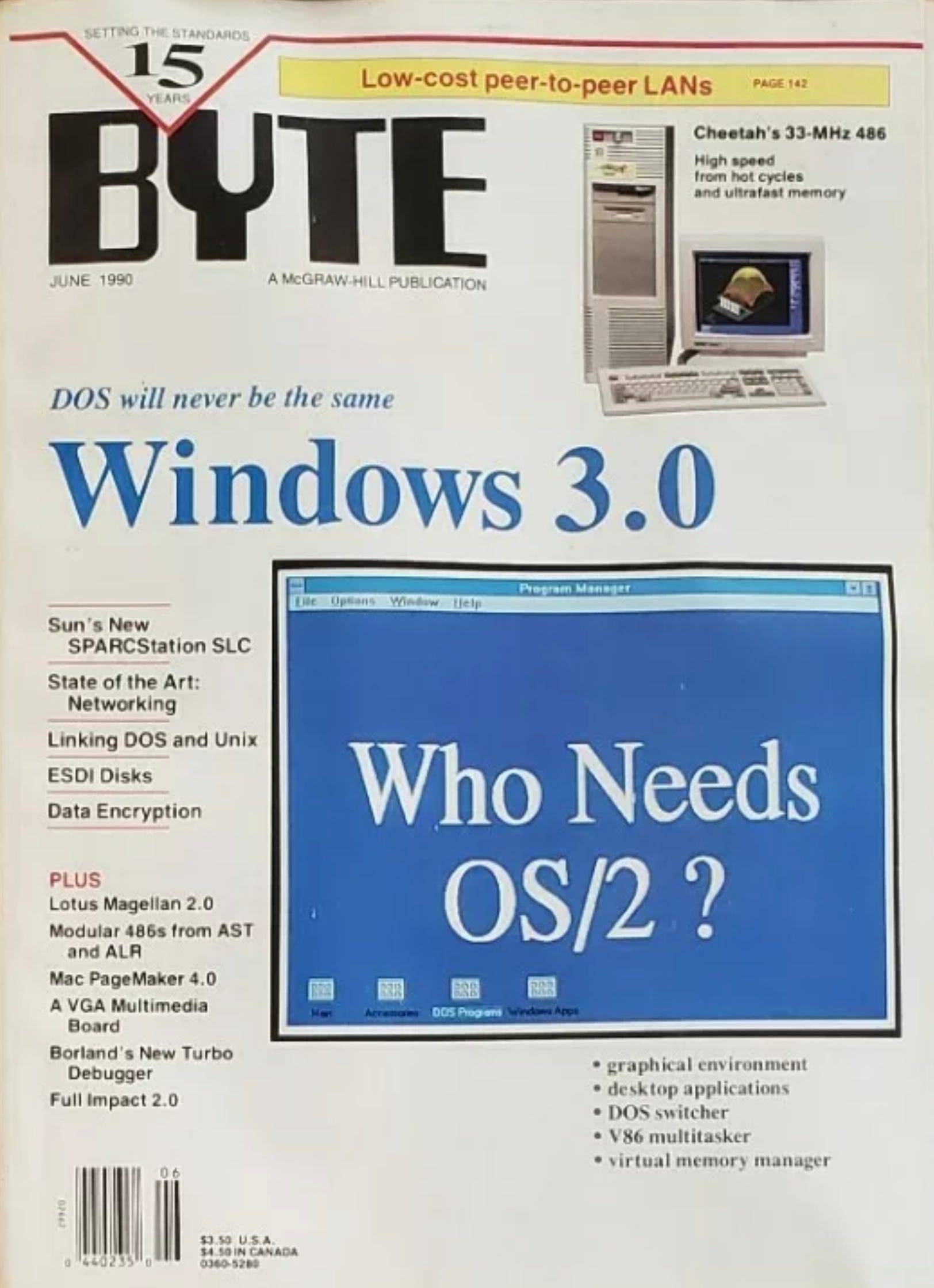
As the summer of 1989 turned to fall, the shipment of Windows 3.0 was looming. When not working on a Mac product or trying to get OS/2 stable for daily use, most of us in Apps were dealing with getting something to work on Windows and reporting bugs back to the Windows team.
Far away in Systems, Windows, what started as a side project was now a full team of people grinding away on a death march to get Windows 3.0 done. Typically, in those days, this period of heightened work hours and intense cycles of bug fixing marked the last months of any project. The cafeterias were not usually open for dinner ushering in a (mostly) Systems tradition of ship meals, featuring a buffet much fancier than the cafeteria offered. The idea of serving dinner as part of routine death marches became a decidedly Systems approach that was so formalized it became a budgeted line item (as I would later learn when I joined Windows). Windows 3 was still months from shipping, but the activity was going on around the clock.
Windows was in Systems, which was the big dog half of Microsoft. While the history of the company was in Languages where BASIC and other tools were made, the center, and at the time the economic engine of the company, was Systems where MS-DOS was made. MS-DOS was the brilliant product born out of a commitment to IBM to deliver a product that didn’t exist and wasn’t yet under development. It was subsequently acquired and modified to meet the deadline, with the twist that Microsoft was free to license the product to other computer companies.
In other words, while IBM was the first contract for MS-DOS it was not exclusive.
Out of that, the entire PC industry was created. And not for one second was that lost on the Systems people.
From those early first days, Microsoft felt like two different companies: Apps and Systems. A buzzword in modern business, these two cultures could not have been more different, at least that’s what I was led to believe by listening to stories at lunch. Even though the company was made up of only about 3,500 people, with half in Redmond, I had not yet met anyone in Systems. While I could have easily walked a few hundred feet over to one of the buildings they occupied, that wasn’t something that people did. Apps and Systems didn’t exactly intermingle.
The one thing we knew about Systems, despite the anonymity, was that as buggy and late as Apps products were, the Systems products, I was informed, were buggier and later. Windows 3.0 was coming down to the wire. There were no real secrets—many people had builds and were installing the product, and the weekly industry tabloids, InfoWorld and PC Week, were tracking the latest rumors, test releases, and gossip. The actual delivery date was not well known, not by the team or anyone else until very close to the announcement of that date.
From the time I arrived at Microsoft and installed that first build in ADC in the summer, the launch of Windows 3.0 was always real soon now, often abbreviated RSN in snarky email. That had no impact at all on the enthusiasm as the buzz that Windows 3.0 would be a breakthrough was pervasive through the hallways. The industry was equally anxious for what appeared to be a showdown across a plethora of operating systems including MS-DOS, Windows, OS/2, and Macintosh.
In hindsight, it was easy to make fun of the fact that everything seemed late and hardly worked. The entire industry was like that. From the earliest days of PCs none of us knew anything else.
The expression vaporware was commonly used to refer to software that was well known and frequently discussed but not yet shipping. The phrase was used first as far back as 1983 by Esther Dyson in the industry thought-leading newsletter Release 1.0. In some sense, most everything was vapor. I remember sitting in my ADC office having just received a Goldman Sachs analyst report on Microsoft from the library. In the report was a table of all our company’s products under development and estimated ship dates. The dates were far in the future and all wrong by many months or even years.
In fairness, it was challenging to simply get a non-trivial product built, have it work on the wide variety of PC configurations that existed, and then ship it in dozens of languages. That’s because there was no internet, no diagnostics, or telemetry, and anything that went wrong simply crashed the whole computer, requiring a power cycle. And, most importantly, the field of software engineering was nascent to the point of not really having the institutional knowledge of building and testing software for mass distribution. Before the PC, there were many complex systems, but each one was custom and staffed by full-time people to keep it running. PCs were different. Everything was new. And that was before the complexity of coding for a graphical interface like Windows and Macintosh.
One of the biggest differences with PCs was that the PC operating system ran in such a way (called real mode compared to protected mode that would be introduced later in Windows and still later in Macintosh) that any bug in a program generally did one of two things, but probably both. First, for certain, whatever file was open and being edited probably became corrupt and data was lost. That was a heart-stopping given. Second, there was a good chance that the crashing program also caused the computer to crash, hang, or otherwise stop working. Thus, the cardinal rules of the early PC era were born: First, frequently save work and make backup copies, and second, if something goes wrong, reboot the machine.
I learned this firsthand too many times. In college when I operated computers in the lab, an entire shift could often be consumed by trying to help a classmate salvage the remains of a term paper off of a floppy after a crash. Those were the most horrific bugs because work was lost that people assumed they were saving. Such were early PCs (and Macs).
Because of this, it was extraordinarily super-human to even get programs working in the first place. By definition, a mistake in the code caused everything on the computer to stop working, including the tools being used to diagnose the bug. The best programmers, like Duane Campbell (DuaneC), ScottRa, and others, were able to figure o…