Back to 004. Everything is Buggy
I finally have a project to work on. Unfortunately it feels a bit like make-work and I have no idea how it fits into the big picture of Microsoft. Actually, I’m not even sure what the big picture is as we’re all in the middle of the strategic shift to GUI and Microsoft has multiple operating systems we’re supposed to be supporting.
As part of the Apps Tools group, we were set up to provide the tools to make it easy to build apps that worked on any platform, regardless of the differences or details of each platform. Isolating app developers from platforms was our job. The industry called this cross-platform development.
Historically, such an approach was at the core of Microsoft from the beginning, simply because computing had always been heterogeneous. The makers of computer hardware customized the operating system, which in turn meant that apps needed to be modified to run on each different computer system. This was not any sort of evil plot, as some believed, but simply something that was in place because the hard part of making a computer system was the hardware. Hardware engineers, naturally, chose to modify the software if it meant making the hardware easy. In Microsoft’s earliest days, PaulA and BillG made the BASIC language for many different computers. Microsoft early apps, like the Multiplan spreadsheet, ran on many different personal computer systems at the time, a variety of 8-bit microprocessors and operating systems. Developers like JonDe and DuaneC were experts in the underlying technologies used to get Microsoft apps running on systems from DEC, Tandy, Zenith, Data General, and a host of other names from a bygone era, as well as IBM and then Hewlett-Packard, Compaq, and Dell. PCode and the virtual machine that DougK talked so poetically about in my summer training were in part about making it easier to run software on multiple platforms.
It was natural, therefore, that with Microsoft looking to grow the graphical interface apps business while also itself building multiple operating systems, there was a need for cross-platform tools that were more sophisticated than the 8-bit character mode tools that were already in place. Microsoft needed cross-platform tools just to be able to develop its own applications for its own operating systems. Let that sink in. It was common practice in the industry at the time for every major independent software vendor to also develop their own cross-platform toolset, designed to optimize for their own app and their own view of the platform landscape. Microsoft was unique in creating its own need for cross-platform tools, with multiple operating systems and its own applications.
Cross-platform product development was the elusive brass ring of development that accompanied each generation when there was no clear platform winner. From mainframes to minis to the increasingly popular Unix variants to microcomputers, and now the rising graphical interface. Each new platform promised to be the one to end all platforms, and it might have been, until the cycle repeated. Cross-platform tools are one of those developer problems that everyone believes they have an answer to, certainly early in software lifecycle.
This did not stop even Microsoft from getting caught up in building cross-platform tools. As platforms and applications mature, cross-platform becomes increasingly difficult and the customer experience decreasingly good. Microsoft was still in the early days of cross-platform so it was looking workable. Given the early success with BASIC and 8-bit character mode, it was no surprise that BillG thought the next generation of such work was trivial, a term he loved to toss around. The difficulty—the lack of a trivial solution—was that more and more work was shifting to operating systems away from apps. In other words, as Microsoft (with IBM, and Apple) invested more into making the operating system feature-rich, it made building cross-platform applications more difficult. In fact, that was the strategy, even if it pertained to its own operating system products.
Still, the industry believed the key to making cross-platform trivial was a programming technique, one that wasn’t too new dating back to the 1970s Xerox Palo Alto Research Center (PARC), called object-oriented programming, or OOP (sounds like oops). OOP was everywhere. A trip to the Tower Books on NE 8th Street in Bellevue, something I routinely did on Friday nights because it featured a necessarily deep section of programming and technology books, yielded new books every week with OO in the title. OOP promised to make programming an order of magnitude easier (another common phrase, meaning 10 times better or more, but with no specific units or ability to measure).
OOP was also deep in my own bones. My lab in graduate school was the Object-oriented Systems Lab. We spent the better part of a year recreating the original OOP platform from Xerox PARC, Smalltalk-80, so we could build our own OOP projects using that as a foundation. It is where I came to believe garbage collection was an important part of OOP. I came to Microsoft already an OOP zealot, which in part was why I was hired I was later told.
Aside from abstract computer science concepts, a new innovation for OOP was a new programming language pioneered at AT&T Labs, which, despite the breakup 10 years earlier, was still functioning and a leader in many fields of research, still winning prizes and medals. C++ was the OOP version of the widely used and taught C programming language. That meant it held the promise of not only making programming an order of magnitude easier, but also through its OOP techniques making it possible to be cross-platform, all while maintaining compatibility with the industry standard C language (the language used across Microsoft at the time). OOP as expressed in C++ would make not just cross-platform programming easier but make all programming easier.
Imagine that? No, really. Imagine that, because that’s all that could be done at the time, or ever.
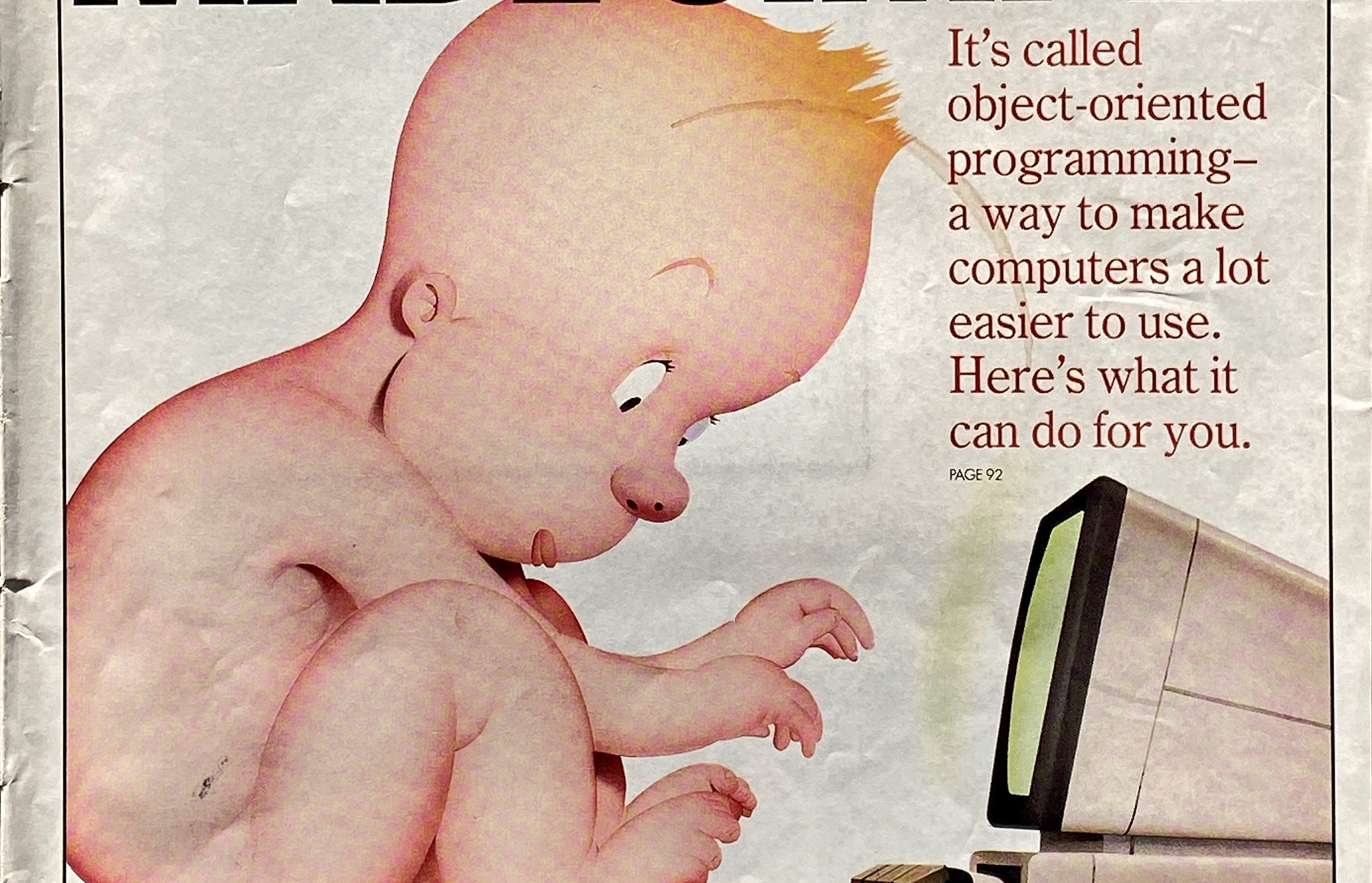
The buzz around OOP reached epic, or comical, proportions even making its way into mainstream business press. The cover of BusinessWeek magazine featured a baby in diapers at a keyboard and monitor introducing OOP to readers as “a way to make computers a lot easier to use”. It was no longer just a magical tool that would make cross-platform programming trivial or a technology that computer scientists believed would lead to more robust and maintainable code. OOP was even going to make resulting applications easier to use.
Object-oriented programming and C++ represented my introduction to the hype cycle of the technology industry. In experiencing this now, I was fortunate in two ways. First, I was still early in career, so I was more mystified than cynical. Second, I was surrounded by already seasoned managers focused on “shipping” who helped our group to navigate the St. Elmo’s fire of OOP.
The industry would undergo a tectonic shift over a multiyear journey to demonstrate the utility of OOP when it comes to mass market software, especially for GUI platforms. Today, most anyone can build GUI applications, but early on the complexity made that extremely difficult. While we could not make it possible for an infant in diapers to program, we could make it much easier for the typical professional or college student. The degree to which OOP or other developments contributed to making it easier will always be the subject of debate, as programming tools and languages always seem to be. There is no doubt, ho…