Back to 008. Competing with Steve Jobs (the First Time) [Chapter II]
It is only fitting that a post about an accomplishment by Steve Jobs would come on the eve of his birthday.
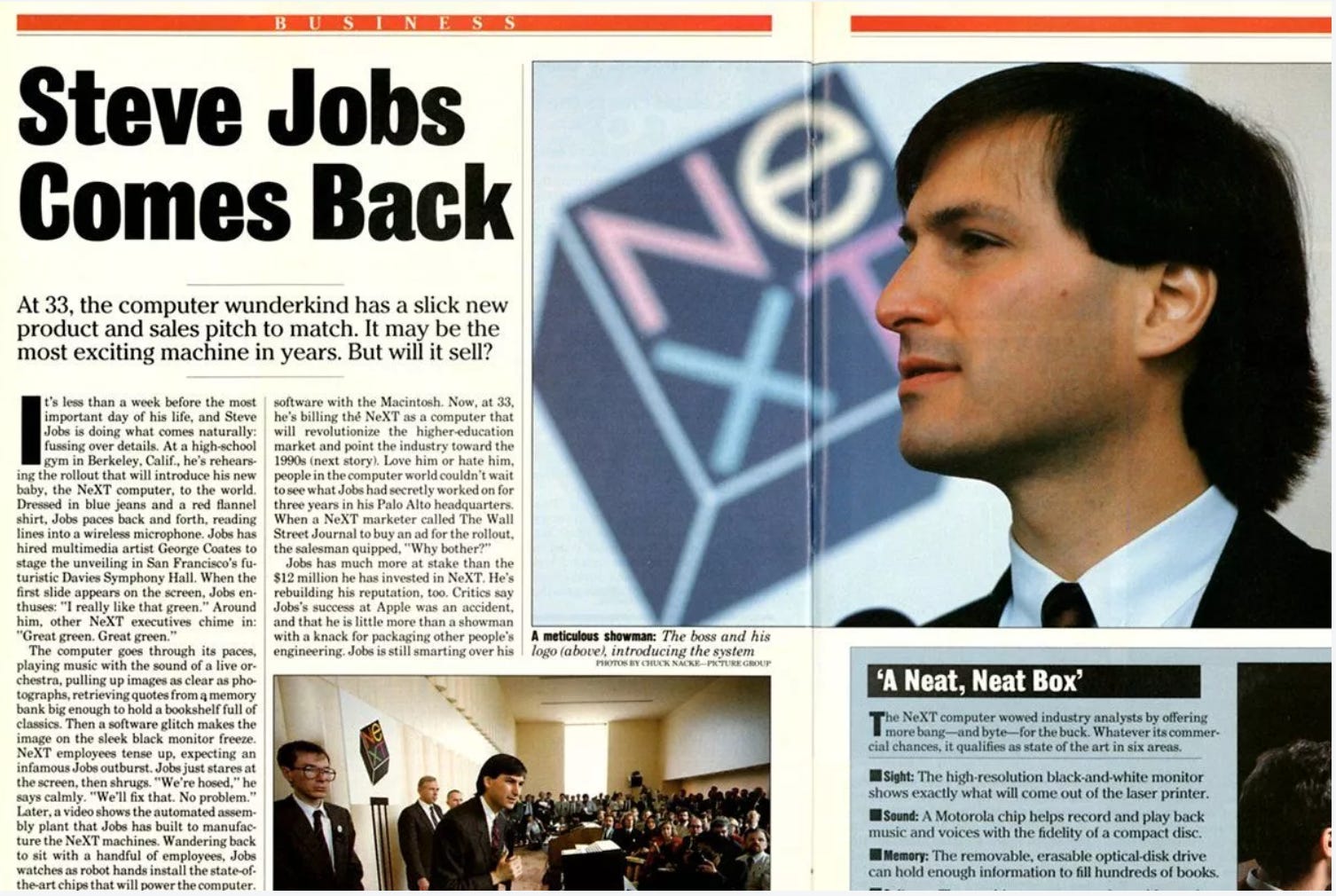
NeXT, founded and led by Steve Jobs, developed new hardware, a new OS, and, importantly, entirely new object-oriented tools to build programs for their platform. The computers were not selling well (yet), but there was a growing belief that the technology was unique and forward-looking. Due in no small part to Jobs himself, the industry stood up and took notice.
One person really noticed. That was BillG.
Steve Jobs was famously separated from Apple in 1985, and later created NeXT Inc. along with several key members of the Apple Macintosh team (he also started Pixar but that’s another story). NeXT produced three main products and had recently been refreshed with new models after the 1988 launch.
First there was the NeXT computer which was a blazing fast workstation class computer (along with an incredible display, fancy optical drive, and a laser printer). Second, was the operating system that ran on the computer, object-oriented (of course) with a graphical user-interface, called NeXTStep. And third, an incredibly rich set of tools for programmers to build object-oriented GUI programs for the hardware and OS, called Interface Builder. The whole product was launched in 1988 as almost a “super Macintosh” or at least was viewed that way by many. It was covered broadly across mainstream press because of the fascination with new home computers and of course Steve Jobs. By this point, many local newspapers were covering home computers as a regular section, something that seemed inconceivable just a few years earlier.
NeXTStep, while object-oriented, did not use C++ but a different object-oriented language which only made it seem cooler. BillG who believed strongly in having complete ownership of a programming language, thus his general reservations around C++ as I would soon learn, and his favorable views of Objective-C.
On my first college recruiting trip to Cornell in search of more Microsofties, I visited my old lab where many of the Macintosh computers were replaced with NeXT computers. Steve Jobs’ new company followed the same marketing plan that Apple followed with the launch of Macintosh, convincing a number of computer science departments to make a bet on NeXT. This would not be the first time a recruiting trip to Cornell would show me something unexpected.
ScottRa procured a NeXT computer, the new pizza box form factor (like a true workstation) and we would explore it late into the night, sharing our discoveries with each other and the rest of our team. It was truly a marvel of engineering and experience. It was amazing to me that a computer and software built from scratch could do so much (technically, much of the core operating system was built on a research project foundation from Carnegie Mellon University, known as Mach, which becomes important later in this story).
It ran at full 32-bits and running a variant of Unix under the graphical interface it rivaled the workstations I used in graduate school. It featured a level of sophistication in software and features that made Windows 3.0 PCs seem almost toy-like while having an ease of use of a packaged software product. It cost almost $10,000 1990 dollars and had minimal support from mainstream software makers who were already busy navigating MS-DOS, Windows, and OS/2.
Still the capabilities were so significant that NeXT was viewed as a major strategic “threat” (Microsoft, as I was learning, frequently used that to describe competitors). ScottRa explained to me the importance of competing with NeXT but I had difficulty grokking what that meant for our little team tasked with building cross-platform tools.
It became increasingly clear to me, however, why our source code server was named \OBJECTS. Scott cleverly named the share \DART, a joke that was lost on me for years. I’ll never forget the first time he told me the password. He said, “the password is ‘NeXTStep’, capitalized correctly.” Everyone by then knew it was “NeXTStep” or perhaps “NeXTSTEP”.
While I had no first-hand knowledge, the idea was in the air that BillG was frustrated at trailing a product by Steve Jobs. NeXT appeared to be a better product than anything Microsoft was about to ship or had planned for the foreseeable future. One of the things I am thankful for is having a direct competitor at such an early stage in my career. While how to compete was fuzzy, it was clear what we were supposed to compete with. Rumors of what BillG thought were cool or competing products or features would race around the company, and NeXT was one of those products. Microsoft was a product company, so the fact that it cost so much money or sold so few units was no excuse for not knowing what a product did or why it was viewed as good (and what we would do about it). BillG was (and remains) fiercely competitive and would often drive conversations about competitors in a relentless fashion, never allowing a team to dismiss one aspect of a competitor simply because of some relative weakness, no matter how overwhelming a weakness it might be. A product that is fantastic but not selling at all is every bit as formidable as your actual number one competitor, at least that is how we had to treat it when it came to BillG.
The rivalry between Bill and Steve was real. Everyone knew about it. We’d been through yearly company meeting updates on the litigation between companies and could read the trade press reviews of Macintosh versus Windows. That’s why our little team was funded. It was why our conference room had a NeXT computer costing as much as four developer PCs.
The Systems division was responsible for delivering the SDK for the platform, though they relied on the Tools team to deliver the underlying compilers and other tools. The SDK was supposed to make it possible to build GUI applications. Unfortunately, the tools were mostly the bare minimum and lacked the elegance seen on Macintosh and NeXT.
The Systems team, aware of NeXT and the high bar it set, staffed an additional, smaller team to build much more innovative and competitive tools for OS/2 and Windows.
I had no idea what they were up to. BillG did of course. But now Microsoft had two small teams chartered to compete with NeXT while the much larger teams in Windows and Tools were not focused on NeXT as a competitor. This struck me as weird, but what did I know?
Jeff Harbers (JeffH) had firsthand knowledge of the BillG–Steve Jobs rivalry. Jeff was the engineering manager for Apps and led many of the earliest Apps products back when the team was merely one group of developers assigned to projects as needed, much like a typical start-up. He was hired to bring a level of experience and engineering quality to Apps and was part of the founding Apps te…