Attending and presenting at the first Win32 Windows Professional Developer Conference (PDC) and meeting (and being intimidated by) Dave Cutler along the way. Shipping my first product while navigating the contentious battle for the real first product.
Back to 011. A Strategy for the ‘90s: Windows
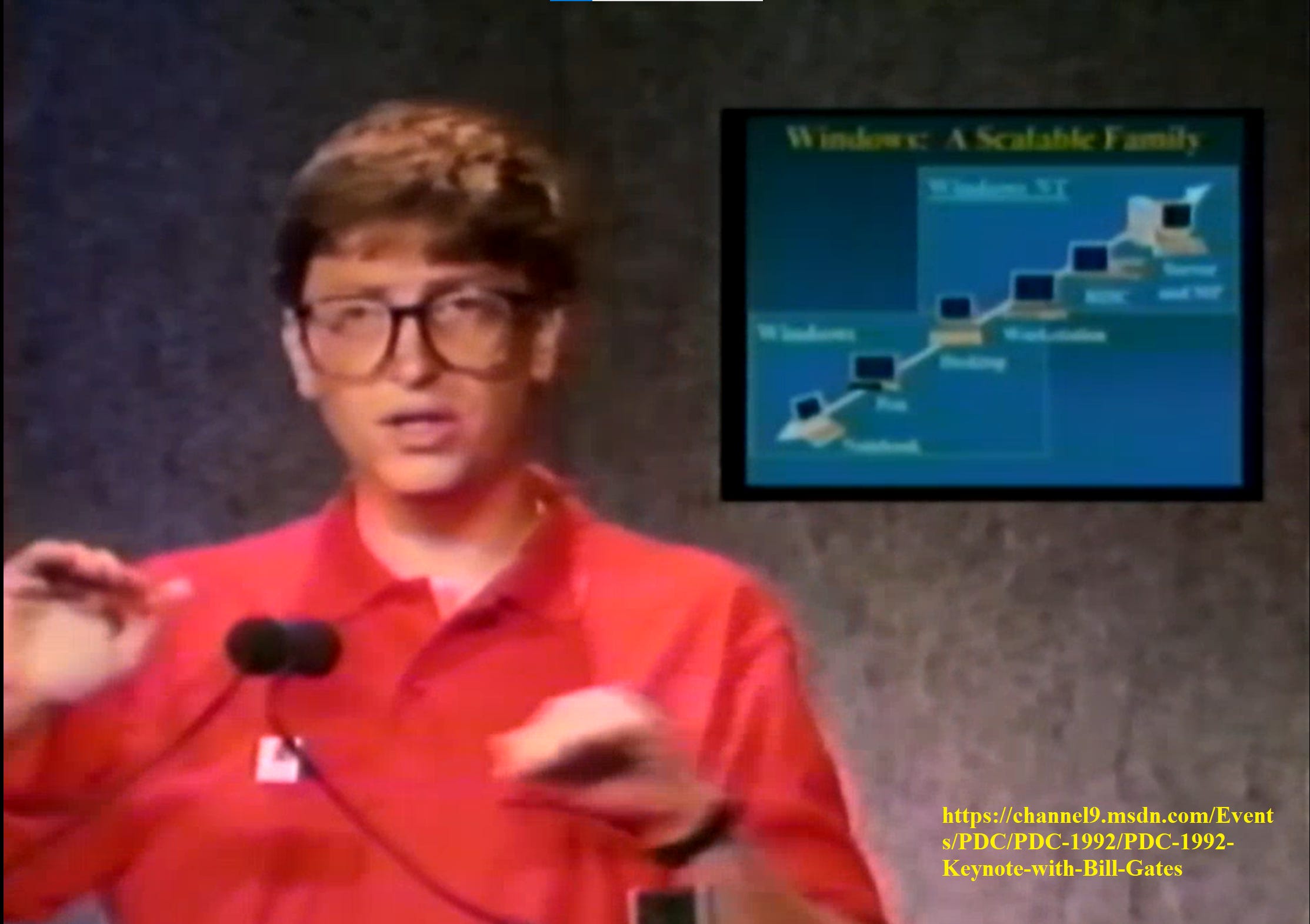
By July 1992, it seemed like the whole of the industry gathered in San Francisco at the Moscone Center for the first Win32 Professional Developers Conference, which came to be known as the Win32 PDC, named after the 32-bit Windows APIs that were unveiled and the cornerstone of the event. For the first time Microsoft also mentioned Chicago, the code name for the successor to Windows 3.11, which would become Windows 95, real soon now. More than 5,000 developers attended this event, an enormous number, and were introduced to Windows NT 3.1 Preliminary Release Build 297, dated June 28 and provided to attendees. As I recall, something like 25,000 developers ultimately received the first CDROM.
Windows NT was a next-generation operating system, aiming for the professional workstation and high-end data center markets to compete with Unix and VMS (from Digital Equipment Corporation, DEC). TThe project leader and architect was the legendary Dave Cutler (DaveC) and included a group of experienced industry engineers also from DEC, collectively the key members of the original VMS team. Windows NT was a 32-bit (and soon 64-bit) operating system designed from the start to run on several of the latest microprocessors, including those from Intel rival AMD and Silicon Valley upstart MIPS. When it was under development, it was always scheduled to ship real soon now, though the project was always under control and managed with military precision and discipline. The task of building NT was immense. Like every project, it just took longer than people thought it would, even the most experienced people.
At the PDC the OS was referred to as a beta by most. Not quite a beta, officially it was labeled Preliminary Release for Developers. It was a build (basically the most current version that worked). The team was extremely hardcore about maintaining daily quality. Every day a build was created that was reliable enough for the team to self-host. The NT daily build was as solid as anything Microsoft was doing at the time, and it was a new OS built from scratch running on brand new hardware. It was impressive, even in its early stages.
Along with the compiler and tools from the Languages group, a major effort, we released a beta version of our entire MFC application framework, which eventually became version 2.0. This included the ability to create Windows programs for NT on MIPS and ‘386 chips (by this time the industry was calling chips ‘386 because the i386 from Intel had a competitor in the AMD Am386 which was fully compatible), and Win32 (and also Windows 3, now referred to as Win16). For the sake of completeness, I should mention “Win32s” the implementation of the Win32 API on Windows 3.1. It was viewed as potential way to expand Win32 applications to existing PCs. In the end it sounded better than it really was (we even considered using it for the C++ product), but at the time it was comforting to developers who thought it would expand the reach of new Win32 applications and a classic Microsoft approach of trying to include existing hardware and code in a new strategy.
Reaching this milestone was huge for our AFX team, all 18,692 lines of code.
Our team shipped our first product! I shipped a product! It was a beta and all, but still. It was on a CDROM and everything!
It was also my first time speaking at an industry conference. This was a huge conference with many tracks and a wide range of developers. C++ and OOP were extremely hot topics, so I ended up giving a talk to what seemed like the largest room I had ever been in, certainly bigger than the USENIX ballroom and bigger than any meeting on Microsoft’s campus. By this time, we had a great story to tell about being reformed oopaholics and “hardcore”, using C++ as a better C, and, importantly, about our class library being all about Windows and not competing with Windows or duplicating it.
A funny thing happened along the way to the PDC—I got to meet DaveC. It was terrifying. And then gratifying.
As soon as it became clear that MFC and C++ would ship with the PDC release of Windows NT we were introduced to the NT “ship room.” This was a conference room, but one where the team met every day to discuss bugs and propose changes to the product. The NT team (and many other teams) preferred to call it the “War Room” as a source of pride, sometimes even officially with an officially engraved door sign. I always hated that term and wouldn’t use it (building software is not a war, at the very least). It was lorded over by the most imposing engineer I ever met, DaveC. Everyone was terrified of Dave. No one wanted to be responsible for slowing down the progress or worse introducing an error somewhere that caused problems for others. The ship rooms in Apps were challenging but nothing at all like this one. During the NT project, Dave famously put his fist through the wall. The team memorialized the hole by writing the date next to it with a marker and putting a wood frame aound it. Things were different over there. My role was to attend these meetings regularly and not say anything, and if I was asked something, to say that “MFC was on track and had no issues.” And then go back and do everything to have no issues. Keith Rowe (KeithRo) had the job representing the compiler to the ship room and was constantly given a much harder time at these meetings. I am certain his Canadian disposition served him well in these moments. I just sat in the back and wasn’t allowed to make a mistake.
There was just one thing. I thought the Windows NT team was making a mistake, and a big one. We were building MFC to make it easy for programmers to create apps for either 16-bit Windows 3.0 as it was shipping millions of copies and for the new 32-bit Windows NT. We were committed to using the Windows APIs and not fixing them or changing them. Unfortunately, there was an organizational and philosophical schism across the 16-bit Windows 3 team and the 32-bit NT team. The resulting divide created a difference in the APIs for each Windows, a difference in expression (in WINDOWS.H to be specific) that made it difficult for the APIs to work in C++. Ostensibly, this was due to expanding the APIs to handle twice as many bytes that is “widening” from 16 to 32 bits. But much of it was also rooted in assumptions for how compilers worked which were not correct. The functionality was the same, but it would have made it tricky for developers and would not have worked if there was ever a world where we would move from 32 bits to 64 bits (which of course happened a decade later). The idea of a seamless and scalable API from 16-bit to 32-bit (also 64-bit) Windows was a key strategic initiative and it felt like we were at ground zero showing it was not coming together nearly as clean as it could. There were also a good number of gratuitous changes in Windows APIs (among the 350 or so that existed at the time) that were made by the NT team, likely “fixing” some irreg…