Welcome to Chapter V. Subscribers, if this were a printed book then you’ve just read through a typical trade press book by word count. Since we’re only in 1994, now you know one good reason why Substack makes for a better approach.
1993 to 1994: The rise of the internet dramatically accelerates the growth of the PC, the Windows PC in particular, as it soon becomes a must-have home appliance and an essential business tool for most every profession around the world. Windows PC unit sales have doubled since 1989 to over 40 million units and the growth rate was increasing.
Microsoft and the industry were in a transition. The world was fired up about the Internet and World-Wide Web, while anxiously awaiting a PC that was really up to the task—that would be Windows 95, code name Chicago. Unfortunately, Chicago was running late. Still, the Internet offered a real break in computing separating the early days of 16-bit computing from what was to come with 32-bit computing.
Inside Microsoft’s hallways the mood was different. Most products were still late and buggy, and importantly the strategy remained confusing internally. “Windows, Windows, Windows” was the top line, but the differences and even rivalries between the two Windows teams, Chicago and Cairo/NT, made for complexity. Applications spent the better part of a year finishing the release of the much-hailed Office 4.2, which was the last 16-bit product. While Windows and Office were the main products, the company was spawning new shiny objects at a feverish pace. Online services was growing incredibly fast and the Consumer Division was becoming the favorite destination for the increasingly experienced workforce.
During this I needed to find a new job and would learn valuable lessons along the way.
Back to 030. My Performance Review (and An Expense Report)
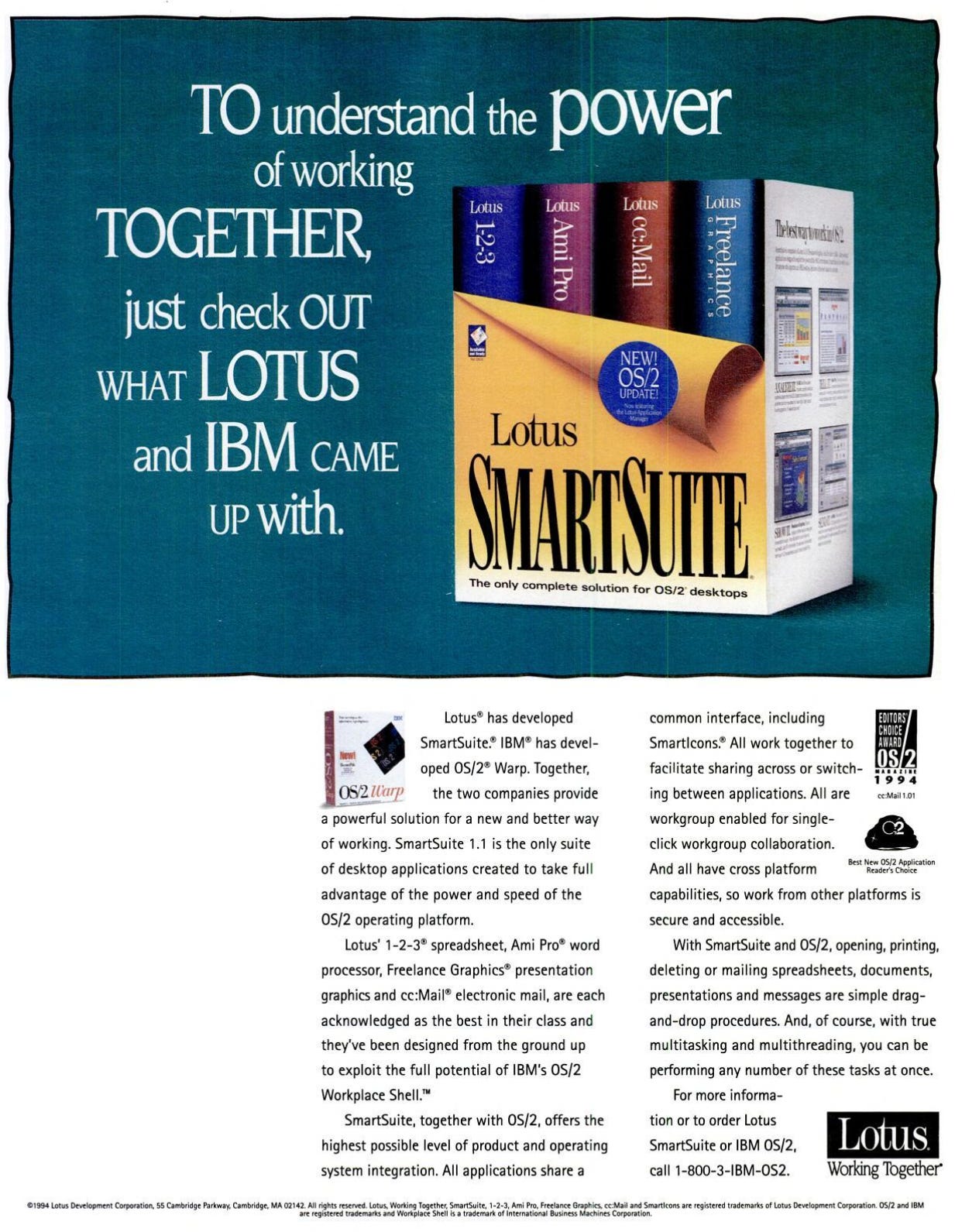
During a visit to my family in Miami, I was bored with the July heat and endless trips to the mall to avoid the heat, so I went to the local CompUSA to buy the newly released Lotus SmartSuite version 2. Wanting to spend time with it firsthand, I loaded it floppy-by-floppy on to my Compaq LTE laptop running Windows 3.11 and used the better part of the vacation diving deep into the product.
The main messaging for SmartSuite was consistency and the way in which each of the programs worked together. At Spring COMDEX 1994, the booth had been a relentless chorus of a work together jingle. The promotional materials offered up SmartIcons® shared across applications as supporting evidence—basically toolbars with customization. As I began to use the 1-2-3 spreadsheet, Ami Pro word processor, Freelance graphics/slides, Lotus Organizer personal information manager, and Approach database (the latter four were acquisitions), I saw a fairly sophisticated suite of products, but I didn’t see a lot of user experience consistency.
It was weird. It felt like we were being marketed to. We were.
A normal person would have taken screenshots of the user experience and compared them. But I was a developer tools person, so I groveled around in the compiled code looking clues to see how shared SmartIcons were in reality. This was a big deal to my Apps friends because performance was everything and loading Word, Excel, and PowerPoint meant a good deal of duplicated code. Surprisingly, all those buttons took a lot of memory and used scarce graphics resources in Windows. Office was a bundle but not an architected product (yet).
Much to my surprise (but given the acquisition history of the product it should not have been), not only did each Lotus app have its own copy of icons, but each frequently varied across apps.
Busted. We were being marketed to.
I quickly put together a nearly 30-page memo, detailing inconsistencies and inefficiencies in the product. I made a giant table of copy/paste between apps to see how each was handled. In hindsight, decades later, nobody would think this was even a problem, but in the early days of cross-application scenarios, simply moving information between products was hit and miss. It had been an area Office 4.x had worked hard on, especially using the new object linking and embedding (OLE) technology. I also detailed the disk footprint, memory utilization, and even the number of help topics.
Consistency was all the rage in the world of applications. There were two historic drivers of this. First, there was a strong belief, in part encouraged by Microsoft and Apple, that a graphical interface was inherently consistent across applications. Apple relentlessly touted their extensive documentation, Human Interface Guidelines or HIG, as a sort of rules of the road for building graphical apps. The HIG provided specific, almost Talmudic, rules for how to display commands, dialog boxes, and menus. Windows was just beginning to recognize the importance of this kind of effort and with Chicago would release a major set of guidelines, the Windows Application Design Guide or WADG (wad-gee). Unlike MS-DOS where every application made up its own user-interface, graphical products should all be very similar as a result.
Second, consistency was supposed to make it easy to move from one application to another without learning an entirely new and equally arcane command system. Most people used only a single application and what easier way to get more out of a PC than if moving from one application to another did not require learning a bunch of new user interface, especially in suites of products that were coming to dominate sales. In reality, developers would be developers and most every application went in its own direction, all justifying that by saying customers had specific needs (a topic we will return to with respect to Office).
To that end my competitive memo was a source of pride. Whether or not any of my findings were relevant to sales or competitive positioning was unclear. My own lens was not particularly broad at age 27. But, up until that point, reviewers of SmartSuite had been quite impressed with the integration and I was growing increasingly disappointed in the lengthy product reviews that failed to reveal all the details.
While I wielded a great technology buzzsaw, I was also applying Microsoft’s perspective, not necessarily what Lotus was looking to accomplish or what reviewers would see. For example, my focus on shared code came straight from BillG as that was his hot button. The Lotus products clearly hadn’t focused on that at all. I thought they were “wrong” not simply different. This mismatch was something I had seen in the evaluations of Borland C++ versus Microsoft VC++. For example, Borland had a compiler optimization switch “/O” that was, basically, “make this code as fast as possible by enabling all the best optimizations.” To us compiler-heads at Microsoft, we thought of this as technical nonsense because each of the myriad potential optimizations meant something unique to the programmer (literally the entire alphabet of c…