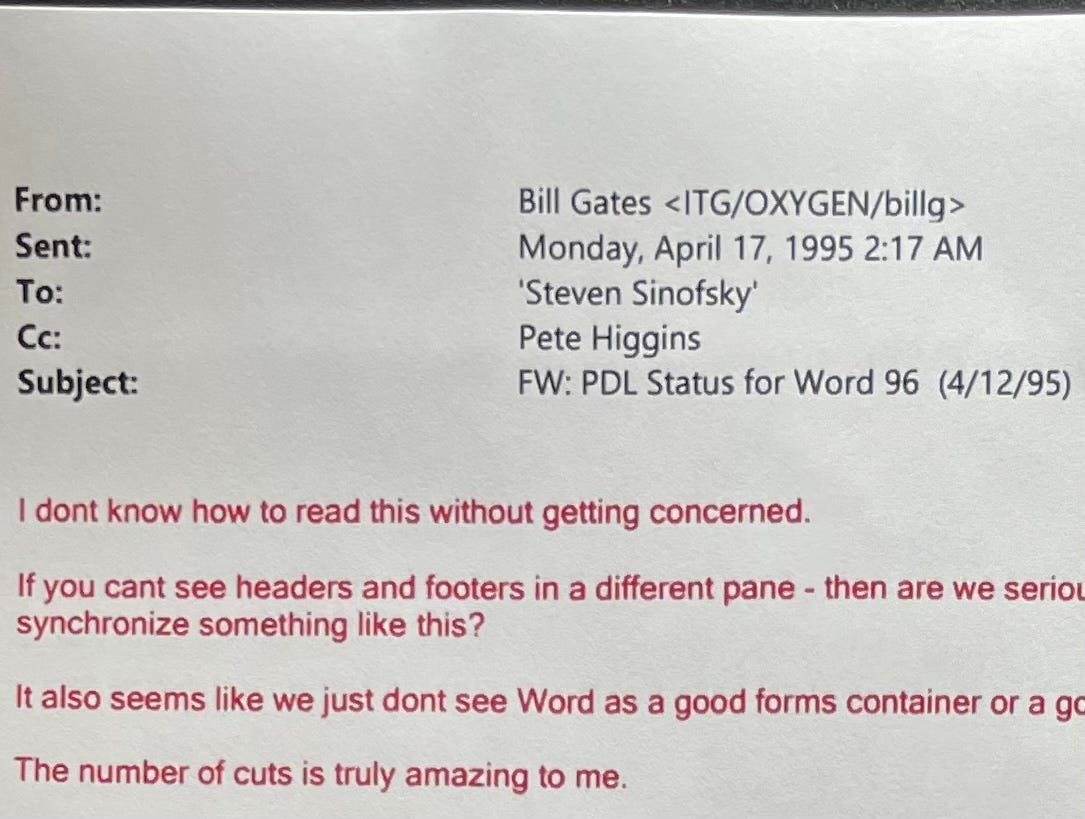
Perhaps more than any particular feature in what would become Office 97, though there were a lot of features, the biggest innovation was building the organization and culture supporting a shared infrastructure and platform team. Before Office 97, Microsoft decidedly switched to selling Office, yet we continued to build Word, Excel, and PowerPoint, and we were organized that way. The Office96 product cycle, starting in 1994 (in parallel with what became Office 95) built out the new team, OPU the Office Product Unit, and new approaches to creating shared code and infrastructure. Not only did this come to define the Office product and organization, in many ways it defined my own career and high-order bit.
Please note, this post might be a bit long for email so be sure to click the link to get the full experience.
Back to 040. Creating the First Real Office [Chapter VII]
In shipping at scale, it is not enough to agree on what needs to be done. There also needs to be agreement on how it gets done.
While the big apps were successful in their own right, won reviews, sold incredibly well, had high customer satisfaction, and were made by teams that were exemplars of the MikeMap value system, they evolved with different engineering systems. Differing in detail, they all accomplished the same: shipping high quality (for the era, or at least higher quality than everyone else), while striving for a ready-to-ship product every single day of the process.
To developers and testers, the micro details of how this worked across teams for committing changes, check-in tests, unit testing, localization, and more were highly evolved. Each step in the process was tuned to the “unique” needs of each product’s engineering organization, or perhaps tribe is a better description. Minor differences would be amplified both at scale and across teams. A common example was how much time in the schedule was reserved or buffered for the unknown. Excel with its record of getting closer and closer to on time RTM, could be seen as either extremely hardcore or excessively conservative, but managing the day-to-day progression through the schedule was critical and very much a key part of the culture.
It is a statement about Microsoft culture that the better Excel got at hitting projected ship dates and shipping award-winning products, the more the discussion across Microsoft (outside the Excel team) centered around how conservative the team was getting. To Excel, they were just being hardcore. This was best symbolized by the leather biker jackets developers earned as a ship gift adorned with a Recalc or Die logo. Times were different.
The idea that getting better at daily engineering and hitting scheduled milestones was somehow a sign of being less aggressive or grandiose in plans gets to the heart of the divergence of Microsoft cultures across the company. The Apps teams not only wrote the Zero Defects memo but internalized a cultural attribute of promise and deliver. Much of the rest of Microsoft seemed to have succumbed to the idea that such a process (or philosophy) was somehow less hardcore or even wimpy. There was a strong belief among the over-promise side of the house that building a platform was simply more difficult than building applications (never mind that the applications were also platforms, but I digress) and that there was a real difference in impact if a platform cut features the ways Apps did in order to ship. I can say this because many times when it came to collaborating across the company I was on the receiving end of comments along the lines of “yes, but that’s only because it is just an app.” In my weaker moments I would say the quiet parts aloud, such as “yes, but you’ll never ship.”
Apps, meaning Office, was the more fragile growth engine of the company, and bigger opportunity for profits. Office depended on customers choosing to buy Office over an existing product they already owned or competitor, and that decision benefitted from a new version of Office drawing interest to new capabilities and over time would come to depend on much more profitable corporate deals (as we will learn in the next chapter). Windows, on the other hand, was going out on most every new PC (at a much lower price than Office but a much higher attach to a PC). Whether an updated version of Windows was on the PC or not, PC sales were going up primarily due to businesses buying first PCs for many employees, and in a bit of a twist those customers often preferred the current or even previous version of Windows anyway. There was certainly a pop that came from a new Windows, especially when timed with updated PCs for back to school or holiday, but no one was confused over the revenue drivers. These differences in the business models directly led to the variation (and tensions) in development processes, and also to the differences in how each business evolved and innovated well into the future. We were all products of our environment.
As an example, within Office each program management team (Word, Excel, PowerPoint) developed unique approaches to overall design and feature selection. When there were differences in design or prioritization the discussion would inevitably turn to a claim along the lines of “Excel users are different [than Word or PowerPoint users].” Each team was focused on ease of use, or what we often called “basic use,” yet maintained a different idea of the prototypical personas using the product.
Putting these together, there were three tensions at play in building Office96:
* Enlisting support across executives for an overall plan. The normal process of each formerly Business Unit then Product Unit doing this on their own no longer sufficed.
* Developing a plan with buy-in from the dev managers and test managers for how Office96 was to be built—the tooling, day-to-day dev process, and the overall testing and verification, through to localization.
* Deciding what to build that represented a suite while continuing to recognize that to the outside world, customers and press, the category battles might not be yesterday’s news even if the Microsoft strategy was all Office.
I wish there was a lot of a story to tell about how this played out, but in reality, “decisions were made” in a bottom-up or distributed manner. The rest was going to be in execution. The Office Product Unit was formed while the product plans were created in parallel, thus much of Office96 would be characterized by OPU and the Apps in a state of tension over planning and execution. Ultimately, this made for a bumpy Office96 release filled with many new execution challenges, but it also built the foundation for an execution machinery that would become unprecedented and largely responsible for what ultimately became the largest and most secure business at Microsoft.
The Office96 plan had two main pillars:
* The Apps product units embarked on deep, category-defining features, continuing to make inroads against legacy MS-DOS competitors and to win against Windows competitors. At the outset the suite included Word, Excel, and PowerPoint within the DAD organization and Access in the Tools group. These products underwent significant architectural work consistent with a full 24-month schedule. The initial plan was to continue to ship Mail and Schedule+, though this would change completely as we will see.
* The Office Product Unit built a set of features shared across the apps and then they integrated those features into one or more apps (this is a key tenet about creating shared infrastructure), leaving the other apps to do integration work on their own. In addition, OPU would, by nature of code and also influence, make sure the suite was designed for consistency and integration across the apps.
The OPU features ranged from a lot of heavy lifting, but straight-forward, to some of the most sophisticated refitting of features envisioned by the apps. In contemporary terms, OPU was both an infrastructure team and a platform team. In terms of inf…