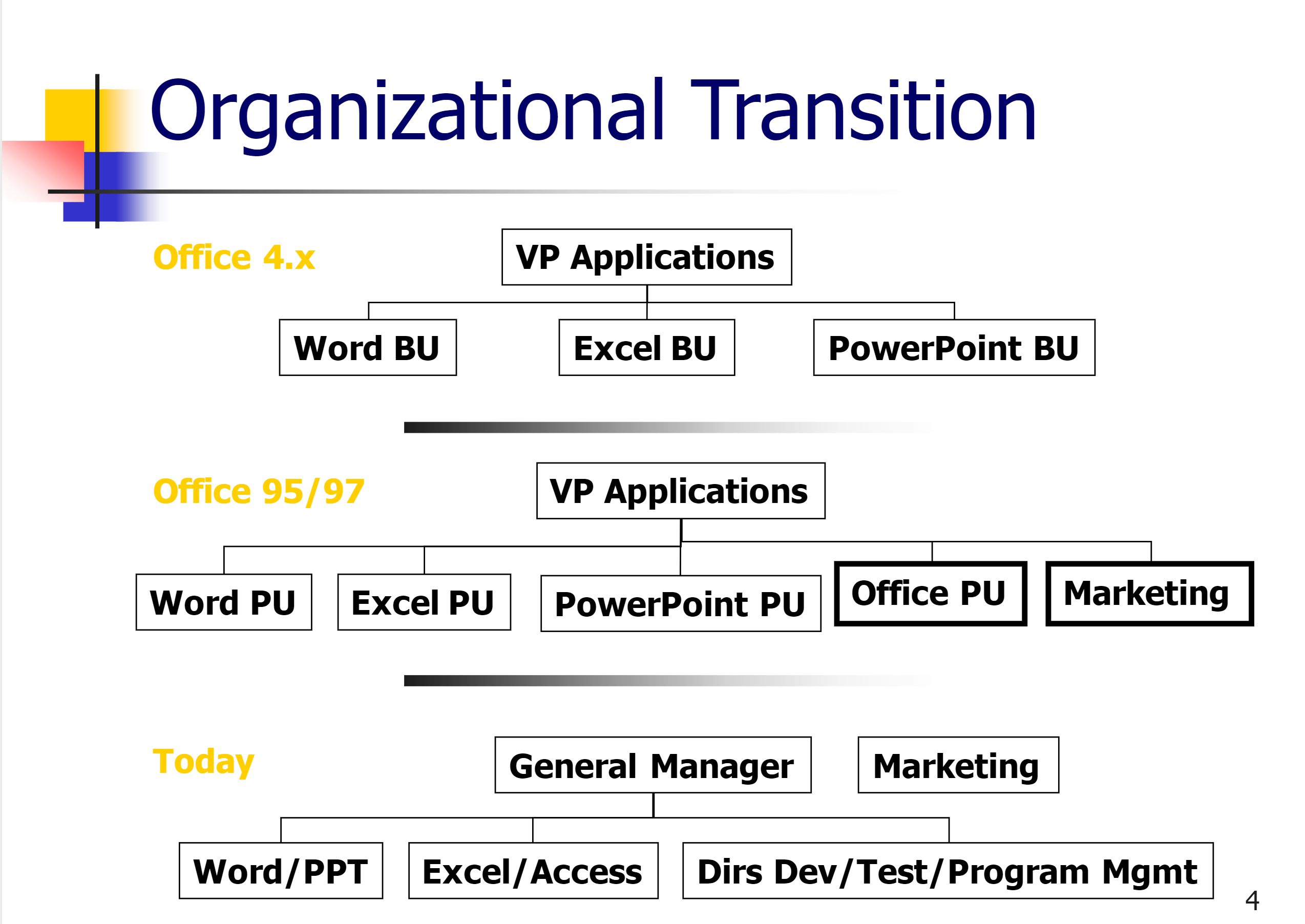
The Microsoft sales force had a ritual of reorganizing every fiscal year, like clockwork. The Platforms teams always seemed to be in some state of organization change, at least to me. Office, on the other hand, had been relatively stable except for two deliberate changes. As successful as Office 97 would prove to be, the product still reflected the development organization more than the value proposition. We needed to change that. To change that required us to develop a more robust planning process that was relevant to everyone that mattered.
Back to 046. Prioritizing a New Type of Customer [Chapter VIII]
With the start of our company-wide transition to becoming enterprise-focused, the product group organization seemed to be in a state of flux as we began a new release to follow Office 97. Churn across the senior leadership was a defining element of middle age for Microsoft.
Over the next decade or more, at least for me, it seemed as though we were always fluid at the top. We were either restructuring or leaders were being moved around, and sometimes both at once.
By the time Bob Muglia (BobMu) was my manager, starting in March 1999 and right around the release of follow-on to Office 97, Microsoft had gone through three major restructurings over the course of seven years—changing first to five main operating units then to seven and then back to three. Just keeping track of division acronyms was impossible, and as fast as we could distribute T-shirts and logo items, the acronyms expired. It wasn’t uncommon to enter an office with moving boxes that remained packed in anticipation of the next move.
Desktop Applications had four different executive leadership structures during planning and delivering a single release of Office over 30 months. From the end of Office 97 until we shipped the next product, the larger division containing Office would change names numerous times: ACG (Applications and Content Group), AICG (Applications and Internet Client Group), ATG (Applications and Tools Group), BPG (Business Productivity Group). The groups were each defined as Office and other stuff, often not particularly adjacent in the market. Each one of those changes came with some feeling that even after the successful launch of Office 97, some things needed to be done differently. But what?
While never explicit, the executive changes all had one thing in common. Each was a gradual move towards Apps being managed by executives from Platforms. There was a subtle reminder that the company was a Windows company, and importantly that when it came to the senior executives, it was the Apps teams that needed leadership from Platforms, not the other way around. It always felt like we were getting a message that we needed help in some way.
A level below these new executives, Applications had been stable for quite some time. As described previously, from the earliest days until Mike Maples’ business unit re-organization in the late 1980s, the teams were organized by job function. The business unit function served well through the rise of the Macintosh business leading to Office and the creation of the apps for Windows, until the creation of OPU in 1994, the Office Product Unit. This relative organization stability coincided with a growing execution capability on the team. While products were late, they were (with few exceptions) never out of control. Individuals became strongly committed to the individual apps teams and finishing what you started became a key element of the strengthening culture of Apps.
By way of comparison, Windows ran with parallel teams through much of a release, with one team focused on shipping the current product and another team focused on the next release. Culturally, there were starters and finishers. The starters were the big thinkers in terms of ideas and architecture, and the finishers were the closers who drove a project to completion and managed the complexities of closing down ecosystem contributions.
That meant that at any given juncture there were always two buckets, with code names: Chicago/Cairo, Nashville/Memphis, and Whistler/Blackcomb, for example. When a product finished, there was a changeover in leadership. The finishers came in and the starters moved on. It was their culture. The presence of a future team seemed to me to almost distract executives providing a team to meet with and a place for all the new ideas to go, while the shipping team worked heads down. The handoffs were never that clean and with some frequency the future product failed to make it to market or would change substantially with the shipping leadership.
Office, on the other hand, was predominantly single-threaded—focused on one release at a time. Office believed firmly in a culture of engineers finishing what they started, program managers owning features from start to finish, and testers being involved from the start of a feature. Most of our performance evaluations and promotions were based on understanding complete product cycle contributions. The idea that features that did not fit in one release rolled into the next release did not work for us, simply because we started each release from a clean slate and awaited feedback or learning from the market. It was almost never a good idea to begin a release with what was not finished previously—a lesson that is even more applicable in today’s continuous delivery model. Planning for the next release began informally around beta and then ramped up—a process that I worked a great deal on developing and honing. Our view was that shipping was learning and that assuming what was not complete needed to be finished was not the right place to start.
The Office team’s single-threaded product development proved frustrating to BillG and Platforms over the years, and given the change going on with the internet, browsers, and even org changes, the pressure to be talking about the future was greater than ever. LORG customers also demanded more information about the future, a constant source of tension for Office that lacked a second team building the next release. Because software was always in a constant state of deployment, LORGs wanted assurances that what was being deployed today would remain relevant in the future. Thus, with LORGs came an ever-increasing demand for long term product roadmaps. Accountability to those roadmaps was another issue entirely.
As much as a LORG customer might wish to standardize on a single version of Office and Windows for their standard PC, the realities of release schedules, product updates, evolving PC hardware, and their own desire for new features made that impossible. Like painting the Golden Gate Bridge, the deployment of Office and Windows was always a work in progress.
The execs felt that without a second team available for ongoing conversations, they had no ability to give input. My own experience, especially in watching this from my role as Bill’s TA and in seeing the hand-off between several versions of Windows, was that much information gathered from those meetings was lost in the transition between starters and finishers. The hand-off was a loss of team momentum as well. I was never convinced that it was possible to execute parallel releases. Our experience on Office 95 and Office 97 only cemented how difficult and consuming that could be, and we were extremely constrained and disciplined.