Launching a product in a local market, natively so to speak, is an extraordinarily special experience. It is so special that for nearly every product I worked on I chose to be outside the US and participate in some aspect of the global launch, most of the time in Asia. With this love of the market came a learning curve and some fun times. Office 2000 was my first chance to launch a product as an executive and in Asia—it was a dream come true.
This is the final post of the millennium and concludes the chapter and launch of Office 2000, which I think you can tell was a tremendous period of personal growth that went along with the scaling of our product team, and why the past three posts have been a bit more personal. The PC is entering a new phase, the maturing of the market as an enterprise product. The next two chapters cover this incredibly important time in an evolving Microsoft—everything was happening at enormous scale and global diversity yet coordinated in a manner consistent with the need to develop enterprise products. The stories of Microsoft during this time are few and far between and I’m hoping to fill that void because this builds the foundation of today’s Microsoft.
There will be no post next week due to the US holiday.
Back to 055. Office 2000 is Good to Go!
Everything about participating in our launch event in Japan was as orchestrated and as on time as the JR subway. For weeks before launch, I received down-to-the-minute schedule updates, “1635: move to event hall”, “0940: prepare with translator”, “1210: meet for the box lunch” and so on. I could not have been more excited to attend.
My friends (co-workers) in Japan were frustrated that I flew there by myself, navigated the city on my own, and declined being met at Narita Airport to be shuttled into town, a 2-hour trip. In the ’90s my ways were not how American executives did Japan, even though it was not one of my first trips (see Michael Lewis’s Liar’s Poker for how bankers did business in Japan). They were so concerned I might get lost that someone prepared a camcorder recording of the entire transit route for me from customs at Narita to the hotel, which they sent to me on a CD-ROM to view.
Using my video directions, I arrived in Tokyo. The head of East Asia R&D,Akio Fujii (AkioF) met me at the hotel—he insisted, no, he really insisted—and drove us (his car had a TV in the dashboard!) to the Windows World Expo/Tokyo 99 event, which was a 1000-person venue that we would fill. Oddly, a bright yellow Lamborghini was parked practically at the front door of the expo hall. Fujii-san explained that the launch event creative manager drove that car and that he was (very) big in Japan event circles. I was already off to an over-the-top start to the event.
We arrived and met with Susumu “Sam” Furukawa (SamF). SamF, a tech legend in Japan, was an original leader of the Microsoft subsidiary, MSKK, and served as Chairman of Microsoft Japan. He was a relentless champion for the PC, Microsoft products, and an advocate for Japan in the United States where he kept a home by Microsoft. In addition to his passion for every conceivable electronic gadget, audio/video tool, or handheld device, Sam was famous for his love of model railroads and built elaborate scale scenes often featured in the magazines. He was also known as one of Japan’s leading gadget gurus and had deep relationships with Japanese consumer electronics companies. His enthusiasm was so remarkable and infectious I often failed to keep up with him in meetings because his excited English ran together and sounded like one long word or sentence. Then once BillG mentioned to me that he was pretty sure no one could keep up with Sam in Japanese either, which was quite a relief.
The stage seemed rather stark. Draped over most of the front of it was a plain gauze curtain, a scrim. Puzzling. SamF arrived and was his incredibly excited self. He secured “the brightest high-definition projector in existence from a best friend at Hitachi.” The Hitachi crew in matching jumpsuits and hard hats was up on the catwalk calibrating the projector.
They gave me staging for the next morning’s event. There was no room for improvisation. The translator was briefed. I was to say only what I was told to say—“Konichiwa, Sinofsky desu” and then recite the English script, ending with “Arigatou gozaimasu.” That became my Japanese business vocabulary that served me for decades. It was Lost in Translation happening to me (also I was staying at the relatively new Park Hyatt). It took hours to get everything right. At least I thought it was right.
They told me that after my rehearsed words, music would play and the scrim would drop, revealing a Hitachi projection of Office 2000. Sam had me leave the stage so I could see it all from the audience perspective. We headed to the back of the room by the control board that must have been twenty feet long staffed by six people.
The stage lights dimmed, a spotlight lit up where I’d been standing, and Sam said, “Pretend now you are finished.”
A rising crescendo of strings and wind instruments, like Yanni, rose in volume to almost an ear-crushing level. Then the scrim dropped in rather dramatic fashion. The stage lights went up. There was a giant backdrop projection of a single huge Bonsai tree brightly filling the brilliant and enormous screen that spanned the stage.
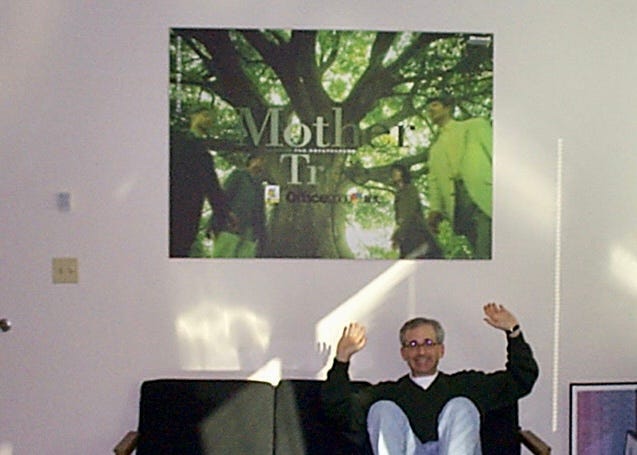
Over the tree in white letters it read Office 2000 with the new logo. There were some Japanese words that I could not read and in the Japanese font used for English letters the words “Mother Tree”.
Sam was blown away. He said, “Isn’t it amazing?!”
I said it was. “Amazing. Beautiful. Brilliant.” But I had absolutely no idea what Mother Tree meant.
I bowed to everyone I could make eye contact with. I said, “Arigatou,” while deeply expressing appreciation.
I had no idea what was being said on the giant display.
When I asked Sam for the meaning, he said, like he often had before, “It can’t be translated.” I asked Fujii-san and he said the same thing. I even asked the head of Office marketing, Nobuyoshi Yokoi (NobuY), who in MSKK was known as Mr. Office, and he simply pursed his lips, pulling in some air, creating a Japanese thought-bubble implying difficulty, and said, “So sorry, Steven-san, but there is no translation.”
The best I could gather was that it was marketing the importance of Office and how it was a strong collection of tools growing from a solid and enduring foundation.
Maybe?
While I never truly learned the full meaning, I loved it. It represented the hard work and dedication of MSKK and the incredible effort they put into the launch. I brought back a giant poster of the image (they packed it incredibly well) that must have been four feet high and six feet wide and hung on my office wall for years. Like every single thing I experienced in Japan, the poster was magic and evoked the warmest of emotions.
In Japan, as in the rest of the world we coupled the launch of Office 2000 with the long-anticipated beta release of Windows 2000, in a campaign informally called Desktop 2000, aimed at d…