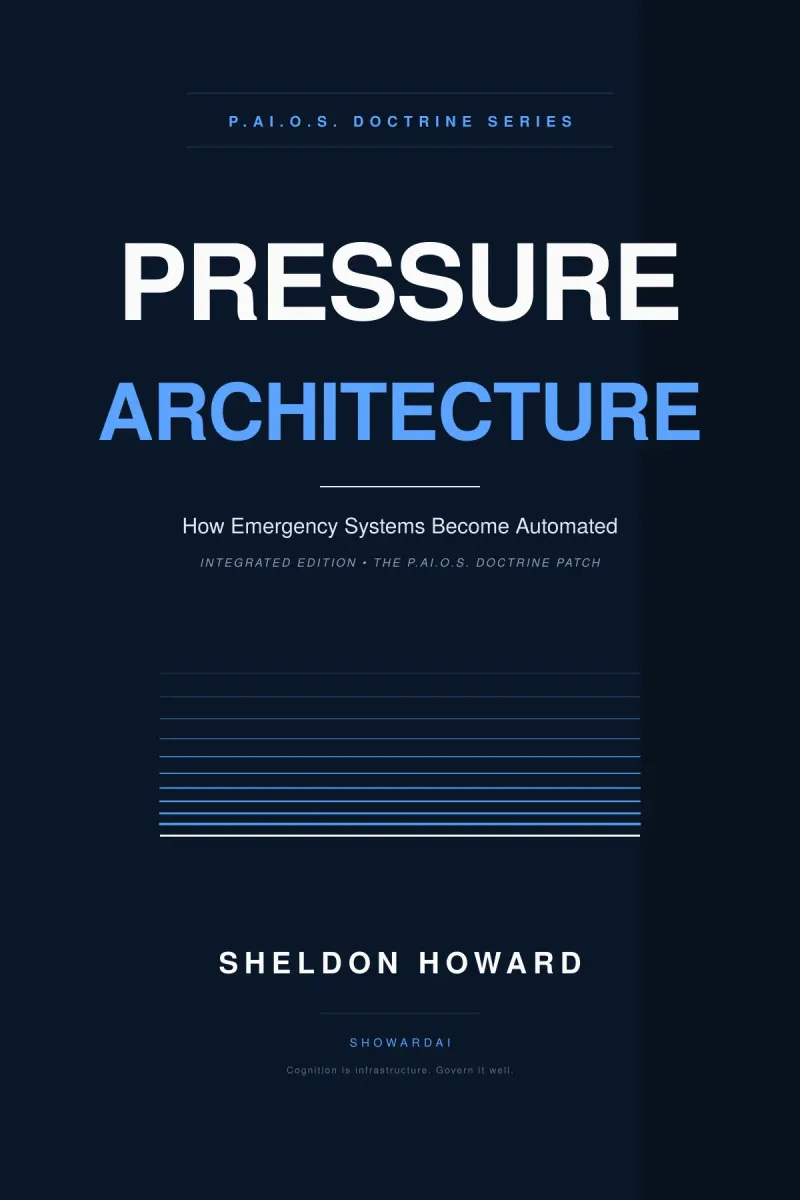
This podcast episode explore the transition from traditional authoritarianism to Pressure Architecture—a modern system of institutional power that shapes human behaviour through rules, technical gateways, and economic incentives rather than physical force.
Episode Summary
In 2021, many were told they had a "choice" regarding mandates, but when refusal meant the loss of a career, travel rights, and social standing, the choice became theoretical. This episode breaks down how institutions learned to make participation in society conditional and why the emergence of AI is making this invisible architecture faster, quieter, and harder to contest.
Key Discussion Points
1. Defining Pressure Architecture
The System Did Not Need a Gun: Unlike old-world tyranny, modern power doesn't rely on overt violence; it relies on the careful alignment of costs and incentives so that the "path of least resistance" leads toward compliance.
Choice as Theory: Refusal remains technically legal, but the accumulated friction of being barred from work, travel, and public life makes non-compliance unsustainable for most people.
2. The Seven Layers of Pressure
The hosts detail how these layers stack to create a system greater than the sum of its parts:
Formal & Employment: Laws and mandates that tie basic income and professional standing to compliance.
Access & Platform: The gating of daily life (travel, events) and the narrowing of "acceptable doubt" through content moderation.
Social & Technical: Reputational costs and digital verification systems that make compliance instantly checkable.
AI-Scaled: The removal of human friction so that enforcement happens at machine speed.
3. Distributed Pressure: No Master Plan Required
Alignment Through Fear: Independent actors (governments, corporations, schools) produce consistent outcomes not through a central command, but through shared fears of liability, blame, and reputational damage.
Institutional Mimicry: When one major actor adopts a restrictive measure, others follow to avoid appearing irresponsible, creating a self-reinforcing baseline for behavior.
4. The Logic of "Emergency Compression"
Ethics under Stress: Emergency declarations act as a "legal switch" that compresses time and ethical deliberation, rewarding immediate certainty while punishing nuance.
Permanent Infrastructure: Tools built for a crisis—like the EU Digital COVID Certificate—rarely disappear; they are transferred to bodies like the WHO to form the foundation for permanent digital identity wallets.
5. The AI qualitative Leap
Removing Friction: AI does not create pressure; it removes the "friction" (human hesitation, mercy, or manual processes) that once made institutional pressure visible and contestable.
Biosecurity Risks: The hosts discuss the "Oversight Failure Nobody Can Ignore," noting that if governance was "too weak" for human-intensive research, the rise of autonomous labs and sequence models makes the consequences of failure potentially catastrophic.
Strongest Lines from the Episode
"Pressure that cannot be named cannot be limited".
"The system did not need a gun. It only needed to make refusal expensive".
"Emergency does not eliminate ethics; it compresses them".
"AI removes the friction that once made institutional pressure visible".
Closing: Seven Governing Principles
To prevent this architecture from becoming fully automated and invisible, the episode concludes with the mandatory safeguards for democratic societies:
No emergency power without sunset.
No automated enforcement without appeal.
No digital ID expansion without purpose limits.
No platform-state pressure without transparency.
No biosecurity acceleration without auditability.
No manufactured certainty where uncertainty remains.
No machine decision without human accountability.