“The individual has always had to struggle to keep from being overwhelmed by the tribe. If you try it, you will be lonely often, and sometimes frightened. But no price is too high to pay for the privilege of owning yourself.”― Friedrich Nietzsche
In today’s episode I’m going to address an aspect of both yours and my life habits that I believe you will find compelling as it’s something that should be obvious to you, but is something I’ve discovered that we all fail to notice on a regular basis as we take some of the most obvious things for granted.
It seems the common theme throughout our society and the world is this ongoing battle between chaos and order. The world is by its nature a chaotic place and when order that has been established for a period of time starts to crumble and break down then it results in a great deal of chaos and instability.
This chaos that ensues once the stabilizing factor of an “order” starts to crumble will often result in a number of fights ranging from the political environment all the way to a violent battlefield of a hot kinetic war.
This ongoing struggle is something that manifests on both the chaotic side, as well as the side that society considers the side of “order” on a constant basis. The chaos that ensues within society manifests in a number of different ways within that society’s institutions.
It is here within these institutions where we find the battles that determine the direction of a society given that a society’s traditional faith has been held within these institutions.
I intend for the focus of today’s episode to be on why and how this chaos comes about when the order of things starts to break apart while also examining the strength, or fragility of this “order” of things within what we define as our society.
Thanks for reading The Official Substack Of Brandon Richey ! Subscribe for free to receive new posts and support my work.
The Trust
First of all, I want to point towards a thing that we all engage in daily whether we think about it or not. If you consider yourself to be the type of person who doesn’t easily trust others then understand that I want you to pause for a moment and evaluate that belief.
Understand that if you are one to espouse that you don’t trust easily then I would contend that you most likely demonstrate that trust every single day you wake up. With each day that you awaken to go out and tackle life you demonstrate trust across several different avenues that you encounter daily in your life. Unless you live off the grid somewhere in a hut you built for yourself with zero electricity, or with zero contact with the outside world, then I will prove it.
So what is TRUST?
Trust is defined as the belief and knowing that we can have reliability in something. That something might be another person, it might be in the hope that when you turn over the key in your ignition that your car will start, and it is the fact that when you walk into your bathroom to brush your teeth every morning that you’ll have the luxury of clean filtered running water from your faucet.
These are just a few important examples of how you demonstrate trust in your life on a daily basis. This trust also occurs in other key areas of your life such as the trust you have in your money. That’s right, you trust that the money you have in your account is a good store of value in order for you to use and exchange for goods and services that you need in your life in order to live.
After all, what is money? Money is simply a trust that society agrees upon with a social contract that it has a certain value, but what happens when that value starts to fall?
When the value of money continues to diminish then that is a signal that you (or society) is in a way losing trust in that social contract associated with the stored value of those dollars. As a result of that lost trust in the store of value the strength of your money will weaken which results in you having to use more of your dollars in order to buy those goods and services that you need to support yourself and your family. This of course is what is known as inflation.
Take a moment to think about that and you will realize very quickly that society is only as strong and stable as it is based on the amount of trust all of us as citizens place on the “order” of all of these things to function at a level that we consider to be satisfactory.
This is where I believe we as individuals often lose sight of how the real world and life actually works. This is not something that is very complicated because it seems so obvious. After all, we all use a bank for holding our money, we use grocery stores to shop for our food, we use phones to communicate with people, and I could go on and on. At the end of the day we are putting trust into all of these institutions.
The point is that we live in an interdependent society where the institutions that manage all of these things that we place our daily trust in are owned, operated, and controlled by people that in most cases you and I have never met. Furthermore we don’t know whether or not we can trust these people either.
Now when you look at all of this in that way this is all either a huge miracle OR in a way it could be the worst nightmare any of us could have ever imagined.
After all, the trust that all of us demonstrate in the function of society all exists because we have all demanded to have these things be provided to us because they create what we perceive to be convenience for our daily lives.
Convenience vs. Inconvenience
So that last word convenient leads me into the next point of this discussion.
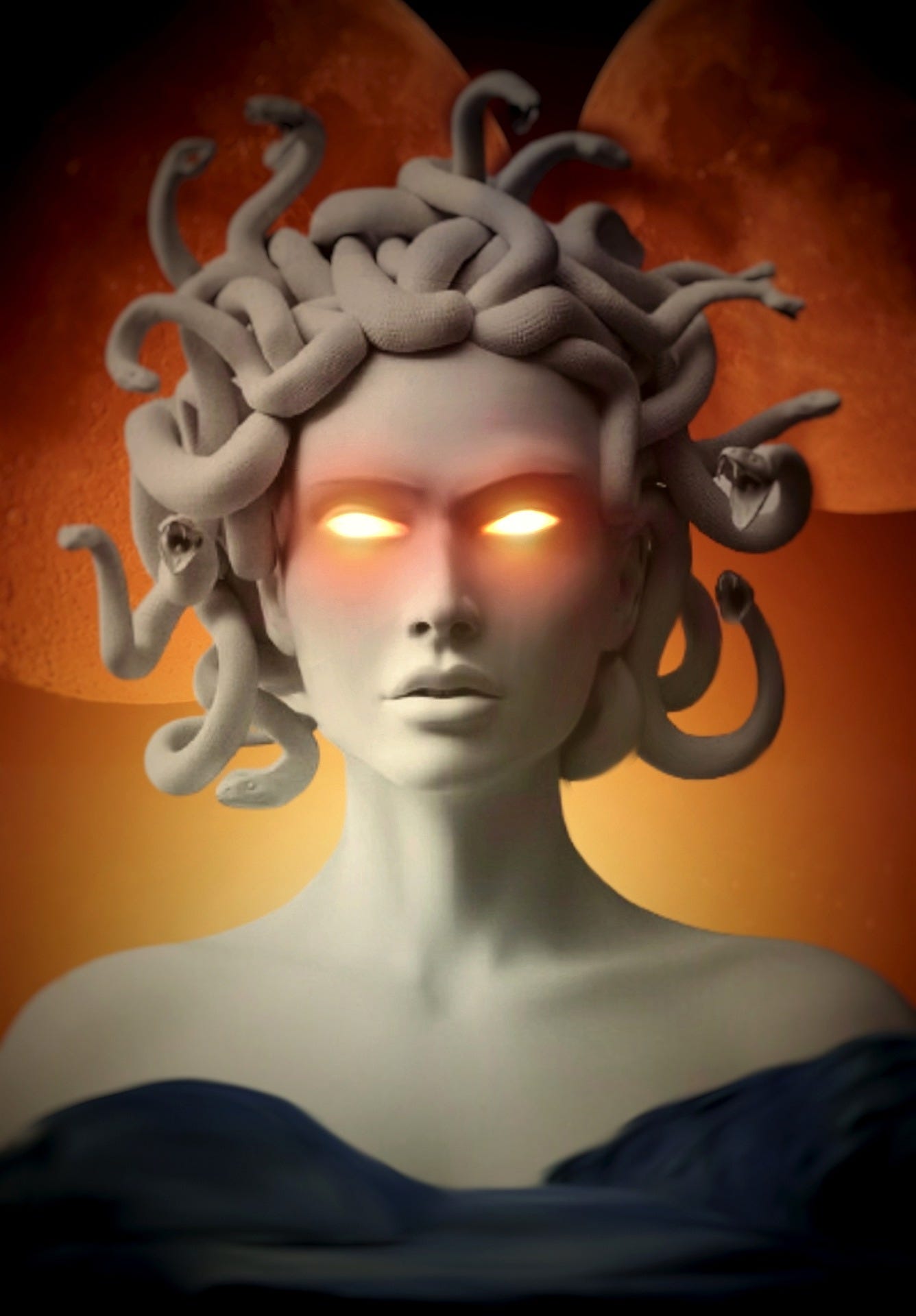
However, before I go there, if we look at the story of Medusa in Greek mythology you can see a very important life lesson that falls in line with everything I’m discussing here with today’s topic associated with society’s desire for convenience. .
Everything I’ve already pointed out in the beginning of this episode points to the connectivity of our society and how we all lend our support in terms of what we spend with our dollars, as well as, what we demand from the marketplace in the name of convenience.
So essentially as a society we’ve gotten a taste and perceive “convenience” as being this apparently attractive thing for us because we are snared by its seductive quality just as many men were seduced by Medusa in the stories of Greek mythology.
However the men that could not resist the temptation of looking Medusa in the eyes all met their demise and were turned to stone. Whether they found themselves satisfying their curiosity about a Gorgon monster, or gazing into the eyes of the same goddess that captured Poseidon’s eye the outcome was the same. Every single one of the men that could not avert her gaze were paralyzed for eternity within their new formation as a fossil, or a freshly made statue.
The only man that was able to turn the tables on Medusa was the Greek hero Perseus. To prevent himself from falling victim to Medusa’s gaze he used a polished shield that was given to him by Athena in order to safely approach and cut the head off of Medusa by looking at her reflection in the shield. This way he could safely watch her without falling victim to her gaze.
He would then later go on to safely rescue his love interest Andromeda from Phineus after the two got into a fight. Phineus was turned to stone by Medusa’s head which Perseus had kept in a safely stored bag.
Thanks for reading The Official Substack Of Brandon Richey ! Subscribe for free to receive new posts and support my work.
So the lesson here is that despite having wreaked havoc on many men that approached Medusa, Perseus wasn’t only able to defeat her, but in the process of slaying Medusa he kept her severed head and used its powerful gaze against his own enemies.
I wanted to inject that little vignette of Greek mythology as I am about to make a strong argument as to why convenience is the single worst thing that you can put your money behind and demand for yourself and y…