Americans are more preoccupied with mental health than ever before. There’s a cultural message that everyone needs therapy. With armchair psychologists on social media, it’s become popular to diagnose ourselves and those around us with mental illness.
Despite this extreme focus, mental health is getting worse by many measures.
The Archbridge Institute (where I work) has started a new initiative, Head Out, that challenges some of our most basic assumptions about how to improve our psychological wellbeing.
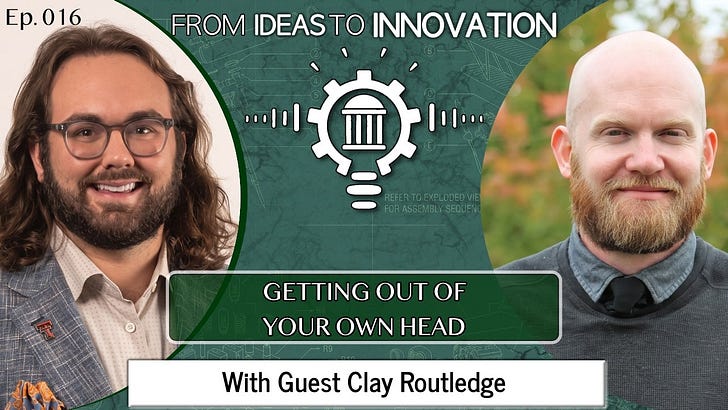
Welcome to Episode 16 of From Ideas to Innovation. Clay Routledge is an existential psychologist, behavioral scientist, and Executive Vice President and Chief Operating Officer (COO) at the Archbridge Institute. His work applies psychology to meaning, nostalgia, mortality, and human agency, bringing a rare combination of rigorous academic training and desire to make his work accessible and useful outside the academy.
It was a pleasure to sit down with my colleague to discuss one of life’s biggest questions: where do we find meaning and purpose? The answer, it turns out, involves getting out of your head and into the world.
About This Episode’s Guest
As a graduate student, Clay Routledge wasn’t sure whether he would pursue academia or a career working directly with people. That was decided as he became fascinated by this question: what do humans actually need to thrive?
Not just economically or socially, but at the deepest psychological level, where we grapple with the fact that we are mortal, that our time here is finite, and that we are (as far as we know) the only species that knows it.
The question led him to existential psychology, the study of how humans navigate the awareness of their own mortality and how that explains their actions on everything from mental health to entrepreneurship to civic participation. It also led him to study nostalgia. Rather than a backward-looking coping mechanism, he found nostalgia to be a powerful psychological resource for moving forward.
After years in academia, Clay traded the university for a think tank, an untraditional path for his discipline. He had already been bringing these questions to broader audiences in outlets like The Wall Street Journal and The New York Times. He didn’t stop valuing research; he wanted it to have a more practical impact.
As Executive Vice President and COO at the Archbridge Institute, he runs the Human Flourishing Lab and Head Out, an initiative built on a counterintuitive but evidence-based premise: the best way to improve your mental health is to stop focusing on yourself and start engaging with the world.
He is also, by his own admission, a nostalgia futurist who wants to bring back Blockbuster. He even wrote the book on nostalgia, Past Forward: How Nostalgia Can Help You Live a More Meaningful Life.
What You’ll Take Away
* The mental health paradox: why doubling treatment, reducing stigma, and expanding awareness have coincided with mental health getting worse by many measures
* Why nostalgia is not a backward-looking weakness but a forward-oriented psychological resource, and what the science actually shows
* What “concept creep” is — and how trauma, addiction, and burnout have been expanded so broadly that they’ve lost their clinical meaning
* Why the “everyone needs therapy” message may be doing more harm than good
* What Head Out is all about, including the most underrated mental health intervention according to Clay
* Which easily accessible, evidence-based tools can reduce symptoms of mild to moderate anxiety and depression
* What “symbolic immortality” means — and why it explains everything from religious belief to entrepreneurship to terrorism
Related Reading & Listening
* The Head Out initiative includes a practical toolkit for assessing whether you actually need a therapist, and what you can do for yourself in the meantime. Worth bookmarking!
* Clay’s book Past Forward: How Nostalgia Can Help You Live a More Meaningful Lifemakes the case for nostalgia as a forward-oriented psychological resource.
* His New York Times piece on the Head Out concept generated significant response and is one of the most accessible entry points into his thinking.
* Clay’s point that the American Dream is a psychological story as much as an economic one picks up a thread from Episode 8 with Gonzalo Schwarz, founder of the Archbridge Institute. Gonzalo shares what it takes to pursue the American Dream: a vision, hard work, and the will to overcome obstacles.