Recent policy conversations have compared artificial intelligence development to a new cold war between the United States and China. But there's a different threat that almost no one is talking about.
In China, 80% of the population views AI positively. In America, it’s almost exactly the opposite.
That gap, more than the technology itself, may end up as the biggest threat to America’s AI future.
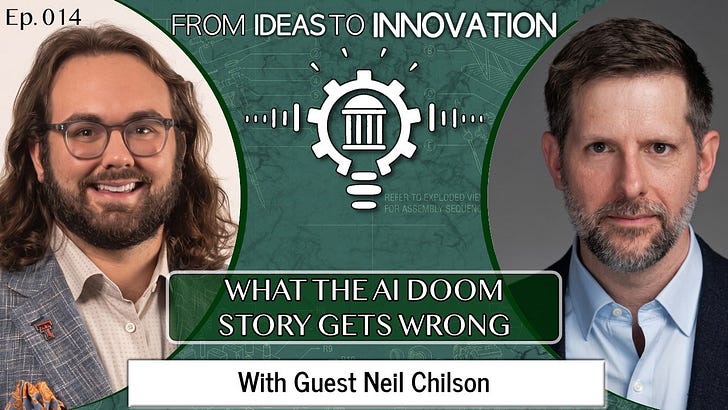
Welcome to Episode 14 of From Ideas to Innovation. Neil Chilson is Head of AI Policy at the Abundance Institute, a former Chief Technologist at the Federal Trade Commission, and one of the clearest thinkers working at the intersection of emerging technology, complex systems, and policy. He’s also the author of Getting Out of Control: Emergent Leadership in a Complex World— a book about why the most powerful systems in the world are the ones nobody controls.
In our conversation, Neil lays out a clear alternative to the doom and gloom narrative around AI.
About This Episode’s Guest
It all started for Neil Chilson with a desire to understand complexity. As a kid, he became obsessed with chaos theory after picking up James Gleick’s Chaos, a book full of fractals, those gorgeous, intricate shapes generated by simple formulas iterated over and over. That early fascination with systems that produce surprising outcomes from simple rules turned out to be the through line connecting everything that came after: a computer science degree, law school, telecom law, a stint as Chief Technologist at the FTC, and now his role at the Abundance Institute, where he focuses on getting ahead of emerging technologies before the panic (a policy surrounding it) sets in.
At the FTC, Neil witnessed the difference between two fundamentally different models of government intervention. The FCC writes detailed rules ahead of time — a Procrustean bed, as Neil calls it, that forces new technologies into the shape of old ones. The FTC takes a case-by-case approach, looking at specific facts and weighing harms against benefits, much like common law. That contrast shaped his beliefs around how to regulate fast-moving technology — and why getting it wrong with AI could be catastrophic.
His book Getting Out of Control makes the case that the most powerful systems in the world — markets, societies, governments — aren’t controlled by anyone. They’re emergent. And the moment you try to impose top-down control on them, you often destroy the very complex properties that made them valuable in the first place.
What You’ll Take Away
* Why the AI doom narrative gets the fundamental nature of complex systems wrong, and what the doomer camp actually gets right
* The “tech panic arc” — why every major technology goes through a backlash before being absorbed into culture, and how to move through it faster
* A better approach to AI regulation than the popular prescriptive model
* The case for federal versus state AI regulation, and the difference between “laboratories of democracy” and “meth labs of democracy”
* Why AI companies calling for an antitrust exemption to slow down development is a bad idea and who are set up to be the most disadvantaged
* What the US-China AI race is really about, and why America may be losing the adoption race even if it wins the frontier model race
* Why the data center water panic is the biggest piece of misinformation in AI policy right now
* One underrated AI application that Neil thinks will change how most people interact with computers within a decade