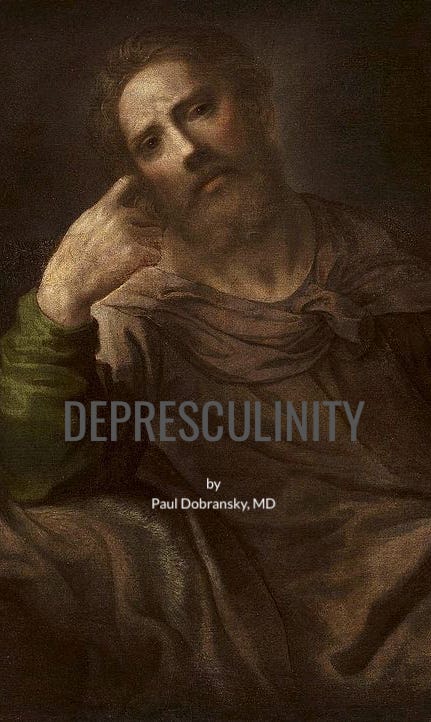
You may or may not be aware that I’ve been hard at work pulling a program from ten years ago out of the vault to revamp it for you.
It’s kind of prescient about the times we now live in and how men feel about their lives.
As a psychiatrist nearly three decades in practice I’ve seen more than my fair share of Dysthymia in men and women, a condition notorious for being “treatment resistant” when it comes to medicines and even many psychotherapies.
Today it’s called Persistent Depressive Disorder (PDD.)
In Freud’s time, it was called Melancholia, meaning “sad person,” which was the best description of all, and flummoxed even Freud, himself.
So of course I’ve been wondering about its mechanics for a very long time, and have always wanted to “decode” it.
It appears to me to frequently be a secondary condition arising after many traumas and the condition, PTSD that you’ve heard much about.
But there has always been more to it for me.
I became curious about the specific social conditions under which it arises, and in the past two decades, the massive sociological changes occurring around men and women.
It struck me that almost every time, there would be universal situations for men and women that give rise to it, very different for men and women.
For men it was always trauma associated with divorce, separation, breakup, separation from children on the one hand, or something to do with career destruction on the other.
These two areas of life I believe to center on the two Darwinian drives of our instincts: “survival” and “reproduction” put generally.
To me these both code to the word “passion,” but used specifically in the life of a male the term means something different from that of a female.
Passion as a word only refers to issues of love and attraction (reproduction) or else issues pertaining to life-and-death such as “crimes of passion” or on the positive side, “my life’s passion”(survival, that which gives life meaning.)
Which is to say there is a “masculine passion” and a “feminine passion” both for meaning in life "(survival) and for romance and love (reproduction.)
In other words, there are masculine and feminine instincts, biologically-determined.
Of course the next question was whether there is a masculine Dysthymia different from a feminine Dysthymia.
If so, it would be a newly uncovered depressive disorder unique to males versus females, and would involve both the limbic circuitry of the sadness of general depressions, but springs from trauma to the male sense of instincts called Masculinity, itself.
A PTSD-depression in males.
Because it is both depression and injury to masculinity, I dubbed it the term, Depresculinity.
I made a program ten years ago by this title but now reviewing it, it is even more relevant today as a concept for us all to wonder about.
I packaged it now as a Course with quizzes and testing of your knowledge, called the Depresculinity Course.
It will come out soon and is available only to those with a monthly Upgraded Membership.
I’ve included a supplemental audio review of the material with the first track included here.
Let me know of interest and consider becoming a monthly member soon…