Whenever I tell my story of how I came to know Jesus, I start with my grandmother, Hazel. My MawMaw, as we called her. Why? Because I know that my faith was passed down to me through her testimony and her faithful tears for my father. In his rebellious youth she would tell him daily, “Jesus Christ is the same yesterday, today, and forever” (Hebrews 13:8). And this pattern of sound words paved the way for his Christian faith and call to ministry. Now, my faith is genuinely mine, I am not a Christian simply because my parents and grandparents were Christians, but because of God’s powerful working in my life and my personal relationship with Jesus. But the faith of my ancestors is vital to my testimony because it was an instrument for God to show his love and kindness in my life.
My story of faith is also deeply tied to the church communities that raised me. I grew up in congregations where most of my friends and mentors were seasoned Christians over the age of 65. The richest seasons throughout my spiritual life have been in congregations that look a lot like this one. That’s part of why I sensed the Lord’s calling to move to St. Augustine—because he gave me a special love for you. It’s true that I long for new people to come here and know Jesus, but a big part of that is that I long for them to see Jesus in you, and to know you.
Like St. Timothy, I’ve had spiritual fathers and mothers to guide and support me in my life. I’m sure you may have had a Paul or Lois in your life. Who were they? How did they encourage you or offer you counsel? What was the pattern of sound words they passed on to you? Take a moment and write down their names, and spend time this week thanking God for the gift of their presence in your life.
One of the most significant benefits of having spiritual mentors who were older than me, is how they could testify to God’s faithfulness through difficult seasons of their life. Often our present circumstances can feel overwhelming, that our trials dwarf our hope in the power of God. Does your fear or pain in the present ever seem bigger than what God can handle?
The prophet Habakkuk seems to feel that way in our Old Testament reading today. Destruction and violence are all he can see, and his suffering magnifies his fears: look at how he describes his enemies with horses swifter than leopards and the riders flying like eagles (Habakkuk 1:8). Why is God silent in the face of evil?
Listen to how God responds to Habakkuk: “For still the vision awaits its appointed time; it hastens to the end—it will not lie. If it seems slow, wait for it; it will surely come; it will not delay” (Habakkuk 2:3).
We think it is slow, but we don’t see from God’s perspective, to see his appointed time hastening until the end. Look at how these words pull against each other: hasten, slow, wait, not delayed.
In the eye of the storm, sometimes we can’t see the big picture. But God’s plan and purpose for your life is right on schedule.
And fast forward to the Apostle Paul as he writes this letter to Timothy from prison. Habakkuk strained to see God’s purpose in the midst of his suffering. But centuries later Paul sees his chains in the big picture of God’s salvation and the victory of his Lord Jesus Christ. He is gladly willing to suffer if it means more people come to know Jesus. Because Paul is testifying that before time began, in the fullness of time, and until the end of time, God loves you and has a purpose for you.
Because of God’s saving love accomplished and secured, Paul has an unwavering resolve in the face of his present circumstances. How? Because in the face of fear God’s Spirit living in him gives him power and love and self-control.
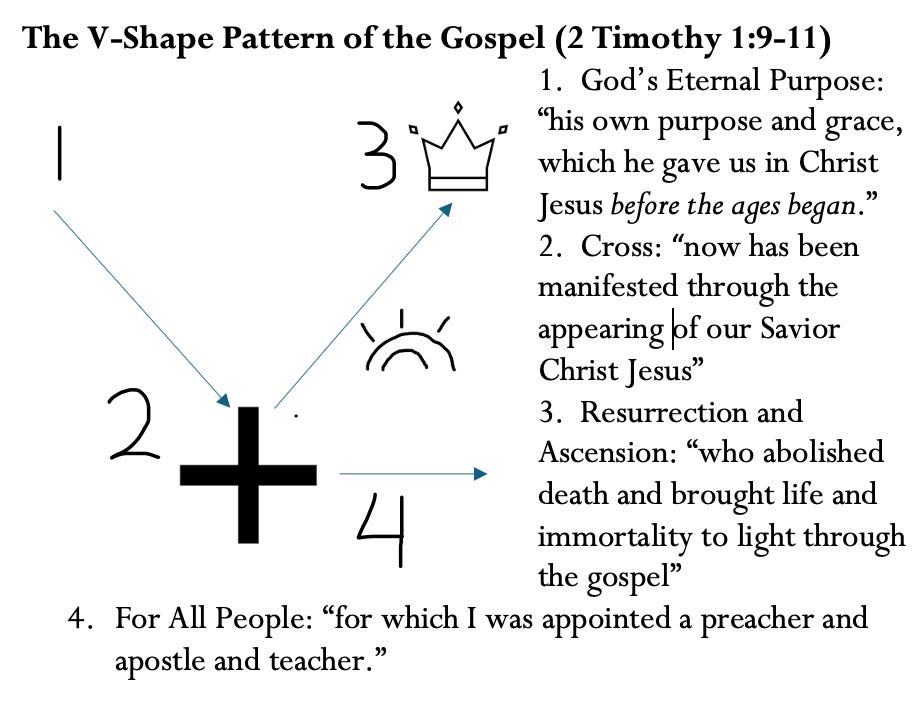
The gospel testifies to God’s saving love purposed before time, accomplished in time, and secured until the end of time—a time-tested pattern of sound words entrusted to us to guard and pass on.
Confessed for All Time
Let’s look at this passage in 2 Timothy together. The Apostle Paul is considered Timothy’s spiritual father, and Paul passed down the faith he received from his ancestors. And his instructions to Timothy at the end of this passage are to “follow the pattern of sound words that you have heard from me, in the faith and love that are in Christ Jesus” (2 Tim 1:13). The pattern of sound words Paul is referring to is the gospel of Jesus Christ’s salvation that we see Paul express in verses 8-12. That gospel proclamation for which Paul has been appointed a messenger and the reason why he is suffering. But that pattern of sound words is also the faith of Paul’s ancestors.
What does Paul mean here? In Philippians, another of Paul’s letters from prison, Paul defends his Jewish credentials: “circumcised on the eighth day, of the people of Israel, of the tribe of Benjamin, a Hebrew of Hebrews” (Phil 3:5). In the letter to the Galatians, Paul says “those who have faith [in Jesus] are children of Abraham” (Gal 3:7). When Paul talks about his ancestors he not only means that he belongs to the physical descent of the people of Israel but more importantly he has the faith of Abraham. And for all those who believe in Jesus, the New Testament is clear those who have faith in Christ are the offspring of Abraham. He is our ancestor in the faith.
So when Paul appeals to the faith of his ancestors, he is emphasizing the continuity of his Jewish heritage with his allegiance to Jesus Christ. There is an unfolding and flowering, it is the proper progression of faith in the God of Israel to belong to and worship Jesus Christ as Savior and Lord. Paul did not break from his ancestral faith but followed the plan of God before the ages revealed fully in Jesus Christ.
This pattern of sound words holds all of Scripture together and finds that it all points us to Jesus. The plan of God’s love before time began was revealed in the fullness of time in Jesus’s life, death, and resurrection, and he is exalted on the throne until the end of time.
Now guarding the pattern of sound words means we hold fast to confessing what we believe. Just as Paul wrote confessional statements about Jesus’s life, death, resurrection, and ascension, the early church followed Paul’s instructions by safeguarding the truth about who Jesus is and what he accomplished so they were passed on from generation to generation.
We can see this pattern of sound words in the Nicene Creed. As we walk through 2 Timothy, I’ll be spending some time this month looking at the Nicene Creed as a faithful expression of Paul’s instructions to “guard the good deposit entrusted” to us.
This year marks the 1700th anniversary of the Nicene Creed, which was written during the Council of Nicaea in AD 325. Why was this necessary?
Because there was confusion about who Jesus is.
Like Paul, the early church knew the Jewish roots of the Christian faith. They knew that every day faithful Jews recited the Shema, the great commandment: “Hear, O Israel, the Lord our God, the Lord is One” (Deuteronomy 6:4).
The Lord our God is One. How do we make sense now of the fundamental command to recognize that God is One, if we are confessing that Jesus is the God who saves and is the Son of God? Paul didn’t have trouble articulating this, but the early church ran into some issues.
Well, there were early heretics who tried to say that Jesus was divine, but he was created by God the Father before the world began. We still see this false teaching today in Jehovah’s Witnesses and Latter-Day Saints. This false teaching said that Jesus was special, a demigod, but inferior to God, and that there “was a time when he was not.”
In response to this false teaching, Christian leaders gathered to write the Nicene Creed, to guard the gospel of faith and love in Jesus Christ. One of the bishops at the Nicene Council was St. Nicholas, the same St. Nick we call Santa Claus.
One of the consequences of the false teaching is that if Jesus is just a viceregent, a representative of God, but not equal to God the Father, and the Roman Emperor who was now c…