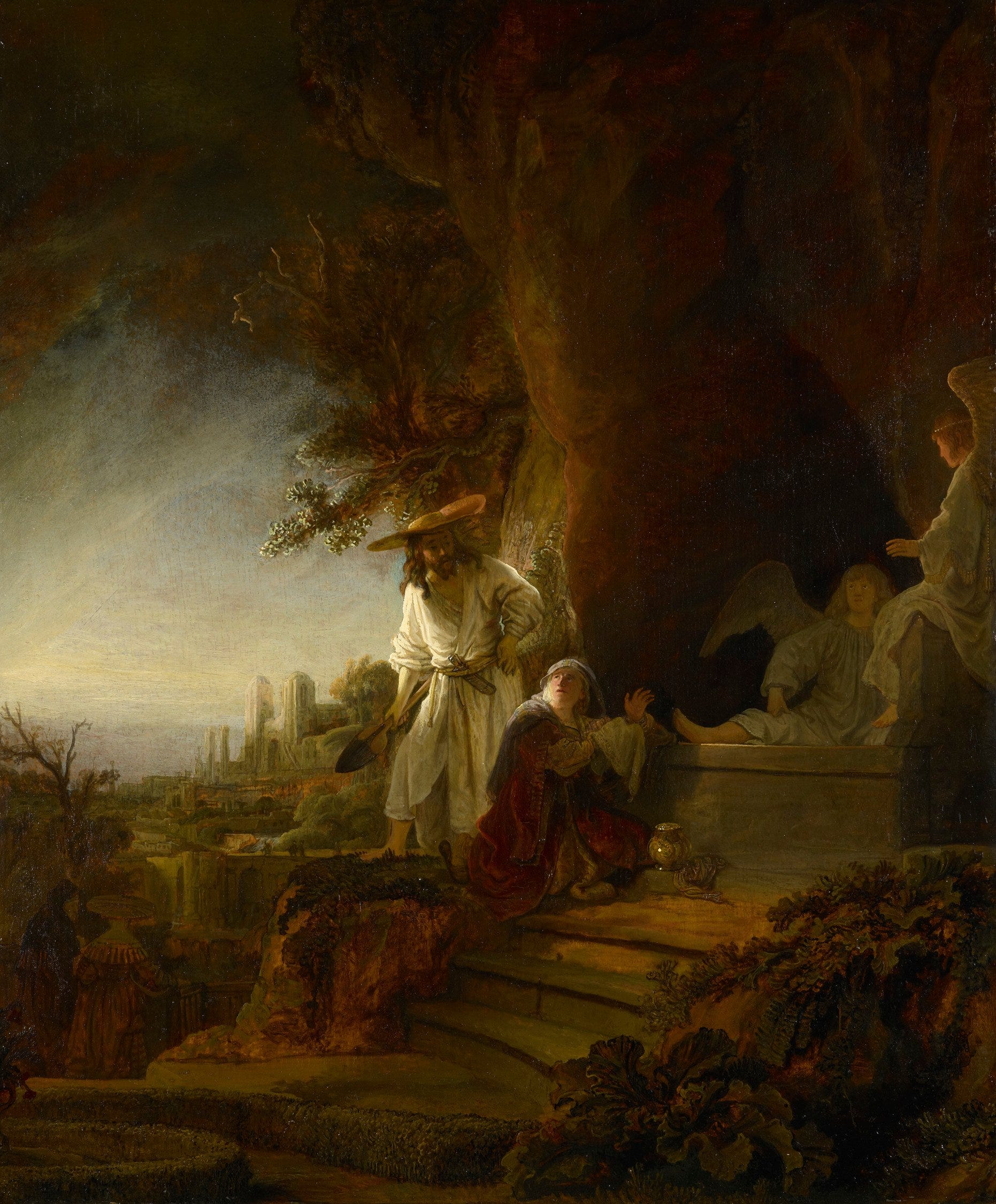
In John’s Gospel, Jesus is lifted up on the cross to draw all people to himself, that through his death we may have life and receive the true light. Jesus, the Tree of Life from whom living water flows, is then placed in a garden.
On the first day of the week, while it is still dark, Mary Magdalene arrives at the garden tomb to see the one who said, “I am the light of the world.” But the stone is rolled away, and Jesus is not there.
Thanks for reading Heaven in Ordinary! Subscribe for free to receive new posts and support my work.
After Peter and the other disciple leave the empty tomb, Mary is left alone, weeping. What ought to make the joy of resurrection morning so palpable for us who read the Gospels is paying attention to the weight of grief and sorrow the disciples carried with them to the tomb. Here in the darkness of that day, Mary does not yet understand, and the tears of weeping blur her vision. Not even the angels sitting in the tomb bring her comfort.
And yet, it may have been the sound of the Lord God walking in the garden in the cool of the morning that catches her attention (see Gen. 3:8). She turns to see Jesus standing there, and he says to her, “Woman, why are you weeping? Whom are you seeking?” But she does not recognize him. Instead we read in John’s account:
Supposing him to be the gardener, she said to him, “Sir, if you have carried him away, tell me where you have laid him, and I will take him away.” Jesus said to her, “Mary.” She turned and said to him in Aramaic, “Rabboni!” (which means Teacher). (John 20:15-16)
This phrase “supposing him to be the gardener” invites us to imagine ourselves in this story. Praying imaginatively through the Gospel stories can enable to us to see and hear (or even smell), as we use our sensory perception in the story. Remember, Jesus had just been buried under a hundred pounds of spices, so I imagine it could have been a fragrance that alerted Mary to his presence.
But why do you think Mary supposed Jesus was the gardener? If you are imagining yourself as a bystander in this garden, why would you assume someone is a gardener? Maybe because he is gardening? Jesus, the true vine, who gives life to those who abide him, is cultivating the garden. Jesus, the Word through whom all things were created, is giving life to a place of death.
John has also presented us with Jesus the Last Adam, who in his sacrificial death undid the curse of the First Adam. In the creation story, “the Lord God took the man and put him in the garden of Eden to work it and keep it” (Genesis 2:15). On the first day of the new creation, the Last Adam is working and keeping the garden.
When Jesus speaks her name, Mary hears the voice of her Good Shepherd and follows him. Notice how Jesus asks her not to cling, but John is still emphasizing the physical body of Jesus’s resurrection, both here and throughout John 20. She ought not to cling because he is going to leave, and she will receive from him the Holy Spirit.
“He Breathed on Them”
The Garden of Eden imagery continues in the resurrection account when Jesus appears to the disciples. In Genesis, the Garden contained God’s special dwelling and his intimacy and nearness to his image-bearers. Here that dwelling is conferred from Jesus when he imparts the Holy Spirit to his disciples:
On the evening of that day, the first day of the week, the doors being locked where the disciples were for fear of the Jews, Jesus came and stood among them and said to them, “Peace be with you.” . . . And when he had said this, he breathed on them and said to them, “Receive the Holy Spirit.” (John 20:19, 22)
The Gospel of John is both overt and subtle when using creation imagery, but in this case it is almost as emphatic as “in the beginning.” The Greek verb John uses for Jesus breathing on the disciples, emphusaó, appears only here in the New Testament. However, it is the same verb used in the Greek translation of the Old Testament:
Then the Lord God formed the man of dust from the ground and breathed [verb: emphusaó] into his nostrils the breath of life, and the man became a living creature (Genesis 2:7)
The word for God’s Spirit in both Hebrew and Greek can also be used for “wind” and “breath,” and so Jesus breathing the Holy Spirit reminds us that God’s breath gives us life from creation, but we are a new creation when we receive the Holy Spirit. Now God’s presence dwells within us and we are being made new in the Spirit.
It also continues and multiplies the theme we first encountered in John 1:14: “The Word became flesh and tabernacled upon us.” The temple of Jesus’s body is now expanded to include his followers.
N.T. Wright puts it this way: “The breathing of Jesus’s spirit on the disciples in 20:19–24 is itself an important temple moment, with the disciples thereby constituted as the new-temple people for the world.”
For us today, we are living temples of God’s Spirit, mobile dwellings of divine presence wherever we go. Just as we bear the Light of the World which can drive away darkness no matter the time of day, we have dwelling in us the presence of God which is not confined (and never was) to any single space.
Receiving the Holy Spirit restores our first commission to have dominion and subdue the earth—to cultivate creation just like the Last Adam—but more than that it empowers us to go out into the world and carry out the work of new creation.
John’s Gospel begins by identifying Jesus as the Word, the agent of creation in the beginning. But it closes by commissioning us, who inherit his Light and receive his Breath, to be the agents of new creation.
*In this Rembrandt painting, notice Jesus holding a gardening tool and the vegetation around the tomb. Set in the background, in opposition to Jesus, is the Jerusalem temple. With Jesus in the foreground, we are reminded again that Jesus is the true temple.
Thank you for reading Heaven in Ordinary. This post is public so feel free to share it.