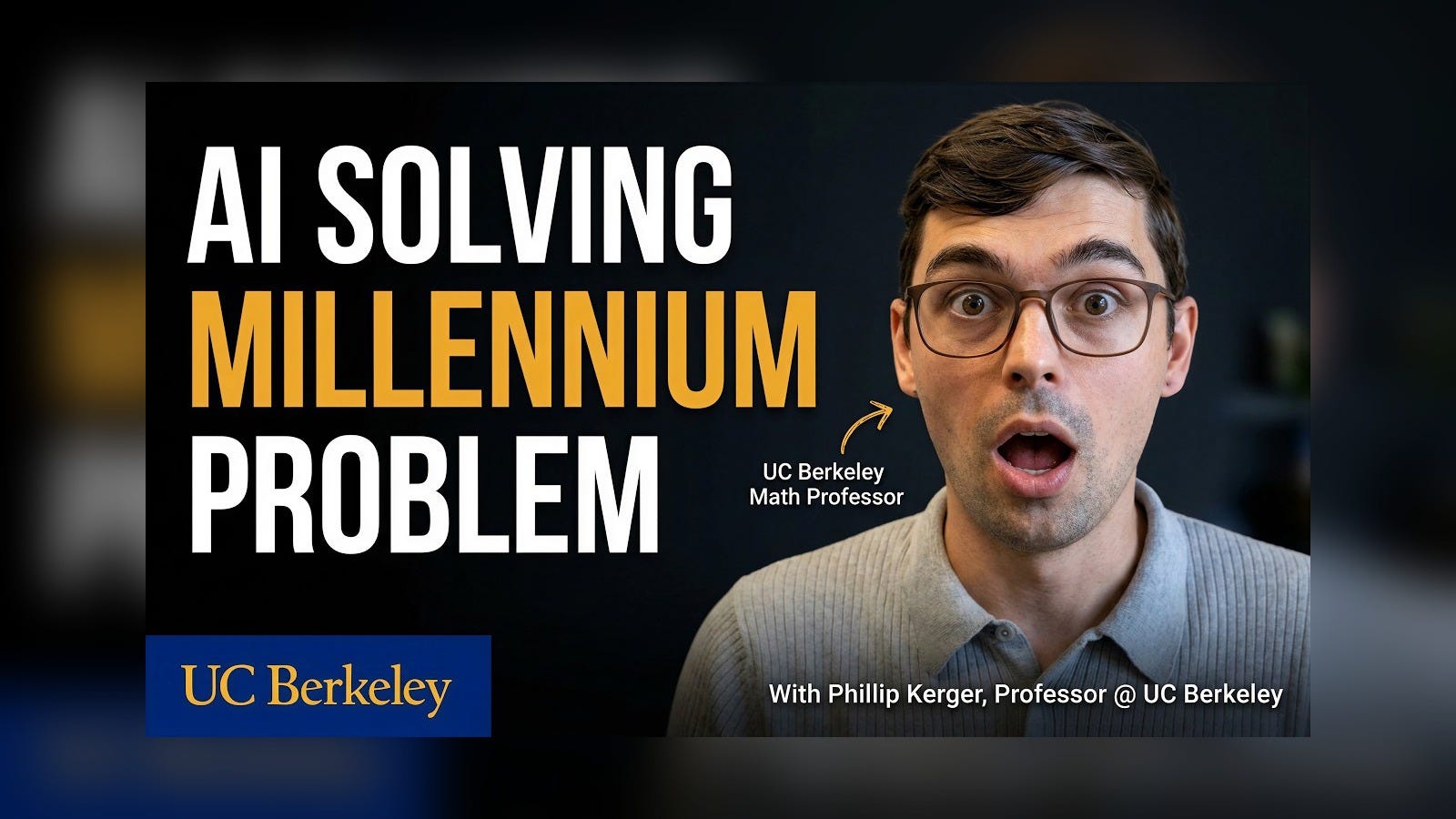
From optimization theory and quantum algorithms to a classroom where a chatbot can do the homework: Phillip Kerger has a close view of what AI can and cannot do. He is a professor in UC Berkeley's Industrial Engineering and Operations Research department and a former NASA quantum researcher. His own research is in optimization complexity theory, the question of how many computational steps certain optimization problems need. He describes colleagues who mostly do applied math and, in his words, are all in an existential crisis because AI is doing their work much better than they can.
In this episode, Phillip joins TwoSetAI to give a calm read on how quickly AI went from no help at all on his research to solving the kind of problem mathematicians have worked on for decades. Earlier that week, by his account, OpenAI announced a solution to the Navier-Stokes Millennium Problem, and he says the math researcher in him had an existential moment when he saw it. He explains the problem in plain terms and is careful about the result: he is not an expert in that field, he has not had time to read the paper, and he notes the controversy over whether results were scooped from other people.
You can learn more about Phillip on his UC Berkeley page and his personal site.
We go deep on how the result was found: by his account, 10,000 agents working at once at the peak, each trying a different construction, which he compares to finding a needle in a haystack with intelligence. He puts the paper at about 160 pages and leaves room for doubters who say no fundamentally new kind of mathematical argument is in there. On quantum, his hot take is that quantum AI is pretty much dead as a practical proposition: a quantum speedup needs a very specific structure, and he says there is not much to do in machine learning even with theoretically perfect quantum hardware. He covers where quantum is useful (simulating quantum systems for chemistry and materials science, and integer factorization, which underlies RSA encryption), his work with the NASA quantum group, where one quantum algorithm turned out to be practical only on a network with more nodes than grains of sand on Earth, and a problem from an Airbus quantum computing challenge that he says ran in 1.1 seconds on a Microsoft Surface tablet.
We also get into the harder parts: what is left for people when agents can try every approach. Phillip's answer is choice and taste. Math is a special case because a correct solution is simply correct, he says, while anything built for the real world costs time and money, so a person still has to pick one design out of many. In his classes, homework is no longer graded on correctness, and he says everyone is going back to paper and pencil exams. He describes what he calls the AI learning paradox: no single skill or piece of knowledge is necessary anymore, yet without a critical mass of them you are lost. He also says the value of a degree has probably diminished, tells students to know their foundations and to favor work with something physical at the end, and explains why he thinks a freshman using the right models in the right way could, in principle, solve an important problem.
We discuss:
* Why Phillip was "properly shook" on a Tuesday morning
* The Navier-Stokes Millennium Problem in plain English: water, a vortex and infinite velocity in finite time
* How 10,000 concurrent agents searched for a construction that works
* What the result does not show, and the room he leaves for doubters
* Brute force plus intelligence, and how a person narrows down approaches instead
* What is left for people: why math is a special case and designing a bike is not
* "AI is not a consumer": Angelina's case for keeping people in the loop
* Why dashboards made with AI all look the same
* What he notices when he reviews applications, resumes and cover letters
* Digital twins, his OpenClaw agent, and what he would hand to the best secretary in the world
* Whether an LLM could write good stand-up comedy, and why chess grew as a viewer sport after it was solved
* The hot take: quantum AI is pretty much dead as a practical proposition
* Why machine learning lacks the structure a quantum speedup needs
* Where quantum is useful: quantum chemistry, materials science and integer factorization
* The network that would need more nodes than grains of sand on Earth
* The Airbus challenge problem that ran in 1.1 seconds on a tablet
* Homework that is not graded on correctness, and the incentive behind it
* Paper and pencil exams, and the open ChatGPT exam with a 99% average
* The AI learning paradox, and the critical mass of skills and knowledge
* What to learn: foundations, retrieval practice, and asking AI to quiz you
* Intrinsic motivation, and the students he worries about
* Whether the value of a degree has diminished
* Choosing a major: why he would move toward something physical
* His own timeline with AI on research, and what he expects a year from now
* Why a freshman could, in principle, solve an important problem
Phillip Kerger
* LinkedIn: https://www.linkedin.com/in/phillip-kerger-17222780/
* UC Berkeley IEOR: https://ieor.berkeley.edu/people/phillip-kerger/
* Personal site: https://phillipkerger.github.io/
* Mentioned in the episode: OpenAI's announced solution to the Navier-Stokes Millennium Problem, and the Airbus quantum computing challenge
Timestamps
00:00:00 From useless to Millennium problems
00:01:27 Who is Phillip Kerger (UC Berkeley IEOR, ex-NASA)
00:03:07 AI solves the Navier-Stokes Millennium Problem
00:07:21 How 10,000 AI agents found the proof
00:11:22 The existential crisis: what is left for humans
00:17:24 Why AI dashboards all look the same
00:20:08 Digital twins and talking to the real person
00:26:22 Hot take: quantum AI is pretty much dead
00:32:13 Where quantum is useful
00:33:35 Classical beats quantum: the 1.1-second problem
00:35:49 Inside the AI classroom: grading and honest effort
00:37:35 Back to paper exams and the 99% ChatGPT exam
00:41:38 The AI learning paradox
00:43:54 What skills to actually learn now
00:54:16 Choosing a major: go where it's physical
00:57:28 Why a freshman could solve a real problem now