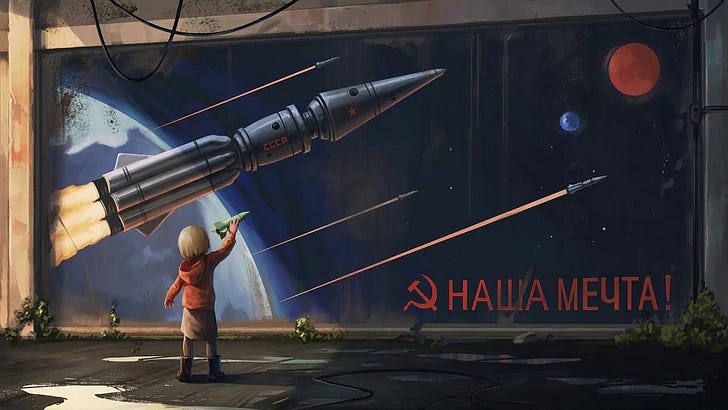
A version of this appeared on my website for the 100th anniversary. I’ve developed different conclusions since then!
106 years ago today was the start of the February Revolution in Russia. It was, quite possibly, the most important single event of the 20th century. Without the October Revolution, there is no Stalin. With no Stalin, it's possible that many western powers would not have seen Hitler as the lesser of two evils (the French right wing, as Hitler marched on Paris, shouted "Better Hitler than Blum!" in reference to the Democratic Socialist — and Jewish — President of France).
Without the Soviet boogeyman, there's no justification for Vietnam, for the CIA-backed coups in Chile, Guatemala, and Iran, for the American training of neofascist Central American death squads. Without those, there's no Ayatollah Khomeini, no General Pinochet, no Che Guevara and Fidel Castro.
There's no need to arm the mujahideen to fight the godless commie invaders in Afghanistan, there's no backing fundamentalist Islam as an anti-communist alternative. Without this divine cause to fight for, the founders of al-Qaeda never meet, and the towers never go down.
Without Stalin, there's no need for a show of massive force in Japan. There's no need for an atomic bomb. There is certainly no need for an arms race and a space race, no need to get to the moon by the end of the decade. Without this fear, the fear of bombs and lasers shot from satellites, there is likely no serious funding for NASA, no real space exploration.
There's no Red Scare, no McCarthy or his acolyte, Richard Nixon, there's no Truman Doctrine, no napalmed villages and cluster bombs and Khmer Rouge.
It is, of course, reductive to trace history back to a single day — events both before and after might have gone differently, and none of this was inevitable. You could make a very good argument that the actual fire started with the assassination of Archduke Franz Ferdinand, but there would be an event before that and an event before that. It was, as the poet William Joel says, always burning since the world's been turning.
But in St. Petersburg, on October 25th of 1917 (November 7th by our calendar), something impossibly immense happened. And immense things are impossible to grapple with, but until a few years ago, I realized I had no clue how the Russian Revolution went down. So I read a few books, and now it seems only proper to TL;DR them for you.
Who knows? You may be planning a revolution of your own and want pointers.
Thank you for reading Better Strangers. This post is public so feel free to share it.
The Revolution and the Left
The history of the Russian Revolution is not taught in American schools, and when it is, it's usually misrepresented. There is a documentary on Netflix (simply called The Russian Revolution) that suggests the whole thing came down to a personal grudge that Lenin had towards the Tsar, which is just fundamentally stupid — the revolution was a mass movement resulting from centuries of oppression and hardship. Individuals were able to influence its outcomes, but no one man dictated its course. The communists, after all, do not believe in the “Great Man” theory of history.
If you're a leftist and you're interested in the history, I'd suggest picking up China Mieville's October. Mieville is a left-wing activist who also happens to be a very good fiction author, and for the 100th anniversary of the revolution, he published October as a mostly sympathetic account to the events of 1917. He does not go into the aftermath of the Revolution, whether it’s the Russian Civil War, or the purges of the 20s and 30s — Stalin is only mentioned twice in the book — but it’s a good starter for how the Soviet Union we’re all familiar with was built out of the chaos and idealism of that year.
But if you aren’t ready to commit to a book, here are some of the basics:
The revolution happened spontaneously — after decades of activism and organizing.
In 1917, there were two revolutions: the February Revolution and the October Revolution. The first deposed the tsar, whose family had ruled Russia for over 300 years. The tsar’s reign was a brutal one — massive swathes of the population lived as serfs (only a slight step up from slaves) until the 1860s, and any political unrest was met with ruthless repression.
Because of this repression, peasants and serfs grew to hate the tsar, making Russia a popular recruiting ground for left-wing radicals. Anarchists like Peter Kropotkin, Mikhail Bakunin and Leo Tolstoy became popular figures, and interest in books on socialism and Russian nihilism made authors like Nikolay Chernyshevsky and Ivan Turgenev superstars.
The most important event before 1917 was the 1905 uprising. In January 1905, a mass of workers, while trying to deliver a petition to the tsar, were fired upon by tsarist troops. Up to 1000 people died, the day became known as “Bloody Sunday,” and massive social unrest followed.
The socialists were led by a rabble of charismatic men who had given names and political names — there was the fiery orator Vladimir Ulyanov (better known as Lenin), there was the bookish, charming Julius Martov, Lenin's friend and, in many ways, his opposite, and there was the eloquent, brilliant Jewish writer and theorist Lev Bronstein (better known as Leon Trotsky). The socialists formed a democratic workers councils called a soviet, of which Trotsky was perhaps the most prominent member, and began organizing mass strikes across the capital of St. Petersburg. But after a couple of years of unrest, the uprising had been effectively suppressed by the tsar, with 15,000 dead.
Many of the leaders of the revolution had to flee the country, and were demoralized by their failure to depose the tsar. In Russia, the right-wing nationalist groups that had been used to fight the socialists began attacking their favorite scapegoats, the Jews, and killed up to 4,000 people. Lenin, now in exile, said in a speech, “We of the older generation may not live to see the decisive battles of this coming revolution.”
But Russia's peasantry had been radicalized, and the repression of the 1905 uprising was not popular. Over the next decade, Russia would enter the horrific, destructive World War I, and the tsar would become increasingly isolated from his people.
In January 1917, workers in St. Petersburg went on strike in honor of the 12th anniversary of Bloody Sunday. More strikes followed, in spite of the threats of a police crackdown, and the factory bosses made a huge mistake — they locked the workers out of the factories, forcing them — all riled up! — out into the streets.
On February 23, 1917 (in the Julian Calendar — in the western Gregorian calendar, March 8th), rallies were held in honor of International Women's Day. No one planned it — but the rallies spontaneously turned into an uprising. And the soldiers who were ordered to put down the revolution, tired of war, tired of the tsar, refused, and sided with the workers. By early March, the tsar was forced to abdicate.
The February Revolution was a mass, organic uprising that took down a 300 year dynasty. But it would not have happened without literally decades of planning, failure, and death. Many who did the work of the revolution did not, as Lenin said, live to see it.
The second revolution
From February 1917 to October 1917, Russia was ruled by a provisional government. The government was thrown together hastily, and was run by popular socialist Alexander Kerensky. Kerensky was not a revolutionary in the way Lenin or Trotsky were, but he was popular, and he was willing to work with the ruling class to transition towards a political system where power was shifted from the less Democratic former government given to the soviets, which at the time, were totally open and democratic.
Side note: I’ll cop to my bias here and say that, as far as I can see, the original Soviets were basically perfect democratic organs. Literally anyone could organize a group and join them, a…